

India's Property Investment Market Slows Sharply. What Are Investors Still Buying?
Summary
India's real estate investment market recorded $705 million in deals during the July to September quarter of 2026, a 76% decline from the same period last year. Yet investors have not abandoned the sector. The latest deal data points to a more selective market, where the visibility of income and the ability to execute a project are becoming increasingly important. According to Grant Thornton Bharat's Q3 2026 Real Estate/REITs Dealtracker, the sector recorded 24 transactions during the quarter, compared with 42 a year earlier. Total deal value fell from $2.9 billion to $705 million.
Published on
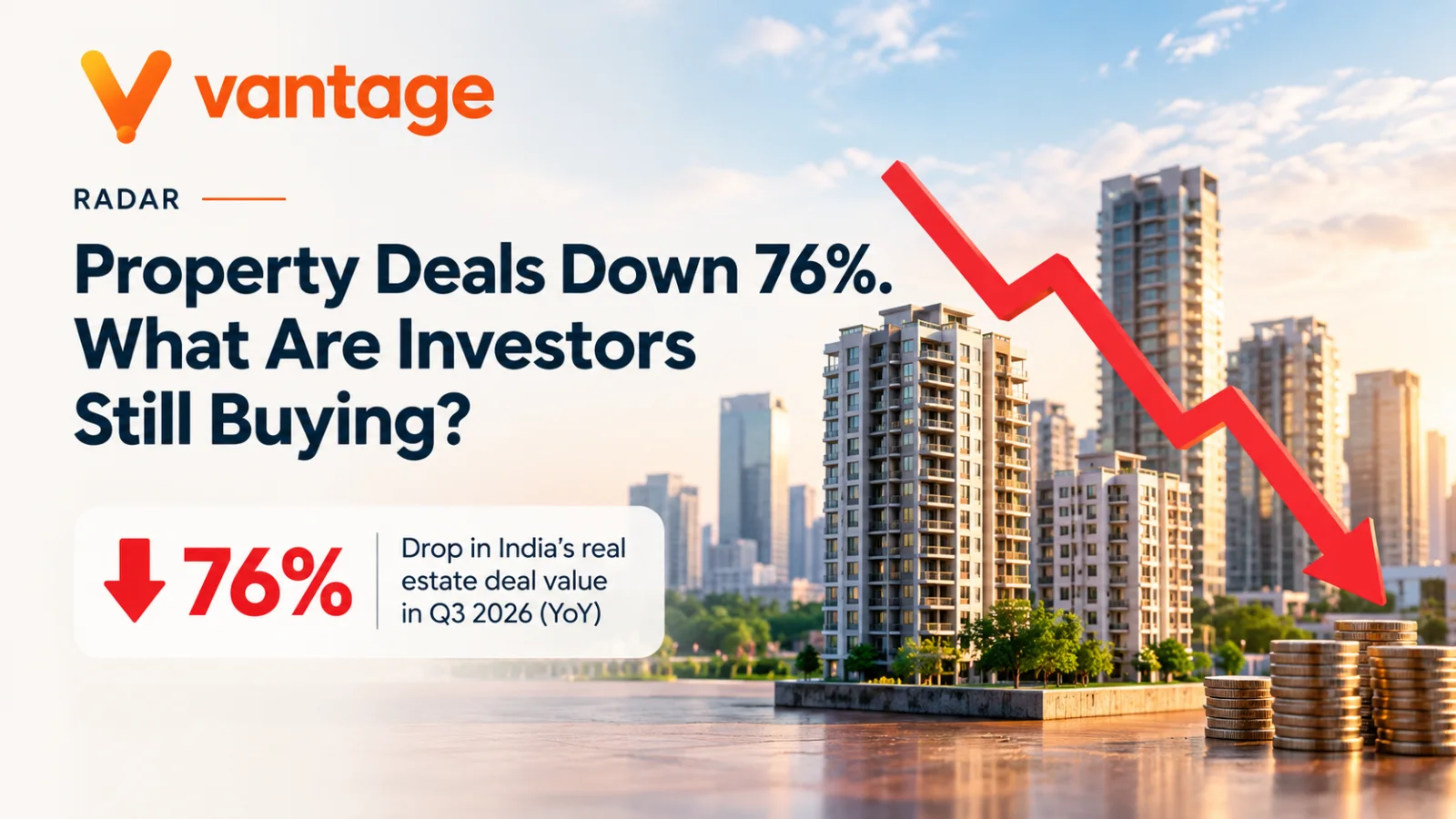
One editorial note: the 76% decline refers to India’s real-estate deal value year-on-year in Q3 2026, not a 76% fall in property prices. The banner reflects that distinction.
Inline Intelligence
India's real estate investment market recorded $705 million in deals during the July to September quarter of 2026, a 76% decline from the same period last year. Yet investors have not abandoned the sector. The latest deal data points to a more selective market, where the visibility of income and the ability to execute a project are becoming increasingly important.
According to Grant Thornton Bharat's Q3 2026 Real Estate/REITs Dealtracker, the sector recorded 24 transactions during the quarter, compared with 42 a year earlier. Total deal value fell from $2.9 billion to $705 million.
The decline was also visible against the previous quarter. Deal value fell 69% from $2.3 billion in Q2 2026, while transaction volumes declined 38%.
These figures point to a substantial slowdown in institutional dealmaking. They do not, by themselves, establish that residential property prices across India are falling by a similar amount.
Why did investment activity fall?
The absence of several large transactions played an important role. When a market records a small number of high-value acquisitions or fundraising events, the delay of even a few deals can significantly change the quarterly total.
The report also points to a more measured investment environment amid global uncertainty. Investors appear to be taking greater care over the quality of assets, the predictability of their cash flows and the likelihood that projects will be completed as planned.
The result is a market in which capital is still moving, but the scale and destination of that capital matter more than headline deal counts alone.
Where is the money going?
Private equity remained the largest contributor to real estate deal value, accounting for $555 million across nine transactions in Q3 2026. That represented approximately 79% of the quarter's total deal value.
Commercial development accounted for five deals worth $371 million, or 57% of the sector's reported deal value. Residential development attracted four private equity investments worth $183 million.
Two major transactions illustrate the concentration of investment. Brookfield India Real Estate Trust and related investment interests participated in a $179 million acquisition of a Grade-A office asset in Mumbai's Bandra-Kurla Complex. Nexus Select Trust made a $168 million investment in a retail and hospitality asset in Guwahati.
These transactions show that sizeable investments are still taking place. They do not prove that all commercial properties, office markets or retail assets are performing well. The transactions are concentrated in specific assets, locations and investment structures.
What does this mean for India's property market?
The distinction between investment activity and property demand is important.
Institutional deal value measures transactions and investment activity across the sector. It is not the same as the number of homes sold to individual buyers, the rate of residential price appreciation, or the rental yield earned by a homeowner.
A slowdown in large transactions can coexist with demand in particular residential markets. Conversely, strong investment in a few premium commercial assets does not mean that every office building or housing project offers attractive returns.
For buyers and investors, the more useful question is whether an individual asset has credible demand, sustainable income, manageable costs and a realistic exit route.
The next signal to watch
The next few quarters should help establish whether Q3 represents a temporary pause caused by delayed large deals or a more sustained period of cautious capital deployment.
Watch for changes in transaction volumes as well as values, the size and number of private equity investments, public-market fundraising, and the distribution of investment across commercial and residential assets. A recovery in headline value driven by one exceptional deal would mean something different from a broad increase across many transactions.
The central takeaway is that a sharp decline in deal value deserves attention, but it should not be treated as a universal property-market verdict. The quality, location, income potential and execution risk of an asset remain essential to understanding its investment case.
Join the attached Vantage forum discussion: Does the shift towards income-generating assets make property investment more disciplined, or does it leave fewer opportunities for investors seeking growth? Share your reasoning or relevant market observations.

From TatvaOps
Property Development
Developing a property?
Structured oversight for multi-unit and investor-led builds.
Free quotes · Verified contractors · tatvaops.com
Discuss this article
Join the conversation
Continue this discussion on Forums. A board named like this Radar article is filed under Radar.
More from Real Estate
Mumbai Luxury Homes Record 3145 Registrations
An industry report records 3,145 registrations of homes priced at Rs 5 crore or more in the Mumbai region in April to September 2026.
Binance Reports Security Incident and Asset Freeze
Binance estimates a $6.3 billion incident impact and says about $3 billion was frozen; withdrawals remain paused, it reports.
Haryana Pauses Gurugram Parallel Power Licence
HERC has halted further action on a parallel power licence for Gurugram and Nuh while Haryana government directions remain operative.
Inline Intelligence
Key Insight Actions
Connected knowledge for Real Estate Market
Move between tutorials, discussions, Studio, and hubs without losing context.
Related discussions
North Bengaluru Property: Is the Airport Premium Worth It?
1 replies
Related discussion210 Crore Mumbai Realty Deal: What Investors Should Know
1 replies
Related discussionRecord Property Investment, but Can Ordinary Buyers Still Afford a Home?
2 replies
Related discussionIndia's Real Estate Investment Slump: Is Capital Retreating or Becoming More Selective?
1 replies
Related discussion
Topic hubs
Conclusion Intelligence
Related Discussions
North Bengaluru Property: Is the Airport Premium Worth It?
Popular in insights discussions1 reply
210 Crore Mumbai Realty Deal: What Investors Should Know
Popular in insights discussions1 reply
Record Property Investment, but Can Ordinary Buyers Still Afford a Home?
Popular in insights discussions2 replies
India's Real Estate Investment Slump: Is Capital Retreating or Becoming More Selective?
Popular in insights discussions1 reply
Was this helpful?
Let us know what you think