

Silver Price Crash: India Rates Fall Below 2 Lakh
Summary
Silver prices in India fell below ₹2 lakh per kilogram in late October 2026, extending a steep correction from the record setting rally earlier this year and raising questions about the metal's near term investment outlook. On 23 October, silver futures on the Multi Commodity Exchange MCX fell to approximately ₹1,92,800 per kilogram, according to The Economic Times. The decline amounted to more than 14% over the preceding 10 trading sessions, with the metal losing ₹32,955 per kilogram over that period.
Published on
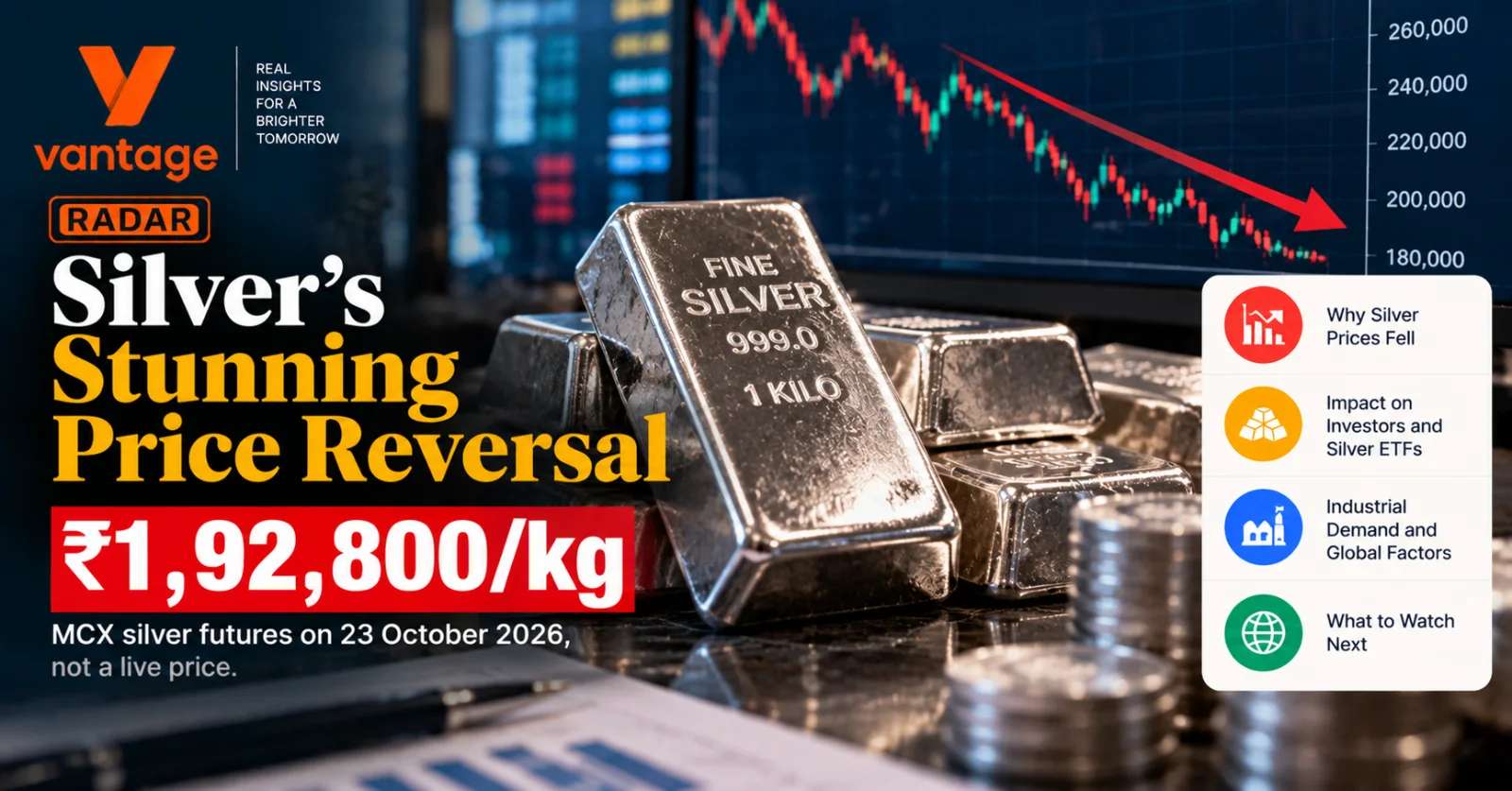
Silver prices in India fell sharply in October 2026, with MCX silver futures reaching ₹1,92,800 per kilogram on 23 October. The image highlights the precious metal's price correction, weakening investor sentiment, industrial demand concerns and potential implications for silver ETFs.
Silver prices in India fell below ₹2 lakh per kilogram in late October 2026, extending a steep correction from the record-setting rally earlier this year and raising questions about the metal's near-term investment outlook.
On 23 October, silver futures on the Multi Commodity Exchange (MCX) fell to approximately ₹1,92,800 per kilogram, according to The Economic Times.
The decline amounted to more than 14% over the preceding 10 trading sessions, with the metal losing ₹32,955 per kilogram over that period.
A separate Moneycontrol report published on 26 October said domestic spot silver touched ₹1,94,170 per kilogram on 23 October, compared with a reported spot-market peak of ₹3,79,983 per kilogram in January.
These figures represent different price benchmarks and contract conventions, but both illustrate how substantially silver has corrected.
Why Have Silver Prices Fallen So Sharply?
Several factors have combined to weaken silver prices.
The first is changing expectations about global interest rates.
Silver does not generate interest or dividend income. When government bond yields rise, the opportunity cost of holding precious metals can increase.
The second is uncertainty surrounding industrial demand.
Unlike gold, silver has substantial applications in manufacturing, electronics, solar technology and electrical equipment.
Concerns about weaker industrial activity or slower demand growth can therefore weigh on its price.
The third is the reversal of earlier investor enthusiasm.
Following a substantial rally, profit-taking and changing market expectations can amplify price declines, particularly when traders reduce leveraged positions.
According to the 23 October Economic Times report, rising crude oil prices, inflation concerns and expectations of tighter monetary policy contributed to the latest selling pressure.
These explanations reflect market reporting and analyst interpretation rather than a definitive statistical attribution of the price decline.
How Far Has Silver Fallen From Its Peak?
Silver reached exceptional price levels during January 2026.
The Economic Times reported a January MCX peak of ₹4,20,048 per kilogram, while Moneycontrol cited a separate domestic spot-market high of ₹3,79,983 per kilogram.
The two figures should not be used interchangeably because spot and futures prices, expiry dates and data conventions can differ.
Moneycontrol reported that its spot-market measure had fallen by more than 53% from the January peak by 23 October.
The correction has prompted investors to reassess whether the earlier rally was sustainable.
However, a large historical decline does not establish that prices have reached a bottom.
The metal may recover, fluctuate or decline further depending on market conditions.
India Has Also Approved Significant New Silver Imports
The price correction coincides with an important development in India's physical silver market.
According to Reuters reporting published on 22 October, India issued permits allowing approximately 6,500 metric tonnes of silver imports over the following six months.
The country depends heavily on overseas supplies to meet domestic silver demand.
Reuters reported that India imports more than 80% of the silver it requires.
Earlier import restrictions had contributed to supply constraints and higher domestic premiums.
The additional import permissions could improve availability and reduce the extra price paid for physical silver in India.
However, import authorisations do not mean all the permitted silver has already entered the country.
Nor do they guarantee a particular future price.
Why Are Dealers Concerned About Demand?
A sharp price decline does not always trigger immediate buying.
Reuters reported that some bullion dealers were experiencing weak investment and jewellery demand despite lower silver prices.
Market participants attributed part of the reluctance to losses experienced by investors during the earlier correction.
Domestic silver premiums had already narrowed substantially by 22 October.
According to Reuters, premiums fell to approximately 45 US cents per ounce from as much as $2.50 per ounce in the preceding week.
This reflects changing conditions in the physical market.
It does not necessarily indicate that international benchmark silver prices will move in the same direction.
What Are Analysts Saying About Silver's Outlook?
Analysts remain divided.
A Moneycontrol report published on 26 October noted that industrial applications, including solar energy, electrification and electronics, remain important sources of longer-term demand.
However, elevated interest rates, a stronger US dollar and uncertain industrial consumption could continue to pressure prices.
An Economic Times report published the same day described HSBC's cautious outlook, suggesting that silver's recovery potential could remain constrained even if downside risks moderate.
These are forecasts and assessments, not guarantees.
They depend on future developments that cannot be known with certainty.
What Does the Decline Mean for Silver ETFs?
Silver exchange-traded funds provide investors with exposure to domestic silver prices without requiring direct storage of bullion.
When the underlying metal declines substantially, silver ETF values can also fall.
Actual ETF performance may differ because of expenses, tracking differences, fund cash positions and market-price premiums or discounts.
India's market regulator, SEBI, introduced revised valuation requirements for physical silver held by mutual fund schemes from 1 April 2026.
The new framework uses polled spot prices published by recognised stock exchanges for valuing physical gold and silver held by relevant schemes.
The regulatory change is separate from the causes of the October silver-price correction.
What Happens Next?
Investors will be watching several developments.
The US Federal Reserve's policy decisions and global bond yields may influence the attractiveness of non-yielding assets.
Industrial demand, particularly in solar energy and manufacturing, will help shape expectations for silver consumption.
India's newly authorised imports may affect domestic availability and physical-market premiums.
Finally, the behaviour of silver ETFs, international silver prices and the rupee-dollar exchange rate may provide additional evidence about the strength of any recovery.
The immediate lesson is that silver's sharp decline has changed its valuation, but it has not removed the risks associated with the metal.
A lower price can attract attention. Whether it represents good value depends on what happens next.
Do you see silver's correction as a potential long-term opportunity or evidence of further market uncertainty? Share your reasoning and relevant market observations in the attached forum discussion.
Sources
Click an article title to view the source.
- Silver hits 11-month low of ₹1.95 lakh as crude stokes inflation fears, published on 23 October 2026 in The Economic Times.
- Silver prices fall 53% from peak: Should buyers wait or buy now? Here's the Outlook, published on 26 October 2026 in Moneycontrol.
- India permits large silver imports despite weak domestic demand, published on 22 October 2026 by Reuters.
- Silver rate today at 11-month low; slips below ₹2 lakh in India, published on 23 October 2026 in Mint.
- Valuation of physical Gold and Silver held by mutual fund schemes, published on 26 February 2026 by SEBI.

From TatvaOps
Residential Construction
Electrical upgrades or fixes?
Certified electricians, safety checks, and transparent pricing on TatvaOps.
Free quotes · Verified contractors · tatvaops.com
Discuss this article
Join the conversation
Continue this discussion on Forums. A board named like this Radar article is filed under Radar.
More from Construction
Silver Trading Revives at IIBX as Import Licensing Reshapes Sourcing
India International Bullion Exchange IIBX recorded approximately 570 metric tonnes of silver trades over roughly three months since August, according to a Mint report published on 29 October 2026. The report links the activity to import licensing changes and the subsequent issuance of…
US Fed Holds Rates at 3.754 as Inflation Keeps Further Tightening in Focus
The US Federal Reserve left its benchmark interest rate target unchanged at 3.75–4% on 28 October 2026, retaining its focus on inflation while waiting for more economic information. The Federal Open Market Committee voted 10–2 for the hold. Lisa Cook and Beth Hammack preferred a quarter percentage…
Cyclone Arnab Hits Andhra Coast, Threatens Homes
Cyclone Arnab struck India's Andhra Pradesh coast on 28 October 2026, bringing dangerous winds, heavy rain and flooding risks. More than 180,000 people were evacuated across Andhra Pradesh and Odisha as authorities worked to protect vulnerable communities. Cyclone Arnab Makes Landfall The India…
Key Insight Actions
Connected knowledge for Commodities
Move between tutorials, discussions, Studio, and hubs without losing context.
Related discussions
DCR Solar Module Premium Raises Rooftop Costs in India
1 replies
Related discussionNoida Adopts New Building Rules to Remove FAR Cap for Eligible Group Housing
1 replies
Related discussionSilver Price Crash: Should You Buy After a 53 Fall?
1 replies
Related discussionRooftop Solar: Bill Savings or Backup Power?
1 replies
Related discussion
Topic hubs
Conclusion Intelligence
Related Discussions
DCR Solar Module Premium Raises Rooftop Costs in India
Popular in radar discussions1 reply
Noida Adopts New Building Rules to Remove FAR Cap for Eligible Group Housing
Popular in radar discussions1 reply
Silver Price Crash: Should You Buy After a 53 Fall?
Popular in insights discussions1 reply
Rooftop Solar: Bill Savings or Backup Power?
Popular in insights discussions1 reply
Was this helpful?
Let us know what you think