

Delhi-NCR Property Prices Rise 12 in Q3 2026, Fastest Among India's Top Seven Cities
Karthik posts articles on Energy and Construction.
Summary
Delhi NCR property prices rose 12% year on year in Q3 2026 , the fastest increase among India's seven major housing markets, according to ANAROCK Research. Average residential prices in the NCR primary market increased to approximately ₹9,980 per sq ft during July–September 2026 , compared with ₹8,900 per sq ft in the corresponding quarter last year. Across India's top seven cities, average residential prices increased 7% to ₹9,714 per sq ft from ₹9,105 per sq ft. That puts Delhi NCR's 12% annual increase well ahead of the overall market.
Published on
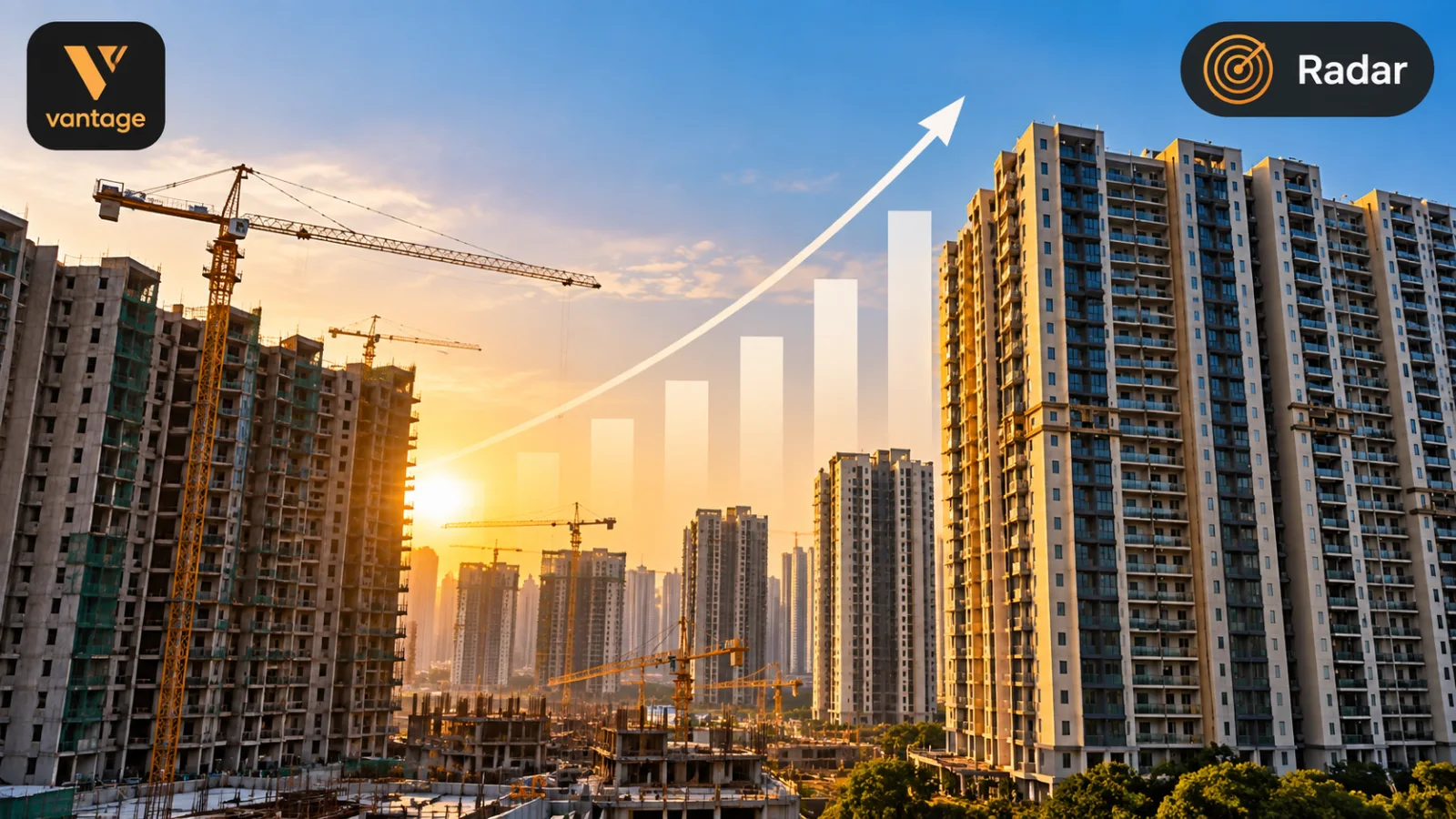
A wide Delhi-NCR residential skyline at golden hour, combining completed high-rise apartment towers with multiple projects under construction and tower cranes. An upward market graphic represents the reported 12% year-on-year increase in average Delhi-NCR primary housing prices.
Inline Intelligence
Delhi-NCR property prices rose 12% year-on-year in Q3 2026, the fastest increase among India's seven major housing markets, according to ANAROCK Research.
Average residential prices in the NCR primary market increased to approximately ₹9,980 per sq ft during July–September 2026, compared with ₹8,900 per sq ft in the corresponding quarter last year.
Across India's top seven cities, average residential prices increased 7% to ₹9,714 per sq ft from ₹9,105 per sq ft.
That puts Delhi-NCR's 12% annual increase well ahead of the overall market.
But the headline contains an important contradiction.
NCR prices rose 12% even though housing sales fell 1% year-on-year and new launches declined 14%.
The combination suggests that Delhi-NCR's price increase cannot simply be interpreted as more buyers chasing more homes.
ANAROCK and industry participants point instead to rising land and construction costs, infrastructure improvements and developers' increasing focus on premium and luxury housing.
How Much Have Delhi-NCR Property Prices Increased?
ANAROCK data cited by Moneycontrol shows average primary-market residential prices in Delhi-NCR at:
Q3 2025: ₹8,900 per sq ft
Q3 2026: ₹9,980 per sq ft
That is an increase of approximately ₹1,080 per sq ft.
The reported annual increase is 12%.
For comparison, average residential prices across the seven-city market increased from ₹9,105 to ₹9,714 per sq ft, or 7%.
Delhi-NCR therefore recorded the highest annual percentage increase among the seven cities.
Which Indian City Saw the Highest Property Price Growth in Q3 2026?
Among the top seven housing markets covered by ANAROCK, Delhi-NCR ranked first with 12% annual price growth.
Bengaluru followed at 8%.
The top-seven-city average was 7%.
The markets covered are:
- Delhi-NCR;
- Mumbai Metropolitan Region;
- Bengaluru;
- Pune;
- Hyderabad;
- Chennai; and
- Kolkata.
These figures refer to average primary-market residential prices within ANAROCK's dataset.
They should not be interpreted as saying every neighbourhood or individual property in Delhi, Gurugram, Noida or Greater Noida appreciated by 12%.
Why Are Delhi-NCR Property Prices Rising So Fast?
ANAROCK attributed the increase partly to higher input costs.
These include both construction costs and land.
ANAROCK Vice Chairman Santhosh Kumar specifically pointed to increases in land rates in Noida, Greater Noida and Gurugram, including prices reflected in development-authority land auctions.
But another structural change is equally important:
developers are increasingly launching premium, luxury and ultra-luxury housing.
A market containing a greater proportion of expensive new homes can record a higher average price even without every existing home appreciating at the headline rate.
This is why the 12% figure needs to be understood as both a price-appreciation signal and a changing-product-mix signal.
Delhi-NCR Prices Rose Even as Housing Sales Fell 1%
The demand picture was much more subdued than the price headline.
Delhi-NCR recorded approximately 13,765 housing sales in Q3 2026, according to ANAROCK data reported by multiple publications.
That was:
- down approximately 1% YoY from 13,920 units in Q3 2025; but
- up approximately 3% QoQ from 13,365 units in Q2 2026.
Across all seven major cities, housing sales increased 3% annually to approximately 100,220 units.
So NCR was unusual:
national major-city sales increased, NCR sales dipped slightly, but NCR still produced the strongest annual price growth.
That divergence is central to understanding the market.
New Housing Supply in Delhi-NCR Also Fell
NCR's new project launches reportedly declined approximately 14% year-on-year during Q3 2026.
This is another reason the price increase should not be read simply as a conventional volume-led boom.
A market where fewer homes are launched while developers increasingly concentrate on expensive projects can produce strong average-price growth without a comparable increase in unit transactions.
The mix of supply therefore matters as much as its volume.
Luxury Housing Is Reshaping the Delhi-NCR Property Market
More than 34% of NCR's new housing supply in Q3 was priced above ₹2.5 crore, according to reporting based on the ANAROCK data.
That provides an important clue to the 12% price increase.
Premium and luxury housing commands much higher per-square-foot rates than mass-market housing.
As developers increase the share of premium launches, the average price of newly marketed residential stock can rise.
This does not mean luxury housing alone caused the entire 12% increase.
ANAROCK also points to higher land and construction costs, while developers cite infrastructure, connectivity and demand for high-quality projects.
But premiumisation is clearly an important part of the NCR story.
Gurugram, Noida and Greater Noida Land Prices Matter
Residential prices do not move independently of land values.
ANAROCK specifically highlighted increasing land rates in:
Gurugram
Noida
and
Greater Noida.
When developers pay more for land, the economics of producing lower-ticket housing become more difficult.
Higher land acquisition costs can push developers towards projects where larger ticket sizes and higher selling prices make the economics viable.
That can reinforce premiumisation.
It can also make affordability increasingly difficult for buyers looking for homes at lower price points.
What Does a ₹9,980 Per Sq Ft Average Mean for a Homebuyer?
The average provides a useful market benchmark, but it should not be used as a universal NCR price.
At ₹9,980 per sq ft, a purely illustrative calculation would imply:
1,000 sq ft × ₹9,980 = ₹99.8 lakh
1,500 sq ft × ₹9,980 = ₹1.497 crore
2,000 sq ft × ₹9,980 = ₹1.996 crore
These are Vantage-derived arithmetic illustrations only.
They are not quotations for actual NCR properties.
Real transaction values depend on the project's location, saleable-area methodology, construction stage, floor, developer, amenities, parking, taxes and other charges.
Micro-market differences across NCR can be substantial.
Are Delhi-NCR Homes Becoming Less Affordable?
The 12% annual increase creates a clear affordability challenge if household incomes and borrowing capacity do not increase at a comparable rate.
The pressure can be particularly significant for first-time buyers.
Moneycontrol previously reported that rising NCR prices have reduced the number of options available below ₹1 crore, with much of the inventory at that price increasingly concentrated in resale housing or peripheral markets.
That does not mean homes below ₹1 crore have disappeared.
But the geographic and product choices available within a fixed budget can shrink as average prices increase.
A buyer may have to compromise on:
- location;
- home size;
- project age;
- construction stage; or
- distance from employment centres.
Infrastructure Is Supporting Premium Micro-Markets
Industry executives cited improved infrastructure and connectivity as another factor supporting NCR residential demand.
This is particularly relevant in markets such as Gurugram, Noida and Greater Noida, where transport and infrastructure projects can change the accessibility of emerging residential corridors.
But infrastructure does not affect every location equally.
A metro extension, expressway or new employment corridor may create significant value for some projects while having little effect on others.
For buyers, proximity to infrastructure should therefore be evaluated at the project and micro-market level, not through the NCR-wide 12% headline.
Why the 12% Price Increase Does Not Mean Every NCR Home Gained 12%
Average property-price indices can move for two broad reasons.
Existing comparable homes become more expensive
This is conventional appreciation.
The mix of homes being sold or launched becomes more expensive
For example, a larger share of luxury housing can lift the average.
Delhi-NCR appears to contain elements of both.
ANAROCK cites rising land and construction costs, while the Q3 supply data shows a significant premium and luxury component.
Without a repeat-sales index for identical properties, the headline 12% should not be interpreted as proof that every existing NCR apartment gained exactly 12% in value.
What Does the Price-Sales Divergence Mean for Investors?
For investors, strong appreciation combined with relatively flat unit sales deserves closer examination.
Rising prices can indicate:
- scarce high-quality supply;
- improving infrastructure;
- stronger premium demand;
- rising replacement costs; and
- increased willingness to pay for selected projects.
But if prices continue rising materially faster than transaction volumes for a prolonged period, affordability and future absorption become more important risks.
Investors should therefore distinguish between:
headline NCR appreciation
and
project-level resale liquidity.
A property can show a high quoted value but still be difficult to sell at that price.
Transaction depth matters.
Delhi-NCR's Longer-Term Price Rise Has Been Even Larger
The Q3 increase is part of a much longer NCR repricing cycle.
A recent ASSOCHAM–Knight Frank report found that NCR residential prices increased approximately 193% between 2015 and 2025, while housing sales volumes increased only around 7% over the same period.
That is a separate dataset and time horizon from ANAROCK's Q3 2026 figures and should not be directly combined with them.
But both point towards the same structural question:
NCR housing value has been rising much faster than unit transaction growth.
That makes affordability, premiumisation and supply composition increasingly important.
What Should Delhi-NCR Homebuyers Watch Next?
The 12% headline should not be the sole reason to buy—or avoid buying.
Buyers should watch five things.
1. Micro-market prices
Gurugram, Noida, Greater Noida and other NCR corridors can behave very differently.
2. Comparable transactions
Actual resale and registration values can provide more context than advertised asking prices.
3. New supply
If launches remain constrained while demand stays resilient, pricing power could persist in selected locations.
4. Luxury concentration
A growing premium share can keep average market prices elevated even if broader demand becomes more selective.
5. Affordability
Home-loan rates, EMI burden and household income ultimately determine how far prices can move before demand weakens.
The Real Delhi-NCR Housing Story Is the Divergence
The headline is straightforward:
Delhi-NCR home prices rose 12%, the fastest among India's top seven cities.
But the underlying market is more complicated.
Sales were down 1%.
New launches were down 14%.
More than one-third of new supply was above ₹2.5 crore.
Land costs in Gurugram, Noida and Greater Noida have risen.
And developers are increasingly targeting premium buyers.
That means NCR's property market is not simply experiencing more housing demand.
It is undergoing a repricing and premiumisation cycle.
For buyers, the distinction matters enormously.
Frequently Asked Questions
How much did Delhi-NCR property prices rise in Q3 2026?
Average primary-market residential prices increased approximately 12% year-on-year to ₹9,980 per sq ft from ₹8,900 per sq ft, according to ANAROCK.
Which Indian city had the highest property price growth in Q3 2026?
Delhi-NCR recorded the highest annual increase among the seven major housing markets covered by ANAROCK, at 12%.
Why are Delhi-NCR property prices rising?
ANAROCK points to rising land and construction costs and developers' growing focus on premium, luxury and ultra-luxury housing. Infrastructure and connectivity are also cited by industry participants as supporting selected NCR markets.
Are Gurugram property prices rising?
The NCR-wide ANAROCK data does not provide a single Gurugram appreciation percentage in the reviewed reports. However, ANAROCK specifically identified rising land rates in Gurugram, Noida and Greater Noida as part of the cost backdrop.
Are Delhi-NCR home sales also rising?
Not year-on-year in Q3 2026. NCR sales were approximately 13,765 units, around 1% below Q3 2025, although they increased about 3% from Q2 2026.
Are Delhi-NCR homes below ₹1 crore still available?
Yes, but previous Moneycontrol reporting indicates rising prices have reduced the options available within a ₹1 crore budget, with buyers increasingly looking at resale stock and peripheral NCR locations.
Will Delhi-NCR property prices continue rising?
The available Q3 data does not establish future appreciation. Prices will depend on supply, buyer affordability, financing conditions, land costs, infrastructure and demand across individual micro-markets.
Sources
Click on article title to view article.
“Delhi-NCR housing prices rise 12% in Q3, highest among top seven cities: Report” published on 3 October 2026 in The Times of India
“Average home prices in Delhi-NCR rise maximum at 12% annually in July-September: Anarock” published on 3 October 2026 in Moneycontrol
“MMR leads Q3 housing sales as top 7 cities clock over 1 lakh units; NCR tops price growth at 12%” published on 29 September 2026 in Hindustan Times
“NCR home prices jump 12% as luxury housing demand gains pace” published on 30 September 2026 in The Tribune
“NCR home prices outpace Pune, Mumbai and other metros, jump 193% in a decade” published on 16 September 2026 in Moneycontrol
Evidence Caveats
The ₹9,980 per sq ft figure is an ANAROCK average for the NCR primary residential market. It is not a quoted market price for every project or locality.
The 12% figure does not establish that every existing NCR property appreciated by 12%. Changes in project and price-segment mix can affect average prices.
The ₹99.8 lakh, ₹1.497 crore and ₹1.996 crore examples are Vantage-derived arithmetic illustrations using ₹9,980 per sq ft. They exclude taxes, parking, floor premiums and other charges and are not actual property quotations.
The 193% decade-long increase comes from an ASSOCHAM–Knight Frank study and uses a different period and methodology from ANAROCK's Q3 data.
No verified evidence reviewed establishes a single current appreciation rate applicable across Gurugram, Noida, Greater Noida and every other NCR micro-market.

From TatvaOps
Residential Construction
Building or extending your home?
Run your residential build with verified contractors and daily progress tracking.
Free quotes · Verified contractors · tatvaops.com
Discuss this article
Join the conversation
Continue this discussion on Forums. A board named like this Radar article is filed under Radar.
More from Real Estate
LTCG and STT: Review Reports Do Not Mean a Tax Cut
Finance Minister Nirmala Sitharaman’s comments on equity taxation have reopened a consequential debate for investors. Speaking at the Bloomberg New Economy Forum in New Delhi on 13 October, she welcomed views on long term capital gains tax and securities transaction tax without committing to…
Blackstone Targets 100 Billion in India Investments
Blackstone aims to double its India investments to approximately $100 billion over about five years, president and chief operating officer Jonathan Gray said in interviews reported this week. The ambition spans private equity and real estate, alongside potential expansion in infrastructure, credit…
Property Registrations Flagged Over Fictitious PAN
Nearly 25,000 property registrations over two years at Badshahpur tehsil in Gurugram reportedly carried the same fictitious PAN, according to The Times of India’s 9 October report on an Income Tax Department survey. The finding raises questions about taxpayer identification and transaction…
Inline Intelligence
Key Insight Actions
Connected knowledge for Housing Market Updates
Move between tutorials, discussions, Studio, and hubs without losing context.
Related discussions
Gaurs Sold 1,088 Yamuna Expressway Homes for 1,800 Crore: Is Airport-Led Housing Demand Becoming Sustainable?
1 replies
Related discussionDelhi-NCR Home Prices Rose 12 While Sales Fell: Is Luxury Housing Distorting the Market?
1 replies
Related discussionWest Bengal May Scrap the Urban Land Ceiling Act: Will It Make Kolkata Real Estate Cheaper or More Expensive?
1 replies
Related discussionMore Expensive Homes Are Gaining Share. Does That Make Them Better Investments?
4 replies
Related discussion
Topic hubs
Conclusion Intelligence
Related Discussions
Gaurs Sold 1,088 Yamuna Expressway Homes for 1,800 Crore: Is Airport-Led Housing Demand Becoming Sustainable?
Popular in insights discussions1 reply
Delhi-NCR Home Prices Rose 12 While Sales Fell: Is Luxury Housing Distorting the Market?
Popular in insights discussions1 reply
West Bengal May Scrap the Urban Land Ceiling Act: Will It Make Kolkata Real Estate Cheaper or More Expensive?
Popular in insights discussions1 reply
More Expensive Homes Are Gaining Share. Does That Make Them Better Investments?
Popular in insights discussions4 replies
Was this helpful?
Let us know what you think