

RBI Raises Repo Rate to 5.50. The Real-Estate Test Is Affordability, Not Just EMI
Karthik posts articles on Energy and Construction.
Summary
The Reserve Bank of India has raised the policy repo rate by 25 basis points to 5.50% , delivering its first increase since February 2023 and ending the rate environment that had supported cheaper borrowing through much of the recent housing cycle. The Monetary Policy Committee voted unanimously for the increase on 7 October 2026 and shifted its policy stance from neutral to calibrated tightening . For Indian real estate, the immediate consequence is straightforward: floating rate home loans can become more expensive as lenders transmit the increase, while developer borrowing costs can also rise.
Published on
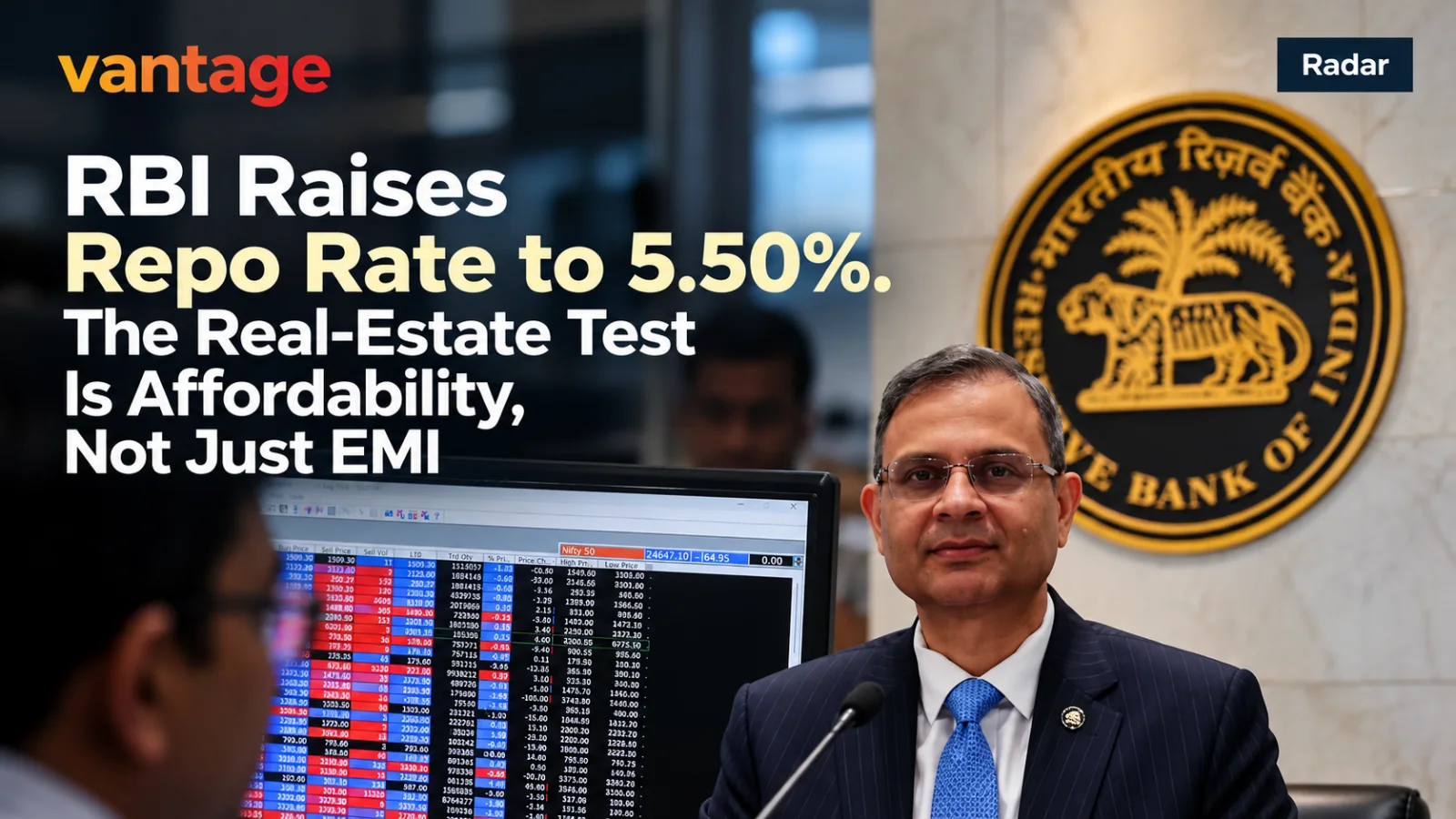
A Vantage Radar editorial banner combining an RBI policy setting with a financial-market trading screen. The Reserve Bank of India emblem and an RBI official appear alongside market data, visually connecting the repo-rate increase to borrowing conditions and the wider financial environment. The headline focuses on the 5.50% repo rate and its implications for housing affordability.
Inline Intelligence
The Reserve Bank of India has raised the policy repo rate by 25 basis points to 5.50%, delivering its first increase since February 2023 and ending the rate environment that had supported cheaper borrowing through much of the recent housing cycle.
The Monetary Policy Committee voted unanimously for the increase on 7 October 2026 and shifted its policy stance from neutral to calibrated tightening.
For Indian real estate, the immediate consequence is straightforward: floating-rate home loans can become more expensive as lenders transmit the increase, while developer borrowing costs can also rise.
But the more important question is where that pressure lands.
The impact is unlikely to be uniform across Indian housing. Affordable and mid-income buyers are more sensitive to monthly financing costs, while premium housing demand is generally less dependent on small changes in mortgage rates.
That makes the RBI decision an affordability test rather than simply a housing-demand test.
See Link -> RBI MPC hikes repo rate by 25 bps to 5.5%, near-term cuts 'off the table'
The rate cycle has changed direction
Before the October meeting, the repo rate stood at 5.25%.
RBI has now increased it to 5.50%.
The Standing Deposit Facility rate moved to 5.25%, while the Marginal Standing Facility rate and Bank Rate moved to 5.75%.
The change in stance is potentially as important as the 25-bp increase itself.
By moving from neutral to calibrated tightening, RBI has signalled that monetary policy is now focused on containing renewed inflation risks rather than preparing for further easing.
Governor Sanjay Malhotra said the duration and extent of the rate-hike cycle would depend on actual growth and inflation developments.
For property markets, that means the next question is no longer simply whether one 25-bp increase can be absorbed.
It is whether this becomes a longer tightening cycle.
What happens to a home loan?
The repo rate does not mechanically increase every borrower's EMI by 25 basis points on the day of the RBI decision.
Transmission depends on the loan structure, benchmark, lender and reset schedule.
For borrowers whose floating-rate home loans are linked to an external benchmark, an increase can eventually result in a higher interest rate.
Depending on the lender and loan structure, that may produce:
- a higher monthly EMI;
- a longer repayment tenure; or
- a combination of both.
This distinction matters because the financial impact can appear differently across households.
A borrower who keeps the same EMI but extends the loan tenure may not immediately see a larger monthly payment, but could pay interest for longer.
See Link -> RBI rate hike may pressure housing affordability, but demand seen resilient
The affordability pressure is uneven
Housing affordability is already being tested by more than interest rates.
According to ANAROCK data reported by Business Standard, average residential prices across India's top seven cities increased 7% year-on-year in Q3 2026.
Approximately 100,220 homes were sold during the quarter, up 3% year-on-year and 10% sequentially.
Affordable housing represented only 16% of those sales.
The combination matters.
A buyer facing both higher property prices and higher financing costs has less room to absorb another increase than a buyer whose purchase depends less heavily on mortgage affordability.
Industry participants therefore expect the impact to be more visible in affordable and mid-income housing.
Business Standard identifies homes below ₹75 lakh as affordable and ₹75 lakh to ₹2 crore as mid-income in its current market discussion.
Those buyers may recalculate budgets, choose smaller homes, move to lower-cost locations or delay purchases.
Premium housing may respond differently
A 25-bp increase does not automatically translate into a broad residential slowdown.
Premium buyers may use lower leverage, have stronger household balance sheets or be less sensitive to incremental changes in EMI.
That helps explain why developers and consultants currently expect the impact on premium housing to be more measured.
This distinction is important for interpreting future sales numbers.
If aggregate housing sales remain resilient while affordable demand weakens, the headline market could conceal a growing affordability divide.
Vantage will therefore watch sales composition, not simply total units sold.
Developers face a second transmission channel
Homebuyers are only one side of the equation.
Developers also borrow.
Higher financing costs can affect construction finance, land acquisition, working capital and project-level returns.
Whether those costs materially affect supply depends on developer leverage, project cash flows and access to alternative sources of capital.
Large developers with strong pre-sales and balance sheets may be better positioned to absorb higher financing costs.
More leveraged developers could become more selective about acquisitions or project launches.
Some costs could eventually be passed to buyers, although competitive conditions will determine how much pricing power developers actually have.
Commercial real estate may be less exposed
The interest-rate impact also differs by property type.
Commercial real estate has structural demand drivers that are not identical to residential mortgage affordability.
Current industry assessments point to demand from global capability centres, technology companies and BFSI occupiers as sources of resilience for offices.
That does not make commercial property immune to higher rates.
Financing costs, acquisition yields and investor return requirements can still change.
But the transmission mechanism is different from a household deciding whether it can afford a monthly home-loan payment.
Retail property could face another channel of exposure if higher borrowing costs reduce discretionary household spending.
RBI is tightening into relatively strong growth
There is another reason this rate increase should not automatically be interpreted as a negative macroeconomic signal.
RBI has projected real GDP growth of 7.1% for FY27.
It also projects CPI inflation at 5.2%.
The central bank therefore appears to be tightening policy against inflation risks while still expecting relatively strong economic growth.
For property, that creates competing forces.
Higher rates increase financing costs.
But economic growth, employment, infrastructure investment and household income can support property demand.
Which force dominates will differ by segment and buyer.
What to watch next
The first indicator is home-loan transmission.
Watch how quickly lenders adjust floating rates and whether borrowers experience higher EMIs, longer tenures or both.
The second is sales mix.
Affordable and mid-income housing will provide a clearer affordability signal than premium sales alone.
The third is developer finance.
If borrowing costs continue increasing, land acquisitions, project launches and balance-sheet leverage could become more important differentiators between developers.
The fourth is the next MPC decision.
A single 25-bp increase is manageable for many borrowers and developers.
A sequence of increases would change the calculation.
That is why the most important real-estate question after the October decision is not:
What does a 25-bp hike do to property?
It is:
How much additional tightening can India's increasingly expensive housing market absorb before affordability begins changing buyer behaviour?
Sources
Click on article title to view article
“RBI MPC hikes repo rate by 25 bps to 5.5%, near-term cuts 'off the table'” published on 7 October 2026 in Business Standard
“Indian shares decline as RBI rate hike signals tighter policy” published on 7 October 2026 in Reuters
“RBI rate hike may pressure housing affordability, but demand seen resilient” published on 7 October 2026 in Business Standard
“Repo rate hike may raise costs, but real estate demand to stay resilient” published on 7 October 2026 in Business Standard
“RBI repo rate hike: What does a 25 basis point increase mean for your home loan EMI?” published on 7 October 2026 in Hindustan Times
What are you seeing in actual housing decisions after the rate increase? Add your perspective to the Vantage discussion, particularly if you work in housing sales, mortgage lending, development or property investment. Where Vantage's participation-points mechanism is active and applicable, substantive participation can also earn points.

From TatvaOps
Residential Construction
Financing your project?
Explore credit and milestone-secured payment options with Tatva Finance.
Free quotes · Verified contractors · tatvaops.com
Discuss this article
Join the conversation
Continue this discussion on Forums. A board named like this Radar article is filed under Radar.
More from Real Estate
LTCG and STT: Review Reports Do Not Mean a Tax Cut
Finance Minister Nirmala Sitharaman’s comments on equity taxation have reopened a consequential debate for investors. Speaking at the Bloomberg New Economy Forum in New Delhi on 13 October, she welcomed views on long term capital gains tax and securities transaction tax without committing to…
Blackstone Targets 100 Billion in India Investments
Blackstone aims to double its India investments to approximately $100 billion over about five years, president and chief operating officer Jonathan Gray said in interviews reported this week. The ambition spans private equity and real estate, alongside potential expansion in infrastructure, credit…
Property Registrations Flagged Over Fictitious PAN
Nearly 25,000 property registrations over two years at Badshahpur tehsil in Gurugram reportedly carried the same fictitious PAN, according to The Times of India’s 9 October report on an Income Tax Department survey. The finding raises questions about taxpayer identification and transaction…
Inline Intelligence
Key Insight Actions
Connected knowledge for Interest Rate News
Move between tutorials, discussions, Studio, and hubs without losing context.
Related discussions
India's 430 Billion Housing Pipeline Is Huge. The Bigger Question Is Whether Buyers Can Absorb It
1 replies
Related discussionDelhi-NCR Home Prices Rose 12 While Sales Fell: Is Luxury Housing Distorting the Market?
1 replies
Related discussionIndias Data-Centre Boom Is Turning Power and Land Into Digital Infrastructure
1 replies
Related discussionRooftop Solar: Bill Savings or Backup Power?
1 replies
Related discussion
Topic hubs
Conclusion Intelligence
Related Discussions
India's 430 Billion Housing Pipeline Is Huge. The Bigger Question Is Whether Buyers Can Absorb It
Popular in insights discussions1 reply
Delhi-NCR Home Prices Rose 12 While Sales Fell: Is Luxury Housing Distorting the Market?
Popular in insights discussions1 reply
Indias Data-Centre Boom Is Turning Power and Land Into Digital Infrastructure
Popular in insights discussions1 reply
Rooftop Solar: Bill Savings or Backup Power?
Popular in insights discussions1 reply
Was this helpful?
Let us know what you think