

India Office Leasing Hits Record 66.4 Million Sq Ft as GCC Demand Reaches 28 Million Sq Ft
Karthik posts articles on Energy and Construction.
Summary
India's office market recorded its highest ever nine month absorption of approximately 66.4 million sq ft during January to September 2026 , according to CBRE. Gross office absorption across nine major cities increased 8% year on year , while Q3 2026 alone recorded approximately 21 million sq ft of leasing , up 6% from the corresponding quarter last year. Global Capability Centres, or GCCs, were one of the strongest demand engines. That means GCCs accounted for approximately 42% of India's office absorption during the period .
Published on
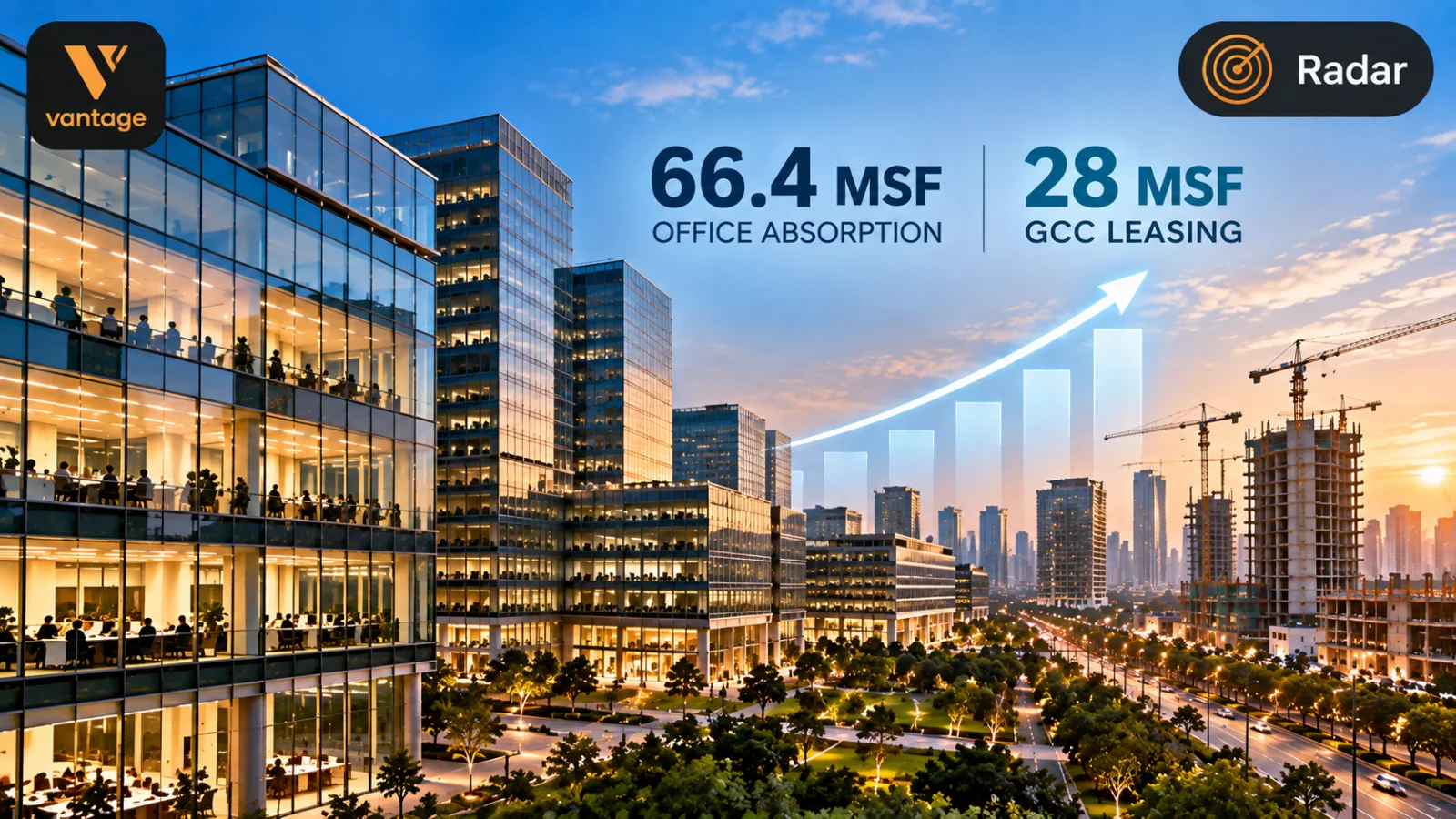
A modern Indian commercial business district with occupied glass office towers and new office construction, illustrating record office absorption and GCC-led leasing demand.
Inline Intelligence
India's office market recorded its highest-ever nine-month absorption of approximately 66.4 million sq ft during January to September 2026, according to CBRE.
Gross office absorption across nine major cities increased 8% year-on-year, while Q3 2026 alone recorded approximately 21 million sq ft of leasing, up 6% from the corresponding quarter last year.
Global Capability Centres, or GCCs, were one of the strongest demand engines.
GCCs leased approximately 28 million sq ft during the first nine months of 2026, another nine-month record and an increase of 16% year-on-year.
That means GCCs accounted for approximately 42% of India's office absorption during the period.
The numbers point to more than another strong year for commercial real estate.
They show how multinational capability centres, flexible workspace operators, financial-services companies and domestic occupiers are collectively reshaping demand for high-quality Indian office buildings.
How Much Office Space Was Leased in India in 2026?
India's top nine office markets recorded approximately 66.4 million sq ft of gross absorption between January and September 2026.
CBRE says this was:
- the highest office absorption recorded for any nine-month period;
- 8% higher than the corresponding period in 2025; and
- already close to 80% of the previous year's full-year leasing.
The nine markets covered are:
- Bengaluru;
- Delhi-NCR;
- Mumbai;
- Hyderabad;
- Chennai;
- Pune;
- Kolkata;
- Ahmedabad; and
- Kochi.
During Q3 2026 alone, office absorption reached approximately 21 million sq ft, an increase of 6% year-on-year.
GCC Office Leasing Reached a Record 28 Million Sq Ft
Global Capability Centres leased approximately 28 million sq ft during January to September 2026.
GCC leasing increased 16% year-on-year and represented approximately 42% of total nine-month office absorption.
The relationship between the numbers is important.
The 28 million sq ft of GCC leasing is included within the 66.4 million sq ft total.
It should not be added to 66.4 million sq ft to produce a larger market figure.
A simple Vantage calculation gives:
28 ÷ 66.4 = approximately 42.2%
That broadly matches CBRE's reported 42% share.
What Is a Global Capability Centre?
A Global Capability Centre is an operation established by a multinational company to perform functions for its global organisation.
These centres can cover areas such as:
- technology;
- software engineering;
- finance;
- analytics;
- artificial intelligence;
- cybersecurity;
- research and development;
- product development; and
- other specialised corporate functions.
India has long hosted such operations, but the role of GCCs is evolving.
Many centres are moving beyond conventional support functions towards higher-value technology, engineering, financial and strategic work.
That evolution has significant real-estate implications because large GCCs can require substantial office campuses.
GCCs Dominated Large Office Transactions
The scale of GCC requirements is visible in CBRE's large-deal data.
During Q3 2026, GCCs accounted for approximately 59% of office transactions larger than 100,000 sq ft.
This is an important distinction.
GCC demand is not simply increasing the number of leases.
It is helping drive large-format office requirements.
For developers and office landlords, that can increase demand for buildings capable of accommodating thousands of employees with suitable infrastructure, amenities, security and connectivity.
Which Cities Are Leading GCC Office Leasing?
During Q3 2026, Hyderabad accounted for approximately 37% of GCC leasing, according to CBRE data reported by ETRealty.
Bengaluru followed with approximately 28%.
Chennai and Delhi-NCR each contributed around 11%, followed by Pune at 7% and Mumbai at 5%.
These percentages refer specifically to Q3 GCC leasing, not each city's share of total Indian office leasing.
Hyderabad and Bengaluru together therefore accounted for approximately 65% of quarterly GCC leasing.
That concentration reinforces the importance of India's established technology and talent hubs.
However, GCC demand is also beginning to broaden geographically.
Vantage has previously examined how future GCC expansion could extend office demand beyond India's largest cities as companies look for talent, lower costs and additional operating locations.
Office Supply Also Hit a Record
Demand was not the only record.
New office supply reached approximately 51 million sq ft during January to September 2026, up 18% year-on-year.
That was also the highest level recorded for a nine-month period.
During Q3 alone, development completions reached approximately 19 million sq ft, increasing 26% year-on-year.
Hyderabad, Bengaluru and Pune accounted for approximately 89% of quarterly development completions.
The simultaneous increase in supply and leasing matters.
Strong demand can support new construction, but developers still need to assess whether future supply remains aligned with occupier requirements at the individual micro-market level.
Is Office Supply Growing Faster Than Leasing?
On a percentage basis, yes.
Nine-month office absorption increased 8% year-on-year, while new supply increased 18%.
But these percentages alone do not establish oversupply.
Absorption during the nine-month period was approximately 66.4 million sq ft, compared with approximately 51 million sq ft of new completions.
These measures should not be interpreted as a simple inventory equation because existing vacant stock, pre-leasing, project timing and individual city conditions also matter.
The relevant question is whether individual markets are adding the right buildings in the right locations for the occupiers driving demand.
Premium Office Buildings Are Taking a Larger Share
CBRE's data shows a pronounced preference for higher-quality office stock.
More than half of new office supply during Q3 and the first nine months of 2026 consisted of premium Grade A+ assets.
Green-certified assets accounted for approximately 80% of Q3 supply, equivalent to around 15 million sq ft.
They also accounted for approximately 82% of Q3 leasing, or roughly 16.4 million sq ft.
This suggests occupiers are not simply seeking more office space.
They are increasingly concentrating demand in higher-quality, sustainable buildings.
For owners of older commercial assets, this can create pressure to upgrade properties if occupiers continue moving towards newer buildings.
Flexible Workspace Operators Were the Largest Q3 Occupier Segment
GCCs describe a type of corporate operating model, while CBRE's sectoral leasing categories provide another way to examine demand.
During Q3:
- flexible workspace operators accounted for 24% of leasing;
- BFSI companies accounted for 22%; and
- technology companies accounted for 15%.
Together, these three categories represented a substantial part of office demand.
The strong flexible-workspace share also fits with a broader change in corporate real estate.
Companies increasingly have several ways to acquire workspace:
traditional direct leases,
managed offices,
flexible workspace,
and
dedicated GCC campuses.
These models can overlap rather than compete in a simple one-for-one manner.
Domestic Companies Are Also Driving Office Demand
India's office boom is not solely dependent on foreign multinationals.
Domestic occupiers accounted for approximately 47% of Q3 office take-up and around 46% during January to September.
American occupiers represented approximately 38% of Q3 activity, while EMEA-based occupiers accounted for around 13%.
This breadth is significant.
If office demand depended primarily on one overseas sector or geography, the market would be more exposed to a single demand shock.
The current leasing cycle instead includes GCCs, domestic companies, BFSI firms, technology businesses and flexible-space operators.
What Does Record Office Leasing Mean for Developers?
For commercial developers, the 66.4 million sq ft record supports the case for continued development of high-quality office assets.
But the opportunity is becoming more selective.
Occupiers increasingly appear to favour:
- Grade A and Grade A+ buildings;
- green-certified offices;
- large floor plates;
- technology-enabled buildings;
- strong transport connectivity;
- access to skilled employees; and
- established business ecosystems.
Simply adding office space may therefore not be sufficient.
Location and building quality can determine whether new supply captures the demand created by GCC and enterprise expansion.
What Does GCC Growth Mean for Office Landlords?
Large GCC requirements can benefit landlords by providing substantial, potentially long-duration occupier demand.
But landlords should still consider concentration risk.
A very large tenant can improve occupancy while simultaneously increasing dependence on that tenant.
Owners should therefore examine:
- lease tenure;
- tenant credit quality;
- rent escalation;
- renewal conditions;
- concentration;
- fit-out requirements; and
- reletting prospects.
The size of a lease is only one part of its value.
What Does Record Leasing Mean for Indian REITs?
India's listed REIT sector owns significant portfolios of Grade A office properties.
Strong demand for premium offices can potentially support:
- occupancy;
- rental growth;
- leasing of vacant space;
- asset valuations; and
- acquisition opportunities.
Vantage recently reported that India's six listed REITs distributed approximately ₹3,136 crore to investors in Q1 FY27.
However, record national office leasing does not guarantee stronger returns for every REIT.
Investors still need to evaluate each portfolio's city exposure, vacancy, tenant concentration, debt, rental growth and lease-expiry profile.
Why Green-Certified Buildings Matter More Now
One of the clearest signals in CBRE's Q3 data is the concentration of leasing in green-certified offices.
Such properties accounted for approximately 82% of quarterly leasing.
That can reflect several occupier priorities:
- corporate sustainability commitments;
- energy efficiency;
- employee experience;
- building quality;
- global ESG requirements; and
- long-term operating efficiency.
For developers, sustainability is therefore increasingly part of the commercial proposition rather than simply a branding feature.
Is India's Office Market Headed for Another Record Year?
CBRE said January to September leasing had already reached nearly 80% of the previous year's full-year total.
That puts 2026 on course for another strong year if leasing momentum continues.
But the nine-month data does not guarantee a particular full-year result.
Future leasing will depend on transactions closing during Q4, corporate expansion decisions, global economic conditions and the availability of suitable space.
The confirmed result at this stage is the nine-month record of approximately 66.4 million sq ft.
What Should Commercial Real-Estate Investors Watch Next?
Five indicators deserve particular attention.
GCC leasing
Can the record 28 million sq ft nine-month run continue?
Large transactions
GCCs accounted for 59% of Q3 transactions above 100,000 sq ft.
New supply
Supply growth of 18% is faster than the 8% growth in absorption, making city-level balance important.
Building quality
Green-certified assets captured 82% of Q3 leasing.
Geographic diversification
Bengaluru and Hyderabad remain major GCC hubs, but future expansion into other cities could broaden commercial real-estate demand.
Why the 66.4 Million Sq Ft Record Matters
India's office market is not simply returning to its pre-hybrid-work structure.
The composition of demand is changing.
GCCs are taking larger spaces.
Flexible workspace operators are expanding.
Domestic occupiers remain important.
Premium and sustainable offices are attracting a disproportionate share of tenants.
And new supply is increasing alongside demand.
The most important figure may therefore not be 66.4 million sq ft by itself.
It is the combination of record leasing, record GCC demand and a strong flight towards high-quality office assets.
That combination will help determine which developers, landlords, cities and office buildings capture the next stage of India's commercial real-estate cycle.
Frequently Asked Questions
How much office space was leased in India in 2026?
India's top nine office markets recorded approximately 66.4 million sq ft of gross office absorption during January to September 2026, according to CBRE.
Is 66.4 million sq ft a record for India's office market?
Yes. CBRE says it is the highest office absorption recorded for any January to September period.
How much office space did GCCs lease in India in 2026?
Global Capability Centres leased approximately 28 million sq ft during January to September 2026, up 16% year-on-year.
What percentage of Indian office leasing comes from GCCs?
GCCs accounted for approximately 42% of office absorption during the first nine months of 2026. A Vantage calculation of 28 million divided by 66.4 million produces approximately 42.2%.
Which Indian cities have the strongest GCC office demand?
In Q3 2026, Hyderabad accounted for 37% of GCC leasing and Bengaluru for 28%, followed by Chennai and Delhi-NCR at 11% each, according to CBRE data reported by ETRealty.
How much new office supply was added in India?
Approximately 51 million sq ft of new office supply was completed during January to September 2026, an increase of 18% year-on-year.
Are companies preferring green office buildings?
CBRE reports that green-certified buildings accounted for approximately 82% of Q3 office leasing and 80% of new quarterly supply, indicating a strong concentration of activity in certified assets.
Sources
Click on article title to view article.
“India office absorption rises 8% to 66.4 million sq ft in Jan-Sep 2026: Report” published on 2 October 2026 in ETRealty
“Office leasing at record 66.4 mn sq ft in Jan-Sep across top 9 cities, driven by GCCs: CBRE” published on 2 October 2026 in The Economic Times
“Office space leasing increases by 6% on-year during July–September” published on 1 October 2026 in The Economic Times
“India Office Figures Q3 2026” published in October 2026 by CBRE
Related Vantage Coverage
Click on article title to view article.
“GCC expansion could take India's next office boom beyond major cities” published on 15 August 2026 in Vantage-Radar
“Six listed Indian REITs distribute Rs 3,136 crore to investors in Q1 FY27” published on 17 August 2026 in Vantage-Radar
Evidence Caveats
The 66.4 million sq ft figure refers to gross office absorption across nine major cities during January to September 2026. It is not India's total occupied office stock.
The 28 million sq ft GCC figure is included within the 66.4 million sq ft total and must not be added to it.
The 42.2% calculation is a Vantage-derived indicator using 28 million sq ft and 66.4 million sq ft. CBRE reports the rounded GCC share at approximately 42%.
The city shares of Hyderabad, Bengaluru, Chennai, Delhi-NCR, Pune and Mumbai refer to Q3 GCC leasing, not nine-month total office absorption.
The 51 million sq ft supply figure measures new development completions. Comparing it directly with gross absorption does not by itself establish vacancy or oversupply.
No reviewed evidence establishes a uniform national figure for current office rents, vacancy, rental growth, cap rates or future 2026 full-year absorption. These should remain unavailable rather than estimated.

From TatvaOps
Commercial Interiors
Building farm infrastructure?
Verified execution partners for agri and rural builds.
Free quotes · Verified contractors · tatvaops.com
Discuss this article
Join the conversation
Continue this discussion on Forums. A board named like this Radar article is filed under Radar.
More from Real Estate
LTCG and STT: Review Reports Do Not Mean a Tax Cut
Finance Minister Nirmala Sitharaman’s comments on equity taxation have reopened a consequential debate for investors. Speaking at the Bloomberg New Economy Forum in New Delhi on 13 October, she welcomed views on long term capital gains tax and securities transaction tax without committing to…
Blackstone Targets 100 Billion in India Investments
Blackstone aims to double its India investments to approximately $100 billion over about five years, president and chief operating officer Jonathan Gray said in interviews reported this week. The ambition spans private equity and real estate, alongside potential expansion in infrastructure, credit…
Property Registrations Flagged Over Fictitious PAN
Nearly 25,000 property registrations over two years at Badshahpur tehsil in Gurugram reportedly carried the same fictitious PAN, according to The Times of India’s 9 October report on an Income Tax Department survey. The finding raises questions about taxpayer identification and transaction…
Inline Intelligence
Key Insight Actions
Connected knowledge for Office Market
Move between tutorials, discussions, Studio, and hubs without losing context.
Related discussions
Chennai Office Lease: What Reaches the REIT Investor?
1 replies
Related discussionGST ITC Relief Could Change Commercial Real Estate Economics, but How Much Would Developers Actually Save?
1 replies
Related discussionWhy TVS Motors 5.3 Lakh Sq Ft Bengaluru Lease Matters Beyond the Headline Rent
1 replies
Related discussionIndia Offices and Malls Could Near 90 Occupancy: Does That Mean Commercial Property Is Running Out of Space?
1 replies
Related discussion
Topic hubs
Conclusion Intelligence
Related Discussions
Chennai Office Lease: What Reaches the REIT Investor?
Popular in insights discussions1 reply
GST ITC Relief Could Change Commercial Real Estate Economics, but How Much Would Developers Actually Save?
Popular in insights discussions1 reply
Why TVS Motors 5.3 Lakh Sq Ft Bengaluru Lease Matters Beyond the Headline Rent
Popular in insights discussions1 reply
India Offices and Malls Could Near 90 Occupancy: Does That Mean Commercial Property Is Running Out of Space?
Popular in insights discussions1 reply
Was this helpful?
Let us know what you think