

India Office and Mall Occupancy Could Approach 90 by March 2027, ICRA Says
Karthik posts articles on Energy and Construction.
Summary
Occupancy across India's major office markets and Grade A shopping malls could move closer to 90% by March 2027 , according to ICRA's latest real estate outlook. For offices, ICRA expects occupancy across the top six markets to reach approximately 88.5% to 89% , implying vacancy of 11% to 11.5%. For Grade A malls, vacancy is projected at approximately 11.5% to 12% in FY27 , which implies occupancy of roughly 88% to 88.5% .
Published on
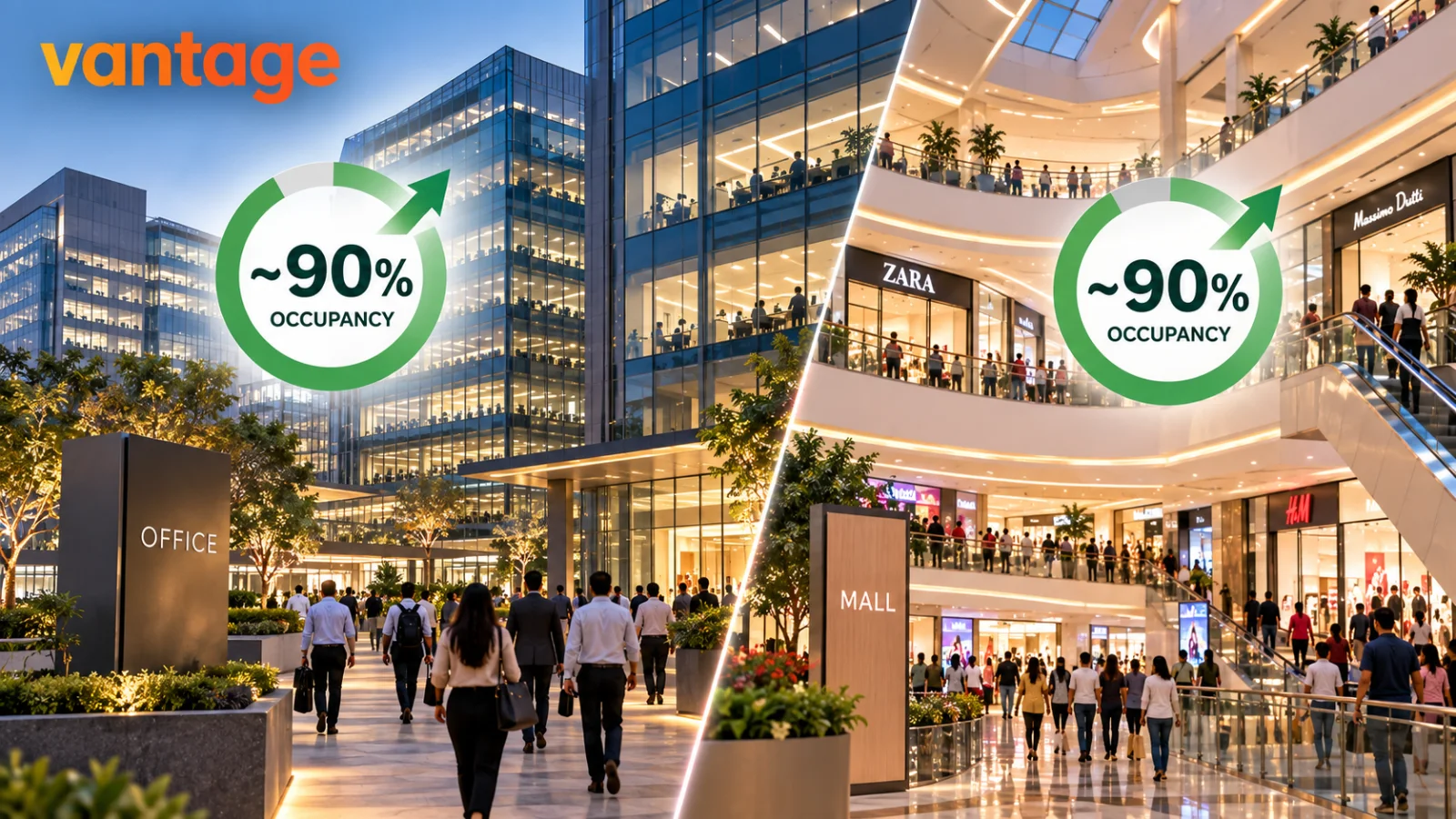
Split-screen editorial banner showing a modern Grade A Indian office district and a busy premium shopping mall, representing ICRA's forecast that occupancy in both commercial-property segments could approach 90% by March 2027
Inline Intelligence
Occupancy across India's major office markets and Grade A shopping malls could move closer to 90% by March 2027, according to ICRA's latest real-estate outlook.
For offices, ICRA expects occupancy across the top six markets to reach approximately 88.5% to 89%, implying vacancy of 11% to 11.5%.
For Grade A malls, vacancy is projected at approximately 11.5% to 12% in FY27, which implies occupancy of roughly 88% to 88.5%.
The numbers point to a resilient operating environment for institutional commercial real estate, but offices and malls are getting there through different demand drivers.
Office occupancy is being supported by Global Capability Centres (GCCs), flexible workspace operators and domestic corporates.
Mall occupancy is being supported by retailer expansion, lease renewals, tenant performance and pre-leasing of upcoming supply.
The important distinction is that these are ICRA forecasts, not occupancy levels that have already been achieved.
India Office Occupancy Could Reach 88.5% to 89%
ICRA expects occupancy across India's top six office markets to reach approximately 88.5% to 89% by March 2027.
That corresponds to expected vacancy of approximately 11% to 11.5%.
The forecast follows a significant improvement during FY26.
India's top six office markets recorded approximately 70 million sq ft of net absorption in FY26, compared with 57.8 million sq ft of new supply.
As absorption exceeded new supply, vacancy declined to 12.2% from 14.1% a year earlier.
This relationship between absorption and new supply is central to the occupancy outlook.
If businesses continue taking up office space faster than new buildings are completed, vacancy can decline even while developers add substantial new stock.
Why Is India Office Occupancy Increasing?
ICRA identifies several demand engines supporting the office market.
Global Capability Centres
GCC expansion remains an important source of office demand.
Multinational companies continue to expand Indian operations across areas such as technology, engineering, artificial intelligence, research and development and other specialised corporate functions.
Bengaluru, Hyderabad, Chennai and Delhi-NCR are expected to remain important beneficiaries of GCC expansion.
Flexible workspace operators
Flexible and managed workspace companies are another source of leasing demand.
These operators can take substantial blocks of office space and then provide workspace to multiple enterprise customers.
Domestic companies
Indian corporates are also contributing to office absorption, providing an additional demand source alongside multinational occupiers.
The combination reduces the office market's reliance on any single occupier category, although GCCs remain an increasingly important part of the leasing cycle.
How Much New Office Supply Is Expected in FY27?
ICRA expects approximately 58 million to 60 million sq ft of new office supply during FY27.
That is substantial.
The agency nevertheless expects leasing demand to remain strong enough for occupancy to improve towards 88.5% to 89%.
This makes FY27 an important test for the office market.
Strong occupancy alone does not establish that India has a shortage of office space. Developers are continuing to add capacity, and the balance between new supply and incremental demand will determine whether vacancy keeps falling.
If absorption remains strong, new buildings can be added without materially weakening occupancy.
If demand slows while completions accelerate, vacancy could move higher than forecast.
Grade A Mall Occupancy Could Remain Around 88%
India's Grade A mall market is also expected to maintain high occupancy.
ICRA projects vacancy of approximately 11.5% to 12% during FY27.
That implies occupancy of roughly:
88% to 88.5%.
The mall outlook differs slightly from the office story.
Office vacancy is expected to improve further.
Mall vacancy is expected to remain broadly stable even as developers add new retail space.
India Could Add 3.5 to 4 Million Sq Ft of Grade A Mall Space
Approximately 3.5 million to 4 million sq ft of new Grade A mall supply is expected during FY27.
Adding new retail space creates a potential occupancy challenge because new malls need tenants before they can generate meaningful rental income.
However, ICRA reports that approximately 35% of upcoming mall supply is already pre-leased.
That provides some visibility on retailer demand before those properties become operational.
Pre-leasing should not be confused with operational occupancy.
A pre-leased store still needs to complete fit-outs, open for customers and begin generating rental income according to its lease terms.
Why 35% Mall Pre-Leasing Matters
Pre-leasing can reduce one of the major risks associated with new shopping-centre development.
A mall that opens with limited tenant commitments may require significant time to build occupancy.
A property that already has retailers committed before completion begins with greater visibility.
Anchor tenants can also help attract other brands.
However, the 35% figure should not be interpreted as evidence that every upcoming mall will open with strong occupancy.
A substantial share of future space still needs to be leased or converted into operational stores.
Mall Rental Income and NOI Could Grow 9.5% to 10%
ICRA expects mall operators' rental income and net operating income to increase approximately 9.5% to 10% in FY27.
The expected growth is supported by factors including:
- contracted rental escalations;
- lease renewals;
- sustained tenant trading performance; and
- resilient occupancy.
This is important because mall income can grow even when occupancy remains relatively stable.
Once a successful mall is already close to full, additional occupancy becomes harder to generate.
Income growth then depends increasingly on rent escalation, tenant turnover, revenue-sharing arrangements and asset expansion.
Does Near-90% Occupancy Mean India Is Running Out of Commercial Space?
Not necessarily.
An occupancy rate approaching 90% indicates relatively high utilisation of the stock covered by the analysis.
But developers are also adding new supply.
For offices, ICRA expects 58 million to 60 million sq ft of new FY27 supply.
For Grade A malls, another 3.5 million to 4 million sq ft is expected.
The more relevant question is whether demand continues to absorb that supply.
A healthy commercial-property market can simultaneously have high occupancy and substantial new construction if tenant demand remains strong enough.
Office and Mall Occupancy Are Driven by Different Forces
The similar occupancy numbers can make offices and malls appear to be experiencing the same cycle.
They are not.
Office demand depends heavily on:
- corporate expansion;
- GCC growth;
- employment;
- flexible workspace demand;
- workplace strategy;
- business confidence; and
- availability of Grade A buildings.
Mall demand depends more heavily on:
- retailer expansion;
- consumer spending;
- footfall;
- tenant sales;
- lease renewals;
- brand mix; and
- quality retail supply.
Both segments may approach similar occupancy levels by March 2027, but the risks behind those numbers are different.
What Does Higher Office Occupancy Mean for Landlords?
Improving occupancy can potentially support:
- rental income;
- lease-renewal negotiations;
- operating cash flow;
- property valuations; and
- developer credit metrics.
But the national or multi-city average does not determine the performance of an individual office building.
Investors still need to evaluate:
- micro-market vacancy;
- competing supply;
- building quality;
- tenant concentration;
- lease expiry schedules;
- rental levels;
- connectivity; and
- access to talent.
A premium Grade A building in a strong GCC corridor can perform very differently from an ageing property in a supply-heavy peripheral location.
What Does High Mall Occupancy Mean for Retailers?
High occupancy can create a different challenge for retailers.
If successful Grade A malls have limited available space, expanding brands may struggle to secure the right store.
That can potentially strengthen landlord negotiating power.
It can also push retailers towards:
- upcoming malls;
- high streets;
- mixed-use developments; or
- alternative retail locations.
This is particularly relevant because recent retail-market data has shown strong high-street leasing alongside tight availability in quality malls.
Could Higher Occupancy Lead to Higher Commercial Rents?
Potentially, but not automatically.
High occupancy can strengthen landlord pricing power when tenants compete for limited suitable space.
However, rental growth depends on local market conditions.
Tenants do not lease a national occupancy percentage. They lease a particular property in a particular micro-market.
A nearly full office building surrounded by limited competing supply may have stronger pricing power.
A similarly occupied building facing substantial upcoming competition may have less.
The same principle applies to shopping malls.
What Does the Occupancy Outlook Mean for REIT Investors?
High occupancy is generally supportive for institutional office and retail portfolios.
It can provide greater visibility on rental income and operating cash flows.
However, REIT investors should look beyond headline occupancy.
Important questions include:
- What is committed occupancy?
- How much space is actually rent-paying?
- When do major leases expire?
- How concentrated are the largest tenants?
- What rental escalations are contracted?
- How much competing supply is coming nearby?
- How much debt does the portfolio carry?
- How much NOI growth comes from existing assets?
High occupancy can support a portfolio, but it does not guarantee attractive investment returns.
Commercial Real-Estate Credit Conditions Are Also Supportive
ICRA expects credit profiles of office developers and mall operators to remain stable during FY27.
The agency points to:
- healthy NOI growth;
- resilient occupancy;
- contracted rental escalations;
- comfortable leverage; and
- comfortable debt-service metrics.
During the first five months of FY27, the sector recorded nine rating upgrades against one downgrade, according to ICRA.
This indicates a supportive credit environment within the entities covered by the agency.
It should not be interpreted as evidence that every commercial-property developer has the same financial strength.
Is 90% Occupancy Guaranteed by March 2027?
No.
The headline should be read as occupancy approaching 90%, not reaching a guaranteed 90%.
ICRA's office forecast is:
88.5% to 89%.
The implied Grade A mall occupancy range is:
approximately 88% to 88.5%.
These are forecasts.
Actual occupancy will depend on leasing, new supply, project completion schedules, corporate expansion, retailer performance and broader economic conditions.
What Should Commercial Real-Estate Investors Watch Next?
1. Office net absorption
The key question is whether occupier demand continues to absorb new office completions.
2. GCC expansion
Global Capability Centres are becoming an increasingly important source of Grade A office demand.
3. New office supply
ICRA expects approximately 58 million to 60 million sq ft of office supply during FY27.
4. Mall pre-leasing
Approximately 35% of upcoming Grade A mall supply is already pre-leased.
5. Mall rental and NOI growth
ICRA expects mall rental income and NOI to increase approximately 9.5% to 10% in FY27.
6. Asset quality
Market-level occupancy can conceal large differences between premium properties and weaker assets.
7. Micro-market supply
Commercial real estate remains highly local. A strong national market can still contain individual corridors with excess supply.
Why the March 2027 Occupancy Forecast Matters
The most important part of ICRA's outlook is not simply that office and mall occupancy could move close to 90%.
It is that high occupancy is expected to coexist with substantial new supply.
For offices, GCCs, flexible workspace operators and domestic corporates are expected to support absorption.
For Grade A malls, retailer expansion and pre-leasing are expected to help absorb new projects.
If those forecasts hold, institutional commercial real estate could enter FY28 with relatively tight availability and resilient operating cash flows.
But near-90% occupancy should not be translated directly into guaranteed rental growth, property appreciation or investment returns.
The individual asset still matters.
Location, tenant quality, lease structure, competing supply, financing and building quality will determine which properties benefit most.
Frequently Asked Questions
What will India office occupancy be by March 2027?
ICRA expects occupancy across India's top six office markets to reach approximately 88.5% to 89% by March 2027.
Will office occupancy reach 90% in India?
ICRA expects office occupancy to approach 90%, rather than forecasting exactly 90%. Its March 2027 forecast is approximately 88.5% to 89%.
What is the expected Grade A mall occupancy in FY27?
ICRA expects Grade A mall vacancy of approximately 11.5% to 12%, implying occupancy of roughly 88% to 88.5%.
Why is India office occupancy increasing?
Strong demand from GCCs, flexible workspace operators and domestic corporates is expected to support office absorption despite substantial new supply.
How much new office supply is expected in FY27?
ICRA expects approximately 58 million to 60 million sq ft of new office supply during FY27.
How much new Grade A mall supply is expected in FY27?
Approximately 3.5 million to 4 million sq ft of Grade A mall supply is expected during FY27.
Does 35% mall pre-leasing mean those stores are already operational?
No. Pre-leasing means space has been committed before completion or opening. It should not automatically be treated as operational or rent-paying occupancy.
Does near-90% occupancy guarantee higher commercial-property returns?
No. Investment returns also depend on rents, financing costs, property valuations, tenant quality, lease terms, asset quality and local supply-demand conditions.
Sources
Click on article title to view article.
“Office, mall occupancies likely to approach 90% by March 2027: Report” published on 3 October 2026 in ETRealty
“Occupancies in offices and malls edge closer to 90% by March 2027” published on 30 September 2026 by ICRA
Related Vantage Coverage
Click on article title to view article.
“GCC expansion could take India's next office boom beyond major cities” published in August 2026 in Vantage-Radar
Evidence Caveats
- The 88.5% to 89% office occupancy figure is an ICRA forecast for March 2027, not an achieved occupancy level.
- The approximately 88% to 88.5% Grade A mall occupancy figure is derived from ICRA's forecast vacancy range of 11.5% to 12%.
- Office occupancy refers to the top six markets covered by ICRA. It should not be interpreted as occupancy across every Indian office building.
- Mall occupancy relates to the Grade A organised retail assets covered by the analysis.
- The expected 58 million to 60 million sq ft of office supply and 3.5 million to 4 million sq ft of mall supply are forecasts.
- Pre-leased mall space should not automatically be treated as operational or rent-paying space.
- Higher occupancy does not by itself establish future rental growth, capital appreciation or investment returns.

From TatvaOps
Commercial Interiors
Building or extending your home?
Run your residential build with verified contractors and daily progress tracking.
Free quotes · Verified contractors · tatvaops.com
Discuss this article
Join the conversation
Continue this discussion on Forums. A board named like this Radar article is filed under Radar.
More from Real Estate
LTCG and STT: Review Reports Do Not Mean a Tax Cut
Finance Minister Nirmala Sitharaman’s comments on equity taxation have reopened a consequential debate for investors. Speaking at the Bloomberg New Economy Forum in New Delhi on 13 October, she welcomed views on long term capital gains tax and securities transaction tax without committing to…
Blackstone Targets 100 Billion in India Investments
Blackstone aims to double its India investments to approximately $100 billion over about five years, president and chief operating officer Jonathan Gray said in interviews reported this week. The ambition spans private equity and real estate, alongside potential expansion in infrastructure, credit…
Property Registrations Flagged Over Fictitious PAN
Nearly 25,000 property registrations over two years at Badshahpur tehsil in Gurugram reportedly carried the same fictitious PAN, according to The Times of India’s 9 October report on an Income Tax Department survey. The finding raises questions about taxpayer identification and transaction…
Inline Intelligence
Key Insight Actions
Connected knowledge for Real Estate Outlook
Move between tutorials, discussions, Studio, and hubs without losing context.
Related discussions
Chennai Office Lease: What Reaches the REIT Investor?
1 replies
Related discussionGST ITC Relief Could Change Commercial Real Estate Economics, but How Much Would Developers Actually Save?
1 replies
Related discussionWhy TVS Motors 5.3 Lakh Sq Ft Bengaluru Lease Matters Beyond the Headline Rent
1 replies
Related discussionIndia Offices and Malls Could Near 90 Occupancy: Does That Mean Commercial Property Is Running Out of Space?
1 replies
Related discussion
Topic hubs
Conclusion Intelligence
Related Discussions
Chennai Office Lease: What Reaches the REIT Investor?
Popular in insights discussions1 reply
GST ITC Relief Could Change Commercial Real Estate Economics, but How Much Would Developers Actually Save?
Popular in insights discussions1 reply
Why TVS Motors 5.3 Lakh Sq Ft Bengaluru Lease Matters Beyond the Headline Rent
Popular in insights discussions1 reply
India Offices and Malls Could Near 90 Occupancy: Does That Mean Commercial Property Is Running Out of Space?
Popular in insights discussions1 reply
Was this helpful?
Let us know what you think