

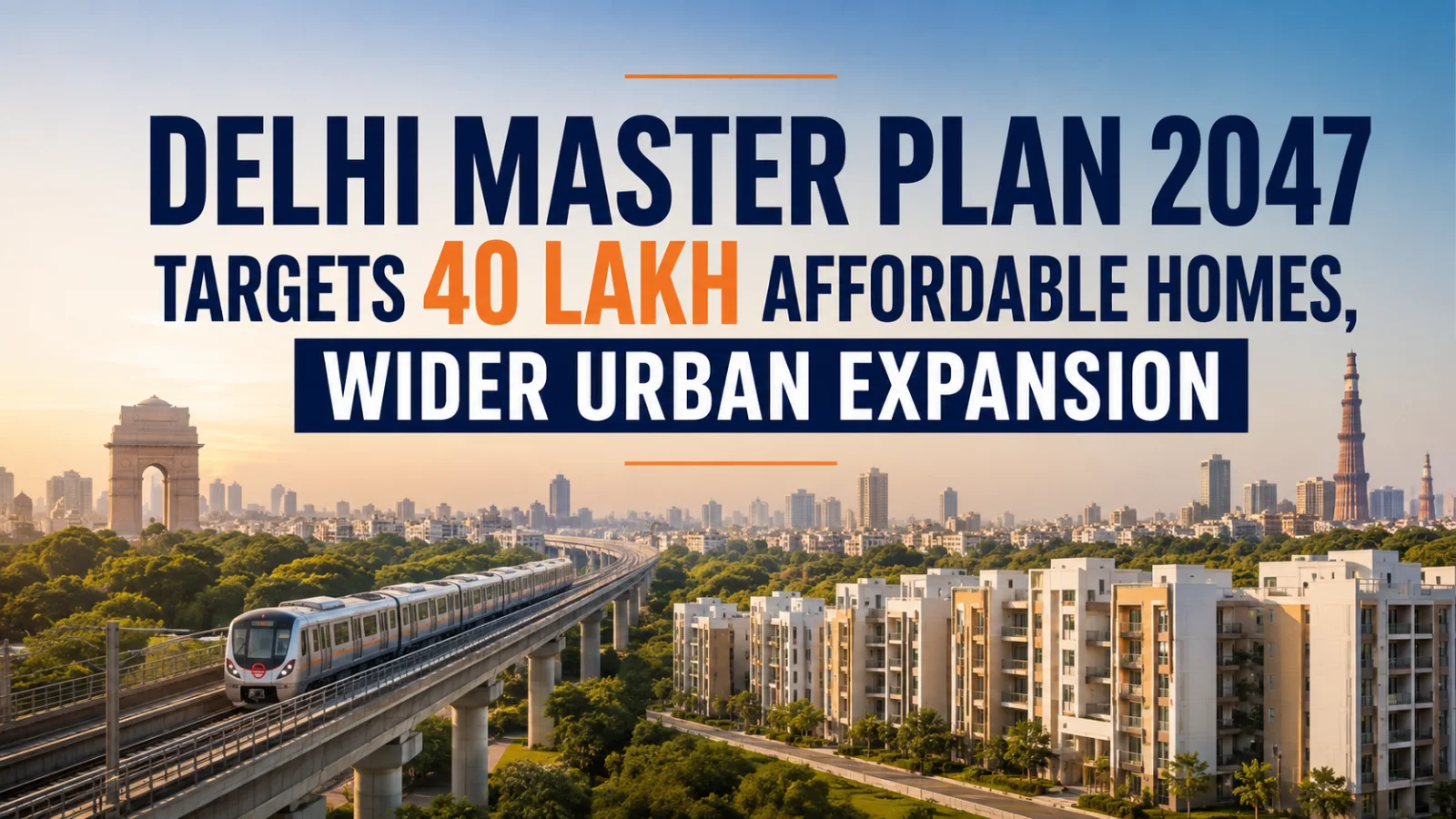
Delhi Master Plan 2047 targets 40 lakh affordable homes, wider urban expansion

Devesh S. is an industry researcher and writer who specializes in translating complex industries into clear, trustworthy, and actionable knowledge. His work…
Summary
NEW DELHI: The Delhi Master Plan 2047 envisages around 40 lakh new affordable housing units as the capital prepares for future population growth, while also pushing redevelopment of existing neighbourhoods and planned expansion through land pooling, according to ETRealty. Union housing and urban affairs minister Manohar Lal unveiled the plan on August 20 in the presence of Delhi lieutenant governor Taranjit Singh Sandhu and chief minister Rekha Gupta. The plan puts housing, transport and infrastructure at the centre of Delhi’s long term urban development. A major component is the redevelopment of existing residential areas.
Published on
Inline Intelligence
NEW DELHI: The Delhi Master Plan 2047 envisages around 40 lakh new affordable housing units as the capital prepares for future population growth, while also pushing redevelopment of existing neighbourhoods and planned expansion through land pooling, according to ETRealty.
Union housing and urban affairs minister Manohar Lal unveiled the plan on August 20 in the presence of Delhi lieutenant governor Taranjit Singh Sandhu and chief minister Rekha Gupta. The plan puts housing, transport and infrastructure at the centre of Delhi’s long-term urban development.
A major component is the redevelopment of existing residential areas. The plan proposes reducing the minimum area required for redevelopment of group housing, DDA housing and government housing from 40,000 square metres to 3,000 square metres. ETRealty reports that this could create around seven lakh additional dwelling units.
The plan also links affordable housing to public transport. Housing along metro corridors is expected to generate around 18 lakh affordable homes in transit-oriented development zones. It also includes housing for jhuggi-jhopri clusters, which is expected to benefit more than 17 lakh residents.
For renters and lower-income workers, the plan proposes a 50% floor area ratio incentive for affordable rental housing aimed at students, working professionals, migrant workers and low-income groups. It also proposes an additional 15% FAR for workers’ housing on industrial plots of 5,000 square metres or more.
Land pooling is another major part of the expansion strategy. The plan envisages nearly 200 square kilometres of planned urban expansion, around 12 lakh new homes and a 600-km road network. The Delhi Development Authority is expected to follow an infrastructure-first approach, developing roads of 30 metres and wider upfront to support connectivity.
The plan also seeks to provide greater certainty to residents of unauthorised colonies. Residential buildings in 1,511 colonies can be regularised on an “as is where is” basis, with the requirement for layout plans removed. According to ETRealty, the move is expected to strengthen property ownership security for around 45 lakh residents.
Beyond housing, the master plan sets out changes to commercial and industrial development. Commercial redevelopment will be permitted on plots of at least 1,000 square metres through incentivised FAR, while mixed-use development will be allowed along roads with a right of way of 30 metres or more.
The plan also proposes modern industrial parks with flexible zoning, allowing uses including warehousing, e-commerce, big-box retail, co-working spaces and data centres.
Transport planning is being given a broader institutional framework. The plan proposes a Unified Metropolitan Transport Authority and multi-modal transit hubs connecting metro, RRTS, buses, intermediate public transport, walking and cycling networks.
Environmental measures include restoration of nearly 1,700 hectares of Yamuna floodplains through 13 projects and a proposed 52-km cycle track along the river. The plan also promotes energy-efficient buildings, rooftop solar, rainwater harvesting, water recycling and green mobility as part of its net-zero development approach.
For Delhi’s property market, the scale of the housing target and the emphasis on redevelopment could open new areas for construction and investment. But the impact will ultimately depend on how quickly the proposed land pooling, redevelopment, infrastructure and regularisation measures are implemented.
As NAREDCO president Parveen Jain told ETRealty, the plan’s focus on renewing older housing and developing new areas could help expand housing supply while making better use of already developed land.

From TatvaOps
Property Management & Rental Operations
Developing a property?
Structured oversight for multi-unit and investor-led builds.
Free quotes · Verified contractors · tatvaops.com
Discuss this article
Join the conversation
Continue this discussion on Forums. A board named like this Radar article is filed under Radar.
More from Real Estate
LTCG and STT: Review Reports Do Not Mean a Tax Cut
Finance Minister Nirmala Sitharaman’s comments on equity taxation have reopened a consequential debate for investors. Speaking at the Bloomberg New Economy Forum in New Delhi on 13 October, she welcomed views on long term capital gains tax and securities transaction tax without committing to…
Blackstone Targets 100 Billion in India Investments
Blackstone aims to double its India investments to approximately $100 billion over about five years, president and chief operating officer Jonathan Gray said in interviews reported this week. The ambition spans private equity and real estate, alongside potential expansion in infrastructure, credit…
Property Registrations Flagged Over Fictitious PAN
Nearly 25,000 property registrations over two years at Badshahpur tehsil in Gurugram reportedly carried the same fictitious PAN, according to The Times of India’s 9 October report on an Income Tax Department survey. The finding raises questions about taxpayer identification and transaction…
Inline Intelligence
Key Insight Actions
Connected knowledge for Urban Planning
Move between tutorials, discussions, Studio, and hubs without losing context.
Related discussions
Kolkata Captured Just 1 of 6.3 Lakh Crore Housing Sales Value: Should the City Chase Premium Housing?
1 replies
Related discussionRaymond Realty Doubled Pre-Sales Without a New Launch: Is Sustenance Demand a Better Signal Than Launch-Day Bookings?
1 replies
Related discussionAjmera Realty: Can New Launches Close the Sales Gap?
1 replies
Related discussionIndian Real Estate Is Building a New Capital Stack
1 replies
Related discussion
Topic hubs
Conclusion Intelligence
Related Discussions
Kolkata Captured Just 1 of 6.3 Lakh Crore Housing Sales Value: Should the City Chase Premium Housing?
Popular in insights discussions1 reply
Raymond Realty Doubled Pre-Sales Without a New Launch: Is Sustenance Demand a Better Signal Than Launch-Day Bookings?
Popular in insights discussions1 reply
Ajmera Realty: Can New Launches Close the Sales Gap?
Popular in insights discussions1 reply
Indian Real Estate Is Building a New Capital Stack
Popular in insights discussions1 reply
Was this helpful?
Let us know what you think