

Green Certification Alone May No Longer Command an Office Premium in India
Karthik posts articles on Energy and Construction.
Summary
A green certification may no longer be enough on its own to command a premium in India's Grade A office market. Occupiers, lenders and investors are increasingly looking beyond certification labels towards measurable building performance, operating efficiency, sustainability data, retrofit readiness and credible decarbonisation plans , according to recent Grant Thornton Bharat reporting. The shift does not mean green buildings are losing relevance. It suggests something more significant: green certification is increasingly becoming a baseline requirement rather than a standalone differentiator. That distinction matters for office landlords.
Published on
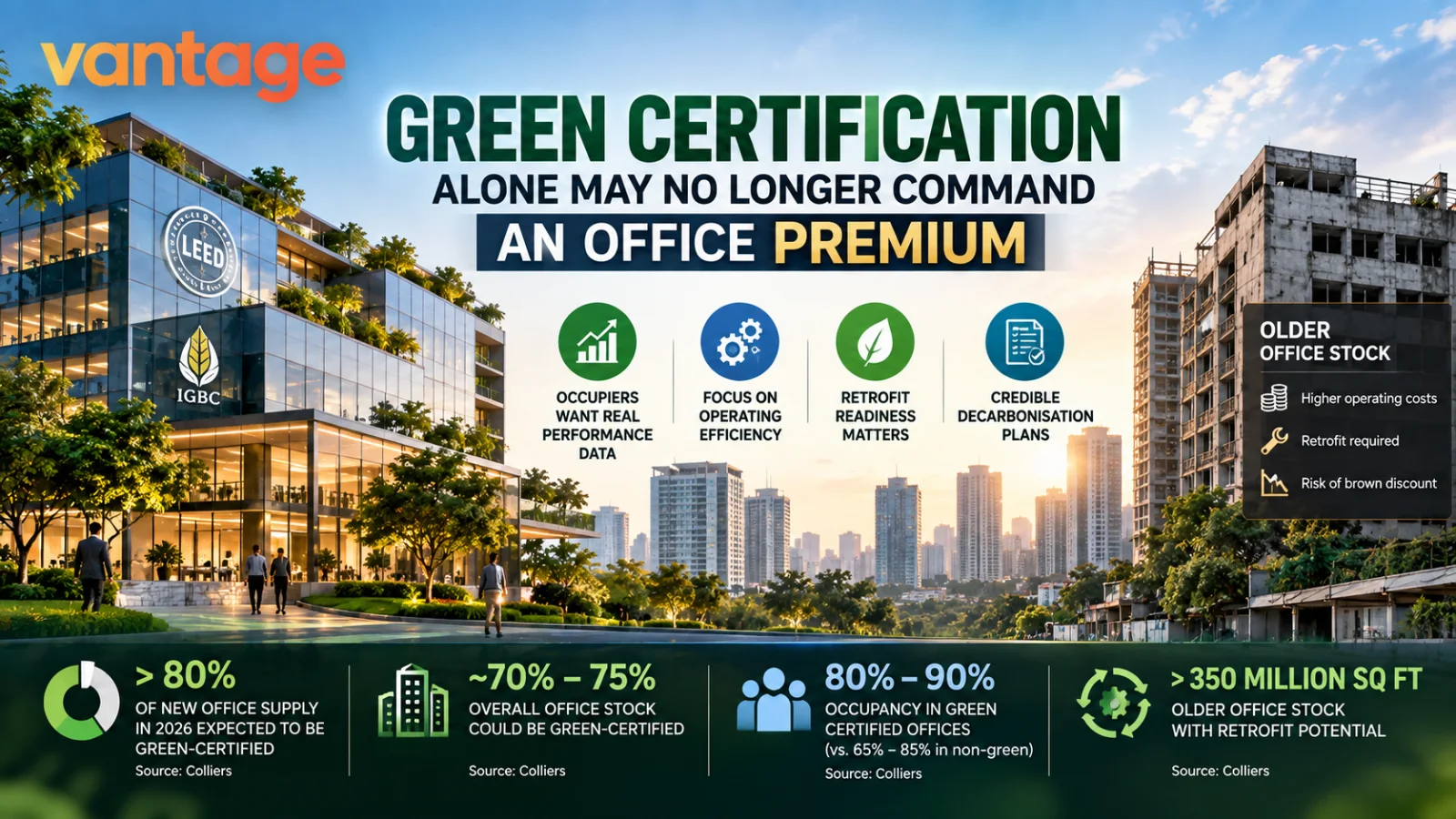
A modern green-certified Grade A office building set against an Indian urban skyline, with visual indicators showing the shift from certification towards measurable building performance. The banner highlights operating efficiency, sustainability data, lower operating costs, climate resilience and stronger tenant demand, while contrasting these advantages with retrofit and brown-discount risks for older office stock.
Inline Intelligence
A green certification may no longer be enough on its own to command a premium in India's Grade A office market.
Occupiers, lenders and investors are increasingly looking beyond certification labels towards measurable building performance, operating efficiency, sustainability data, retrofit readiness and credible decarbonisation plans, according to recent Grant Thornton Bharat reporting.
The shift does not mean green buildings are losing relevance.
It suggests something more significant:
green certification is increasingly becoming a baseline requirement rather than a standalone differentiator.
That distinction matters for office landlords.
A certified building can still benefit from strong occupier demand, but Grant Thornton says the premium is not automatic. Location, tenant quality, operating efficiency, building-management data and a credible decarbonisation roadmap increasingly determine whether an asset can preserve its competitive advantage.
For older offices, the opposite risk is emerging.
Buildings that cannot demonstrate strong sustainability performance or cannot be economically upgraded could face what the report describes as a "brown discount".
Why Is Green Certification Becoming Less of a Differentiator?
India's premium office market has rapidly adopted green certification.
Colliers said approximately 574 million sq ft of Indian office stock was green-certified as of 2025, representing nearly two-thirds of overall office stock.
It expects more than 80% of new office supply in 2026 to be green-certified.
Overall green penetration could consequently reach approximately 70% to 75%.
Colliers also expects green-certified and technology-integrated buildings to account for nearly 80% of office leasing in 2026.
These numbers help explain why certification alone can become less distinctive.
When only a limited number of buildings meet a standard, certification can distinguish an asset.
When most new Grade A buildings meet it, occupiers need additional criteria to determine which building is genuinely better.
Green Certification Is Not Becoming Unimportant
This distinction is essential.
The emerging argument is not:
green certification no longer matters.
It is:
green certification alone may no longer be sufficient.
Multinational companies and Global Capability Centres are increasingly considering sustainability information when selecting offices and renewing leases.
For many institutional occupiers, environmental performance is becoming embedded in property requirements.
Certification can therefore function as an entry requirement.
But once several competing buildings are certified, tenants can compare them using more detailed operational data.
What Are Office Tenants Looking for Beyond Certification?
Grant Thornton says the next phase of sustainable real estate will place greater emphasis on measurable performance.
That can include areas such as:
- energy consumption;
- water consumption;
- operating efficiency;
- building-management data;
- emissions performance;
- retrofit readiness;
- climate resilience; and
- decarbonisation planning.
The difference is between a building possessing a sustainability credential and being able to demonstrate how efficiently it actually operates.
For occupiers with their own ESG or net-zero commitments, that distinction can become increasingly important.
Why Building Performance Data Matters
Large companies increasingly need environmental information from their operations and supply chains.
An office building forms part of that operational footprint.
A landlord that can provide credible information on energy, water and other sustainability indicators can potentially make it easier for tenants to measure and manage their own environmental performance.
This gives building-management systems and operating data a more strategic role.
Technology that monitors building performance is therefore becoming part of the sustainability proposition rather than simply a facilities-management tool.
Can Green Offices Still Command Higher Rents?
Yes, green-certified offices can still be associated with stronger rents and occupancy.
Historical market evidence supports that relationship.
Colliers reported that green-certified Grade A offices had occupancy levels of approximately 80% to 90%, compared with approximately 65% to 85% for non-green-certified buildings in its earlier analysis.
Its 2024 city-level analysis showed rental premiums ranging substantially across markets, including approximately:
- Mumbai: 24%
- Chennai: 16%
- Hyderabad: 14%
- Delhi-NCR: 13%
- Bengaluru: 9%
- Pune: 4%
These figures provide evidence that certified buildings have historically achieved premiums.
But they should not be interpreted as evidence that certification itself caused the entire rental difference.
Location, building age, asset quality, amenities, tenant profile and other characteristics can also influence rents.
The emerging 2026 argument is therefore more nuanced.
A green building can still command a premium, but the label alone may not be sufficient to create one.
What Determines the Green Premium Now?
Grant Thornton says a premium is strongest where certification is supported by factors including:
- location;
- tenant quality;
- operating efficiency;
- building-management data; and
- a credible decarbonisation roadmap.
This changes the landlord proposition.
Previously, obtaining a recognised certification could itself be a major sustainability milestone.
Increasingly, certification may represent the beginning rather than the end of the process.
Owners need to demonstrate how the building performs after certification.
What Is a Brown Discount in Commercial Real Estate?
The "brown discount" is the opposite side of the green-premium debate.
Instead of asking how much extra rent a sustainable building can command, landlords increasingly need to ask whether an inefficient building could lose competitiveness.
Grant Thornton warns that older offices with weak sustainability credentials may face a brown discount if they become more expensive to:
- occupy;
- finance; or
- retrofit.
The concept matters because sustainability can affect asset values even when a landlord cannot extract an explicit green premium.
If modern buildings become the expected standard, older inefficient assets can be discounted relative to them.
India's Older Office Buildings Face a Retrofit Test
The shift creates a major challenge for ageing office stock.
Colliers estimates that more than 350 million sq ft of office buildings older than 10 years have retrofit potential.
It estimates the potential retrofit opportunity at more than ₹425 billion, equivalent to over ₹42,500 crore.
Retrofitting can include improvements to:
- HVAC systems;
- lighting;
- energy management;
- renewable-energy integration;
- building automation;
- water systems;
- indoor environmental quality; and
- other operating infrastructure.
The economics will differ substantially by building.
Some assets may justify major upgrades.
Others may require redevelopment or repositioning.
Retrofit Readiness Could Become an Asset-Quality Metric
The important question is no longer simply whether an older building is currently certified.
Owners also need to know whether the asset can be economically upgraded as tenant requirements change.
A retrofit-ready building may have:
- adaptable mechanical systems;
- usable building-management infrastructure;
- sufficient electrical capacity;
- space for equipment upgrades;
- ownership structures capable of funding improvements; and
- physical characteristics compatible with modern standards.
Buildings that are difficult or expensive to upgrade could become less competitive even if they remain usable.
GCCs Could Accelerate the Shift
Global Capability Centres are particularly relevant to this trend.
GCCs increasingly account for a substantial share of India's Grade A office demand.
Many are operated by multinational companies with global sustainability commitments.
That means office selection can involve more than:
- rent;
- location;
- floorplate;
- transport; and
- employee amenities.
Environmental performance can become another corporate requirement.
As GCCs expand, their procurement standards can influence what landlords need to provide across the broader Grade A office market.
Green Leases Could Become More Common
Grant Thornton expects green leases to become increasingly important.
A green lease can incorporate sustainability-related responsibilities or data-sharing arrangements between landlord and tenant.
For example, lease structures can support access to building information covering energy or water use.
This matters because sustainability performance often depends on both sides.
The landlord operates the building.
The tenant controls a significant portion of what happens inside the leased space.
A green lease can create a framework for both parties to cooperate on performance objectives.
Climate Resilience Is Joining Energy Efficiency
The sustainability conversation is also expanding beyond energy consumption.
Grant Thornton identifies climate resilience as another factor likely to influence long-term asset quality.
A building may be energy efficient but still face exposure to:
- extreme heat;
- flooding;
- water stress;
- power disruption; or
- other climate-related risks.
For long-duration real estate investors, these issues can affect operating costs, insurance, financing and long-term asset usability.
That makes resilience increasingly relevant to investment decisions.
What Does This Mean for Office Developers?
For new developers, certification remains important.
But simply obtaining a label may not create a durable competitive advantage.
Future-ready offices may increasingly need:
- sophisticated building-management systems;
- real-time performance monitoring;
- efficient HVAC;
- renewable-energy integration;
- measurable energy and water performance;
- climate-resilience planning; and
- infrastructure capable of future upgrades.
The focus moves from constructing a certified building to operating a high-performing building.
What Does This Mean for Office Landlords?
Existing landlords face a more difficult decision.
They need to determine whether additional sustainability investment will:
- protect occupancy;
- support rents;
- reduce operating costs;
- improve financing access;
- retain institutional tenants; or
- preserve asset value.
Not every retrofit will produce the same economic return.
The correct strategy will depend on building age, location, tenant demand, current efficiency and upgrade costs.
What Does This Mean for Commercial Property Investors?
Investors may need to expand office due diligence beyond certification status.
Instead of asking only:
Is this building LEED, IGBC or otherwise green-certified?
they may increasingly need to ask:
- What is the building's actual energy performance?
- How efficiently is water used?
- What operating data is available?
- How old are the major mechanical systems?
- What retrofits will be required?
- How expensive will those upgrades be?
- Can the asset meet future tenant requirements?
- How exposed is it to climate risk?
- Is there a credible decarbonisation roadmap?
These questions can influence future capital expenditure and leasing competitiveness.
Green Certification Could Become the New Grade A Baseline
Colliers expects more than 80% of India's new office supply in 2026 to be green-certified.
If that forecast materialises, certification will increasingly become standard among newly completed premium offices.
That does not reduce the importance of sustainability.
It raises the standard.
The market can move from asking whether a building is green to asking how well the green building actually performs.
The Next Office Premium May Be a Performance Premium
India's commercial real estate market is not abandoning green buildings.
It is moving into a more demanding phase of sustainability.
Certification remains relevant.
But certification alone may not tell occupiers, lenders or investors enough about an asset.
The next premium could increasingly depend on whether landlords can prove:
lower operating costs,
measurable environmental performance,
high-quality building data,
retrofit readiness,
and
credible long-term decarbonisation.
For newer Grade A offices, that raises the standard required to differentiate.
For older buildings, it creates a more urgent question.
Can the asset be upgraded economically, or will it eventually face a brown discount?
That may become one of the defining investment questions in India's next office cycle.
Frequently Asked Questions
Does green certification still matter for office buildings in India?
Yes. Green certification remains important and is increasingly common in Grade A offices. The emerging change is that certification alone may no longer be enough to differentiate a building or guarantee a rental premium.
Do green-certified offices command higher rents in India?
Historical Colliers data shows rental premiums for green-certified Grade A offices, but premiums vary significantly by city. Certification should not be assumed to be the sole cause because location, asset quality and other characteristics also affect rents.
What is a brown discount in real estate?
A brown discount describes the potential reduction in competitiveness or value faced by inefficient or sustainability-lagging buildings relative to better-performing assets.
Why are office occupiers asking for sustainability data?
Large occupiers increasingly need measurable environmental information for operational efficiency, ESG reporting and decarbonisation commitments. Building-level energy, water and performance data can support those requirements.
What is retrofit readiness?
Retrofit readiness refers to how easily and economically an existing building can be upgraded with more efficient systems, automation, renewable energy or other sustainability improvements.
How much Indian office space could require retrofitting?
Colliers estimates that more than 350 million sq ft of office stock older than 10 years presents retrofit potential.
Will every green office earn a rental premium?
No. Grant Thornton says the premium is not automatic. Location, tenant quality, operating efficiency, management data and a credible decarbonisation roadmap can all influence whether a premium exists.
What should commercial property investors check beyond green certification?
Investors should consider actual energy and water performance, operating data, building systems, retrofit requirements, climate resilience, tenant demand and the cost of future upgrades.
Sources
Click on article title to view article.
“Green label losing edge as occupiers seek performance data, retrofit-ready offices: Grant Thornton” published on 2 October 2026 in The Times of India
“India Real Estate Outlook and Trends 2026” published in 2026 by Colliers
“India Office Market Demand Forecast 2026” published in 2026 by Colliers
Evidence Caveats
- Grant Thornton's conclusion is not that green certification has no value. It says certification alone is becoming less of a differentiator and does not automatically guarantee a premium.
- Historical rental premiums for certified offices should not be interpreted as proof that certification alone caused the rent difference.
- More than 80% green certification for new 2026 office supply and 70% to 75% overall green penetration are Colliers forecasts.
- The more than 350 million sq ft retrofit opportunity and more than ₹425 billion estimated retrofit potential are Colliers estimates.
- A brown discount is a market-risk concept, not a fixed percentage discount applicable to every older building.
- No reviewed evidence establishes a single nationwide 2026 rental premium attributable solely to green certification.
- Future asset values, retrofit returns, financing costs and rental premiums remain unavailable at a uniform national level.

From TatvaOps
Home Renovation
Financing your project?
Explore credit and milestone-secured payment options with Tatva Finance.
Free quotes · Verified contractors · tatvaops.com
Discuss this article
Join the conversation
Continue this discussion on Forums. A board named like this Radar article is filed under Radar.
More from Real Estate
LTCG and STT: Review Reports Do Not Mean a Tax Cut
Finance Minister Nirmala Sitharaman’s comments on equity taxation have reopened a consequential debate for investors. Speaking at the Bloomberg New Economy Forum in New Delhi on 13 October, she welcomed views on long term capital gains tax and securities transaction tax without committing to…
Blackstone Targets 100 Billion in India Investments
Blackstone aims to double its India investments to approximately $100 billion over about five years, president and chief operating officer Jonathan Gray said in interviews reported this week. The ambition spans private equity and real estate, alongside potential expansion in infrastructure, credit…
Property Registrations Flagged Over Fictitious PAN
Nearly 25,000 property registrations over two years at Badshahpur tehsil in Gurugram reportedly carried the same fictitious PAN, according to The Times of India’s 9 October report on an Income Tax Department survey. The finding raises questions about taxpayer identification and transaction…
Inline Intelligence
Key Insight Actions
Connected knowledge for Construction Industry News
Move between tutorials, discussions, Studio, and hubs without losing context.
Related discussions
Raymond Realty Doubled Pre-Sales Without a New Launch: Is Sustenance Demand a Better Signal Than Launch-Day Bookings?
1 replies
Related discussionAjmera Realty: Can New Launches Close the Sales Gap?
1 replies
Related discussionIndian Real Estate Is Building a New Capital Stack
1 replies
Related discussionNoida Sports City: What Does a Conditional OC Resolve?
1 replies
Related discussion
Topic hubs
Conclusion Intelligence
Related Discussions
Raymond Realty Doubled Pre-Sales Without a New Launch: Is Sustenance Demand a Better Signal Than Launch-Day Bookings?
Popular in insights discussions1 reply
Ajmera Realty: Can New Launches Close the Sales Gap?
Popular in insights discussions1 reply
Indian Real Estate Is Building a New Capital Stack
Popular in insights discussions1 reply
Noida Sports City: What Does a Conditional OC Resolve?
Popular in insights discussions1 reply
Was this helpful?
Let us know what you think