

Silver Price Crash: Should You Buy After a 53 Fall?
Summary
Silver prices have fallen sharply from January 2026 peaks, with MCX futures below ₹2 lakh per kg. Is silver a buying opportunity or a risk? Explore silver ETFs, industrial demand, interest rates and what Indian investors should check. Silver has lost more than half its value from its January 2026 peak on a reported domestic spot market measure. For someone who considered buying silver when prices were rising, the correction may appear to offer a second chance. But for investors who purchased near the top, it represents a substantial loss of portfolio value.
Published on
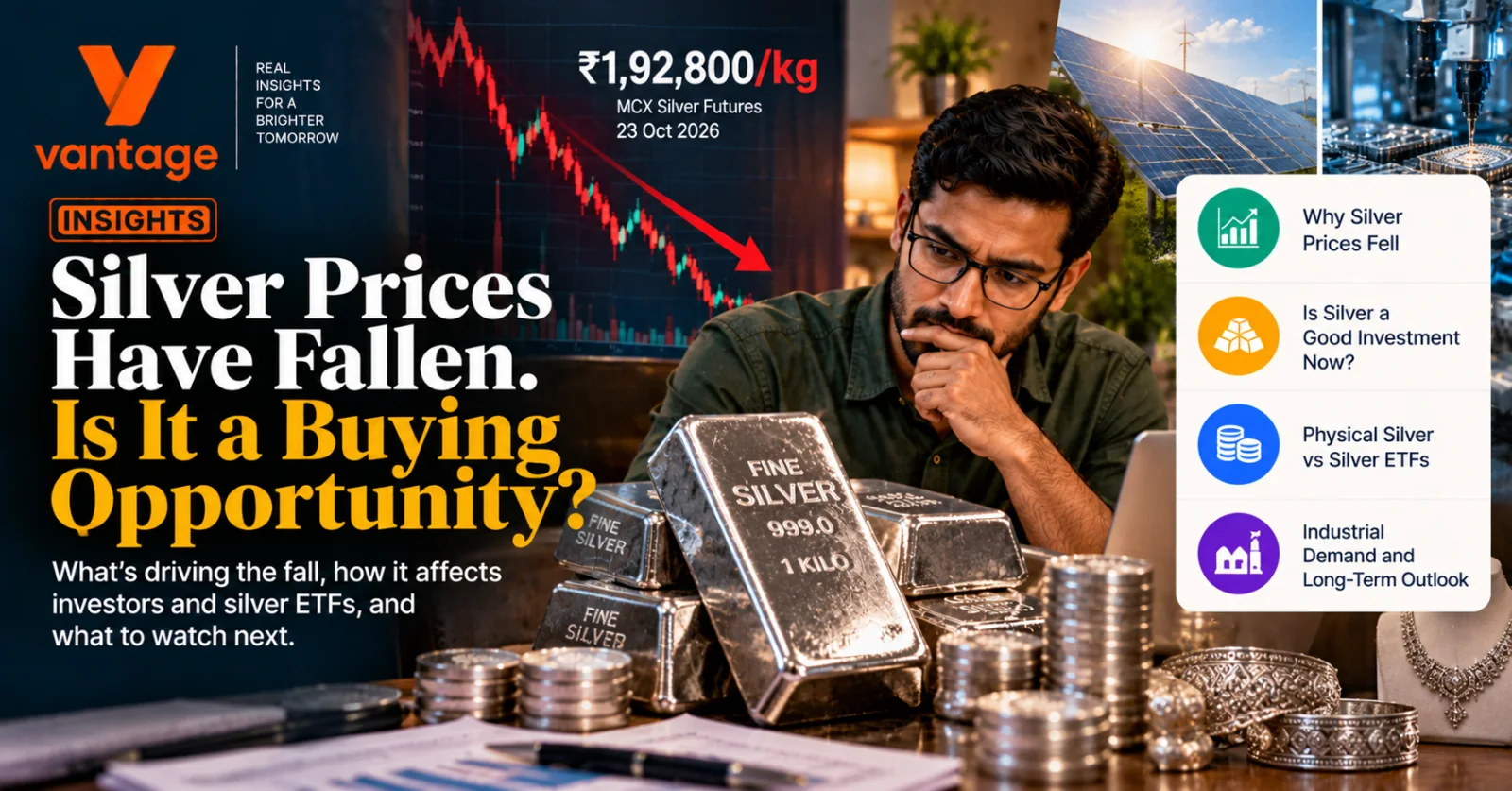
Silver prices in India fell sharply in October 2026, with MCX silver futures reaching ₹1,92,800 per kilogram on 23 October. The image explores whether falling silver prices offer an investment opportunity, covering physical silver, silver ETFs, industrial demand and market risks.
Inline Intelligence
Silver has lost more than half its value from its January 2026 peak on a reported domestic spot-market measure.
For someone who considered buying silver when prices were rising, the correction may appear to offer a second chance.
But for investors who purchased near the top, it represents a substantial loss of portfolio value.
Both groups face the same underlying question.
Has silver become a better investment because its price has fallen, or have the risks affecting its value become more serious?
The answer requires examining demand, interest rates, currency movements, product costs and the role silver is expected to play in a portfolio.
How Severe Has the Silver Price Crash Been?
According to Moneycontrol's 26 October report, domestic silver's reported spot-market price declined from approximately ₹3,79,983 per kilogram on 29 January to ₹1,94,170 on 23 October.
That is a fall of approximately 48.9% on those two reported Indian spot-price observations.
The same report described silver's international decline as exceeding 53%, comparing the late-January international peak with prices around 23 October.
Meanwhile, The Economic Times reported that MCX silver futures reached ₹1,92,800 per kilogram on 23 October.
These distinctions matter because percentages can change according to the price series, contract expiry, currency and dates used.
Investors should compare like-for-like prices before making decisions based on a headline percentage.
Whatever benchmark is selected, the broader conclusion remains significant: silver has experienced an unusually large price correction.
Does a 50% Price Decline Make Silver Cheap?
Not necessarily.
Silver is a commodity rather than a business that generates earnings or distributes profits.
An investor cannot evaluate it using the same price-to-earnings ratios applied to shares.
Silver's value depends on supply, industrial consumption, investment demand, physical-market conditions and changing expectations.
A price can fall substantially and still decline further if those underlying conditions worsen.
The price at which an asset previously traded is not proof of its fair value.
This is particularly important for silver because investment demand can change quickly when sentiment shifts.
Why Does Silver React to Interest Rates?
Silver does not generate regular interest payments.
When government bond yields increase, income-generating alternatives may become more attractive.
Investors who previously held precious metals may reassess the opportunity cost of tying up capital in a non-yielding asset.
The relationship is not mechanical.
Silver prices can rise even when interest rates are elevated, particularly if other demand forces are sufficiently strong.
However, expectations about monetary policy can contribute to short-term volatility.
The latest decline has coincided with concerns that energy-driven inflation could keep global interest rates higher than previously anticipated.
That is one reason market analysts are watching US Federal Reserve decisions and bond yields.
Why Is Silver Different From Gold?
Gold and silver are both precious metals, but they have different demand characteristics.
Gold is widely held for jewellery, investment and reserve-related purposes.
Silver also has meaningful industrial applications.
It is used in electrical equipment, electronics, solar photovoltaic technology and other manufacturing processes.
That gives silver exposure to developments in industrial activity and technology.
When manufacturing demand is strong, industrial silver consumption can provide support.
When demand weakens, the same connection can create additional pressure.
Silver therefore combines characteristics of a precious metal and an industrial commodity.
This does not make it inherently better or worse than gold.
It means investors should examine a somewhat different set of risks.
Could Solar Energy Demand Support Silver?
Solar photovoltaic manufacturing uses silver in electrical contacts, although the amount required varies by technology and design.
Growth in solar deployment can support demand for silver.
However, manufacturers also have incentives to reduce the amount of silver used per unit of output because it is a significant material cost.
Technological changes, improved efficiency and substitution can therefore weaken the relationship between solar installations and silver consumption per unit.
Long-term demand depends on both the number of systems produced and the amount of silver each system requires.
A growing solar industry does not guarantee uninterrupted growth in silver prices.
Investors should be cautious about simplified claims that silver must rise because renewable energy is expanding.
What Do India's New Import Permits Mean?
India recently approved substantial additional silver imports.
According to Reuters reporting on 22 October, permits were issued covering approximately 6,500 metric tonnes over six months.
India relies on imports for more than 80% of its silver requirements.
The additional permissions could ease domestic supply constraints.
Reuters also reported that physical-market premiums declined from as much as $2.50 per ounce in the previous week to approximately 45 US cents by 22 October.
That suggests tighter domestic supply conditions had begun to ease.
However, investors should distinguish three different prices:
- The international silver benchmark.
- The Indian wholesale or futures-market price.
- The actual retail price offered by a dealer.
Changes in import availability can affect domestic premiums without producing an equivalent movement in international silver prices.
What Is the Difference Between Physical Silver and Silver ETFs?
Indian investors can obtain silver exposure in different ways.
Physical silver
Coins and bars provide direct ownership of metal, subject to verifying purity and authenticity.
Costs may include dealer premiums, applicable taxes, storage and resale spreads.
The resale value may be below the retail purchase price even if the underlying silver benchmark has not changed.
Silver ETFs
Silver exchange-traded funds offer exchange-listed exposure to domestic silver prices through regulated investment schemes.
They can avoid the investor having to store bullion personally.
However, ETF investors face expenses, tracking differences, exchange-trading liquidity risk and possible differences between the traded unit price and net asset value.
According to SEBI's February 2026 circular, the valuation of physical gold and silver held by mutual fund schemes moved to a recognised domestic spot-price polling framework from 1 April 2026.
That regulatory methodology does not eliminate investment losses or guarantee exact price tracking.
Silver futures
Silver futures are derivative contracts, often involving margin requirements and potentially substantial leverage.
They can produce losses much greater than an investor initially expects from the price movement alone, and market participants may be required to provide additional margin.
Futures are not interchangeable with fully paid physical silver or unleveraged ETF units.
The appropriate instrument depends on objectives, understanding and financial capacity.
What Happens to an Investor Who Bought at the Peak?
Consider a hypothetical investment of ₹1 lakh in an asset that subsequently falls 50%.
The investment's value becomes ₹50,000, ignoring expenses.
To return from ₹50,000 to ₹1 lakh, the asset must rise 100%.
That is because percentage changes are calculated from the new, lower base.
This arithmetic is especially important after deep commodity corrections.
A large fall can create the impression that the asset must recover the lost percentage quickly.
But the market does not operate according to an investor's previous purchase price.
Recovery depends on future conditions, not the amount an individual has lost.
Should Investors Average Down?
Buying more after a price decline reduces an investor's average acquisition cost per unit, assuming additional units are purchased below the previous average.
However, it also increases exposure to the asset.
If prices fall further, the investor may experience greater absolute losses than if no additional purchase had been made.
For example, suppose an investor buys ₹50,000 worth of silver and its value falls to ₹30,000.
If the investor adds another ₹50,000, the total amount originally invested becomes ₹1 lakh.
That does not erase the earlier decline or make the new combined position safe.
The decision should reflect portfolio allocation, liquidity needs and whether the underlying investment case still holds.
Averaging down is a transaction approach, not proof of value.
Is Silver Suitable for Someone Saving for a Home?
Suppose a household plans to use ₹10 lakh for a property down payment within twelve months.
If that amount is held in a highly volatile commodity, an adverse market movement could create a shortfall close to the deadline.
Even if silver eventually recovers, the family may need the money before any recovery occurs.
A long-term investor without a fixed spending deadline may have greater flexibility to withstand fluctuations, although time does not guarantee positive returns.
The main question is whether the potential downside is compatible with the importance and timing of the goal.
Silver should not be viewed as a substitute for emergency reserves or money needed for essential near-term obligations without assessing those risks.
What Should Investors Check Before Buying?
1. Identify the exact price benchmark
Compare spot with spot, or the same futures contract across dates.
Do not rely on a single percentage decline without understanding its baseline.
2. Understand why the price has fallen
Review changes in interest-rate expectations, industrial demand, investment flows and physical-market premiums.
A lower price matters more when its underlying drivers are understood.
3. Compare investment products
Evaluate purity and resale terms for physical silver.
For ETFs, review expenses, tracking difference, net asset value and exchange liquidity.
For derivatives, understand margin and leverage risks.
4. Review allocation and financial goals
Consider whether adding silver would create excessive exposure to one volatile commodity.
Account for the time when invested funds may be needed.
The Bigger Lesson: A Lower Price Is Only the Beginning
Silver's correction has made it considerably less expensive than it was during the January 2026 rally.
But its future performance depends on industrial consumption, global monetary conditions, trade flows and investment demand.
There are legitimate reasons to study silver's longer-term prospects.
There are also meaningful reasons to remain cautious.
Investors should not confuse a large historical decline with an assured buying opportunity.
The question is not whether silver has fallen enough to look tempting. It is whether the price, risks and investment purpose make sense together.
FAQ
1. Why are silver prices falling in India in October 2026?
Analysts cite higher interest-rate expectations, a stronger US dollar, uncertainty over industrial demand and the reversal of earlier speculative enthusiasm.
2. What was the MCX silver price on 23 October 2026?
The Economic Times reported silver futures at approximately ₹1,92,800 per kilogram. This is a dated futures-market quote, not a universal retail rate.
3. Has silver fallen more than 50% in 2026?
Some reported international and futures-market comparisons show declines exceeding 50% from January peaks. The exact percentage depends on the benchmark and dates compared.
4. Does a silver price crash mean it is a good time to buy?
Not necessarily. A lower price does not guarantee fair value, a market bottom or future positive returns.
5. Can industrial demand support silver prices?
Yes. Manufacturing and solar applications are important demand sources, but technological changes and weaker industrial activity can also affect consumption.
6. Are silver ETFs safe investments?
Silver ETFs provide regulated market exposure but carry commodity price risk, tracking differences, liquidity risk and expenses. They do not guarantee capital protection.
7. Is physical silver better than a silver ETF?
Neither is universally better. The decision depends on ownership preferences, storage, liquidity, product costs, taxes and investment objectives.
8. What does averaging down mean?
It means buying additional units after prices fall. This may reduce average acquisition cost but increases total exposure and potential losses.
9. Will silver recover its January 2026 high?
No reliable evidence establishes when or whether the metal will return to that price. Forecasts depend on uncertain future conditions.
10. What should investors watch next?
Important variables include global bond yields, US monetary policy, industrial demand, silver import flows, domestic premiums and currency movements.
Sources
Click an article title to view the source.
- Silver prices fall 53% from peak: Should buyers wait or buy now? Here's the Outlook, published on 26 October 2026 in Moneycontrol.
- Silver hits 11-month low of ₹1.95 lakh as crude stokes inflation fears, published on 23 October 2026 in The Economic Times.
- India permits large silver imports despite weak domestic demand, published on 22 October 2026 by Reuters.
- Silver price has broken below ₹2 lakh for the first time since December 2025, published on 24 October 2026 in Mint.
- Valuation of physical Gold and Silver held by mutual fund schemes, published on 26 February 2026 by SEBI.
Evidence Caveats
Silver price figures in the cited reporting include domestic spot-market measures, MCX futures and international spot benchmarks. They cannot be compared without matching dates, currencies and contract definitions.
Moneycontrol's more-than-53% international price decline differs from the percentage implied by its reported Indian spot-market observations. The article has kept those benchmarks separate.
The industrial demand and monetary-policy explanations are attributed to reporting and analyst assessments, not established as exclusive causes of the correction.
Silver import permits do not establish completed shipment volumes or guarantee lower international commodity prices.
Illustrative financial examples are hypothetical and exclude transaction costs, taxes and other individual circumstances.
Join the Discussion
Has silver's sharp correction made the metal more attractive to you, or has the volatility changed how you think about investing in precious metals?
Which factor deserves the most attention now: industrial demand, interest rates, physical-market supply or investor sentiment?
Share your reasoning, evidence or practical experience in the attached forum discussion. Different views are welcome.
Disclaimer
This article is for general educational and informational purposes only. It is not personalised investment, financial, legal or tax advice. Silver, silver ETFs and derivatives carry significant market risks, including the possibility of capital loss. No return or recovery is guaranteed. Readers should assess their circumstances and consult appropriately qualified professionals where necessary.

From TatvaOps
Property Development
Developing a property?
Structured oversight for multi-unit and investor-led builds.
Free quotes · Verified contractors · tatvaops.com
Discuss this article
Join the conversation
Continue this discussion on Forums. A board named like this InSights article is filed under InSights.
1 reply already on Forums
More from Solar
What Clean Energy Spending Must Deliver
A national clean-energy target is not an investment instruction. Check delivery, contracts, grid access and your own bill before acting.
Rooftop Solar Costs Rise: Is It Still Worth Installing?
Rising prices of DCR-compliant solar modules could extend rooftop solar payback periods in India. Explore government subsidies, installation economics and what homeowners should calculate before investing.
Battery Storage: What Matters Beyond Factory Capacity?
India has a larger battery manufacturing base. That does not settle your backup requirements, installed cost or warranty. Here is what a property owner should ask before choosing a storage system.
Inline Intelligence
Key Insight Actions
Connected knowledge for Precious Metals Investment
Move between tutorials, discussions, Studio, and hubs without losing context.
Related discussions
Topic hubs
Conclusion Intelligence
Related Discussions
Was this helpful?
Let us know what you think