

Glass Import Duties: Will Building Costs Rise in India?
Summary
India has proposed countervailing duties on Malaysian clear float glass. Explore what the recommendation could mean for construction costs, windows, domestic manufacturers and homeowners. India's proposal to introduce countervailing duties on certain Malaysian glass imports has raised an important question for the construction industry: could protecting domestic manufacturers also increase the cost of windows, façades and other building materials? The Directorate General of Trade Remedies DGTR has recommended duties ranging from 8.58% to 15.66% on specified clear float glass imports from Malaysia.
Published on
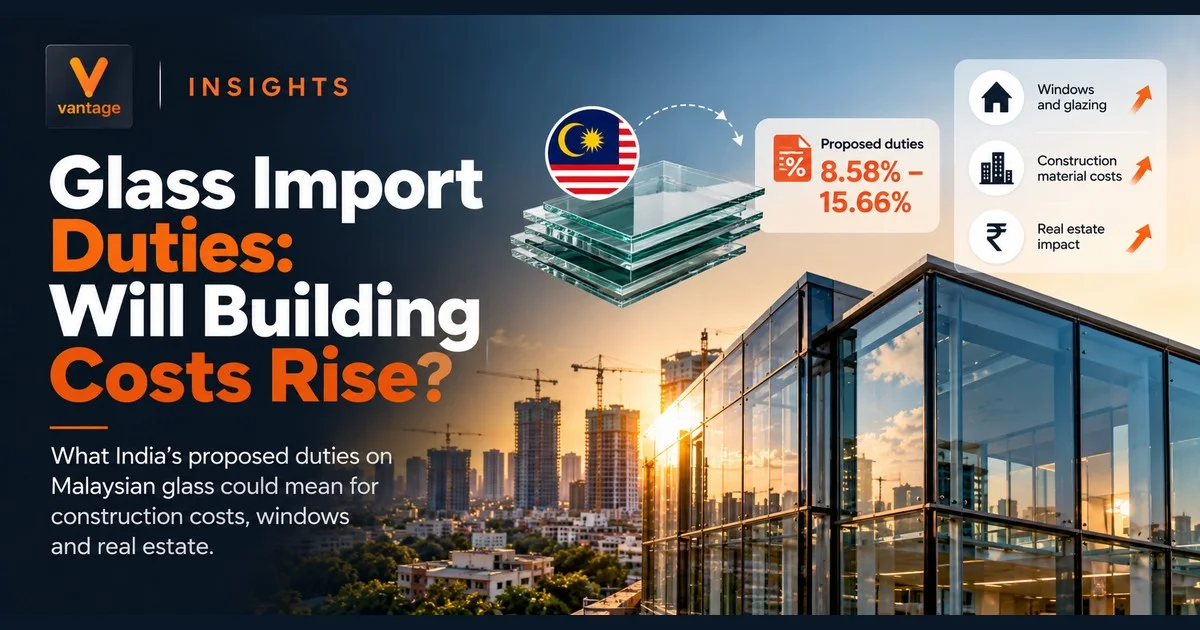
Modern glass-fronted commercial building under construction in India, illustrating proposed countervailing duties on Malaysian clear float glass and their potential effects on architectural glazing, window prices and construction costs.
India's proposal to introduce countervailing duties on certain Malaysian glass imports has raised an important question for the construction industry: could protecting domestic manufacturers also increase the cost of windows, façades and other building materials?
The Directorate General of Trade Remedies (DGTR) has recommended duties ranging from 8.58% to 15.66% on specified clear float glass imports from Malaysia.
The recommendation follows an investigation into allegedly subsidised imports and their impact on Indian glass manufacturers.
For builders, homeowners and property developers, the potential implications extend beyond international trade.
Glass is used throughout modern buildings, including windows, partitions, balconies, commercial façades and interior applications.
But understanding the proposed policy requires separating three different issues: the duty recommended by the government authority, its potential effect on glass procurement, and its ultimate impact on construction budgets.
Why Is India Considering New Glass Import Duties?
In September 2025, DGTR initiated a countervailing duty investigation concerning clear float glass imported from Malaysia and Indonesia.
The application came from domestic glass manufacturers seeking relief from allegedly subsidised imports.
Following its investigation, DGTR issued final findings on September 28, 2026.
The authority concluded that certain Malaysian producers had received countervailable subsidies and that the Indian domestic industry had suffered material injury.
The findings identified price undercutting, financial losses, pressure on selling prices and declining capacity utilisation.
DGTR subsequently recommended duties on covered Malaysian imports for five years.
The investigation concerning Indonesia was terminated because the relevant subsidised import volumes fell below the applicable threshold.
This distinction is important. The recommendation is directed at specified Malaysian imports, not all foreign glass entering India.
What Are the Recommended Import Duty Rates?
The investigation reported different subsidy margins for different Malaysian manufacturers.
| Producer | Reported margin |
|---|---|
| Xinyi Energy Smart (Malaysia) | 11.61% |
| Kibing Group (M) | 11.44% |
| Jinjing Technology Malaysia | 8.58% |
| Other Malaysian producers | 15.66% |
The proposed measure covers clear float glass of nominal thicknesses from 4 mm to 12 mm, subject to the formal product description and exclusions.
DGTR's findings are recommendations to the government.
A separate legally effective customs notification is necessary before the new duty can be treated as implemented.
Therefore, contractors and buyers should not automatically apply these percentages to existing glass quotations.
What Is Clear Float Glass?
Clear float glass is a flat glass product manufactured through a process that produces a relatively uniform sheet with smooth surfaces.
It serves as a base material for many glass products used in buildings.
After additional processing, it can be used in applications such as:
- Residential windows and glazed doors.
- Office partitions.
- Shopfronts and commercial glazing.
- Laminated or toughened architectural glass.
- Certain interior and furniture applications.
- Insulating glass assemblies.
However, not every finished glazing product necessarily falls directly within the scope of this countervailing duty investigation.
The classification and treatment depend on the product description and the relevant customs rules.
That distinction is particularly important when evaluating quotations for finished windows or complex façade systems.
Could Construction Glass Become More Expensive?
Potentially, but an increase is not automatic.
If additional duties are imposed on covered imports, the direct landed cost of those imports could increase.
Importers might respond by raising selling prices, absorbing part of the additional cost or changing suppliers.
Domestic manufacturers could also adjust pricing based on demand, capacity and competition.
The result would depend on the structure of India's glass supply market.
For example, a company purchasing a substantial quantity of covered Malaysian glass may be more directly exposed than a contractor already sourcing entirely from Indian manufacturers.
Similarly, a glazing fabricator may purchase glass sheets from multiple producers, making the overall effect dependent on its purchasing mix.
The recommended duties should therefore be treated as a potential cost factor rather than evidence of a confirmed nationwide construction-glass price increase.
How Import Duties Can Affect a Building Project
The relationship between raw-glass prices and finished construction costs is more complex than it initially appears.
A completed window system includes more than the glass sheet.
It may also include aluminium or uPVC frames, hardware, gaskets, seals, fabrication, transportation, installation and applicable taxes.
Consider a purely hypothetical example.
Suppose the glass component represents ₹40,000 of a finished glazing package costing ₹1,00,000.
If that glass component becomes 10% more expensive, its additional cost would be ₹4,000.
If every other expense remains unchanged, the final package could increase from ₹1,00,000 to ₹1,04,000.
That is a 4% increase in the complete package, rather than 10%.
This example is only arithmetic. It does not represent a forecast of actual glass prices or the expected impact of the proposed duties.
The real outcome depends on product coverage, sourcing, contracts and supplier pricing.
What Could This Mean for Homeowners?
Most homeowners do not purchase large quantities of raw clear float glass directly.
Instead, they generally buy finished products such as sliding windows, bathroom partitions, glass doors or balcony glazing systems.
A change in the input cost of glass may eventually influence these quotations.
But the effect will differ by project.
A small renovation using limited glazing may experience little change in its total project budget.
A commercial building with extensive glass façades may have substantially greater exposure to glass procurement costs.
For homeowners planning a construction or renovation project, the practical response is to request clear material specifications and compare quotations rather than assuming all glazing prices will rise.
Will Indian Glass Manufacturers Benefit?
The proposed measure is designed to address injury attributed to subsidised Malaysian imports.
If implemented, it could reduce the price advantage enjoyed by the covered imports.
That may improve competitive conditions for some Indian manufacturers.
However, business benefits are not guaranteed.
Future profitability would still depend on domestic demand, production costs, capacity utilisation, energy expenses and other competing suppliers.
Import protection can also create trade-offs.
A measure intended to support domestic production may increase purchasing costs for some downstream users.
The economic outcome depends on whether domestic capacity, competition and supply-chain efficiency can meet market needs at acceptable prices.
Does This Affect Real Estate Prices?
It would be premature to suggest that the proposed duty will meaningfully raise housing prices across India.
Residential property prices depend on numerous factors, including land acquisition, financing, labour, approvals, construction costs, location and market demand.
Glass is only one component of the building-material budget.
Even where glazing costs rise, developers may not pass the full increase directly to property buyers.
Existing contracts, project margins, procurement agreements and competitive market conditions can influence how additional costs are absorbed.
The impact could be greater in highly glazed commercial developments, but that would require project-specific evidence.
There is currently insufficient verified evidence to quantify any nationwide housing-price impact arising from this recommendation.
Five Steps for Builders and Renovating Homeowners
1. Ask for detailed glazing specifications
A quotation should identify glass thickness, type, relevant safety requirements, frame material and hardware.
Comparing only the total price can conceal important differences in quality and performance.
2. Understand the supplier's pricing basis
Ask whether a price is fixed for an agreed period or subject to material-price adjustments.
This becomes especially important for projects with long procurement schedules.
3. Check whether imported glass is actually involved
A proposed duty on certain imports does not affect every manufacturer and product in the same way.
Ask the supplier to explain the origin and specification of the glass being offered.
4. Compare compliant alternatives
Alternative products should be assessed for safety, durability, thermal performance, acoustic performance and required certifications.
Choosing cheaper glass without checking suitability can create larger long-term costs.
5. Track the final government notification
Before accepting a claim that the new duty has already increased costs, verify whether the applicable government notification has taken effect.
The DGTR recommendation and an implemented customs duty are separate regulatory stages.
What Happens Next?
The immediate development to watch is whether India's Ministry of Finance issues a notification implementing the recommended countervailing duties.
If the measure takes effect, market participants will need to assess its impact on imports, sourcing arrangements and downstream pricing.
Another factor will be how domestic manufacturing capacity and competing suppliers respond.
For the construction industry, the debate is ultimately about finding a balance between fair competition, domestic manufacturing and affordable building inputs.
For homeowners and property investors, the practical lesson is to understand the materials they are purchasing and avoid reacting to headline duty percentages without checking the actual financial impact.
Conclusion
India's proposed countervailing duties on Malaysian clear float glass reflect an effort to address subsidised imports and protect domestic producers from documented injury.
The recommendation is relevant to the glass supply chain and could have consequences for selected construction products.
However, it does not establish that finished windows, commercial façades or residential property prices have already increased.
The eventual impact depends on implementation, market competition, sourcing decisions and how costs are transmitted through the supply chain.
For anyone planning construction or renovation, clear specifications, transparent quotations and proper supplier comparisons remain more useful than assumptions about future price increases.
FAQ
1. Has India imposed new duties on Malaysian glass?
DGTR recommended countervailing duties in its September 28, 2026 final findings. A separate effective customs notification is required to establish implementation.
2. What is the recommended duty rate?
The reported producer-specific subsidy margins range from 8.58% to 15.66%. Actual applicable treatment must be checked against the formal findings and any subsequent customs notification.
3. Will window prices increase?
They could change if covered imported glass becomes more expensive, but there is no verified basis for claiming a uniform increase in finished window prices.
4. Does the proposal cover all imported glass?
No. The investigation concerns specified clear float glass imports from Malaysia, within the formal product scope.
5. Should homeowners purchase glazing immediately?
There is no evidence-based reason for every homeowner to rush purchases solely because of the recommendation. Buyers should evaluate project timing, product specifications, supplier quotes and contractual terms.
Sources
Click an article title to view the source.
-
Countervailing Duty Investigation Concerning Clear Float Glass from Malaysia and Indonesia, final findings published on 28 September 2026 by the Directorate General of Trade Remedies, Government of India.
-
CVD Investigation of Clear Float Glass from Indonesia and Malaysia, published on 5 October 2026 in the Gazette of India, reproduced by Gazette Tracker.
-
Anti-Dumping Investigation Concerning Clear Float Glass from Malaysia, containing the separate 2025 review findings published on 6 November 2025, by the Directorate General of Trade Remedies.
Evidence Caveats
The principal policy findings are dated September 28, 2026. This article is an analysis of those findings as of October 27, rather than a claim that a new decision was issued today.
The proposed duty has not been treated as implemented because a corresponding effective notification could not be confirmed during this review.
The numerical glazing-cost illustration is hypothetical. No measured effect on Indian finished-glass prices, project budgets or property prices is claimed.
Countervailing and anti-dumping proceedings are separate trade-remedy mechanisms. The earlier anti-dumping investigation should not be confused with the present countervailing recommendation.
Join the Discussion
Could import duties ultimately strengthen Indian manufacturing while keeping construction materials affordable?
Have you noticed changes in glass or window quotations for your own building projects?
Share your experience with other readers through the Vantage community. Comparing actual sourcing decisions and itemised quotations can help clarify how these trade measures affect end users.
Disclaimer
This article is intended for general editorial and educational purposes. It is not legal, trade-compliance, engineering or investment advice. Customs treatment, material prices and building specifications can vary. Readers should verify current official notifications and obtain qualified professional guidance before making purchasing, contracting or investment decisions.

From TatvaOps
Residential Construction
Building or extending your home?
Run your residential build with verified contractors and daily progress tracking.
Free quotes · Verified contractors · tatvaops.com
Discuss this article
Join the conversation
Continue this discussion on Forums. A board named like this InSights article is filed under InSights.
2 replies already on Forums
More from Construction
IIBXs Silver Revival: Will Better Imports Reduce What You Pay?
IIBX’s silver trading revival could improve wholesale sourcing. Will buyers benefit? Examine retail premiums, purity, total purchase costs and buyback terms before treating increased exchange activity as a saving.
L&T's 8.54 Lakh Crore Order Book: Is Bigger Better?
L&T's order book has reached a record ₹8.54 lakh crore as profit grows 33%. But infrastructure margins are under pressure. Can India's engineering giant turn its massive project pipeline into sustainable profits and long-term investor returns?
Bengaluru Construction Costs Rise: Who Pays More?
Bengaluru construction costs have reportedly risen by up to 33% as material supplies tighten. Discover what this means for home prices, project delays, developers and homeowners, and how to protect your construction budget.
Key Insight Actions
Connected knowledge for Trade & Construction Regulations
Move between tutorials, discussions, Studio, and hubs without losing context.
Conclusion Intelligence
Was this helpful?
Let us know what you think