

Battery Storage: What Matters Beyond Factory Capacity?
Summary
India has a larger battery manufacturing base. That does not settle your backup requirements, installed cost or warranty. Here is what a property owner should ask before choosing a storage system. A larger battery industry sounds like good news for a property owner considering backup power. But should a national manufacturing headline change the equipment you buy, the price you expect or the assurance you demand from an installer? The useful answer is narrower than the headline. More capacity can support a broader supply ecosystem.
Published on
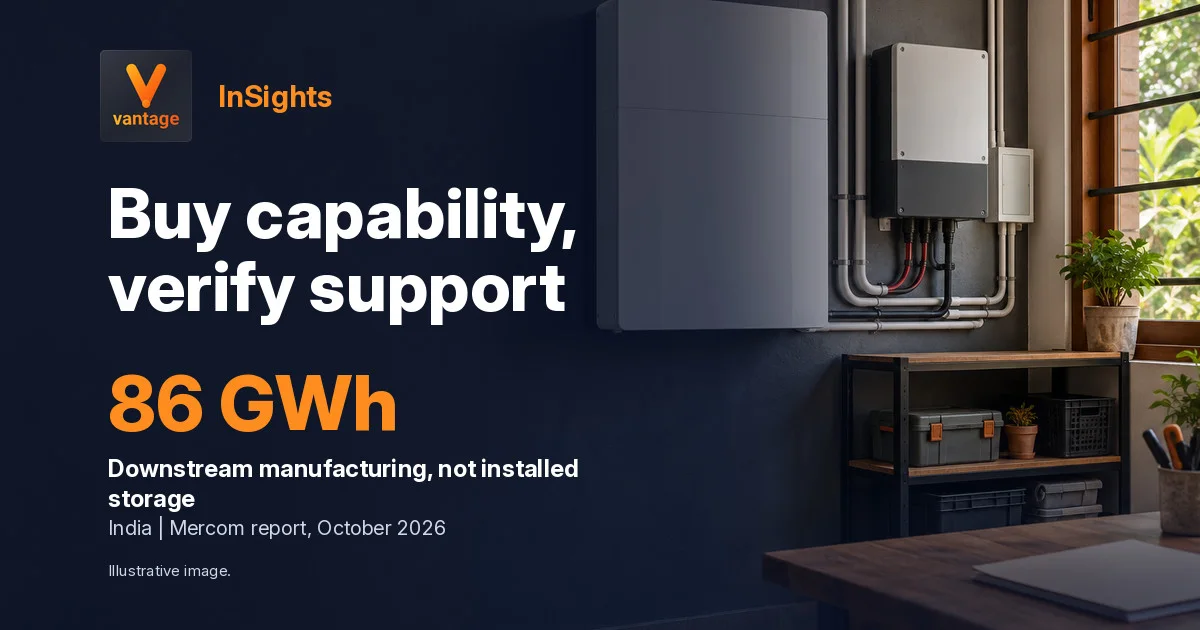
Illustrative stationary battery equipment highlights the distinction between manufacturing capacity and a property-specific purchase.
Credit: Illustrative image, AI-generated
Inline Intelligence
A larger battery industry sounds like good news for a property owner considering backup power. But should a national manufacturing headline change the equipment you buy, the price you expect or the assurance you demand from an installer?
The useful answer is narrower than the headline. More capacity can support a broader supply ecosystem. It cannot establish that the particular system offered to your home or business is suitable, well supported or economical.
What changed in the supply picture?
Mercom India puts downstream battery-storage manufacturing capacity at approximately 86 GWh. Its research separates the assembly of packs and integrated systems from the production of cells, the components that store energy. Domestic assembly and domestic cell production are different claims -> India's Downstream Battery Storage Manufacturing Capacity Reaches 86 GWh.
The companion report explains the news and its measurement limits -> Battery Manufacturing: India Reaches 86 GWh Downstream.
This is a stationary-storage industry development. It does not provide a tested specification for a residential product, and it should not be presented as a promise that household batteries have become cheaper.
What are you actually trying to buy?
Begin with the service you need. Is the priority keeping a few essential circuits running during outages, shifting electricity use between periods, or supporting a larger commercial load? These needs call for different comparisons.
Energy capacity and power capability answer different questions. Capacity concerns how much energy can be delivered under the specified conditions. Power concerns the load that can be supplied at a time. A system that appears adequate on energy alone may still be unsuitable for the appliances you intend to operate together.
The appropriate design should come from a competent installer or engineer working with the site's actual loads. This article does not specify a universal battery size or installation arrangement.
Does local assembly settle the quality question?
No single origin label answers every procurement question. Buyers can ask who made the cells, who assembled the pack, who supplies the controls and who accepts the warranty claim. Those are separate responsibilities even when sold under one product name.
A manufacturer may have a credible local service operation while using imported components. Another may promote local production without demonstrating the support needed at your location. The point is to establish what the claim means, rather than assume that either imported or domestic automatically means better.
Ask for documents covering the actual model offered. A brochure describing a company's future factory does not demonstrate that your unit has the claimed characteristics. Equally, a large factory does not remove the need to check installation and after-sales arrangements.
Can an attractive battery quote still be incomplete?
A quotation is difficult to compare if one supplier includes electrical work, commissioning and a specified backup arrangement while another prices only equipment. The equipment figure can look lower without representing the lower installed cost.
A useful comparison asks for the same intended service from each supplier. Record the supported loads, the usable-energy assumptions, the warranty conditions, the installation scope and the proposed maintenance responsibilities. Ask what happens when performance falls below the agreed terms.
These are questions for a written proposal. The manufacturing report does not establish any particular warranty, price or saving, and those claims need their own product-specific evidence.
What should you check next?
If backup is the objective, ask the installer to show how the proposed equipment would keep the agreed circuits operating during a grid failure. Do not infer that capability merely because solar panels and a battery appear in the quotation.
If savings are the objective, request the assumptions behind the calculation: the applicable tariff, when electricity will be used, losses and the cost of the complete installation. Without those inputs, a payback claim is not a reproducible comparison.
If the purchase is substantial, consider an independent technical review of the design and contract. More national supply capacity is relevant context, but the commitment remains to a particular system at a particular property.
FAQ
Is 86 GWh electricity already stored in India?
No. The cited figure concerns downstream manufacturing capacity, not deployed storage or energy currently available on the grid.
Does the figure mean all battery cells are made domestically?
No. The report explicitly distinguishes cell production from downstream manufacturing.
Does more factory capacity guarantee lower prices?
No. The research figure alone does not establish a current product price or predict the quote a buyer will receive.
Is a battery's capacity enough to choose a system?
No. Ask about power capability, usable energy, intended loads, controls, installation and support as well.
Can this article tell me the right battery size?
No. A site-specific load assessment and competent technical design are needed.
Sources
Click an article title to view the source.
India's Downstream Battery Storage Manufacturing Capacity Reaches 86 GWh published on 22 October 2026 in Mercom India, summarising its own industry research.
Battery Manufacturing: India Reaches 86 GWh Downstream published in Vantage Radar.
Evidence Caveats
The full commercial research dataset was not inspected. National capacity does not verify a supplier's claims. The procurement questions are general analytical guidance; they do not certify equipment, establish legal requirements or replace a property-specific engineering assessment.
Which item in a storage proposal has most changed your buying decision: supported loads, warranty conditions, service access or the installed cost? Explain why, or offer counter-evidence, in the attached forum discussion.
Disclaimer
This article provides general editorial information, not engineering, electrical, financial or investment advice. Obtain qualified site-specific advice and verify product documents before purchasing or installing equipment.

From TatvaOps
Home Maintenance & Appliance Care
Considering rooftop solar?
Verified installers, subsidy support, and milestone-secured payments.
Free quotes · Verified contractors · tatvaops.com
Discuss this article
Join the conversation
Continue this discussion on Forums. A board named like this InSights article is filed under InSights.
More from Solar
Apartment Solar: Can Surats Savings Be Reproduced?
Surat’s apartment solar figures imply a 3.23-year simple payback after reported subsidy. We examine why subsidy receipts, actual bills, operating costs and household benefit allocation must be checked before another society adopts that estimate.
Bihar Rooftop Solar: What Is Surplus Power Worth?
Bihar’s draft solar amendments raise a question beyond subsidy: what is surplus electricity worth? We distinguish on-site savings, export adjustments and year-end payments, and explain why a proposal should not be treated as an implemented rule.
Rooftop Solar: Bill Savings or Backup Power?
Night-time power pressure raises a practical solar question: lower bills, backup power, or both? We separate generation from outage protection and explain which quotation details help households assess storage costs and capability.
Inline Intelligence
Key Insight Actions
Connected knowledge for Solar / Trade & Manufacturing
Move between tutorials, discussions, Studio, and hubs without losing context.
Conclusion Intelligence
Was this helpful?
Let us know what you think