

Rooftop Solar Costs Rise: Is It Still Worth Installing?
Summary
Rising prices of DCR compliant solar modules could extend rooftop solar payback periods in India. Explore government subsidies, installation economics and what homeowners should calculate before investing. India's rooftop solar market faces an important affordability question. If domestically compliant solar modules become more expensive, can homeowners still recover their investment through electricity bill savings within a reasonable period? A report published by Mercom India on October 26, 2026, points to growing concerns about premiums on Domestic Content Requirement DCR modules and their impact on residential installation costs.
Published on
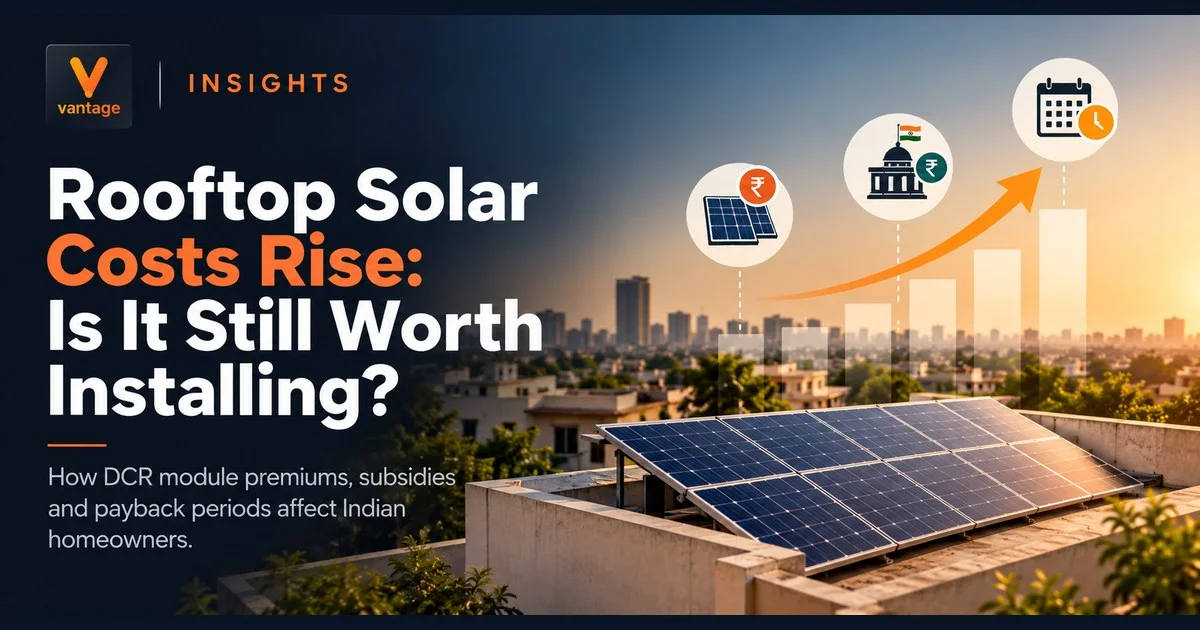
Residential rooftop solar installation in an Indian city, illustrating the financial impact of higher solar module prices, government subsidies, and longer investment payback periods.
Inline Intelligence
India's rooftop solar market faces an important affordability question. If domestically compliant solar modules become more expensive, can homeowners still recover their investment through electricity-bill savings within a reasonable period?
A report published by Mercom India on October 26, 2026, points to growing concerns about premiums on Domestic Content Requirement (DCR) modules and their impact on residential installation costs.
For homeowners, this development changes the financial calculation, but it does not necessarily eliminate the benefits of rooftop solar.
The important question is no longer simply how much electricity a solar panel produces. It is how much a complete, compliant system costs, what the household actually saves and how long those savings take to recover the investment.
Why Rooftop Solar Costs Are Under Pressure
Solar installations contain several cost components, including modules, inverters, supporting structures, wiring, protection equipment, installation and grid-connection requirements.
Solar panels are an important part of that overall cost.
India's domestic-content rules require eligible projects under certain government programmes to use qualifying Indian-manufactured solar equipment.
These rules support domestic manufacturing objectives, but the applicable modules may cost more than alternative products.
Mercom India's October 26 report identifies the widening DCR versus non-DCR module price gap as an affordability concern.
The publicly accessible report confirms the direction of this concern but does not provide sufficient open price data to establish a reliable nationwide premium percentage.
Homeowners should therefore avoid treating any single quoted module premium as a universal market price.
What Is the Difference Between DCR and Non-DCR Solar Panels?
DCR refers to Domestic Content Requirement compliance.
For government-supported installations where DCR applies, relevant solar components must satisfy the programme's domestic-manufacturing requirements.
Non-DCR modules may be suitable for certain projects outside those requirements, depending on applicable regulations.
However, a homeowner applying for PM Surya Ghar assistance cannot simply substitute a cheaper non-compliant module and assume the same subsidy will remain available.
It is also important not to confuse DCR compliance with the separate Approved List of Models and Manufacturers (ALMM) framework.
Both can influence equipment selection, but they are not interchangeable certifications.
Before finalising an installation, the homeowner should ask the vendor to identify the exact module model, applicable certifications and subsidy eligibility.
How Much Subsidy Can Indian Homeowners Receive?
The PM Surya Ghar: Muft Bijli Yojana provides central financial assistance for eligible residential rooftop solar installations.
The published standard assistance structure is:
| Installed system size | Central subsidy |
|---|---|
| 1 kW | ₹30,000 |
| 2 kW | ₹60,000 |
| 3 kW | ₹78,000 |
| Above 3 kW | ₹78,000 maximum |
The central subsidy increases for eligible capacity up to 3 kW but does not continue increasing indefinitely for larger residential installations.
That matters because a household investing in a 5 kW system will not necessarily receive a proportionately larger central subsidy than a qualifying 3 kW installation.
Additional state-level programmes may be available in particular locations, subject to separate conditions.
Homeowners should verify current eligibility and technical requirements through the official PM Surya Ghar scheme portal before assuming any assistance is guaranteed.
The Real Question: What Is Your Solar Payback Period?
The payback period measures how long the electricity savings take to recover the household's net installation investment.
A basic calculation is:
Simple payback period = Net upfront investment ÷ Annual electricity-bill savings
Net investment should account for the final installed cost and eligible subsidies.
A more realistic calculation also considers maintenance, component replacement, financing costs and changes in electricity tariffs.
Consider this hypothetical example.
A household receives a quotation of ₹2,10,000 for a 3 kW installation.
Assume the household qualifies for and receives ₹78,000 in central subsidy.
Its resulting net investment would be:
₹2,10,000 - ₹78,000 = ₹1,32,000.
Now suppose the system produces annual electricity-bill savings of ₹24,000.
The simple payback period would be:
₹1,32,000 ÷ ₹24,000 = 5.5 years.
This is an illustrative scenario, not a verified national installation price, typical electricity-saving figure or guaranteed return.
Actual economics will depend on location, consumption and system performance.
How Higher Equipment Costs Can Affect Payback
Suppose the same household receives a revised installation quote of ₹2,40,000.
Assume its eligibility, system performance, electricity savings and subsidy remain unchanged.
Its revised net investment becomes:
₹2,40,000 - ₹78,000 = ₹1,62,000.
With annual savings still assumed at ₹24,000:
₹1,62,000 ÷ ₹24,000 = 6.75 years.
Under these assumptions, the simple payback increases by 1.25 years.
The calculation demonstrates an important relationship: higher upfront costs reduce the attractiveness of an installation if the resulting electricity savings do not also increase.
However, the size of the impact varies significantly between households.
A residence with higher daytime electricity consumption may use more of its solar generation directly.
Another household with limited daytime usage may depend more heavily on the local export-credit or net-metering arrangements.
Those differences can produce substantially different financial results even when the installed systems are similar.
Should Homeowners Choose Smaller Solar Systems?
A higher installation price may encourage households to reduce their planned system capacity.
But choosing a smaller system solely because it is cheaper can be misleading.
An undersized system may fail to deliver the intended annual savings.
An oversized system may produce electricity that the household cannot use economically, depending on local billing and export-credit rules.
The right system capacity should reflect:
- Actual monthly electricity consumption.
- Expected future demand, including air-conditioning or electric-vehicle charging.
- Available usable rooftop space.
- Roof orientation and shading.
- Local electricity tariffs and billing arrangements.
- Installation costs and subsidy eligibility.
The government's published scheme guidance provides indicative system-sizing ranges, but a household-specific assessment remains necessary.
What About Solar Loans?
Some banks provide dedicated rooftop solar financing under the government programme.
For example, State Bank of India publishes specific eligibility, interest-rate and repayment conditions for PM Surya Ghar rooftop solar loans.
Financing can reduce the amount a homeowner must pay immediately, but loan interest changes the overall economics.
A homeowner using a loan should calculate both the total repayment obligation and the timing of expected electricity savings.
Monthly electricity savings should not automatically be treated as equal to EMI savings.
The two depend on different factors.
A financed system may also have a different effective payback period from an equivalent cash-funded installation.
Five Checks Before Accepting a Solar Quote
1. Confirm the final installed price.
Check whether the quotation includes mounting structures, inverter, electrical protection, installation, taxes, approvals and connection-related expenses.
2. Verify the module specifications.
Ask for the manufacturer, model, capacity, warranty conditions and documentary evidence of applicable DCR and ALMM compliance.
3. Calculate realistic generation.
Request an annual generation estimate that accounts for the roof's orientation, shading and local conditions.
4. Understand the subsidy process.
Confirm which parts of the installation are eligible and when government assistance may be released.
5. Compare savings after ongoing costs.
Account for maintenance, inverter replacement where relevant, insurance, financing costs and the effects of local electricity billing rules.
A quotation with the lowest initial price may not offer the best long-term financial outcome.
Should Indian Homeowners Install Solar Now or Wait?
Waiting for lower module prices may appear attractive, particularly when premium pricing is in the news.
However, postponing installation also delays potential electricity savings.
Conversely, installing immediately without checking prices, technical specifications and expected savings can lock a household into an unnecessarily expensive system.
There is no single correct timing decision for every household.
A practical approach is to obtain comparable quotations, calculate conservative savings and decide whether the expected financial outcome is acceptable.
Homeowners with suitable rooftops, stable electricity demand and access to eligible assistance may still find rooftop solar attractive.
Others may benefit from improving energy efficiency first or reconsidering the system size.
The Bigger Picture for India's Solar Market
Domestic manufacturing requirements are part of India's wider effort to strengthen its renewable-energy supply chain.
The longer-term objective includes greater manufacturing capability and reduced dependence on overseas suppliers.
Yet the near-term interests of manufacturers and individual rooftop consumers do not always align perfectly.
If qualifying modules remain substantially more expensive, the resulting installation costs can affect adoption decisions.
The long-term outcome will depend on manufacturing capacity, market competition, policy implementation and equipment availability.
For households, the most useful measure of affordability remains the total cost of a compliant, properly installed system relative to the realistic value of the electricity it generates.
Conclusion
Higher DCR solar-module premiums are putting pressure on the economics of residential rooftop solar in India.
But a more expensive module does not automatically make rooftop solar a poor investment.
The outcome depends on installed cost, available subsidies, electricity consumption, roof conditions, financing and local billing rules.
For Indian homeowners, the strongest approach is to compare complete quotations and calculate the expected savings using realistic assumptions.
Rooftop solar should be evaluated as a long-term household energy investment, not purchased solely because of a subsidy or a promise of free electricity.
FAQ
1. Are rooftop solar panels becoming more expensive in India?
Mercom India reported on October 26, 2026 that premiums on DCR-compliant modules are increasing affordability concerns. This does not establish that every rooftop solar system or module has become more expensive by the same percentage.
2. What is the maximum central subsidy under PM Surya Ghar?
The standard central subsidy is capped at ₹78,000 for eligible residential installations of 3 kW or greater, subject to scheme conditions.
3. Can non-DCR solar panels receive PM Surya Ghar subsidy?
Installations must meet the programme's applicable DCR and other technical requirements. Homeowners should not assume that non-compliant modules qualify.
4. How many years does rooftop solar take to pay for itself?
There is no universal payback period. It depends on net installed cost, generation, electricity-bill savings and ongoing expenses.
5. Is a bigger solar system always better?
No. The appropriate size depends on electricity demand, usable roof area, tariffs and local billing rules.
Sources
Click an article title to view the source.
-
DCR Module Premium Raises Rooftop Solar Affordability Concerns published on 26 October 2026 in Mercom India.
-
Cabinet Approves PM-Surya Ghar: Muft Bijli Yojana published on 29 February 2024 by the Prime Minister's Office, Government of India.
-
PM Surya Ghar: Scheme Details and Eligibility published by MyScheme, Government of India; publication date not stated.
-
PM Surya Ghar Loan for Solar Rooftop published by State Bank of India; webpage currently displays terms effective 15 October 2026.
Evidence Caveats
Mercom India's publicly accessible article opening identifies module-price premiums and affordability concerns, but detailed market pricing is not openly available for independent verification here.
All installation prices, electricity savings and payback figures in the examples above are hypothetical and are not market quotations.
Actual subsidies, equipment eligibility, tariff structures, financing rates and approval requirements must be checked before purchase.
What are homeowners experiencing? If you have recently requested rooftop solar quotations, did you find a significant difference between the available equipment and installation options?
Share your experience in the Vantage community. Your comparison may help other homeowners understand the practical questions they should ask before installing solar.
Disclaimer
This article is for general information and education only. It does not constitute personalised financial, engineering, tax or legal advice. Costs, regulations, eligibility and estimated savings vary. Readers should verify current information with relevant authorities, electricity distributors, lenders and qualified solar professionals before making an investment decision.

From TatvaOps
Solar & Energy Solutions
Considering rooftop solar?
Verified installers, subsidy support, and milestone-secured payments.
Free quotes · Verified contractors · tatvaops.com
Discuss this article
Join the conversation
Continue this discussion on Forums. A board named like this InSights article is filed under InSights.
More from Solar
What Clean Energy Spending Must Deliver
A national clean-energy target is not an investment instruction. Check delivery, contracts, grid access and your own bill before acting.
Silver Price Crash: Should You Buy After a 53 Fall?
Silver prices have fallen sharply from January 2026 peaks, with MCX futures below ₹2 lakh per kg. Is silver a buying opportunity or a risk? Explore silver ETFs, industrial demand, interest rates and what Indian investors should check.
Battery Storage: What Matters Beyond Factory Capacity?
India has a larger battery manufacturing base. That does not settle your backup requirements, installed cost or warranty. Here is what a property owner should ask before choosing a storage system.
Inline Intelligence
Key Insight Actions
Connected knowledge for Solar Energy
Move between tutorials, discussions, Studio, and hubs without losing context.
Related discussions
Topic hubs
Conclusion Intelligence
Related Discussions
Was this helpful?
Let us know what you think