

India Is Closing In on 2 GW of Data Centres. The Next Constraint Is Physical Infrastructure
Karthik posts articles on Energy and Construction.
Summary
India's data centre market is on track to reach 2 GW of operational capacity by the end of 2026 , according to new research from CBRE. The country had approximately 1.75 GW operational at the end of H1 2026 , after adding around 130 MW during the first six months of the year. More than 200 MW is expected to become operational during H2. But the bigger built environment story begins beyond the 2 GW milestone. Data centres require more than buildings and servers.
Published on
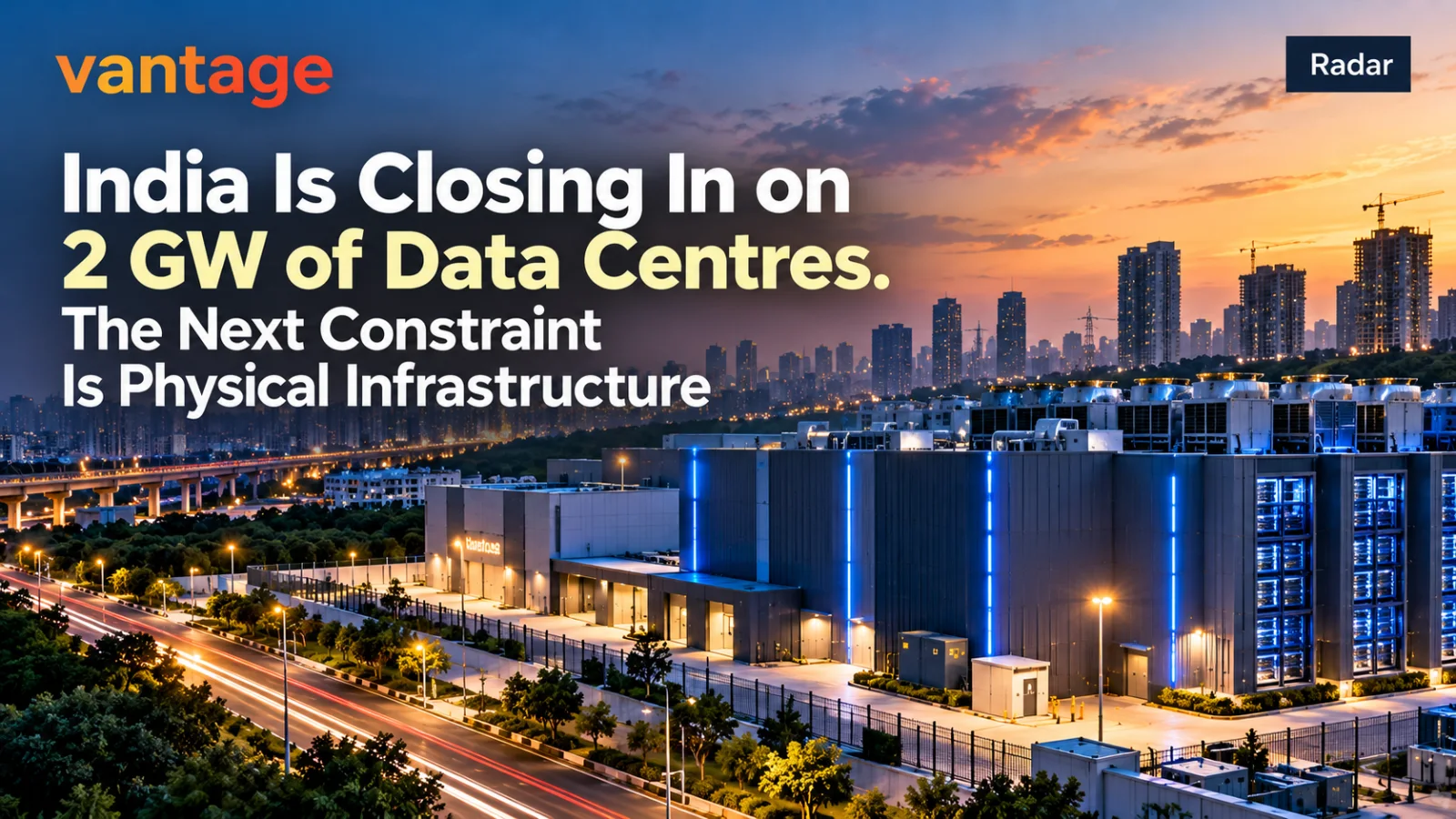
A dusk view of a large modern data-centre campus set against an expanding Indian city skyline. Illuminated facilities, cooling infrastructure, roads and construction activity connect the growth of digital capacity with the physical infrastructure required to support it.
Inline Intelligence
India's data-centre market is on track to reach 2 GW of operational capacity by the end of 2026, according to new research from CBRE.
The country had approximately 1.75 GW operational at the end of H1 2026, after adding around 130 MW during the first six months of the year. More than 200 MW is expected to become operational during H2.
But the bigger built-environment story begins beyond the 2 GW milestone.
Data centres require more than buildings and servers. Expansion depends on securing large and reliable electricity connections, suitable land, network connectivity, cooling infrastructure and increasingly renewable power.
As India's digital infrastructure scales, those requirements are becoming part of the location economics determining where the next generation of data-centre campuses can actually be built.
See Link -> Beyond Growth: India’s Rise Among APAC’s Leading Data Centre Markets
India added about 130 MW in six months
CBRE estimates that approximately 130 MW of new operational capacity was added during H1 2026.
More than 200 MW is expected to go live in the second half.
If delivered as expected, total operational capacity would reach approximately 2 GW by year-end.
The longer-term pipeline is larger still. CBRE had previously projected India's data-centre stock to exceed 3 GW by the end of 2028.
Those figures refer to operational or expected capacity. They should not be confused with announced projects or investment commitments, which can take years to translate into operating facilities.
Mumbai still dominates new supply
The geographic concentration is striking.
Mumbai accounted for 94% of the new data-centre supply delivered during H1 2026, according to CBRE.
The broader operational market remains concentrated too. More than 80% of India's existing capacity is located across Mumbai, Chennai and Delhi-NCR.
Navi Mumbai and Siruseri in Chennai remain important clusters, supported by connectivity infrastructure, cable landing stations and established business ecosystems.
But the next phase may become more geographically distributed.
CBRE expects incremental supply to extend into markets including Hyderabad, Bengaluru, Kolkata and Visakhapatnam.
Why?
Among the factors are three basic physical inputs: land, power and water.
Power is becoming a property constraint
Data centres are unusually electricity-intensive real-estate assets.
Unlike conventional commercial buildings, the electricity requirement is central to both their operation and their location.
CBRE's India Data Centre Operator Survey identifies network connectivity, power availability, renewable-energy sourcing and market access among the important considerations shaping development and site-selection strategies.
That changes how suitable land should be understood.
A large parcel may appear attractive on conventional real-estate metrics. But without sufficient power capacity, network connectivity and a viable route to development, its usefulness for hyperscale infrastructure can be limited.
Across Asia Pacific, CBRE has similarly identified power availability as an increasingly important determinant of where new data-centre capacity can be delivered.
See Link -> APAC Data Centre Investment Hits Record US$11.6 Billion as Power Access Reshapes Growth
AI is adding another layer of demand
Artificial intelligence is part of the expansion story, but it should not be treated as the only driver.
CBRE says more than 15% of cumulative investment commitments between 2021 and H1 2026 were linked to AI.
AI workloads can also require higher-density computing infrastructure, affecting power and cooling requirements inside facilities.
But India's demand base is broader.
CBRE identifies sustained demand from BFSI, cloud providers, hyperscalers and OTT occupiers, particularly in established markets such as Mumbai and Chennai.
The distinction matters because it suggests that India's capacity expansion is not dependent on a single technology cycle.
$173 billion is not $173 billion already invested
The investment numbers require particular care.
CBRE estimates that India's data-centre sector accumulated approximately $173 billion in investment commitments between 2021 and H1 2026, including about $38 billion announced during H1 2026.
Those are commitments.
They should not be interpreted as $173 billion of completed construction, deployed capital or operating assets.
Hyperscale and colocation projects accounted for about 62% of cumulative commitments.
Multi-city portfolios represented more than 85% of commitments during H1 2026, indicating that investors and operators are increasingly thinking beyond single facilities.
Domestic developers also accounted for 48% of new supply delivered in H1, ahead of American players at 28% and European players at 24%, according to CBRE.
Reliability standards are rising too
Expansion is not occurring only in quantity.
CBRE reports that Tier IV facilities accounted for 43% of overall supply in H1 2026, up from 21% in 2024.
Tier IV represents a high level of data-centre infrastructure resilience and fault tolerance.
That shift matters for construction and engineering.
Higher resilience requirements increase the importance of electrical redundancy, backup systems, cooling infrastructure and specialised mechanical and electrical design.
Data-centre growth therefore creates demand not simply for more square footage, but for technically complex built assets.
The 2 GW milestone is only the beginning
India's data-centre market is moving towards a scale at which its relationship with the wider built environment becomes increasingly important.
CBRE's preliminary operator survey found that 92% of surveyed operators plan to add more than 100 MW of capacity during the next 24 months.
If those expansion ambitions translate into projects, competition will intensify for sites capable of supporting them.
That means the next data-centre map may increasingly be shaped by questions such as:
- Where can large power connections be secured?
- Which sites offer resilient fibre connectivity?
- Where is suitable land available at sufficient scale?
- Can operators source renewable electricity?
- What cooling strategy is viable for the location?
- How quickly can supporting infrastructure and approvals be delivered?
For real-estate investors, those questions change the meaning of a good site.
The most valuable data-centre land may not simply be land near a major city.
It may increasingly be land where digital demand and physical infrastructure can meet at scale.
What to watch next
The first marker is whether the expected 200 MW-plus H2 supply becomes operational on schedule and pushes India to the 2 GW threshold.
The second is geography. Watch whether Hyderabad, Bengaluru, Kolkata and Visakhapatnam begin taking a larger share of actual operating capacity rather than simply announced projects.
The third is power.
India's overall electricity demand is already forecast by the International Energy Agency to grow at an average 6.4% annually through 2030. Data centres will therefore compete for infrastructure inside an electricity system simultaneously serving rapidly growing industrial, commercial, household and cooling demand.
The final marker is conversion.
India has accumulated very large data-centre investment commitments. The real test will be how much of that pipeline converts into powered, connected and operational facilities.
That conversion rate will tell us more about India's emergence as a major digital-infrastructure market than announcements alone.
Sources
Click on article title to view article
“Beyond Growth: India’s Rise Among APAC’s Leading Data Centre Markets” published on 21 September 2026 by CBRE
“India Data Centre Market Monitor H1 2026” published on 17 September 2026 by CBRE
“India’s operational data centre capacity on track to reach 2 GW by the end of the year” published on 6 October 2026 in The Economic Times
“APAC Data Centre Investment Hits Record US$11.6 Billion as Power Access Reshapes Growth” published on 21 May 2026 by CBRE
“Demand – Electricity 2026” published in 2026 by the International Energy Agency
Data-centre development increasingly sits at the intersection of real estate, power and digital infrastructure. Add your perspective to the Vantage discussion: which constraint is becoming hardest to solve in actual Indian projects, power, land, connectivity, cooling or approvals? Where Vantage's participation-points mechanism is active and applicable, substantive participation can also earn points.

From TatvaOps
Residential Construction
Building or extending your home?
Run your residential build with verified contractors and daily progress tracking.
Free quotes · Verified contractors · tatvaops.com
Discuss this article
Join the conversation
Continue this discussion on Forums. A board named like this Radar article is filed under Radar.
More from Real Estate
LTCG and STT: Review Reports Do Not Mean a Tax Cut
Finance Minister Nirmala Sitharaman’s comments on equity taxation have reopened a consequential debate for investors. Speaking at the Bloomberg New Economy Forum in New Delhi on 13 October, she welcomed views on long term capital gains tax and securities transaction tax without committing to…
Blackstone Targets 100 Billion in India Investments
Blackstone aims to double its India investments to approximately $100 billion over about five years, president and chief operating officer Jonathan Gray said in interviews reported this week. The ambition spans private equity and real estate, alongside potential expansion in infrastructure, credit…
Property Registrations Flagged Over Fictitious PAN
Nearly 25,000 property registrations over two years at Badshahpur tehsil in Gurugram reportedly carried the same fictitious PAN, according to The Times of India’s 9 October report on an Income Tax Department survey. The finding raises questions about taxpayer identification and transaction…
Inline Intelligence
Key Insight Actions
Connected knowledge for Data Centre Infrastructure
Move between tutorials, discussions, Studio, and hubs without losing context.
Related discussions
Topic hubs
Conclusion Intelligence
Related Discussions
Was this helpful?
Let us know what you think