

Gurugram real estate boom is worsening its flooding problem

Devesh S. is an industry researcher and writer who specializes in translating complex industries into clear, trustworthy, and actionable knowledge. His work…
Summary
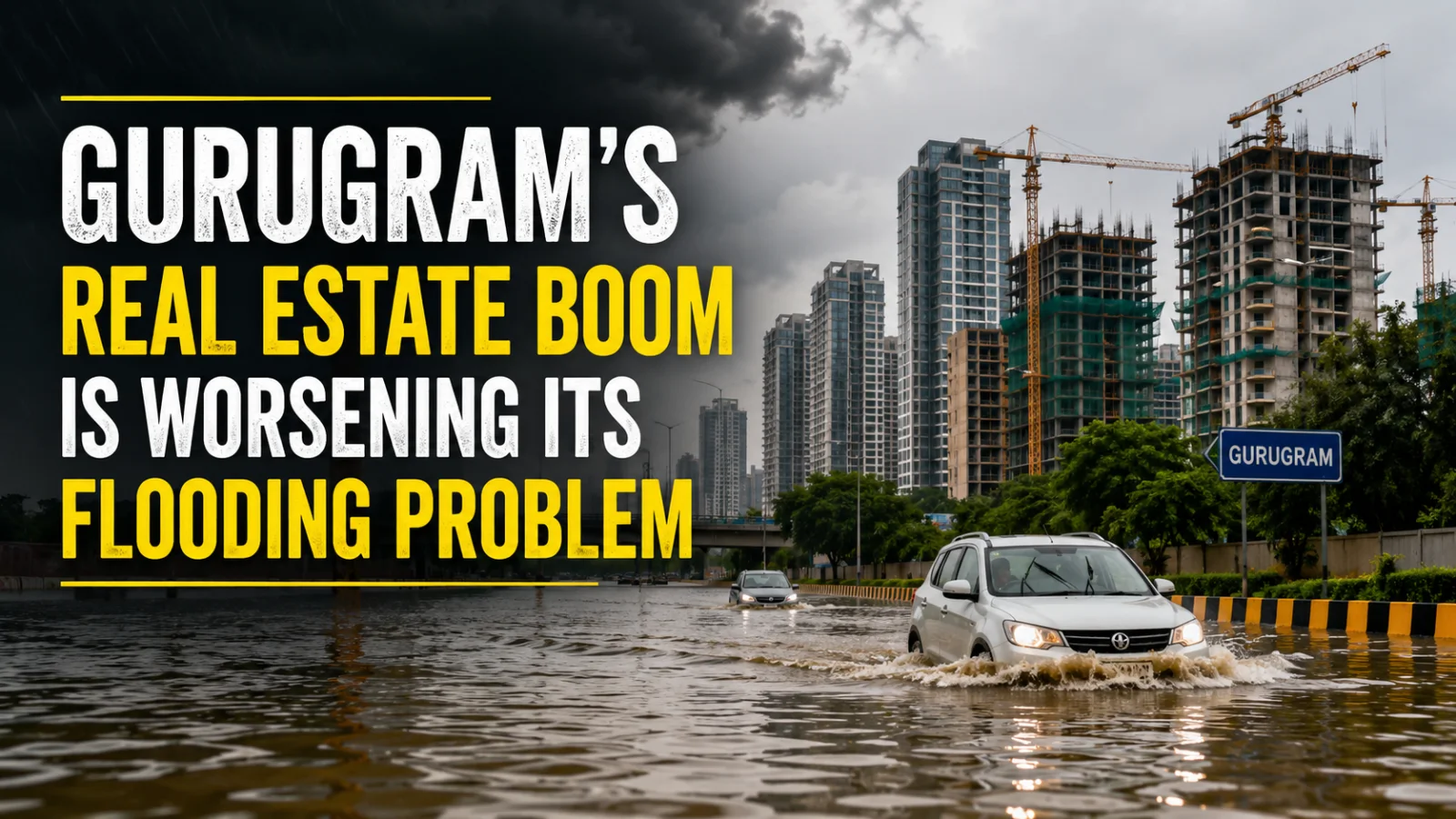
Gurugram’s real estate boom has come with a growing infrastructure problem: the city has lost large parts of the natural drainage network and water bodies that once helped absorb and carry away rainwater, according to a report by Newslaundry published on August 26. The problem was starkly visible after heavy rain on Monday, when roads across the city were waterlogged and vehicles, including cars, buses, autos and two wheelers, were submerged. Newslaundry reported that Gurugram tehsil recorded 75 mm of rain between 8 am and 5 pm, citing the district administration.
Published on
Inline Intelligence
Gurugram’s real estate boom has come with a growing infrastructure problem: the city has lost large parts of the natural drainage network and water bodies that once helped absorb and carry away rainwater, according to a report by Newslaundry published on August 26.
The problem was starkly visible after heavy rain on Monday, when roads across the city were waterlogged and vehicles, including cars, buses, autos and two-wheelers, were submerged. Newslaundry reported that Gurugram tehsil recorded 75 mm of rain between 8 am and 5 pm, citing the district administration.
The report links the recurring flooding to decades of rapid urbanisation, during which forests, wetlands, ponds and natural drainage channels have been encroached upon or built over.
A state survey cited by Newslaundry found that nearly 75% of Gurugram’s natural stormwater drains had been lost to high-rise buildings and townships. A separate Municipal Corporation of Gurugram geo-tagging survey found that 65 of 181 ponds had been buried under construction.
That leaves rainwater with fewer natural routes out of the city. Newslaundry reported that runoff from the Aravalli Hills increasingly converges on the built-up areas instead of flowing through natural drainage channels towards wetlands such as the Najafgarh Lake.
A TERI assessment cited in the report also found that urbanisation and encroachment had blocked natural drains and damaged water bodies that were important to the city’s drainage system.
The pressure on land has intensified alongside rising property values. Newslaundry reported that Gurugram’s revised 2026-27 circle rates increased by 15% to 30% across categories. It also cited data showing that home prices in the city had risen by more than 117% in recent years, while prices of newly launched projects had increased by 160%.
The consequences extend beyond flooded roads. Newslaundry also pointed to Gurugram’s problems with air pollution, groundwater quality and solid-waste management, arguing that the city’s physical expansion has repeatedly outpaced the infrastructure needed to support it.
Ankur Bisen, author of Wasted and a Gurugram resident, told Newslaundry that the city’s rapid urbanisation had come at the expense of its drainage systems, water bodies and wetlands. He described recurring waterlogging as a symptom of deeper failures in planning and development.
Gurugram’s dilemma is therefore larger than a single episode of monsoon flooding. The city’s economic rise has been closely tied to construction and real estate, but the same development has reduced the natural systems that can protect an increasingly built-up landscape from extreme rainfall.
For residents, that trade-off is becoming harder to ignore every monsoon.

From TatvaOps
Residential Construction
Building or extending your home?
Run your residential build with verified contractors and daily progress tracking.
Free quotes · Verified contractors · tatvaops.com
Discuss this article
Join the conversation
Continue this discussion on Forums. A board named like this Radar article is filed under Radar.
More from Real Estate
LTCG and STT: Review Reports Do Not Mean a Tax Cut
Finance Minister Nirmala Sitharaman’s comments on equity taxation have reopened a consequential debate for investors. Speaking at the Bloomberg New Economy Forum in New Delhi on 13 October, she welcomed views on long term capital gains tax and securities transaction tax without committing to…
Blackstone Targets 100 Billion in India Investments
Blackstone aims to double its India investments to approximately $100 billion over about five years, president and chief operating officer Jonathan Gray said in interviews reported this week. The ambition spans private equity and real estate, alongside potential expansion in infrastructure, credit…
Property Registrations Flagged Over Fictitious PAN
Nearly 25,000 property registrations over two years at Badshahpur tehsil in Gurugram reportedly carried the same fictitious PAN, according to The Times of India’s 9 October report on an Income Tax Department survey. The finding raises questions about taxpayer identification and transaction…
Inline Intelligence
Key Insight Actions
Connected knowledge for Urban Infrastructure
Move between tutorials, discussions, Studio, and hubs without losing context.
Related discussions
Blackstones India Bet: What Should You Check?
1 replies
Related discussionIndian Real Estate Is Building a New Capital Stack
1 replies
Related discussionIndias Data-Centre Boom Is Turning Power and Land Into Digital Infrastructure
1 replies
Related discussionHousing Sales Fall 6 percent Across 9 Major Indian Cities in Q3
6 replies
Related discussion
Topic hubs
Conclusion Intelligence
Related Discussions
Blackstones India Bet: What Should You Check?
Popular in insights discussions1 reply
Indian Real Estate Is Building a New Capital Stack
Popular in insights discussions1 reply
Indias Data-Centre Boom Is Turning Power and Land Into Digital Infrastructure
Popular in insights discussions1 reply
Housing Sales Fall 6 percent Across 9 Major Indian Cities in Q3
Popular in radar discussions6 replies
Was this helpful?
Let us know what you think