

Celebrity-Backed Property: What Buyers Must Verify
Summary
Salman Khan's reported ₹2,500 crore Punjab housing project raises an important buyer question: does celebrity branding make a property safer? Explore RERA verification, developer accountability, approvals and investment risks before booking. A famous name can make a residential project memorable. But can it make the investment safer? A proposed ₹2,500 crore luxury housing development in Punjab, reportedly associated with Salman Khan, brings that question into focus. Media reports describe six planned residential towers, three and four bedroom apartments and a promotional association involving GB Realty and Jacob & Co.
Published on
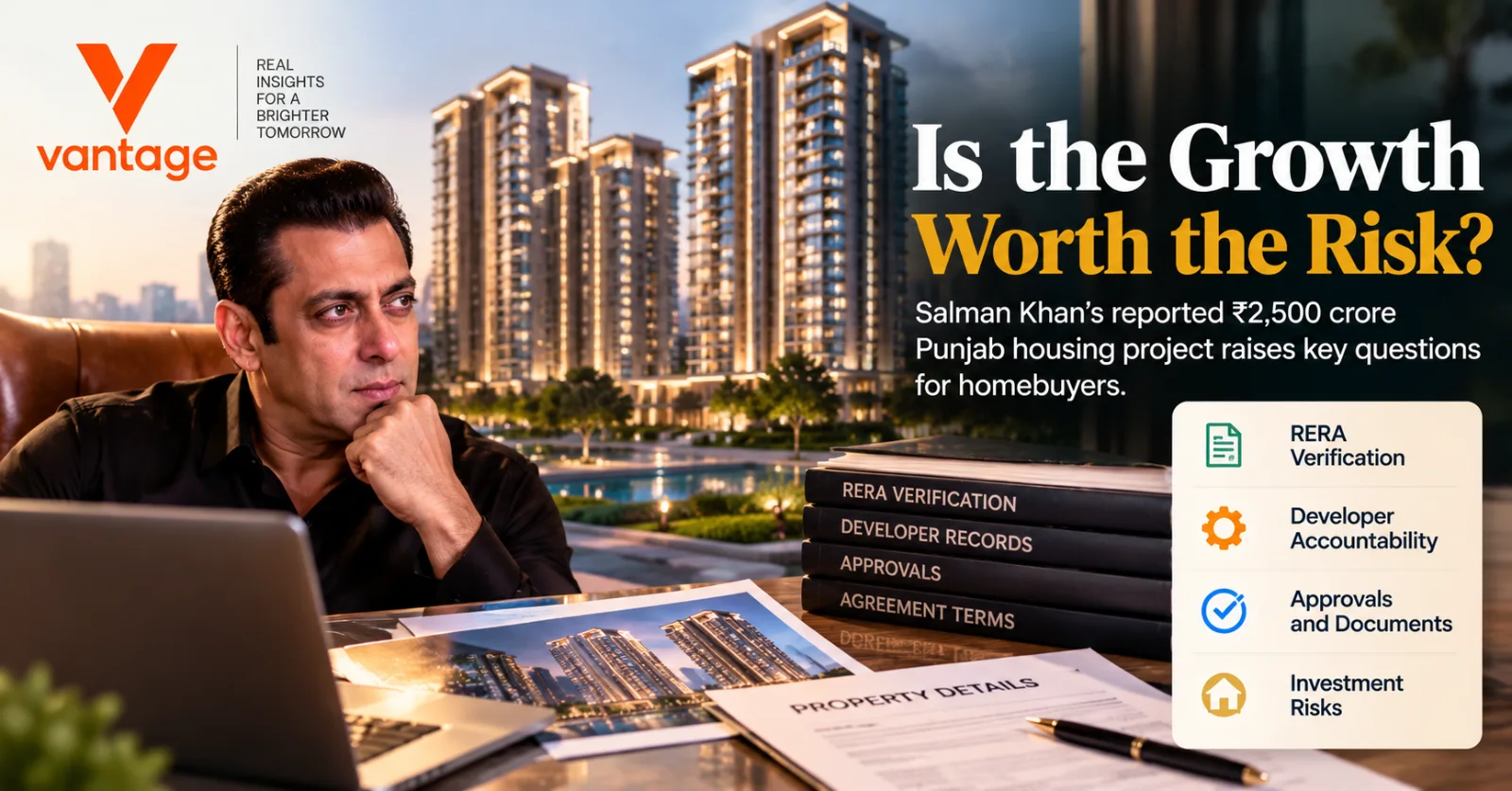
Salman Khan's reported ₹2,500 crore luxury housing project in Punjab raises important questions about property investment safety. The visual highlights the need for RERA verification, developer accountability, legal approvals and transparent agreements before investing in celebrity-backed real estate.
Inline Intelligence
A famous name can make a residential project memorable. But can it make the investment safer?
A proposed ₹2,500 crore luxury housing development in Punjab, reportedly associated with Salman Khan, brings that question into focus.
Media reports describe six planned residential towers, three- and four-bedroom apartments and a promotional association involving GB Realty and Jacob & Co.
However, the available reports do not independently establish the project's detailed regulatory registration, sanctioned plans, financing arrangements or delivery commitments.
For a prospective buyer, that distinction matters more than the celebrity association itself.
Does a Celebrity Name Reduce Property Investment Risk?
Not automatically.
A celebrity can make a project more visible and may influence how buyers perceive its exclusivity.
But brand recognition and legal accountability are different things.
Consider two hypothetical properties.
Project A has a prominent celebrity ambassador, attractive marketing and an ambitious development proposal.
Project B has no celebrity association but provides clear title documentation, applicable regulatory registration, sanctioned plans, a credible construction programme and a transparent agreement.
The celebrity association alone does not establish that Project A is safer or more valuable than Project B.
The more important questions concern who is responsible for delivery, what has been approved, what the buyer is purchasing and how the transaction is documented.
What Is Actually Known About the Punjab Project?
According to Moneycontrol's report dated 25 October 2026, Salman Khan appeared in promotional material associated with GB Realty and Jacob & Co.
The proposed residential development reportedly includes six towers and an estimated ₹2,500 crore investment.
An earlier Moneycontrol report from 7 October discussed potential project names and an expected announcement.
These reports establish public discussion and promotion of the proposal.
They do not establish the precise financial relationship between the actor and the project developer.
There is also no independently verified project-specific RERA registration number in the sources examined for this article.
That information gap should not be confused with proof that the development lacks approvals.
It means buyers need official documentation before reaching conclusions.
Who Is Actually Responsible for the Property?
This may be the most important question in any celebrity-associated development.
An actor appearing in advertising is not automatically the landowner, promoter, construction contractor or contractual seller.
The project's legal structure determines responsibility.
A prospective buyer should establish:
- The registered promoter's full legal name.
- The entity holding or legally controlling the development rights.
- The company named in the agreement for sale.
- Whether the marketing brand differs from the legal promoter.
- Which parties have enforceable obligations to the purchaser.
If an individual or company is described as an investor, buyers should distinguish equity participation from financial guarantees or contractual delivery obligations.
A public association may be genuine without creating the protections a buyer assumes it does.
The documents, rather than publicity, establish those responsibilities.
Why Should RERA Verification Come Before Booking?
India's Real Estate (Regulation and Development) Act, 2016, provides a statutory framework for regulating covered real estate projects.
Its application depends on the project and relevant statutory provisions.
For developments subject to registration, buyers should establish that the particular project and phase are registered with the correct state regulatory authority.
The official Punjab RERA registered-project search allows users to search using details such as the project name, promoter or registration number.
A buyer examining a Punjab development can use those records to identify and verify the applicable registration.
However, the Chandigarh region includes territories subject to different administrative jurisdictions.
A marketing description referring to Chandigarh is not sufficient to identify the correct regulator.
The exact project address is essential.
Buyers should first establish the jurisdiction and then verify the relevant regulatory records.
What Documents Matter More Than Promotional Material?
A useful property review connects the project being advertised to the property that can legally be purchased.
1. Registration and promoter information
Check whether the promoter and project or phase match the official regulatory record.
A developer may operate several projects under related brand names.
Registration of one development does not establish registration of another.
2. Land rights and statutory approvals
Relevant checks may include title, development rights, permitted land use, sanctioned plans and applicable permissions.
Document requirements vary with the location, development structure and stage.
A property lawyer can help assess whether the records actually cover the unit being offered.
3. Apartment specifications and common areas
Marketing images may emphasise impressive towers, landscaped areas and premium amenities.
Buyers should compare those representations against approved plans, technical specifications, contractual schedules and available disclosures.
An amenity appearing in promotional material should not be assumed to be a legally binding commitment without reviewing the applicable documents.
4. Delivery timelines and contractual remedies
An expected launch date, construction milestone and contractual possession date are different things.
Buyers should examine the agreement's terms, applicable statutory protections, provisions for delays and the conditions governing possession.
What Does a ₹2,500 Crore Project Estimate Tell Buyers?
Less than it might initially appear.
A reported investment estimate may indicate the intended scale of a development.
It does not by itself disclose:
- How much capital has already been committed.
- The amount of debt financing arranged.
- Whether the land cost is included.
- The phasing of construction expenditure.
- How many apartments are planned for sale.
- The project's expected net profitability.
- Whether every component has received approval.
Without those details, buyers cannot reliably calculate the development's financial strength or likely returns.
Dividing ₹2,500 crore by an assumed number of apartments would not produce a meaningful property valuation.
The estimate is a reported development figure, not an apartment price or evidence of an investment return.
Does Celebrity Branding Justify Paying More?
A branded residence may command buyer interest because of its design, services, amenities, location or exclusivity.
But a marketing premium should be assessed against benefits that are specific, measurable and contractually supported.
For example, a buyer can compare the property's effective price per square foot with reasonably comparable developments.
That comparison should account for differences in carpet area, location, construction stage, specifications, maintenance costs and legal rights.
A premium may be justified by demonstrable advantages.
It is harder to evaluate when the additional price is based mainly on reputation or expectations of resale demand.
Celebrity association is not evidence that a property will appreciate faster than comparable alternatives.
Could It Be a Good Property Investment?
Potentially, but the available project information is insufficient to make that assessment.
A reasonable investment evaluation needs several inputs.
Purchase price: The full acquisition cost, including applicable taxes, duties and transaction expenses.
Rental economics: Expected rent, vacancy, maintenance, management costs and applicable taxation.
Financing: Borrowing rates, loan obligations and exposure to changing interest costs.
Liquidity: The likely ability to resell the particular apartment, rather than assuming strong marketing interest guarantees a buyer.
Execution risk: Construction progress, approvals, financial capacity and contractual delivery obligations.
Opportunity cost: The return and risk characteristics of alternative properties or financial assets.
Luxury properties may offer lifestyle value, investment potential or both.
But lifestyle appeal should not be presented as a guaranteed financial return.
What If the Developer Is Reputable?
Developer reputation can be relevant to due diligence.
Experience, completed developments, historical delivery performance and financial capacity may provide useful information.
However, even an established developer can encounter construction, financing, approval or market difficulties.
A sound review therefore examines both the developer's track record and the specific project.
The regulatory environment provides an additional layer of disclosure and accountability, but registration alone is not a guarantee against delays or losses.
Vantage previously examined broader consumer-protection concerns in -> RERA Turns 10, but Homebuyers Still Face Long Enforcement Battles.
The importance of documentary verification is also reflected in -> ED Asks Homebuyers to Report Builders Demanding Cash Deals.
Those earlier reports address wider buyer-protection issues and do not make allegations about the Salman Khan-linked development.
What Should Buyers Check Next?
Before making any financial commitment to a newly announced development, consider four steps.
-
Identify the exact property. Obtain the complete address, project or phase name, legal promoter details and applicable regulatory jurisdiction.
-
Check official records. Match the promoter and registration particulars against the appropriate government portal. Confirm the scope and validity of the record.
-
Review the contract and approvals. Have qualified professionals examine relevant land documents, sanctioned plans, specifications, agreement terms and payment obligations.
-
Evaluate the purchase independently. Compare price, location, financing costs, completion risk, expected holding period and potential resale or rental demand.
If the documentation is incomplete, the appropriate response is to seek clarification before relying on promotional representations.
These checks are useful for celebrity-branded and ordinary developments alike.
The Real Value of a Famous Name
A celebrity endorsement can help a project attract public attention.
It cannot replace legal documents, regulatory disclosures, financial assessment or evidence of construction progress.
The proposed Punjab project has generated interest partly because of the reported association with Salman Khan and its estimated ₹2,500 crore scale.
But its eventual value to buyers will depend on much more than its name.
For a homebuyer, confidence should come from information that can be verified and obligations that can be understood.
That is the difference between an attractive property announcement and a well-informed purchase decision.
FAQ
1. Is Salman Khan launching a residential project in Punjab?
Reports published on 25 October 2026 describe a promotional association between Salman Khan and a proposed luxury residential development involving GB Realty and Jacob & Co. The precise ownership and contractual arrangements have not been independently established.
2. What is the reported investment value?
Media reports cite an estimated ₹2,500 crore. This is not independently verified expenditure or committed financing.
3. Is the project called SK Towers?
SK Towers is among the reported names. Buyers should verify the legal project name against official records before relying on promotional descriptions.
4. Is the project registered with RERA?
A project-specific registration has not been independently confirmed in the sources examined for this article. That does not establish that the development is unregistered.
5. Where can buyers verify Punjab RERA projects?
Use the official Punjab RERA website at https://rera.punjab.gov.in/ and its registered-project search. Verify the project's precise jurisdiction first.
6. Does a celebrity endorsement guarantee project completion?
No. A celebrity's promotional association does not automatically establish contractual responsibility for development or delivery.
7. Can luxury branded residences generate higher returns?
They may attract particular buyer segments, but returns depend on purchase price, demand, costs, liquidity and wider market conditions. No premium or appreciation is guaranteed.
8. What should a buyer verify before paying a booking amount?
Check the applicable registration, promoter identity, project documents, payment terms, legal approvals and agreement provisions with appropriately qualified advisers.
9. Does a large proposed investment make a developer financially secure?
Not necessarily. A reported project estimate does not independently establish financing, cash reserves, debt obligations or financial resilience.
10. Is this article alleging problems with the Punjab project?
No. It examines the distinction between reported promotional announcements and verified project documents. No finding of misconduct or non-compliance has been established.
Sources
Click an article title to view the source.
- Salman Khan launches luxury residential project in Punjab named SK Towers, misses event due to unavoidable circumstances: Report, published on 25 October 2026 in Moneycontrol.
- Salman Khan Towers in Chandigarh? High-rise project may be named after Bollywood superstar, published on 7 October 2026 in Moneycontrol.
- Search Registered Projects, official service of the Real Estate Regulatory Authority, Punjab, accessed on 25 October 2026.
- RERA Turns 10, but Homebuyers Still Face Long Enforcement Battles, published on 8 September 2026 in Vantage Radar.
- ED Asks Homebuyers to Report Builders Demanding Cash Deals, published on 19 August 2026 in Vantage Radar.
Evidence Caveats
The proposed project's reported scale, association and estimated investment come from news coverage rather than independently inspected promoter filings or authenticated project documents.
No definitive promoter agreement, official project-specific RERA certificate, sanctioned building plan, construction contract, financing document or price list was independently examined.
Earlier reporting and the 25 October promotional coverage may concern the same proposed development, but the project's exact legal identity and structure remain to be verified.
This article does not establish that any party has breached regulatory requirements, misrepresented a development or failed to obtain an approval.
The buyer checklists and financial considerations are general analytical guidance, not findings about this particular project or personalised recommendations.
Join the discussion: Would a celebrity association increase your interest in a property, or would it have little influence on your decision? Which documents would you insist on seeing before paying a booking amount? Share your reasoning, questions or relevant experience in the attached forum discussion.
Disclaimer
This article is for general educational and informational purposes only. It does not constitute personalised investment, financial, legal or property-purchase advice. It does not endorse or recommend the reported project or make allegations against its associated parties. Project-specific information, approvals and contractual terms should be verified through official records and appropriately qualified professionals before any financial commitment.

From TatvaOps
Property Purchase
Building or extending your home?
Run your residential build with verified contractors and daily progress tracking.
Free quotes · Verified contractors · tatvaops.com
Discuss this article
Join the conversation
Continue this discussion on Forums. A board named like this InSights article is filed under InSights.
2 replies already on Forums
More from Real Estate
Mumbai Luxury Home Data What Buyers Should Check
Luxury registration totals are not a like-for-like price index. Here is how buyers can compare properties and ownership costs.
Binance Security Incident What Holders Can Check
The Binance incident highlights the difference between a displayed balance and access to assets. Here are practical checks for holders.
Gurugram Power Choice What Residents Should Check
A proposed second electricity distributor is on hold. Here is what Gurugram and Nuh residents can check on bills and service.
Inline Intelligence
Key Insight Actions
Connected knowledge for Real Estate Due Diligence
Move between tutorials, discussions, Studio, and hubs without losing context.
Related discussions
India Has Had 16 Quarters of Housing Launches Above Sales: Is the Market Building Too Much of the Wrong Housing?
1 replies
Related discussionIndias Housing Market Is Selling More Homes, but Supply Is Running Faster Than Demand
1 replies
Related discussionMore Expensive Homes Are Gaining Share. Does That Make Them Better Investments?
4 replies
Related discussion
Topic hubs
Conclusion Intelligence
Related Discussions
India Has Had 16 Quarters of Housing Launches Above Sales: Is the Market Building Too Much of the Wrong Housing?
Popular in insights discussions1 reply
Indias Housing Market Is Selling More Homes, but Supply Is Running Faster Than Demand
Popular in insights discussions1 reply
More Expensive Homes Are Gaining Share. Does That Make Them Better Investments?
Popular in insights discussions4 replies
Was this helpful?
Let us know what you think