

DCR Solar Module Premium Raises Rooftop Costs in India
Summary
Rising premiums on domestically compliant solar modules are creating fresh affordability concerns for Indian households considering rooftop solar, with higher upfront costs potentially extending the time needed to recover their investment. What Has Changed? A Mercom India report published on October 26, 2026, highlights the widening price gap between Domestic Content Requirement DCR solar modules and non DCR alternatives. According to the report, higher module prices are affecting residential installation costs, system sizing and investment payback periods. The development matters as India continues expanding residential rooftop solar through the PM Surya Ghar: Muft Bijli Yojana.
Published on
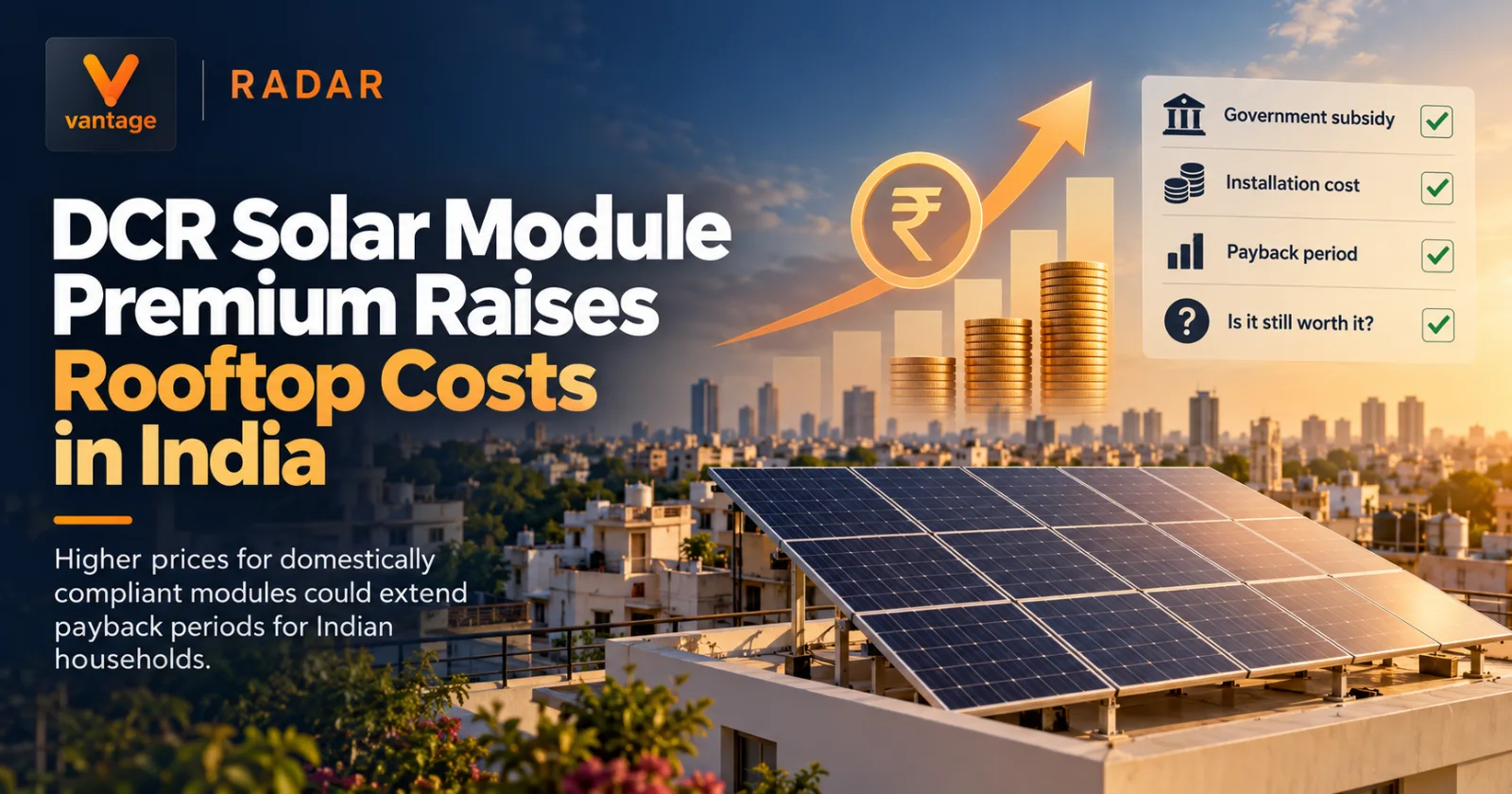
Rooftop solar panels installed on an Indian residential building, with an urban skyline and financial graphics illustrating rising solar-module costs and their possible effect on installation affordability and investment payback periods.
Inline Intelligence
Rising premiums on domestically compliant solar modules are creating fresh affordability concerns for Indian households considering rooftop solar, with higher upfront costs potentially extending the time needed to recover their investment.
What Has Changed?
A Mercom India report published on October 26, 2026, highlights the widening price gap between Domestic Content Requirement (DCR) solar modules and non-DCR alternatives.
According to the report, higher module prices are affecting residential installation costs, system sizing and investment payback periods.
The development matters as India continues expanding residential rooftop solar through the PM Surya Ghar: Muft Bijli Yojana.
Why DCR Modules Matter
Domestic Content Requirement rules apply to solar installations under specified government-supported programmes.
For eligible installations under PM Surya Ghar, homeowners must comply with the programme's applicable sourcing and technical requirements to receive financial assistance.
This means households cannot assume that a cheaper non-DCR module qualifies for the same government subsidy.
The distinction creates an important purchasing decision: compare the total compliant installation cost after eligible assistance, rather than module prices alone.
How Much Subsidy Is Available?
The central government's published subsidy structure provides:
- ₹30,000 for a 1 kW residential system.
- ₹60,000 for a 2 kW system.
- ₹78,000 for a 3 kW system or larger.
The central subsidy is capped at the applicable 3 kW assistance level, even where the installed system is larger.
Actual eligibility depends on scheme conditions and the application process.
What Higher Prices Mean for Homeowners
A higher installation quote can increase the time required to recover the household's net investment.
However, payback also depends on electricity tariffs, rooftop generation, self-consumption, net-metering arrangements and future maintenance costs.
A higher module price does not automatically make every rooftop solar installation uneconomical.
Equally, the promise of lower electricity bills does not justify overlooking the actual installed cost.
Homeowners should compare multiple compliant quotations and request clearly itemised pricing before proceeding.
What Happens Next?
The key developments to monitor are domestic module price trends, availability of compliant equipment and any changes to government procurement or subsidy requirements.
For households considering installation, the immediate priority is to obtain a detailed quote and calculate realistic savings using their own electricity consumption.
Vantage Radar will continue tracking how module pricing and policy requirements affect residential solar affordability.
Sources
Click an article title to view the source.
-
DCR Module Premium Raises Rooftop Solar Affordability Concerns published on 26 October 2026 in Mercom India.
-
Cabinet Approves PM-Surya Ghar: Muft Bijli Yojana published on 29 February 2024 by the Prime Minister's Office, Government of India.
-
PM Surya Ghar: Scheme Details and Eligibility published by MyScheme, Government of India; publication date not stated.

From TatvaOps
Solar & Energy Solutions
Considering rooftop solar?
Verified installers, subsidy support, and milestone-secured payments.
Free quotes · Verified contractors · tatvaops.com
Discuss this article
Join the conversation
Continue this discussion on Forums. A board named like this Radar article is filed under Radar.
1 reply already on Forums
More from Solar
Clean Energy Needs 220 Billion Dollars
India's reported 220 billion dollar clean-energy funding need puts the focus on grids, storage and delivery, not just new capacity.
Battery Manufacturing: India Reaches 86 GWh Downstream
India's downstream battery storage manufacturing capacity stands at about 86 GWh, according to Mercom India. Its new research highlights a gap between assembling storage systems and producing the cells inside them. A large headline with an important boundary Mercom's 22 October account of its…
Surat Apartment Solar: Savings Claim Needs a Bill Check
A rooftop solar project at Shreepad Park Arena in Surat offers a useful apartment community case study, but its reported annual savings need to be distinguished from a verified year of electricity bills. Mercom India’s 9 October report describes 612.69 kW across eight towers, comprising 158…
Inline Intelligence
Key Insight Actions
Connected knowledge for Solar Policy
Move between tutorials, discussions, Studio, and hubs without losing context.
Related discussions
Topic hubs
Conclusion Intelligence
Related Discussions
Was this helpful?
Let us know what you think