

210 Crore Mumbai Realty Deal: What Investors Should Know
Summary
Raymond Realty has agreed to secure ₹210 crore from an ICICI Prudential real estate fund for Mumbai redevelopment. Explore what institutional financing means for property buyers, developers and investors. Mumbai's redevelopment market has attracted a new institutional financing commitment. Raymond Realty has announced an agreement for an investment of up to ₹210 crore from an ICICI Prudential managed real estate fund into its subsidiary, Ten X Realty West. The development is part of a wider conversation about how Indian property developers finance urban redevelopment without relying entirely on traditional land purchases or their own capital.
Published on
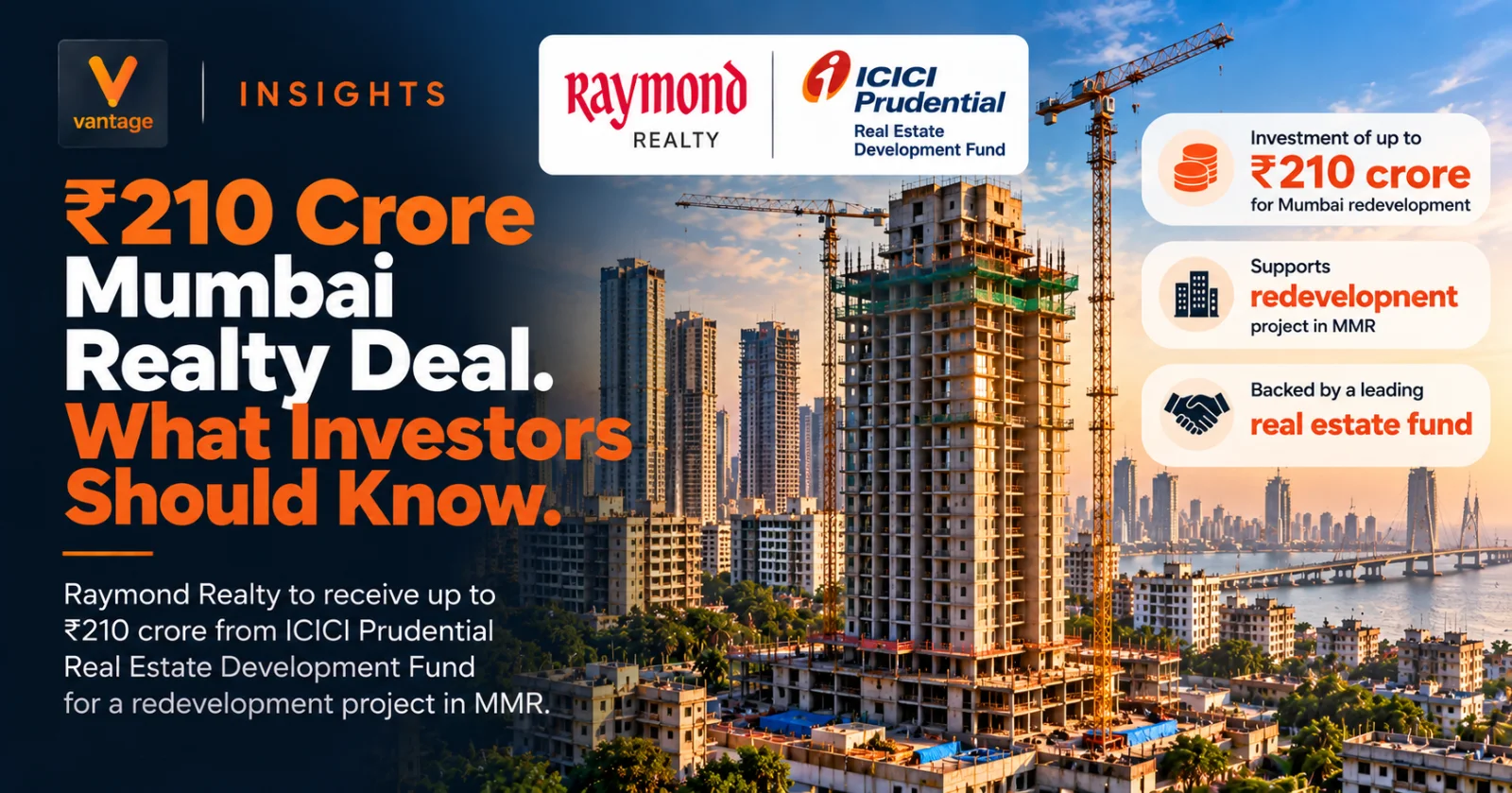
Mumbai residential redevelopment construction scene highlighting Raymond Realty's agreement with ICICI Prudential Real Estate Development Fund for an investment of up to ₹210 crore and its implications for property investors.
Inline Intelligence
Mumbai's redevelopment market has attracted a new institutional financing commitment. Raymond Realty has announced an agreement for an investment of up to ₹210 crore from an ICICI Prudential-managed real estate fund into its subsidiary, Ten X Realty West.
The development is part of a wider conversation about how Indian property developers finance urban redevelopment without relying entirely on traditional land purchases or their own capital.
For homebuyers, housing societies and property investors, the announcement raises important questions.
Does institutional investment make redevelopment projects financially stronger? Why are developers pursuing asset-light models? And does a major funding agreement offer meaningful protection against construction delays and other project risks?
The answers depend on how capital is structured, deployed and converted into completed developments.
What Exactly Is the ₹210 Crore Transaction?
On October 26, 2026, Raymond Realty Limited disclosed that Ten X Realty West Limited, its wholly owned subsidiary, had signed an investment agreement with ICICI Prudential Real Estate Development Fund.
The fund is a scheme of ICICI Prudential Real Estate AIF, a Category II alternative investment fund represented by ICICI Prudential Asset Management Company Limited.
Under the agreement, the financial investor has committed an aggregate amount of ₹210 crore for a redevelopment project in the Mumbai Metropolitan Region.
Raymond Realty and the fund will jointly invest in the subsidiary under the agreed contractual terms.
The company's regulatory disclosure states that the transaction does not affect management or control of the listed holding company.
Importantly, the disclosed agreement should not be confused with confirmation that ₹210 crore has already been fully transferred into the project.
The public information reviewed also does not disclose every investment condition or financial return arrangement.
Those limitations matter when assessing what the announcement means for investors.
Why Institutional Capital Matters in Redevelopment
Redevelopment involves transforming older buildings or underutilised properties into new developments.
In the Mumbai Metropolitan Region, this can include housing-society redevelopment, joint development with landowners and other property-restructuring arrangements.
Unlike purchasing vacant land and immediately starting construction, redevelopment can involve several overlapping obligations.
Developers may need to negotiate existing ownership interests, secure development rights, obtain regulatory approvals, manage rehabilitation commitments and finance construction before receiving substantial sales collections.
These requirements can create significant upfront financial pressure.
Institutional investment may help developers meet some of these funding needs.
A specialist real estate fund may also assess financial, legal and commercial risks before committing capital.
However, the existence of a professional investor should not be interpreted as proof that every project risk has been eliminated.
The investment decision serves the fund's objectives, which may differ from those of homebuyers or existing society members.
What Is an Asset-Light Real Estate Development Model?
Traditionally, developers often purchased land and held it on their balance sheets before constructing projects.
This can require substantial capital, especially in high-value urban locations.
An asset-light approach can reduce the requirement to own every development site outright.
Developers may instead enter into joint development agreements with landowners, under which the landowner contributes development rights and the developer undertakes specified responsibilities.
Compensation may be structured through revenue sharing, developed area or other contractual arrangements.
A financing investor can provide another source of capital at the project level.
The commercial attraction is straightforward: developers may be able to pursue more projects without tying up equivalent amounts in land acquisition.
But asset-light does not mean risk-free.
The developer still faces execution obligations, contractual liabilities, approvals, sales uncertainty and potentially significant financial exposure.
Raymond Realty's Development Strategy
Raymond Realty's October 26 announcement provides additional context.
The company reported an estimated total portfolio gross development value of approximately ₹52,000 crore.
It also stated that its joint development agreement portfolio comprises eight projects with combined potential revenue of approximately ₹27,000 crore.
This represents roughly 52% of its reported portfolio GDV.
These are company-reported estimates, not guaranteed future revenues.
Gross development value describes the estimated sales value of a project or portfolio.
It should not be confused with operating profit, free cash flow or the market value of a company's equity.
A developer can report a large GDV pipeline while still requiring substantial investment to construct, market and deliver those projects.
The financial outcome depends on how much revenue is actually realised and what costs are incurred.
The ₹210 crore transaction is therefore better understood as one element of Raymond Realty's financing strategy than as proof of a specific future profit.
How Could the Deal Affect Mumbai's Property Market?
The transaction highlights continued interest in financing selected redevelopment opportunities in the Mumbai Metropolitan Region.
But it would be an overstatement to treat one agreement as evidence that institutional investment is accelerating across every Mumbai locality.
The disclosed transaction concerns one redevelopment project.
Without more detailed project information, it is not possible to establish which neighbourhood, housing society or property segment will receive the direct benefit.
Institutional funding can potentially influence the ability of a developer to launch or progress an individual project.
However, broader market effects depend on several other factors, including land availability, development permissions, infrastructure, buyer demand, selling prices and construction capacity.
A single financing agreement cannot establish that Mumbai property prices will rise.
What Does It Mean for Existing Housing Societies?
Housing-society redevelopment involves a particular set of risks.
Existing residents may need to vacate their homes temporarily while their buildings are demolished and reconstructed.
They may depend on the developer to provide transit accommodation arrangements, rent payments, bank guarantees and timely delivery of replacement homes, as applicable under the relevant agreements.
For these residents, the presence of institutional capital can be relevant because construction and rehabilitation require financing.
But residents should examine the actual contractual protections.
Important questions include:
- What financial security supports the developer's obligations?
- How are rent and transit accommodation commitments documented?
- What happens if construction is delayed?
- Are bank guarantees or other agreed protections in place?
- How will changes in the project's financing structure affect the society?
The answers must come from the redevelopment agreement, applicable approvals and professional legal review.
A press release about investment funding does not establish these protections.
Does Institutional Funding Make a Project Safer for Homebuyers?
Not automatically.
An institutional investor may conduct due diligence before providing capital.
That process can involve reviewing the developer's financial capacity, project feasibility, approvals, security arrangements and expected cash flows.
Nevertheless, the investor's protections are designed primarily around its contractual position.
Homebuyers face a different set of risks.
These include delayed possession, changes to sanctioned plans, construction quality, contractual disputes and financing uncertainty.
Before purchasing an apartment in a redevelopment project, buyers should independently confirm its MahaRERA registration status and review relevant disclosures.
The official Maharashtra Real Estate Regulatory Authority website provides access to registered project information and other regulatory records.
The registration number should match the specific project or phase being marketed.
A developer's wider corporate reputation and financing announcements should not replace project-level checks.
What Does a Category II Real Estate AIF Do?
An Alternative Investment Fund, or AIF, is a privately pooled investment vehicle operating under the applicable SEBI framework.
Category II AIFs can include private-equity, private-credit and real estate-oriented strategies, depending on their structure.
These vehicles typically invest according to defined fund documents and risk-return objectives.
Unlike a standard bank deposit, an AIF investment does not guarantee repayment or a fixed return merely because it is professionally managed.
The ICICI Prudential Real Estate Development Fund's participation in this transaction is an institutional financing arrangement.
It should not be confused with a retail fixed deposit or a conventional mutual fund investment.
The announcement does not provide sufficient information to calculate the fund's expected internal rate of return, redemption terms or eventual profit from this specific transaction.
Investors should avoid inferring those figures.
How Could the ₹210 Crore Be Used?
Project financing can support several stages of real estate development, subject to the permitted uses established under the financing agreements.
Potential needs include approval-related expenditure, development obligations, construction work and other eligible project costs.
However, these are examples of general project-financing requirements.
The reviewed Raymond Realty filing confirms the redevelopment purpose but does not provide a fully itemised allocation of the ₹210 crore.
It would therefore be misleading to state that any particular amount is allocated to landowners, construction, rehabilitation or approvals.
The company or relevant project disclosures would need to establish those details.
Does More Investment Mean Higher Property Prices?
A common assumption is that institutional investors enter markets only when they expect property prices to rise.
But a fund may pursue a project because of expected development margins, financing arrangements, contractual security or opportunities to improve the property's value.
Those objectives do not require every property in the surrounding area to appreciate.
Consider a hypothetical redevelopment project with estimated eventual sales value of ₹1,000 crore.
If total development costs, landowner obligations, financing expenses, taxes and other commitments are ₹850 crore, the difference is ₹150 crore before considering any further adjustments.
If those costs increase to ₹950 crore, the remaining margin falls sharply even if selling prices remain unchanged.
This simplified illustration demonstrates why project profitability depends on more than its headline sales potential.
It is not an estimate of Raymond Realty's project economics.
Investors should distinguish the gross value of a development from the capital ultimately available to shareholders or financial investors.
What Are the Main Risks in Redevelopment Financing?
Several risks can influence the outcome.
Approval risk: Development permissions, plan sanctions and other statutory approvals can take longer than anticipated.
Execution risk: Demolition, construction, procurement and contractor management can produce delays or unexpected costs.
Sales risk: Revenue expectations depend on the ability to sell units at assumed prices and within projected timelines.
Financial risk: Funding conditions, cash-flow gaps and borrowing costs can place pressure on project delivery.
Contractual risk: Disputes involving landowners, societies or development partners can affect execution.
Market risk: Local demand, competition and broader financing conditions may change between project launch and completion.
Institutional investment may help manage some financial challenges, but it does not eliminate these risks.
What Should Raymond Realty Shareholders Watch?
Shareholders evaluating the announcement should examine the development alongside the company's wider financial position.
A fresh investment commitment can support growth, but its ultimate effect depends on project economics and the structure of the financing.
Relevant questions include whether the deal changes the subsidiary's ownership structure, what obligations exist under the definitive agreements, and when the project is expected to contribute revenue and cash flow.
It is also useful to track construction expenditure, sales bookings, customer collections and consolidated debt.
The filing states that the investment does not affect management or control of the listed holding company.
That statement does not, by itself, determine the transaction's eventual effect on earnings, cash flows or shareholder value.
A stock's investment attractiveness also depends on its market valuation.
A strategically useful transaction can still be insufficient to justify an expensive share price.
What Should Property Buyers Monitor Next?
The most useful future disclosures would identify the redevelopment project and clarify its regulatory and execution status.
Prospective buyers should look for:
- The project's location and MahaRERA registration.
- Approved plans and relevant permissions.
- Declared construction and possession milestones.
- Progress of financial commitments and project work.
- Contractual payment schedules and buyer protections.
For existing society residents, redevelopment agreements and transit accommodation provisions deserve particular attention.
It is also important to distinguish company-wide performance from progress on the specific project receiving funding.
A developer may have successful completed projects while a newly financed project remains at an early approval or execution stage.
The Bigger Picture
India's urban redevelopment needs are likely to continue creating opportunities for developers, landowners and specialist financial investors.
In land-constrained cities, redevelopment can make more intensive use of existing sites, subject to planning rules, infrastructure capacity and resident protections.
Project-level institutional financing can help mobilise development capital.
However, successful redevelopment requires far more than raising funds.
It depends on transparent agreements, realistic budgets, approvals, construction discipline and accountability to existing residents and future buyers.
The Raymond Realty investment agreement offers a concrete example of how financial capital is being structured around a redevelopment opportunity.
Whether the transaction creates durable value will depend on execution and the eventual financial outcome.
Conclusion
Raymond Realty's ₹210 crore investment agreement with an ICICI Prudential-managed real estate fund is a significant project-financing development for its Mumbai Metropolitan Region business.
It supports the company's asset-light expansion strategy and illustrates how institutional investors can participate in redevelopment.
But the announcement does not guarantee faster construction, higher property prices or superior shareholder returns.
For homebuyers, project-level regulatory and contractual checks remain essential.
For investors, the questions are whether the capital is deployed effectively, the redevelopment progresses on schedule and the eventual cash flows justify the risks.
In real estate, access to capital matters. Turning that capital into completed, financially sustainable projects matters more.
FAQ
1. How much is ICICI Prudential investing in Raymond Realty's subsidiary?
ICICI Prudential Real Estate Development Fund has agreed to invest an aggregate amount of ₹210 crore in Ten X Realty West, according to Raymond Realty's October 26, 2026 filing.
2. Has the ₹210 crore already been paid?
The verified filing confirms an investment agreement. It does not independently establish that the full committed amount has already been disbursed.
3. Which Mumbai redevelopment project will receive the funds?
The reviewed announcement identifies a project in the Mumbai Metropolitan Region but does not provide enough detail to confirm its precise location or MahaRERA registration.
4. Does the deal guarantee project completion?
No. Financing availability is only one factor. Approvals, contracts, construction execution and other risks still affect delivery.
5. What is an asset-light development strategy?
It generally involves arrangements such as joint development agreements that allow developers to undertake projects without purchasing every underlying land parcel outright.
6. Is the investment positive for Raymond Realty shareholders?
The transaction may support the company's development plans, but shareholder outcomes depend on financing terms, project performance, the company's financial position and market valuation.
7. Can ordinary homebuyers invest in the ICICI Prudential Real Estate Development Fund?
The fund is a Category II AIF scheme, not a standard retail mutual fund. Access depends on its applicable eligibility requirements, fund documents and regulatory rules.
Sources
Click an article title to view the source.
-
Raymond Realty Investment Agreement Disclosure published on 26 October 2026, reproducing the Raymond Realty stock-exchange filing.
-
Raymond Realty Ten X Realty West Investment Announcement published on 26 October 2026, reproducing the Raymond Realty company press release.
-
Raymond Realty Raises Rs 210 Crore From ICICI Prudential Real Estate Development Fund published on 26 October 2026 by The Economic Times / PTI.
-
MahaRERA Project Registration, official guidance and project-registration access provided by the Maharashtra Real Estate Regulatory Authority; publication date not stated.
Evidence Caveats
The underlying investment agreement is verified from Raymond Realty's October 26, 2026 exchange disclosure.
The public announcement does not establish full disbursement of the committed funds, the precise redevelopment site or the expected financial return.
Portfolio GDV and JDA revenue potential are company-reported estimates, not realised earnings.
The hypothetical financial example is illustrative and does not describe the economics of the announced transaction.
No conclusion about the project's current MahaRERA approval status or possession timeline is made because its precise registration details have not been verified.
Join the Discussion
Does institutional investment make you more confident about buying property in a redevelopment project?
Or would you place greater importance on regulatory approvals, the construction schedule and buyer protections?
Join the discussion on Vantage and share which factors influence your property decisions most.
Disclaimer
This article is intended for general information and education. It does not constitute personalised investment, legal, financial or property-purchase advice. Real estate projects, listed securities and alternative investment funds carry risks. Readers should verify project documents, regulatory filings and current financial information before making decisions.

From TatvaOps
Property Development
Developing a property?
Structured oversight for multi-unit and investor-led builds.
Free quotes · Verified contractors · tatvaops.com
Discuss this article
Join the conversation
Continue this discussion on Forums. A board named like this InSights article is filed under InSights.
1 reply already on Forums
More from Real Estate
Mumbai Luxury Home Data What Buyers Should Check
Luxury registration totals are not a like-for-like price index. Here is how buyers can compare properties and ownership costs.
Binance Security Incident What Holders Can Check
The Binance incident highlights the difference between a displayed balance and access to assets. Here are practical checks for holders.
Gurugram Power Choice What Residents Should Check
A proposed second electricity distributor is on hold. Here is what Gurugram and Nuh residents can check on bills and service.
Inline Intelligence
Key Insight Actions
Connected knowledge for Real Estate Financing
Move between tutorials, discussions, Studio, and hubs without losing context.
Related discussions
Topic hubs
Conclusion Intelligence
Related Discussions
North Bengaluru Property: Is the Airport Premium Worth It?
Popular in insights discussions1 reply
Record Property Investment, but Can Ordinary Buyers Still Afford a Home?
Popular in insights discussions2 replies
India's Real Estate Investment Slump: Is Capital Retreating or Becoming More Selective?
Popular in insights discussions1 reply
Was this helpful?
Let us know what you think