

WeWork India Adds 2.25 Lakh Sq Ft and 4,500+ Desks Across Bengaluru and Pune
Karthik posts articles on Energy and Construction.
Summary
WeWork India is expanding in two of India's important technology and office corridors, adding approximately 2.25 lakh sq ft and more than 4,500 desks through new centres in Whitefield, Bengaluru, and Wakad, Pune. The expansion includes WeWork Infinix Palladium in Whitefield and WeWork Millennium Towers in Wakad. Together, the centres increase WeWork India's network to 79 centres spanning approximately 9.1 million sq ft across eight Indian cities . But the more interesting real estate signal is where the company is adding capacity. Whitefield is already a large established office district.
Published on
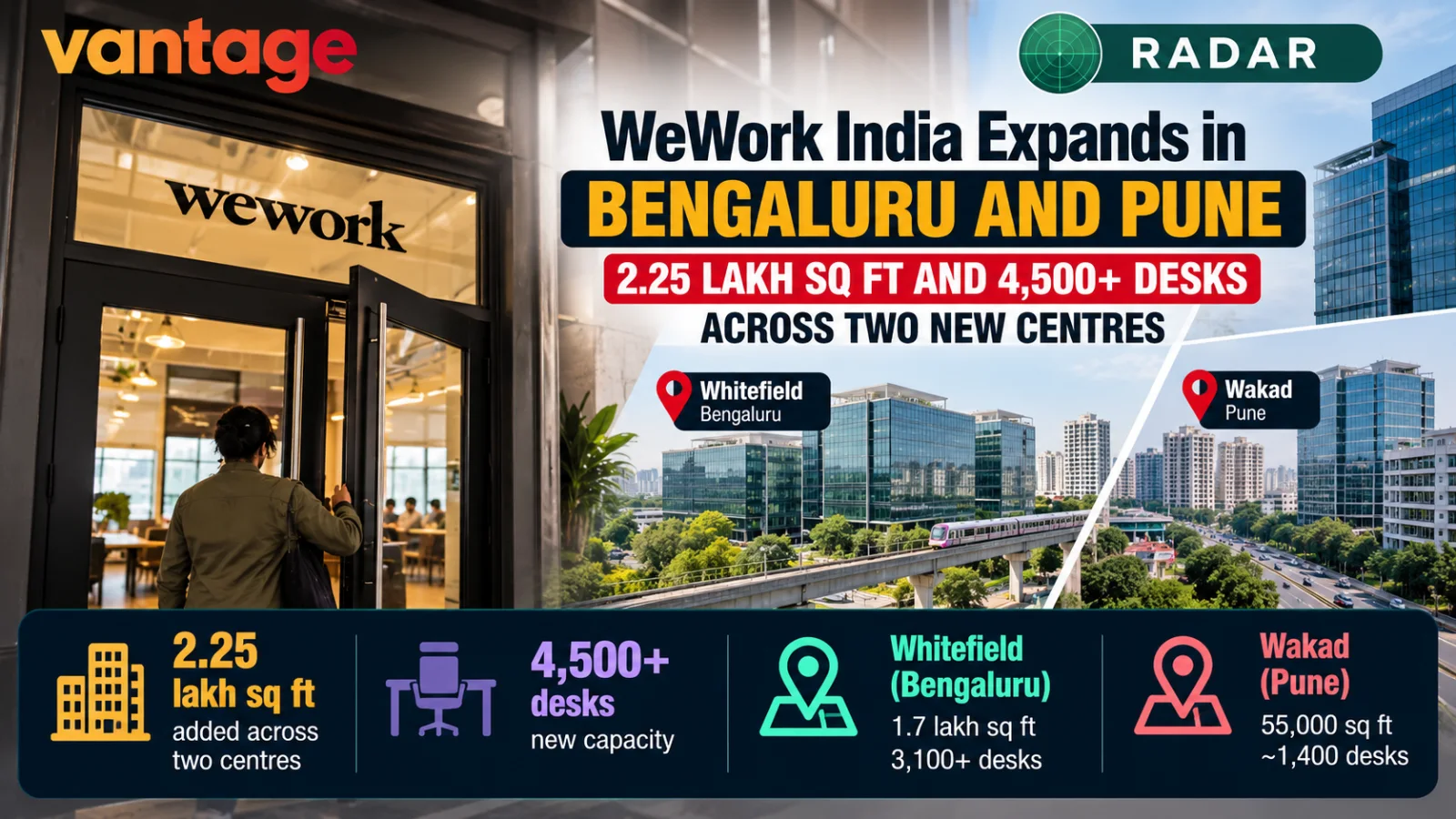
banner examining WeWork India's expansion in Whitefield, Bengaluru, and Wakad, Pune, through a flexible-office and location-strategy lens. The visual combines coworking space, modern office districts, residential catchments and urban transport to explore whether companies are moving workplaces closer to where employees live, while highlighting implications for hybrid work, decentralised office corridors, enterprise demand and future occupancy.
Inline Intelligence
WeWork India is expanding in two of India's important technology and office corridors, adding approximately 2.25 lakh sq ft and more than 4,500 desks through new centres in Whitefield, Bengaluru, and Wakad, Pune.
The expansion includes WeWork Infinix Palladium in Whitefield and WeWork Millennium Towers in Wakad.
Together, the centres increase WeWork India's network to 79 centres spanning approximately 9.1 million sq ft across eight Indian cities.
But the more interesting real estate signal is where the company is adding capacity.
Whitefield is already a large established office district.
Wakad sits close to Pune's Hinjewadi employment hub while drawing on a substantial residential catchment.
The expansion therefore reflects a broader office-market question:
Are flexible workspace operators increasingly following employees towards mixed residential and employment corridors rather than concentrating only in traditional central business districts?
WeWork India Adds More Than 4,500 Desks
The two centres have very different scales.
WeWork Infinix Palladium, Whitefield
The Bengaluru centre spans approximately 1.7 lakh sq ft and provides more than 3,100 desks.
It is a standalone full-building workspace extending from the ground floor through the sixth floor, with a terrace.
The centre is positioned near Singayyanapalya Metro Station.
WeWork Millennium Towers, Wakad
The Pune centre spans approximately 55,000 sq ft and provides around 1,400 desks.
It occupies the 16th and 17th floors of Millennium Towers.
The location sits between Hinjewadi and the Mumbai-Pune Expressway.
Together, the reported areas reconcile to approximately 2.25 lakh sq ft.
Bengaluru Remains WeWork India's Largest Concentration
As of Q1 FY27, WeWork India had 30 centres across approximately 3.3 million sq ft in Bengaluru, providing around 51,700 desks.
The new Whitefield centre alone represents approximately:
5.2% of the reported Bengaluru portfolio area
and
6% of its reported desk capacity.
These are Vantage-derived comparisons using the reported portfolio and centre figures.
They are measures of scale, not revenue contribution or market share.
Pune Reaches Eight Centres
The Wakad expansion takes WeWork India's Pune portfolio to eight centres spanning approximately 0.8 million sq ft and 14,400 desks, according to Business Standard.
The new 1,400-desk centre therefore represents approximately 9.7% of the reported Pune desk portfolio.
This is a Vantage-derived scale comparison.
It should not be interpreted as a forecast of occupancy or revenue.
Why Whitefield?
Whitefield has evolved from a peripheral technology cluster into a major mixed-use business district.
It combines:
- large office campuses;
- technology employers;
- residential catchments;
- Metro connectivity;
- retail;
- hospitality; and
- social infrastructure.
For flexible-office operators, that combination can be important.
Corporate tenants increasingly need to consider not only the quality of an office building but also the commute experienced by employees.
WeWork India's expansion reflects that location logic.
Why Wakad?
Wakad offers a different proposition.
It sits near Hinjewadi, one of Pune's major technology employment clusters, while also being part of a large residential corridor.
The Mumbai-Pune Expressway adds regional connectivity.
WeWork India has already leased close to 1.8 lakh sq ft within the same Millennium Towers asset for its Managed Office offering, according to company-linked reporting.
That existing commitment provides context for the additional Wakad centre.
But it should not be interpreted as proof that every flexible workspace in the micro-market will achieve similar demand.
Offices Are Moving Closer to Where Employees Live
Arnav S. Gusain, Chief Supply Officer at WeWork India and CEO of Rivet by WeWork India, said businesses are increasingly evaluating workplaces based on the ability of employees to move between where they live, work and spend their time.
That is an important shift for commercial real estate.
The traditional office-location hierarchy placed enormous weight on established CBDs and major business parks.
Hybrid work and distributed employment can change that equation.
A high-quality office in a residentially dense employment corridor can reduce commute friction while retaining access to corporate infrastructure.
Flexible Workspace Is Increasingly an Enterprise Product
Coworking was once associated heavily with freelancers and startups.
That description is increasingly incomplete.
WeWork India says its centres serve enterprises, Fortune 500 companies, global capability centres and growing businesses alongside smaller users.
The Whitefield centre's more than 3,100 desks make the enterprise orientation particularly visible.
A full-building flexible workspace of that scale is not simply a collection of small coworking memberships.
It can accommodate substantially larger teams.
WeWork India's Network Has Reached 9.1 Million Sq Ft
The company's current portfolio spans:
79 centres
across
eight cities
and approximately
9.1 million sq ft.
Its website reports approximately 134,000 desks and more than 110,000 members as of 30 June 2026.
The newly announced centres should not simply be added mechanically to those totals without checking whether they were already included in the June portfolio data.
This is especially important because Infinix Palladium appeared in an earlier company expansion filing.
Infinix Palladium Was Already in WeWork India's Pipeline
An April 2026 exchange-filed company release identified Infinix Palladium as one of five buildings in its southern India expansion.
That filing described the Whitefield property as approximately 169,485 sq ft with around 3,100 desks.
The 5 October announcement therefore represents the opening or operational progression of previously announced capacity rather than evidence that the entire 1.7 lakh sq ft was newly contracted during October.
That distinction matters.
Newly opened space is not necessarily newly leased space.
What Does the Expansion Say About Bengaluru Office Demand?
It reinforces Whitefield's importance as an enterprise office market.
But a single operator's expansion does not establish market-wide occupancy, rental growth or absorption.
Those conclusions require broader leasing data.
The evidence supports a narrower observation:
WeWork India is willing to deploy a large flexible workspace format in Whitefield, with more than 3,100 desks in a single building.
That indicates strategic confidence by the operator, not a guaranteed market outcome.
What Does It Say About Pune?
The Wakad move is potentially more interesting from a location perspective.
Hinjewadi is already an established employment centre.
Wakad adds a strong residential base and access to the expressway.
If corporate occupiers increasingly prioritise employee commute and distributed offices, locations sitting between employment hubs and residential catchments could become more important.
But this remains an emerging location strategy rather than proof of a structural shift across India's entire office market.
The Economics Depend on Occupancy
Adding desks creates capacity.
It does not create revenue automatically.
For a flexible workspace operator, the eventual economics depend on factors including:
- occupancy;
- desk pricing;
- enterprise contracts;
- lease or revenue-share obligations;
- fit-out costs;
- operating expenses;
- contract duration; and
- member retention.
The current announcement does not disclose centre-level economics for either new location.
More Than 4,500 Desks Need to Be Filled
That is the commercial test.
If enterprises and GCCs absorb the capacity at healthy pricing, the expansion can strengthen the company's operating leverage in these markets.
If demand takes longer to materialise, the additional capacity can increase fixed operating exposure.
The accessible announcement does not disclose current occupancy or pre-commitment levels for the two centres.
Those metrics should therefore not be assumed.
What Should Commercial Property Owners Watch?
The expansion offers several signals for landlords.
Large flex operators can take meaningful space
A 1.7 lakh sq ft full-building centre demonstrates the potential scale of flexible workspace requirements.
Residential catchments increasingly matter
Employee accessibility can influence office-location decisions.
Transit matters
Metro and arterial-road connectivity can improve the attractiveness of decentralised office districts.
Enterprise-ready buildings matter
Large occupiers require infrastructure, floorplates, technology and operational quality capable of supporting substantial teams.
Flexible workspace can complement conventional leasing
Operators can provide enterprises with capacity without requiring every corporate tenant to directly lease and fit out its own office.
What Should Investors Watch Next?
The important metrics are not the number of desks announced.
They are:
occupancy,
revenue per occupied desk,
enterprise demand,
centre-level maturity,
lease commitments,
and
cash generation.
Those numbers determine whether portfolio expansion creates economic value.
Frequently Asked Questions
How much new office space has WeWork India added in Bengaluru and Pune?
The two announced centres together represent approximately 2.25 lakh sq ft and more than 4,500 desks.
Where are WeWork India's new centres?
WeWork Infinix Palladium is in Whitefield, Bengaluru, while WeWork Millennium Towers is in Wakad, Pune.
How large is WeWork Infinix Palladium?
The Whitefield centre spans approximately 1.7 lakh sq ft and provides more than 3,100 desks.
How large is WeWork Millennium Towers in Pune?
The Wakad centre spans approximately 55,000 sq ft and provides around 1,400 desks.
How large is WeWork India's total portfolio?
The company reports 79 centres across approximately 9.1 million sq ft in eight Indian cities.
Why is WeWork India expanding in Whitefield and Wakad?
The company points to proximity to talent, residential catchments, transit, employment hubs and everyday amenities as important location factors.
Does 4,500 new desks mean they are already occupied?
No. The accessible evidence establishes capacity, not occupancy of all the newly announced desks.
Does this prove flexible office demand is booming across India?
No. It supports evidence of WeWork India's expansion in these two markets, but broader conclusions about industry-wide demand require market-level leasing and occupancy data.
Sources
Click on article title to view article.
“WeWork India expands Bengaluru, Pune footprint with two new centres” published on 5 October 2026 in Business Standard
Primary Sources
“WeWork India” current portfolio information published by WeWork India
“Millennium Towers” centre information published by WeWork India
Evidence Caveats
- The 2.25 lakh sq ft represents the combined area of the two announced centres. It should not be described as 2.25 lakh sq ft of newly signed leases in October.
- Infinix Palladium had already appeared in an April 2026 company expansion filing, so the October announcement reflects operational progression of previously announced capacity.
- The company's website reports 79 centres, 134,000 desks and more than 110,000 members as of 30 June 2026. The newly announced centre figures should not be mechanically added to those totals without confirming whether the centres were already included.
- WeWork India's current website contains inconsistent status labels for Millennium Towers, with some pages describing it as "opening shortly" or "coming soon", while the 5 October announcement describes the centre as opened.
- Centre-level occupancy, pre-commitments, revenue, rent, fit-out cost, operating margin and payback period were not disclosed in the reviewed evidence.
- More than 4,500 desks represents capacity, not confirmed occupied desks.

From TatvaOps
Commercial Interiors
Building farm infrastructure?
Verified execution partners for agri and rural builds.
Free quotes · Verified contractors · tatvaops.com
Discuss this article
Join the conversation
Continue this discussion on Forums. A board named like this Radar article is filed under Radar.
More from Real Estate
LTCG and STT: Review Reports Do Not Mean a Tax Cut
Finance Minister Nirmala Sitharaman’s comments on equity taxation have reopened a consequential debate for investors. Speaking at the Bloomberg New Economy Forum in New Delhi on 13 October, she welcomed views on long term capital gains tax and securities transaction tax without committing to…
Blackstone Targets 100 Billion in India Investments
Blackstone aims to double its India investments to approximately $100 billion over about five years, president and chief operating officer Jonathan Gray said in interviews reported this week. The ambition spans private equity and real estate, alongside potential expansion in infrastructure, credit…
Property Registrations Flagged Over Fictitious PAN
Nearly 25,000 property registrations over two years at Badshahpur tehsil in Gurugram reportedly carried the same fictitious PAN, according to The Times of India’s 9 October report on an Income Tax Department survey. The finding raises questions about taxpayer identification and transaction…
Inline Intelligence
Key Insight Actions
Connected knowledge for Office Space News
Move between tutorials, discussions, Studio, and hubs without losing context.
Related discussions
WeWork India Adds 4,500+ Desks in Whitefield and Wakad: Are Offices Following Employees Home?
1 replies
Related discussionWhy TVS Motors 5.3 Lakh Sq Ft Bengaluru Lease Matters Beyond the Headline Rent
1 replies
Related discussionGCCs Now Drive 42 of India's Office Leasing: Is Commercial Real Estate Becoming Too Dependent on Them?
1 replies
Related discussion
Topic hubs
Conclusion Intelligence
Related Discussions
WeWork India Adds 4,500+ Desks in Whitefield and Wakad: Are Offices Following Employees Home?
Popular in insights discussions1 reply
Why TVS Motors 5.3 Lakh Sq Ft Bengaluru Lease Matters Beyond the Headline Rent
Popular in insights discussions1 reply
GCCs Now Drive 42 of India's Office Leasing: Is Commercial Real Estate Becoming Too Dependent on Them?
Popular in insights discussions1 reply
Was this helpful?
Let us know what you think