

Kolkata Accounts for Just 1 of 6.3 Lakh Crore Housing Sales Value as Premium Markets Pull Ahead
Karthik posts articles on Energy and Construction.
Summary
Kolkata accounted for just 1% of the ₹6.3 lakh crore residential sales value recorded across nine major Indian cities in FY26 , according to the CREDAI ANAROCK Report 2026. That places the city far behind India's three largest housing markets by transaction value. Mumbai Metropolitan Region accounted for 34% of the total, Delhi NCR for 22% , and Bengaluru for 15% . But Kolkata's 1% share does not mean the city lacks housing demand.
Published on
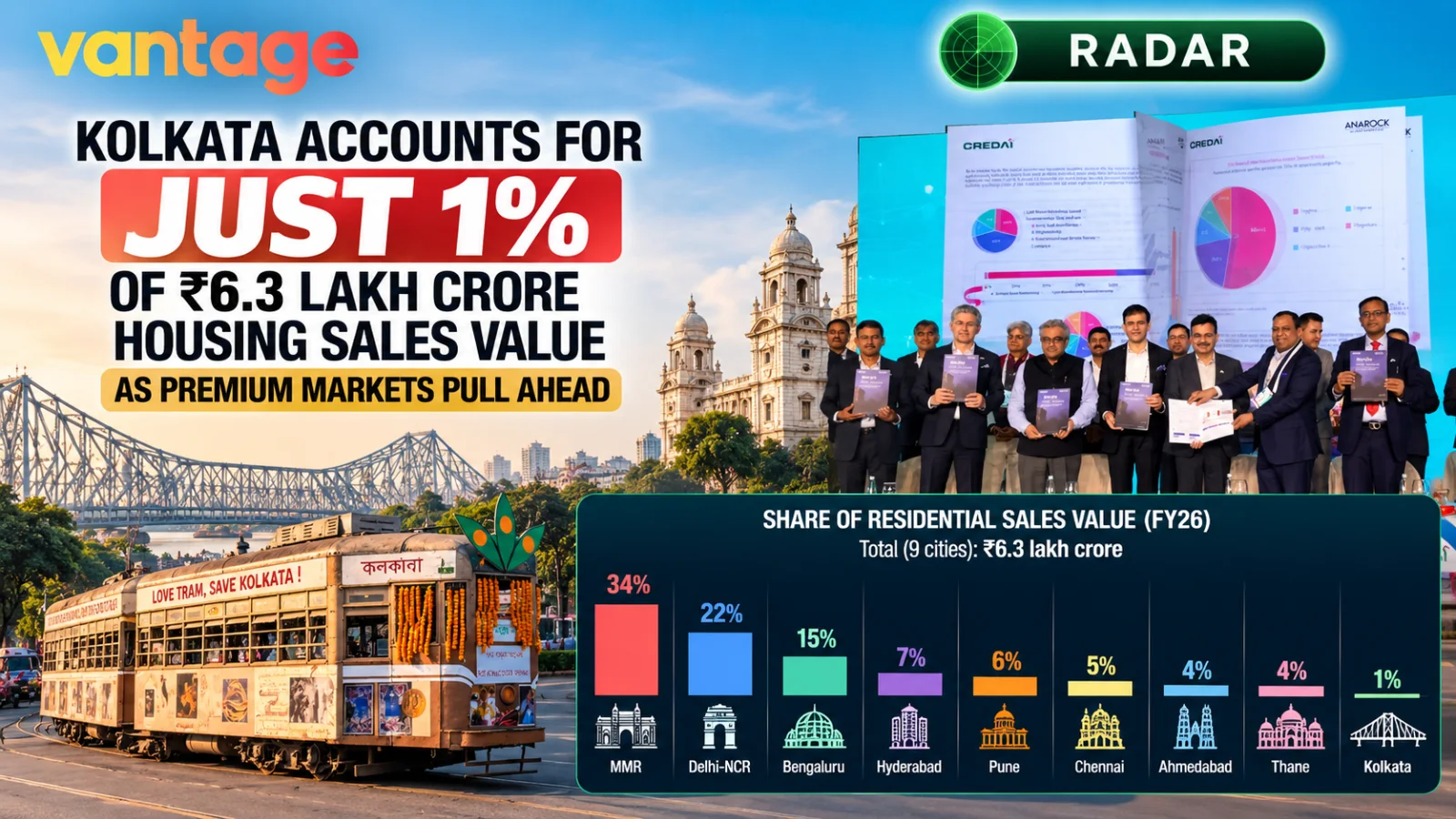
banner presenting Kolkata's housing sales-value gap through a city-focused visual featuring the tram, Howrah Bridge, urban development and CREDAI-ANAROCK research imagery. The analysis contrasts Kolkata's 1% share of ₹6.3 lakh crore in FY26 housing sales value across nine cities with its lower ticket sizes and mid-income housing base, while highlighting Metro expansion, employment growth, organised development and selective premiumisation as potential drivers of higher value.
Inline Intelligence
Kolkata accounted for just 1% of the ₹6.3 lakh crore residential sales value recorded across nine major Indian cities in FY26, according to the CREDAI-ANAROCK Report 2026.
That places the city far behind India's three largest housing markets by transaction value.
Mumbai Metropolitan Region accounted for 34% of the total, Delhi-NCR for 22%, and Bengaluru for 15%.
But Kolkata's 1% share does not mean the city lacks housing demand.
The more revealing explanation is that Kolkata continues to sell substantially lower-priced homes while India's largest markets have moved rapidly towards premium and luxury housing.
The challenge for Kolkata is therefore not simply how to sell more homes.
It is how to increase housing value without pricing out the middle-income buyers who remain central to the city's market.
India's Housing Market Is Increasingly a Value Story
The nine markets covered by the CREDAI-ANAROCK report generated approximately ₹6.3 lakh crore of residential sales value in FY26.
The distribution was highly concentrated.
MMR alone accounted for 34%.
Delhi-NCR contributed 22%.
Bengaluru contributed 15%.
Together, those three markets represented 71% of the reported sales value.
This is a Vantage-derived addition of the reported market shares.
Kolkata's share was approximately 1%.
What Does Kolkata's 1% Share Mean in Rupees?
Applying the reported 1% share to ₹6.3 lakh crore gives an indicative value of approximately:
₹6,300 crore.
This is a Vantage-derived approximation.
It should not be treated as a precise city sales figure because the reported 1% market share is rounded.
The underlying report's exact unrounded Kolkata percentage was not available in the accessible evidence reviewed.
Kolkata's Problem Is Not Simply Unit Sales
Sales value and unit sales measure different things.
A city can sell a meaningful number of homes while generating comparatively little transaction value if those homes have lower ticket sizes.
That distinction is particularly important in Kolkata.
Moneycontrol reports that the city's market remains heavily concentrated in mid-income housing.
CREDAI West Bengal President and Merlin Group Chairman Sushil Mohta described the ₹60 lakh to ₹1.25 crore range as the city's dominant housing segment.
That is an industry participant's assessment, not an independently measured share of Kolkata sales.
Kolkata Remains Relatively Affordable
ANAROCK's residential market data show Kolkata's average residential price at approximately ₹6,120 per sq ft in 2025, up from ₹5,820 per sq ft in 2024.
That represents approximately 5% annual growth.
The city's lower pricing remains an attraction for buyers.
But it also limits aggregate transaction value compared with markets where significantly more homes are sold at premium and luxury prices.
Affordability is therefore both a competitive advantage and a reason Kolkata contributes less to national sales value.
India's Housing Supply Has Moved Upmarket
The broader market is changing quickly.
According to the CREDAI-ANAROCK report cited by Moneycontrol, high-end, luxury and ultra-luxury homes represented approximately 45% of new housing supply across the nine cities in FY26.
In FY22, their share was only 12.6%.
That is a dramatic change in the composition of new supply.
It helps explain why residential sales value nationally has grown much faster than unit volumes.
Sales Value Has Risen Faster Than Unit Sales
The CREDAI-ANAROCK report says annual residential sales value across major markets increased from approximately ₹2.35 lakh crore in FY22 to ₹6.3 lakh crore in FY26.
That is approximately 2.68 times the FY22 level.
The report describes this as compound annual growth of more than 27%.
Unit sales have grown much more modestly.
The implication is important.
A significant part of India's housing growth story is now being driven by higher ticket sizes and premiumisation, not simply by more homes being sold.
Kolkata Has Not Followed the Same Premiumisation Path
Kolkata's market remains more dependent on middle-income housing.
That creates a strategic dilemma for developers.
Moving towards higher-priced housing can increase sales value per transaction.
But moving too quickly can reduce the addressable buyer pool.
The city therefore cannot simply copy Mumbai or Gurugram's luxury-heavy development model.
Its pricing strategy has to reflect local incomes, employment, land economics and buyer depth.
Infrastructure Could Expand the Market
Kolkata's Metro expansion is creating new residential corridors.
ANAROCK identifies the Orange and Purple lines as important catalysts for residential development.
East Kolkata, including Rajarhat, New Town, Tangra, Salt Lake and the EM Bypass corridor, accounted for approximately 35% of the city's new residential launches in 2025.
Launches in East Kolkata increased 121% year on year.
South Kolkata remained the largest market by sales, accounting for approximately 28%.
These numbers indicate that the city's residential geography is changing as connectivity improves.
Peripheral Development Could Help Developers Scale
Peripheral locations can offer something established neighbourhoods often cannot:
larger parcels of developable land.
That matters because large integrated developments can support more housing, amenities and infrastructure than fragmented urban sites.
Improved Metro connectivity can also reduce the accessibility penalty traditionally associated with peripheral housing.
But infrastructure alone does not guarantee higher property values or absorption.
Employment, social infrastructure, execution and affordability remain important.
Land Remains a Constraint
Developers interviewed by Moneycontrol highlighted difficulties assembling large, dispute-free land parcels in Kolkata.
Land ownership structures and older regulations have historically complicated development.
This issue intersects with the separate debate over West Bengal's Urban Land Ceiling framework.
But any reform should be treated carefully.
Policy signals do not automatically translate into immediately available development land.
Legal changes, land titles, approvals and infrastructure still determine whether individual sites can actually be developed.
Should Kolkata Build More Luxury Housing?
Not simply because other cities are doing so.
The city's 1% sales-value share does indicate room to increase transaction value.
But sales value alone is not a measure of housing-market health.
A market that remains affordable while maintaining healthy absorption can serve a different economic role from one dominated by high-ticket housing.
The better question is whether Kolkata has enough depth to support selective premiumisation.
That means higher-value projects in locations where infrastructure, income profiles and buyer demand justify them, without abandoning the mid-market.
A ₹6,300 Crore Approximation Needs Perspective
The indicative ₹6,300 crore figure derived from Kolkata's rounded 1% share can appear small beside MMR.
Applying the same simple calculation to MMR's 34% share produces approximately ₹2.14 lakh crore.
But these are value comparisons.
They should not be interpreted as direct measures of housing accessibility, affordability, quality or investment returns.
High transaction value can result from expensive homes as much as from high transaction volume.
What Should Kolkata Developers Watch?
Ticket-size progression
Can developers gradually move buyers towards higher-value homes without sharply reducing absorption?
Metro corridors
Do new connectivity improvements translate into sustained residential demand?
Land reform
Do proposed regulatory changes make large, clean land parcels easier to develop?
Employment growth
Can office, logistics, retail and other commercial investment create a larger base of higher-income housing demand?
Premium absorption
Can premium projects sustain sales beyond a limited affluent buyer segment?
Affordability
Does Kolkata retain its relative cost advantage as prices rise?
These factors will determine whether the city's national sales-value share can increase sustainably.
What Does the 1% Share Mean for Homebuyers?
For homebuyers, a low national sales-value share is not inherently negative.
It partly reflects Kolkata's lower housing prices.
That can mean a lower entry cost compared with India's most expensive metropolitan markets.
But buyers should not assume lower prices guarantee better investment returns.
Future performance remains highly location-specific.
Connectivity, employment access, developer execution, supply and neighbourhood infrastructure matter more than the city's national value ranking alone.
Kolkata Does Not Need to Become Mumbai
The national premiumisation trend creates pressure on developers to move upmarket.
But Kolkata's opportunity may lie in a different model.
The city can potentially increase residential value through:
better infrastructure,
larger organised developments,
higher-quality mid-market housing,
selective premium projects,
and stronger employment corridors.
That could increase average ticket sizes without transforming the entire market into luxury housing.
The Real Question Is Value Without Exclusion
Kolkata's 1% share of the ₹6.3 lakh crore sales-value pool makes for a striking headline.
But it should not be interpreted as a verdict that Kolkata's housing market is weak.
The city's challenge is more nuanced.
It needs to capture more economic value from residential development while preserving the affordability that differentiates it from India's most expensive metropolitan markets.
If prices rise faster than incomes, premiumisation can shrink the buyer pool.
If prices remain too low to support viable development, new supply and investment can suffer.
Kolkata therefore needs something more difficult than simply higher prices.
It needs higher-value housing that a sufficiently deep local buyer base can still afford.
Frequently Asked Questions
What share of India's housing sales value did Kolkata have in FY26?
Kolkata accounted for approximately 1% of the ₹6.3 lakh crore residential sales value across the nine cities covered by the CREDAI-ANAROCK report.
Does Kolkata's 1% share mean it sold only 1% of homes?
No. The figure refers to sales value, not the number of housing units sold.
How much is 1% of ₹6.3 lakh crore?
Approximately ₹6,300 crore. This is a Vantage-derived approximation because the reported 1% share is rounded.
Which housing market had the highest FY26 sales value?
Mumbai Metropolitan Region led with 34%, followed by Delhi-NCR at 22% and Bengaluru at 15%.
Why is Kolkata's housing sales value relatively low?
Lower residential ticket sizes and a market concentrated more heavily in mid-income housing are major factors.
What is the average residential price in Kolkata?
ANAROCK reported an average of approximately ₹6,120 per sq ft in 2025, up around 5% from ₹5,820 per sq ft in 2024.
Is luxury housing growing across India?
Yes. The CREDAI-ANAROCK report says high-end, luxury and ultra-luxury homes accounted for about 45% of new supply across the nine markets in FY26, compared with 12.6% in FY22.
Could Kolkata's Metro expansion increase property demand?
Improved connectivity can support residential demand and open new development corridors, but future prices and absorption also depend on employment, supply, affordability and project execution.
Sources
Click on article title to view article.
“Kolkata sells homes but misses the big money as premium housing boom lifts other cities” published on 5 October 2026 in Moneycontrol
“Mumbai leads top 9 cities in residential sales value with 34% share in FY26: CREDAI-ANAROCK report” published on 2 October 2026 in Hindustan Times
Primary Data
“Indian Residential Real Estate Sector Annual Report 2025” published by ANAROCK
Evidence Caveats
- Kolkata's 1% figure measures sales value across the nine markets covered, not its share of all Indian housing transactions.
- Approximately ₹6,300 crore is a Vantage-derived approximation using the rounded 1% share and should not be treated as an exact Kolkata FY26 sales figure.
- The reported city shares may be rounded and therefore should not be used to reconstruct exact market values.
- The ₹60 lakh to ₹1.25 crore description is an industry participant's characterisation of Kolkata's market, not a disclosed distribution from the CREDAI-ANAROCK report.
- Higher sales value does not automatically mean a healthier, more affordable or better-performing housing market.
- Infrastructure expansion does not guarantee property-price appreciation.

From TatvaOps
Residential Construction
Financing your project?
Explore credit and milestone-secured payment options with Tatva Finance.
Free quotes · Verified contractors · tatvaops.com
Discuss this article
Join the conversation
Continue this discussion on Forums. A board named like this Radar article is filed under Radar.
More from Real Estate
LTCG and STT: Review Reports Do Not Mean a Tax Cut
Finance Minister Nirmala Sitharaman’s comments on equity taxation have reopened a consequential debate for investors. Speaking at the Bloomberg New Economy Forum in New Delhi on 13 October, she welcomed views on long term capital gains tax and securities transaction tax without committing to…
Blackstone Targets 100 Billion in India Investments
Blackstone aims to double its India investments to approximately $100 billion over about five years, president and chief operating officer Jonathan Gray said in interviews reported this week. The ambition spans private equity and real estate, alongside potential expansion in infrastructure, credit…
Property Registrations Flagged Over Fictitious PAN
Nearly 25,000 property registrations over two years at Badshahpur tehsil in Gurugram reportedly carried the same fictitious PAN, according to The Times of India’s 9 October report on an Income Tax Department survey. The finding raises questions about taxpayer identification and transaction…
Inline Intelligence
Key Insight Actions
Connected knowledge for Housing Market Analysis
Move between tutorials, discussions, Studio, and hubs without losing context.
Related discussions
Senior Living: Buy the Home, Examine the Services: what most readers overlook
1 replies
Related discussionData Centres Next Door: What Should Homebuyers Check?
1 replies
Related discussionIf Green Certification Is Becoming Standard, What Will Make One Office Building Worth More Than Another?
1 replies
Related discussionMerlin Group Plans 10,000 Crore Expansion: Can a 20 Million Sq Ft Pipeline Deliver Without Stretching Execution?
1 replies
Related discussion
Topic hubs
Conclusion Intelligence
Related Discussions
Senior Living: Buy the Home, Examine the Services: what most readers overlook
Popular in insights discussions1 reply
Data Centres Next Door: What Should Homebuyers Check?
Popular in insights discussions1 reply
If Green Certification Is Becoming Standard, What Will Make One Office Building Worth More Than Another?
Popular in insights discussions1 reply
Merlin Group Plans 10,000 Crore Expansion: Can a 20 Million Sq Ft Pipeline Deliver Without Stretching Execution?
Popular in insights discussions1 reply
Was this helpful?
Let us know what you think