

Smartworks Adds 540 Crore of Contracted Revenue: Why Enterprise Demand Is Changing India's Flexible Office Market
Karthik posts articles on Energy and Construction.
Summary
Smartworks has added ₹540 crore of contracted rental revenue through new clients and existing client expansions. The bigger signal is how large enterprises are turning managed offices from a coworking alternative into a mainstream corporate real estate strategy. The most interesting number in Smartworks' latest announcement may not be ₹305 crore . It may be ₹540 crore . Smartworks has signed approximately ₹305 crore of new managed office engagements with corporate customers after recently announcing another ₹235 crore of contracted rental revenue from existing clients expanding their requirements .
Published on
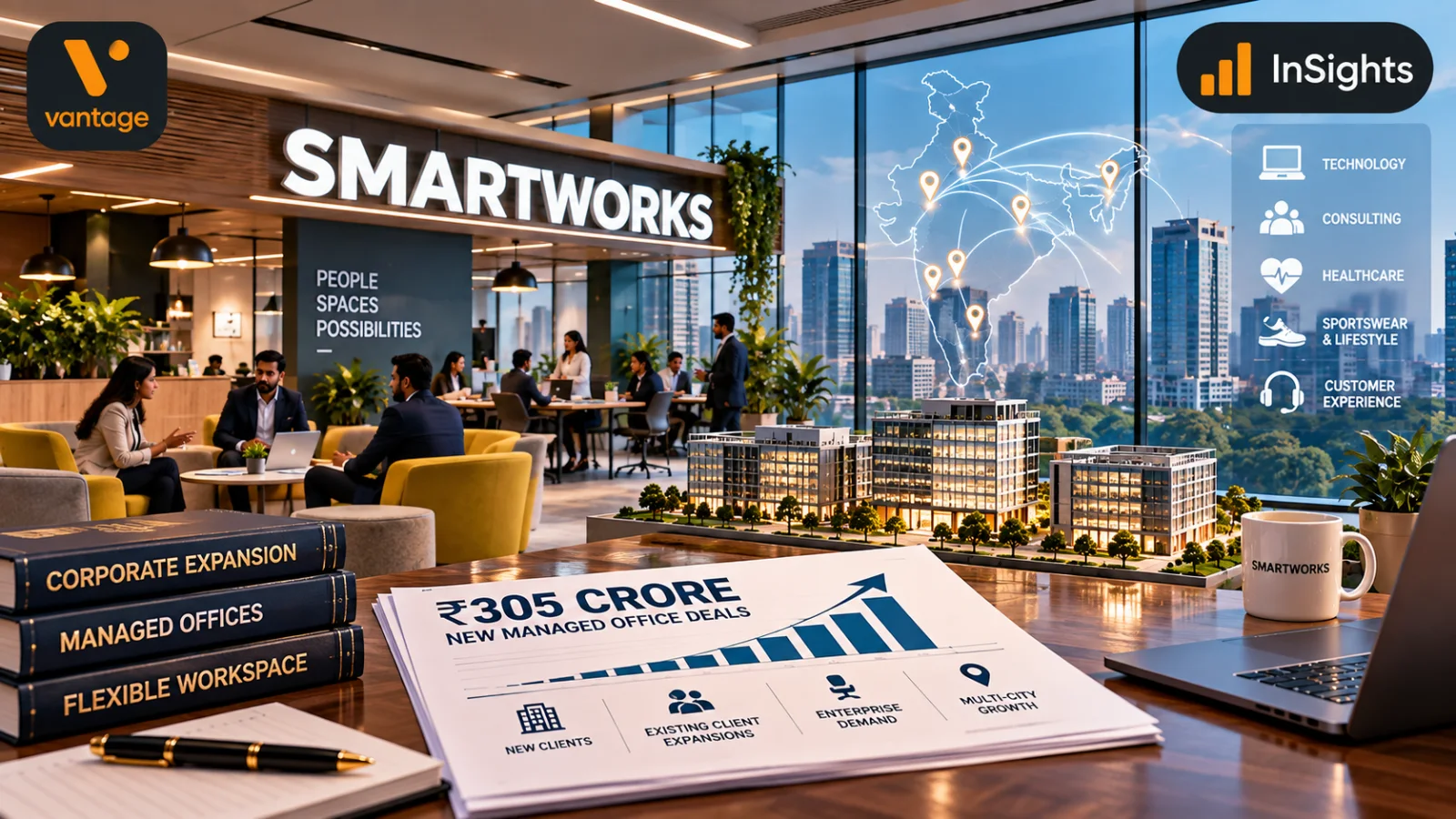
A modern Smartworks managed-office environment showing corporate professionals alongside a multi-city India map, office-building models and enterprise-sector indicators. The foreground highlights the ₹305 crore of new managed-office contracts, while references to corporate expansion, flexible workspace and existing-client growth illustrate Smartworks’ broader enterprise-office strategy.
Inline Intelligence
The most interesting number in Smartworks' latest announcement may not be ₹305 crore.
It may be ₹540 crore.
Smartworks has signed approximately ₹305 crore of new managed-office engagements with corporate customers after recently announcing another ₹235 crore of contracted rental revenue from existing clients expanding their requirements.
Together, the two developments represent approximately ₹540 crore of incremental contracted rental revenue.
That equals 10% of Smartworks' ₹5,400 crore contracted rental revenue base as of 30 June 2026, based on a Vantage calculation.
But the 10% figure is not a revenue-growth rate.
The more important signal is behavioural:
companies are not only entering managed offices—they are expanding within them.
That suggests India's flexible-workspace story is increasingly becoming an enterprise corporate-real-estate story, rather than simply a coworking story.
Managed Offices and Coworking Are Not Quite the Same Story
The word “coworking” can create the wrong mental image.
It often suggests freelancers, startups and individuals renting desks in shared offices.
Smartworks' operating model is much more enterprise-oriented.
The company says approximately 92% of its rental revenue comes from enterprise clients.
It operates large campuses and serves mid-to-large companies, including multinational corporations and major Indian businesses.
This means the structural shift to watch is not merely whether more people are using flexible desks.
It is whether corporations are changing how they procure and operate office real estate.
Why Would a Large Company Use Managed Offices?
Consider a company entering a new Indian city.
Under a conventional model, it may need to:
- identify a suitable office building;
- negotiate a long-term lease;
- design the workplace;
- fund the fit-out;
- procure furniture and technology;
- hire facilities teams;
- manage amenities; and
- maintain the property.
That process requires capital, management time and execution capability.
A managed-office provider can bundle much of this into one solution.
The corporate customer can focus more directly on:
How many employees need space?
Where should the office be?
How quickly does it need to become operational?
This can be particularly attractive when companies are entering new markets or expanding quickly.
Why the Existing-Client Expansion Number Matters
New customer wins demonstrate demand.
Existing-customer expansion can reveal something different: product acceptance after actual use.
Smartworks recently reported approximately ₹235 crore of incremental contracted rental revenue from expansions by existing clients.
That suggests some enterprises already using its campuses have chosen to increase their requirements.
When combined with ₹305 crore from new clients, the picture becomes more useful.
Demand is arriving through both:
new logos
and
deeper relationships with existing occupiers.
For a workspace operator, those two sources of growth can have different economics and risks.
Contracted Revenue Is Visibility, Not Profit
A ₹5,400 crore contracted rental revenue base sounds substantial.
But it is important not to confuse contracted revenue with earnings.
A managed-office operator has its own long-term obligations.
Smartworks leases large properties and then invests in transforming them into managed campuses.
That means the economics involve both sides of the equation.
Customer side
The operator needs occupiers generating rental and service revenue.
Property side
The operator has commitments to landlords and costs associated with running the campuses.
The crucial analytical question is therefore not simply:
How much revenue is contracted?
It is:
How profitably can contracted customer revenue be matched against property, fit-out, financing and operating costs?
Why Long-Term Property Commitments Create Operating Leverage
The managed-office model can benefit substantially when occupancy is high.
Once a campus has been leased and fitted out, additional occupied seats can improve the utilisation of the underlying asset.
But the reverse also applies.
If an operator commits to large properties and demand weakens, property obligations do not necessarily disappear at the same speed.
That creates operating leverage.
In a strong office market, it can amplify growth.
In a weak market, it can amplify pressure.
This is why occupancy and contracted demand become especially important as operators scale.
The 92% Enterprise Mix Changes the Risk Profile
Smartworks says approximately 92% of rental revenue comes from enterprise clients.
That provides a different demand profile from a workspace business dependent predominantly on individual desks and very small companies.
Large enterprises can bring:
- bigger requirements;
- multi-city demand;
- longer relationships;
- expansion potential; and
- potentially more predictable occupancy.
But enterprise concentration does not remove risk.
Large clients can also negotiate aggressively, consolidate locations or reduce space requirements.
The relevant question is therefore not simply whether customers are large.
It is how diversified the customer base is and how sticky those relationships prove to be.
Multi-City Clients May Be Particularly Valuable
Smartworks reports approximately 35% of revenue from multi-city clients.
That can matter strategically.
Once a workspace operator becomes embedded with a corporate occupier in one location, it may have an opportunity to support the same company elsewhere.
A customer expanding from Bengaluru into Hyderabad, Pune or another city does not necessarily need to restart its entire office-procurement process.
The workspace platform can potentially follow the customer.
That creates a network effect of a different kind:
not more users on a digital platform, but more locations available to an existing corporate relationship.
Large Seat Requirements Show How the Sector Is Changing
Smartworks also reports that approximately 41% of revenue comes from its 1,000-plus-seat customer cohort.
That is important because a requirement for more than 1,000 seats is not a small coworking transaction.
It is a corporate real-estate decision.
At that scale, managed workspaces compete more directly with conventional office leasing and custom corporate campuses.
The distinction between “flex space” and “mainstream office market” therefore becomes less clear.
Managed workspace can increasingly become one of the channels through which conventional corporate demand reaches commercial property.
What Does This Mean for Office Developers and Landlords?
For landlords, a successful managed-office operator can aggregate demand.
Instead of a developer independently sourcing several corporate tenants, a workspace operator can take a large property and fill it with enterprise customers.
That can accelerate leasing of sizeable buildings.
But it also changes counterparty exposure.
The landlord may have a lease with the workspace operator, while the operator carries the relationship with the underlying occupiers.
That makes the operator's:
- balance sheet;
- occupancy;
- customer diversification;
- lease structure; and
- execution capability
important to the property owner.
In other words, managed-office growth does not eliminate leasing risk.
It redistributes it.
Could Managed Offices Take Share From Traditional Leasing?
Potentially—but it is better to think about the market as evolving rather than one format simply replacing another.
Traditional direct leases remain suitable for companies that want:
- complete control of premises;
- long occupancy horizons;
- customised corporate environments; and
- economics that justify their own fit-out investment.
Managed offices can become more attractive when businesses prioritise:
- speed;
- flexibility;
- outsourced operations;
- capital efficiency; and
- multi-city scalability.
A large corporation can also use both models simultaneously.
Headquarters might remain conventionally leased while growth teams, satellite offices or new-market operations use managed space.
GCC Growth Could Strengthen the Managed-Office Proposition
India's office market is increasingly influenced by Global Capability Centres.
GCCs can require substantial employee capacity while also needing to establish operations quickly.
That creates a potentially attractive use case for managed workspaces.
A company can enter a market without immediately undertaking the full real-estate process required for a conventional standalone campus.
As its workforce stabilises, it can decide whether to remain in managed space, expand there or move part of its operations elsewhere.
This makes flexible workspace potentially relevant not just for temporary demand but for market-entry strategy.
The Metrics Investors Should Watch
The ₹305 crore headline provides evidence of new bookings.
But several other indicators matter more for evaluating whether the model creates sustainable value.
Occupancy
Is the existing portfolio being filled efficiently?
Revenue conversion
How quickly does contracted revenue become reported revenue?
Expansion from existing customers
Are customers increasing space after joining?
Client retention
Do enterprise customers remain through renewal cycles?
Operational versus total footprint
How quickly does committed space become revenue-producing?
Capital expenditure
How much money is required to open each additional campus?
Lease liabilities
What long-term obligations sit behind the operating footprint?
Profitability and cash generation
Does greater scale produce sustainable earnings and cash flow?
These indicators determine whether contracted revenue represents economically attractive growth.
What Would Make the Managed-Office Thesis Stronger?
The thesis becomes stronger if several things happen simultaneously:
enterprise demand continues growing;
existing customers keep expanding;
occupancy remains high;
new campuses become operational quickly;
margins improve with scale;
and
long-term lease commitments remain covered by diversified customer demand.
In that scenario, managed workspace could take a larger role in India's mainstream corporate real-estate market.
What Could Challenge It?
The model can become more difficult if:
- corporate hiring slows;
- companies consolidate offices;
- operators add capacity faster than demand;
- fit-out costs rise;
- lease commitments become excessive;
- competition pressures pricing; or
- enterprise clients demand greater flexibility than operators receive from landlords.
The key mismatch to watch is therefore:
long-term property commitments versus potentially changing occupier requirements.
That is the fundamental trade-off in the managed-office model.
The Bigger Real-Estate Shift
Smartworks' ₹305 crore announcement is a company event.
But the more important question is what it says about the office itself.
For decades, large companies typically treated offices as infrastructure they needed to lease, fit out and operate.
Managed-office providers are asking companies to treat workspace more like a service.
That shifts some capital expenditure, operational work and real-estate execution away from the occupier.
If enterprise adoption continues, commercial real estate will increasingly involve three parties rather than two:
landlord → managed-office operator → corporate occupier.
Each participant carries a different piece of the risk.
The landlord provides the asset.
The workspace operator takes property and operating commitments.
The corporation purchases a managed workplace.
That is why the latest Smartworks numbers matter beyond one ₹305 crore announcement.
They provide another piece of evidence that flexible workspace is moving deeper into mainstream enterprise real estate.
Frequently Asked Questions
Why are large companies choosing managed offices in India?
Managed offices can allow companies to enter markets and expand teams without independently fitting out and operating each workplace. Their attraction can include speed, flexibility and lower internal real-estate management requirements.
What does Smartworks' ₹540 crore contracted revenue addition mean?
It combines approximately ₹305 crore from newly signed corporate clients and ₹235 crore from recent expansions by existing clients. It represents incremental contracted rental revenue rather than revenue already recognised.
Is ₹540 crore equal to 10% growth for Smartworks?
No. ₹540 crore equals 10% of the ₹5,400 crore contracted rental revenue base reported at 30 June 2026, but this is only a Vantage-derived scale comparison. It is not a reported revenue-growth rate.
Are managed offices replacing traditional office leases?
They are becoming an increasingly important alternative for some corporate requirements, but traditional leases remain relevant. Large companies can use both models depending on tenure, control, cost and flexibility requirements.
Why do existing-client expansions matter for managed-office operators?
They can indicate that customers already using the platform are increasing their requirements. This provides a different demand signal from acquiring new customers alone.
What is the biggest risk in the managed-office business model?
One structural risk is a mismatch between relatively long property commitments and changing customer demand. Occupancy, customer retention, lease obligations and operating costs therefore matter alongside contracted revenue.
What should commercial-property landlords watch as managed offices grow?
Landlords should assess the operator's financial strength, occupancy, customer diversification and ability to service long-term lease commitments because the operator may become the landlord's direct tenant even when multiple corporations occupy the property.
Sources
Click on article title to view article.
“Smartworks wins Rs 305 crore managed office deals as corporate demand stays strong” published on 1 October 2026 in Moneycontrol
“Smartworks adds ₹305 crore in contracted rental revenue from new clients” published on 30 September 2026 in Business Standard
“Smartworks to get Rs 305 cr office rent from new corporate clients” published on 30 September 2026 in The Economic Times
“Investor Relations — Smartworks Coworking Spaces Limited” accessed on 4 October 2026 from Smartworks
Evidence Caveats
Contracted rental revenue measures revenue associated with signed engagements over their contractual periods. It should not be treated as cash already received, current-period reported revenue or profit.
The 10% comparison between ₹540 crore of recently announced additions and the ₹5,400 crore June contracted base is a Vantage-derived indicator, not company guidance.
Statements concerning the wider implications for landlords, corporate occupiers and managed-office operators are editorial analysis based on the structure of the model rather than forecasts of Smartworks' financial performance.
No verified information in the reviewed announcement establishes:
- square footage associated with the ₹305 crore contracts;
- seats associated with those contracts;
- individual client identities;
- city-level allocation;
- individual contract rents;
- profitability of the new engagements;
- future renewal rates; or
- future occupancy generated by these contracts.
These remain unavailable rather than estimated.

From TatvaOps
Property Management & Rental Operations
Building or extending your home?
Run your residential build with verified contractors and daily progress tracking.
Free quotes · Verified contractors · tatvaops.com
Discuss this article
Join the conversation
Continue this discussion on Forums. A board named like this InSights article is filed under InSights.
1 reply already on Forums
More from Real Estate
LTCG Tax Debate: Should You Delay Selling Investments?
Could waiting for LTCG tax relief cost more than it saves? With proposals under discussion, we examine how your current tax liability, market exposure and cash deadline should shape a planned investment sale.
Blackstones India Bet: What Should You Check?
Blackstone’s $100-billion India ambition is a useful signal. For your own money, the harder questions are access, valuation, cash flow and risk. Here is what to check before turning institutional optimism into a personal investment decision.
Senior Living: Buy the Home, Examine the Services: what most readers overlook
Rustomjee’s senior-living evaluation raises a household question: can you afford and rely on the services after buying the home? We examine recurring charges, operator responsibilities, changing support needs and exit flexibility.
Inline Intelligence
Key Insight Actions
Connected knowledge for Real Estate Market Analysis
Move between tutorials, discussions, Studio, and hubs without losing context.
Related discussions
Topic hubs
Conclusion Intelligence
Related Discussions
Supertech Delays: What Makes a Completion Date Credible?
Popular in insights discussions1 reply
WeWork India Adds 4,500+ Desks in Whitefield and Wakad: Are Offices Following Employees Home?
Popular in insights discussions1 reply
GST ITC Relief: Can Property Investors Count on Savings?
Popular in insights discussions1 reply
Was this helpful?
Let us know what you think