

A 25-Basis-Point RBI Hike Looks Small. For Housing Affordability, the Starting Point Matters
Karthik posts articles on Energy and Construction.
Summary
With home prices already higher, the real test is whether rising borrowing costs change budgets, locations, unit choices and purchase timing. A quarter of a percentage point does not sound like much. But housing affordability is not determined by interest rates alone. It depends on the combination of home prices, household income, loan size, interest rate and repayment period . That makes the Reserve Bank of India's latest decision more consequential than the headline increase suggests.
Published on
Inline Intelligence
A quarter of a percentage point does not sound like much.
But housing affordability is not determined by interest rates alone.
It depends on the combination of home prices, household income, loan size, interest rate and repayment period.
That makes the Reserve Bank of India's latest decision more consequential than the headline increase suggests.
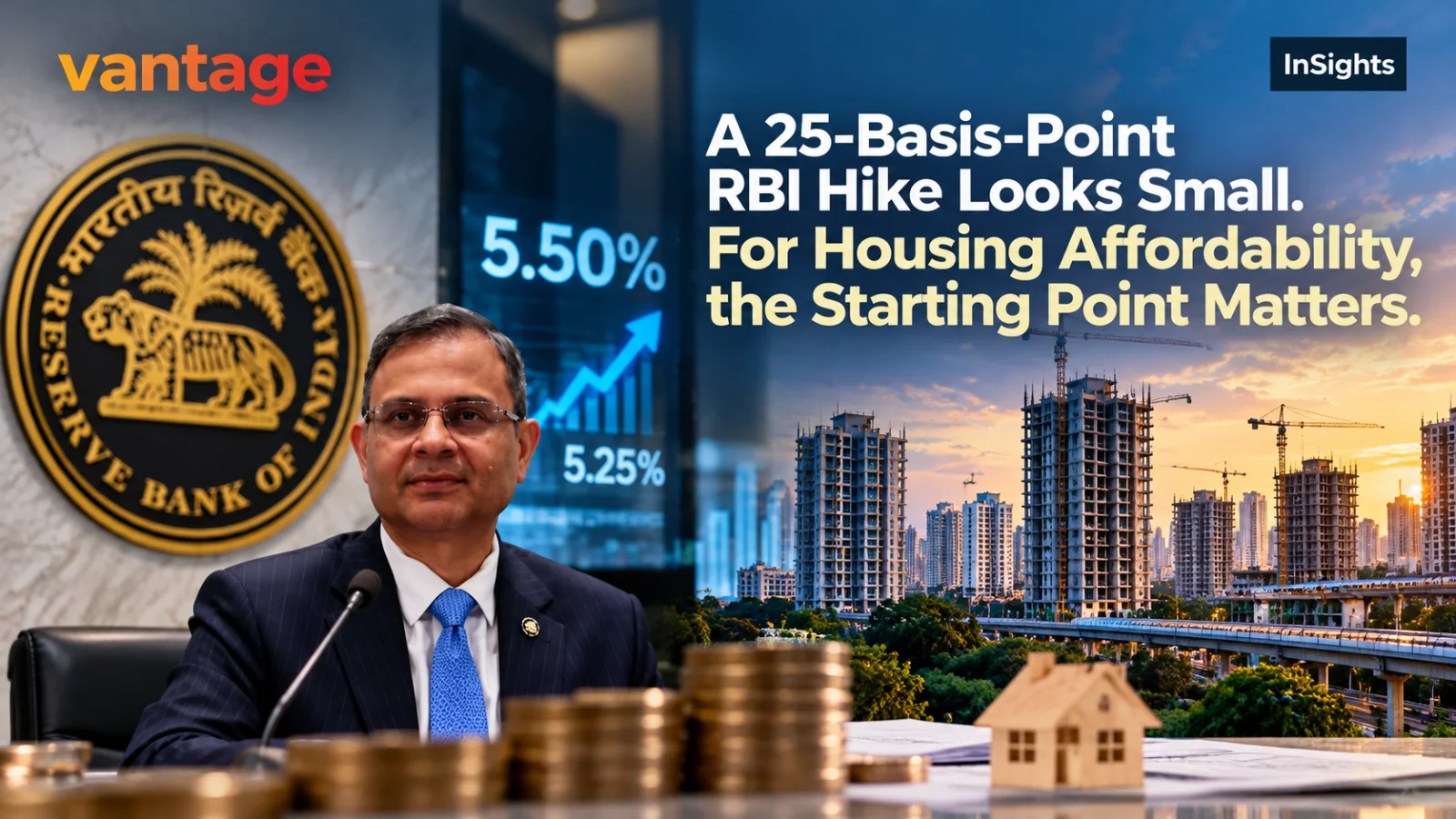
On 7 October 2026, the Monetary Policy Committee unanimously increased the repo rate by 25 basis points to 5.50% and shifted its stance from neutral to calibrated tightening.
It was RBI's first repo-rate increase since February 2023.
For Indian housing, however, the important question is not whether every buyer can absorb one additional 25-bp increase.
Many can.
The question is which buyers were already close to their affordability limit before rates started rising.
Housing enters this cycle from a different price base
India's residential market is not entering monetary tightening from the same position it occupied several years ago.
According to ANAROCK data reported by Business Standard, average residential prices across India's top seven cities increased 7% year-on-year during Q3 2026.
Approximately 100,220 homes were sold during the quarter, up 3% year-on-year.
Affordable housing accounted for 16% of those sales.
So RBI's increase arrives after property prices have already risen across major urban markets.
That matters because interest rates operate on the amount borrowed.
The larger the home price and loan, the greater the rupee effect of a change in financing cost.
The EMI headline can be misleading
When RBI changes the repo rate, borrowers often ask a simple question:
How much will my EMI increase?
But there is no single answer.
The impact depends on the loan amount, remaining tenure, interest rate, benchmark, lender and reset schedule.
Some floating-rate borrowers may see their EMI rise.
Others may retain approximately the same monthly payment while their loan tenure increases.
Some may experience both.
That means two borrowers with apparently similar loans can experience the same rate increase differently.
The correct affordability question is therefore broader:
How much of the household's future income is being committed to servicing the home?
Consider the direction, not just one instalment
Suppose a household has carefully selected a home because its EMI fits within a monthly budget.
A small rate increase may still be manageable.
But if the household is simultaneously dealing with a higher property price, larger down payment, rising living costs and other debt obligations, the available buffer can shrink.
This is why marginal changes matter most near an affordability boundary.
A wealthy buyer purchasing a premium home with low leverage may barely change behaviour after a 25-bp increase.
A first-time buyer relying heavily on mortgage finance may reconsider the purchase price, location or timing.
The same monetary-policy decision can therefore produce very different property-market outcomes.
India's housing market is already segmented
Industry reaction after the RBI decision points towards that divergence.
Affordable and mid-income housing are expected to be more sensitive to higher borrowing costs.
Premium housing is expected to be more resilient.
This should not be surprising.
Mortgage sensitivity generally increases when the loan represents a larger share of the purchase price and the EMI consumes more of household income.
Premium buyers may also have more flexibility in down payments, loan size and timing.
That creates a risk for anyone reading aggregate housing statistics.
Total sales could remain relatively strong even while financing-dependent buyers retreat.
A market can therefore look healthy at the top while affordability deteriorates lower down.
Watch what buyers change
The clearest evidence may not initially appear as a collapse in sales.
Buyers have several ways to respond before abandoning a purchase altogether.
They can:
- reduce the budget;
- increase the down payment;
- choose a smaller unit;
- move farther from an employment centre;
- select a different project;
- extend the loan tenure;
- postpone the transaction.
Those behavioural adjustments matter for the built environment.
If buyers move outward to preserve affordability, transport connectivity becomes more important.
If they choose smaller homes, unit mix can change.
If purchases are delayed, developers may adjust launch schedules or payment plans.
If affordability pressure persists, the geography and design of housing supply can eventually respond.
Interest rates therefore influence more than mortgage payments.
They can influence what gets built, where it gets built and who can buy it.
Developers are borrowers too
The second-order effect sits on the supply side.
Developers use capital for land, approvals, construction and working capital.
A higher-rate environment can increase financing costs and change project returns.
The impact will not be identical across developers.
Companies with strong balance sheets, high pre-sales and access to institutional capital may have greater flexibility.
More leveraged developers may face tougher decisions around new land acquisitions and project launches.
This could reinforce an existing advantage for developers with stronger balance sheets.
It could also increase the importance of alternative financing structures, private credit and institutional equity.
For property investors, monetary tightening therefore changes both sides of the market:
what buyers can afford and what developers can finance.
One 25-bp increase is not the central risk
RBI's change in policy stance is especially important here.
The MPC moved from neutral to calibrated tightening.
Governor Sanjay Malhotra said the duration and extent of the rate-hike cycle would depend on growth and inflation developments.
That means another increase is not predetermined.
But rate cuts are no longer the immediate direction of travel.
For housing, the difference between one increase and a cycle is significant.
A single adjustment can often be absorbed through household budgeting, developer incentives or lender structures.
Repeated increases can accumulate.
At that point, affordability pressure can become behavioural rather than mathematical.
People stop asking how much more the same house costs each month.
They start asking whether they should buy the same house at all.
Strong economic growth complicates the picture
The monetary environment is tightening, but RBI is not forecasting a weak economy.
It projects 7.1% real GDP growth for FY27.
That matters because property demand depends on income and confidence as well as interest rates.
Strong employment, salary growth and business activity can offset part of the affordability impact from higher borrowing costs.
Infrastructure investment can also support new development corridors and property demand.
So the housing outlook cannot be inferred from repo rates alone.
The market is being pulled by two opposing forces:
higher financing costs on one side, and relatively strong economic growth on the other.
The balance will differ by city, price segment and household.
Commercial property faces a different equation
The RBI decision also illustrates why "real estate" should not be treated as one interest-rate-sensitive market.
Office demand depends heavily on occupier activity, business expansion, global capability centres, technology companies and BFSI.
Commercial-property valuations and financing costs can respond to interest rates, but tenants do not decide whether to lease office space using the same affordability calculation as a household buying a home.
Retail has another exposure.
If tighter monetary conditions reduce discretionary consumption, retailers and shopping centres could eventually experience softer spending growth.
Warehousing, hospitality, data centres and other specialised assets each have their own demand drivers.
A repo-rate increase therefore moves through different parts of the built environment through different channels.
The affordability test is really a segmentation test
The next few quarters could reveal something important about India's residential market.
If higher rates have little effect on premium sales but affordable and mid-income volumes weaken, the issue will not be a broad housing downturn.
It will be increasing segmentation by financial capacity.
That matters for developers.
It matters for lenders.
And it matters for policymakers concerned with home ownership.
A housing market can produce strong sales values while serving fewer households at the lower end of the income distribution.
That is why unit sales, ticket sizes and price growth need to be read together.
What should Vantage track from here?
The first indicator is home-loan pricing.
How much of the repo increase is transmitted, and how quickly?
The second is buyer behaviour.
Do purchasers accept higher EMIs, extend tenures, reduce budgets or delay transactions?
The third is sales composition.
Do affordable and mid-income homes lose share while premium housing remains resilient?
The fourth is developer financing.
Do higher borrowing costs reduce land purchases or project launches among more leveraged companies?
And the fifth is RBI itself.
If October proves to be a single insurance hike, the property impact may remain limited.
If it becomes the first step in a longer tightening cycle, affordability calculations will change progressively.
That distinction matters much more than 25 basis points on its own.
For India's housing market, the next monetary-policy cycle may therefore answer a deeper question:
How much of recent housing resilience came from strong underlying demand, and how much depended on buyers continuing to stretch their affordability?
If you are buying, selling, financing or developing housing, has the latest increase actually changed a decision yet? Or would it take another rate increase before behaviour changes?
If this analysis could help a buyer, developer, lender, investor or adviser think more clearly about the affordability implications, consider sharing it with them.
FAQ
What did RBI decide in October 2026?
The Monetary Policy Committee unanimously increased the policy repo rate by 25 basis points from 5.25% to 5.50% on 7 October 2026.
Why is the change in policy stance important?
RBI moved from a neutral stance to calibrated tightening. That indicates a greater focus on containing inflation risks and means near-term monetary easing is no longer the central expectation.
Will every home-loan EMI immediately increase?
No. Transmission depends on the loan's benchmark, interest-rate structure, lender and reset date. Borrowers may experience a higher EMI, longer tenure or both.
Which housing buyers are likely to be most sensitive?
Financing-dependent affordable and mid-income buyers are generally more exposed because mortgage payments can consume a larger proportion of household income.
Does the rate increase mean housing sales will fall?
Not necessarily. Housing demand also depends on income growth, employment, property prices, supply and buyer confidence. Premium and less leveraged buyers may be relatively resilient.
How can higher rates affect developers?
They can increase the cost of construction finance, working capital and land acquisition. The effect will vary according to developer leverage, pre-sales, balance-sheet strength and access to alternative capital.
Are commercial properties affected in the same way?
No. Commercial property has different demand and financing channels. Office demand, for example, is influenced by corporate occupiers and business expansion rather than household mortgage affordability.
Why does the next RBI decision matter so much?
One 25-bp increase may be manageable for many borrowers. A series of increases can progressively raise financing costs and eventually change purchasing and development decisions.
What housing indicators should investors watch?
Watch home-loan rates, sales by price segment, average ticket sizes, project launches, developer borrowing costs, unsold inventory and changes in buyer budgets or loan tenures.
Sources
Click on article title to view article
“RBI MPC hikes repo rate by 25 bps to 5.5%, near-term cuts 'off the table'” published on 7 October 2026 in Business Standard
“Indian shares decline as RBI rate hike signals tighter policy” published on 7 October 2026 in Reuters
“RBI rate hike may pressure housing affordability, but demand seen resilient” published on 7 October 2026 in Business Standard
“Repo rate hike may raise costs, but real estate demand to stay resilient” published on 7 October 2026 in Business Standard
“RBI repo rate hike: What does a 25 basis point increase mean for your home loan EMI?” published on 7 October 2026 in Hindustan Times
Evidence Caveats
The RBI policy decision, repo rate and policy stance are observed policy outcomes. However, at the time of this package, RBI's own October 2026 policy page was not reliably surfaced through its searchable web archive, so the decision has been cross-verified through multiple current reports rather than linked to an unverified RBI URL.
Statements about the likely impact on different housing segments are analytical interpretations supported by current industry reporting. They should not be read as evidence that sales have already declined because of the October increase.
The Q3 2026 housing sales and price figures cited in this article originate from ANAROCK research reported by Business Standard. They are industry research rather than official transaction statistics.
Actual home-loan transmission varies by lender, benchmark, borrower profile and reset date. A 25-bp repo increase does not imply that every mortgage rate or EMI rises by exactly 25 basis points.
Add your experience to the Vantage discussion: has the October rate increase changed an actual home purchase, loan, launch or land decision yet? We are especially interested in evidence that shows where the affordability threshold begins to change behaviour. Where Vantage's participation-points mechanism is active and applicable, substantive participation can also earn points.
Disclaimer
This article is for general information and educational purposes only. It does not constitute financial, investment, lending, legal, tax or real-estate advice. Loan terms, interest-rate transmission, affordability and property-market conditions vary materially by borrower, lender, project and location. Readers should independently verify current lending terms and obtain appropriate professional advice before making financial or property decisions.

From TatvaOps
Property Purchase
Financing your project?
Explore credit and milestone-secured payment options with Tatva Finance.
Free quotes · Verified contractors · tatvaops.com
Discuss this article
Join the conversation
Continue this discussion on Forums. A board named like this InSights article is filed under InSights.
2 replies already on Forums
More from Real Estate
LTCG Tax Debate: Should You Delay Selling Investments?
Could waiting for LTCG tax relief cost more than it saves? With proposals under discussion, we examine how your current tax liability, market exposure and cash deadline should shape a planned investment sale.
Blackstones India Bet: What Should You Check?
Blackstone’s $100-billion India ambition is a useful signal. For your own money, the harder questions are access, valuation, cash flow and risk. Here is what to check before turning institutional optimism into a personal investment decision.
Senior Living: Buy the Home, Examine the Services: what most readers overlook
Rustomjee’s senior-living evaluation raises a household question: can you afford and rely on the services after buying the home? We examine recurring charges, operator responsibilities, changing support needs and exit flexibility.
Inline Intelligence
Key Insight Actions
Connected knowledge for Housing Affordability Analysis
Move between tutorials, discussions, Studio, and hubs without losing context.
Related discussions
Supertech Delays: What Makes a Completion Date Credible?
1 replies
Related discussionGST ITC Relief: Can Property Investors Count on Savings?
1 replies
Related discussionWest Bengal May Scrap the Urban Land Ceiling Act: Will It Make Kolkata Real Estate Cheaper or More Expensive?
1 replies
Related discussionIf India Removes the 45 Lakh Affordable-Housing Cap, What Should Replace It?
5 replies
Related discussion
Topic hubs
Conclusion Intelligence
Related Discussions
Supertech Delays: What Makes a Completion Date Credible?
Popular in insights discussions1 reply
GST ITC Relief: Can Property Investors Count on Savings?
Popular in insights discussions1 reply
West Bengal May Scrap the Urban Land Ceiling Act: Will It Make Kolkata Real Estate Cheaper or More Expensive?
Popular in insights discussions1 reply
If India Removes the 45 Lakh Affordable-Housing Cap, What Should Replace It?
Popular in insights discussions5 replies
Was this helpful?
Let us know what you think