

Indias Inflation Crosses 6 as Food Prices Climb: What Happens Next?

Summary
India’s retail inflation rose to 6.09% in October 2026, crossing the upper end of the Reserve Bank of India’s tolerance band as food prices increased more quickly. The October reading was up from 5.54% in September, according to reports by Reuters and Business Standard. Food inflation rose to 8.94% from 7.74% in September, adding pressure to household budgets and putting future interest rate decisions in focus. What the numbers show Measure September 2026 October 2026 : : Retail inflation 5.54% 6.09% Food inflation 7.74% 8.94% The figures compare prices with the corresponding month a year earlier.
Published on
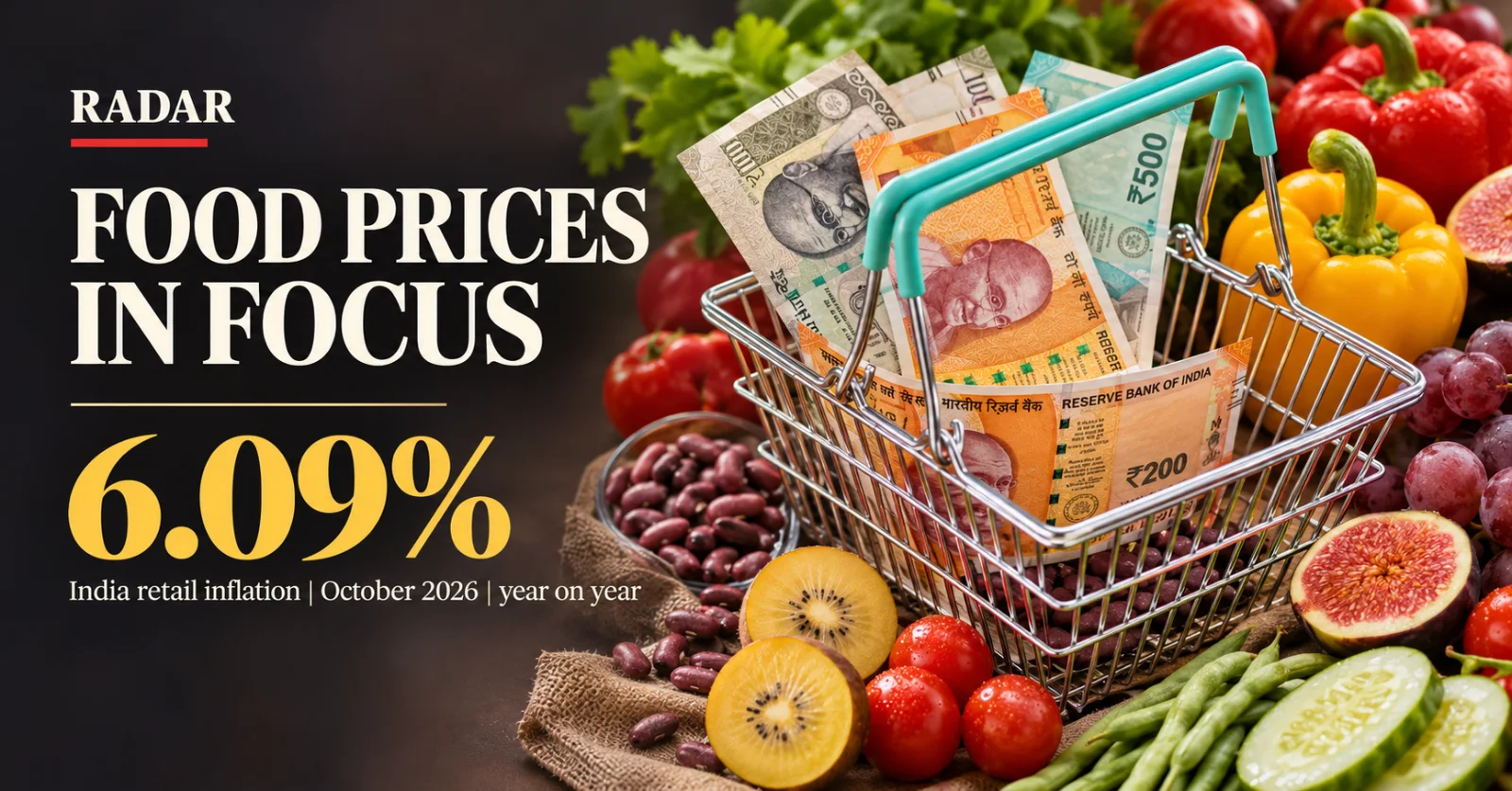
An editorial illustration connects rising consumer prices with everyday grocery spending, alongside the October retail inflation figure.
Inline Intelligence
India’s retail inflation rose to 6.09% in October 2026, crossing the upper end of the Reserve Bank of India’s tolerance band as food prices increased more quickly.
The October reading was up from 5.54% in September, according to reports by Reuters and Business Standard.
Food inflation rose to 8.94% from 7.74% in September, adding pressure to household budgets and putting future interest-rate decisions in focus.
What the numbers show
| Measure | September 2026 | October 2026 |
|---|---|---|
| Retail inflation | 5.54% | 6.09% |
| Food inflation | 7.74% | 8.94% |
The figures compare prices with the corresponding month a year earlier. October’s 6.09% reading does not mean that prices rose by 6.09% between September and October.
The increase from September was 0.55 percentage points for retail inflation and 1.20 percentage points for food inflation.
Why the 6% mark matters
The RBI’s inflation target is 4%, with a tolerance band of 2% to 6%. October’s reading is above that upper boundary.
The RBI raised the repo rate by 25 basis points to 5.50% in October. Higher inflation will be part of the information considered in future policy decisions, but one inflation reading does not establish what the central bank will do next.
What it means for households and homebuyers
Faster increases in food prices can leave households with less money for savings, rent or a home-loan payment. The effect will differ depending on what each family buys and how its income changes.
For borrowers, the inflation release does not automatically change an EMI. Any change in a floating-rate home loan depends on the applicable benchmark, lender, reset date and loan terms. A lender may adjust the EMI, the loan tenure or both, depending on the agreement.
Vantage has previously examined how a policy-rate increase can affect housing affordability and home-loan borrowers.
What to watch next
The next inflation readings will show whether price pressure persists or eases. Borrowers and prospective buyers should also watch the RBI’s next policy announcement and any communication from their lenders.
Sources
Click an article title to view the source.
- India October inflation tops RBI’s 6% limit, strengthens case for rate hikes, Reuters, 12 November 2026.
- Retail inflation at 6.09% in October, breaches RBI’s upper band after 2 yrs, Business Standard, 12 November 2026.
- A 25-Basis-Point RBI Hike Looks Small. For Housing Affordability, the Starting Point Matters, Vantage InSights, October 2026.
What are you watching more closely: grocery costs, savings returns or your home-loan rate? Join the discussion.

From TatvaOps
Property Purchase
Financing your project?
Explore credit and milestone-secured payment options with Tatva Finance.
Free quotes · Verified contractors · tatvaops.com
Discuss this article
Join the conversation
Continue this discussion on Forums. A board named like this Radar article is filed under Radar.
More from Real Estate
Bharat Future City Core Works Estimated at 18000 Crore
Telangana's reported estimate for roads, utilities and other core infrastructure at Bharat Future City is close to ₹18,000 crore. A master plan unveiling is expected in December.
Telangana to Return Title Deeds to Housing Beneficiaries
Telangana plans to return original housing documents to nearly seven lakh beneficiaries of older government schemes. District collectors have been asked to arrange the return.
Amrapali Assets Could Be Auctioned. Will That Bring Your Home Closer?
When a court considers recovering money from a developer's assets, a homebuyer may reasonably ask: will that money help finish my flat? The answer depends on several steps that cannot be assumed from a hearing alone. Properties must be identified, any applicable attachment and sale process must be…
Inline Intelligence
Key Insight Actions
Connected knowledge for Economy & Real Estate
Move between tutorials, discussions, Studio, and hubs without losing context.
Related discussions
If India Removes the 45 Lakh Affordable-Housing Cap, What Should Replace It?
5 replies
Related discussionInflation at 5.54: Is a 7 Return Really Enough?
1 replies
Related discussionWest Bengal May Scrap the Urban Land Ceiling Act: Will It Make Kolkata Real Estate Cheaper or More Expensive?
1 replies
Related discussionA 25-Basis-Point RBI Hike Looks Small. For Housing Affordability, the Starting Point Matters
2 replies
Related discussion
Topic hubs
Conclusion Intelligence
Related Discussions
If India Removes the 45 Lakh Affordable-Housing Cap, What Should Replace It?
Popular in insights discussions5 replies
Inflation at 5.54: Is a 7 Return Really Enough?
Popular in insights discussions1 reply
West Bengal May Scrap the Urban Land Ceiling Act: Will It Make Kolkata Real Estate Cheaper or More Expensive?
Popular in insights discussions1 reply
A 25-Basis-Point RBI Hike Looks Small. For Housing Affordability, the Starting Point Matters
Popular in insights discussions2 replies
Was this helpful?
Let us know what you think