

Meghalaya Net Metering Sets Battery Rule Above 10 kW

Summary
Meghalaya requires storage for net metered systems above 10 kW. Check the daily generation estimate, battery size and costs before comparing bids. Meghalaya's 10 November application guidelines confirm that net metered renewable systems above 10 kW need a hybrid inverter and battery storage. The minimum storage is 20% of the system's daily generation potential. The Meghalaya State Electricity Regulatory Commission set the battery requirement in its 26 October amendment. The November guidelines carry that requirement into the application process and lay out how the distribution licensee, MePDCL, handles technical feasibility and connection.
Published on
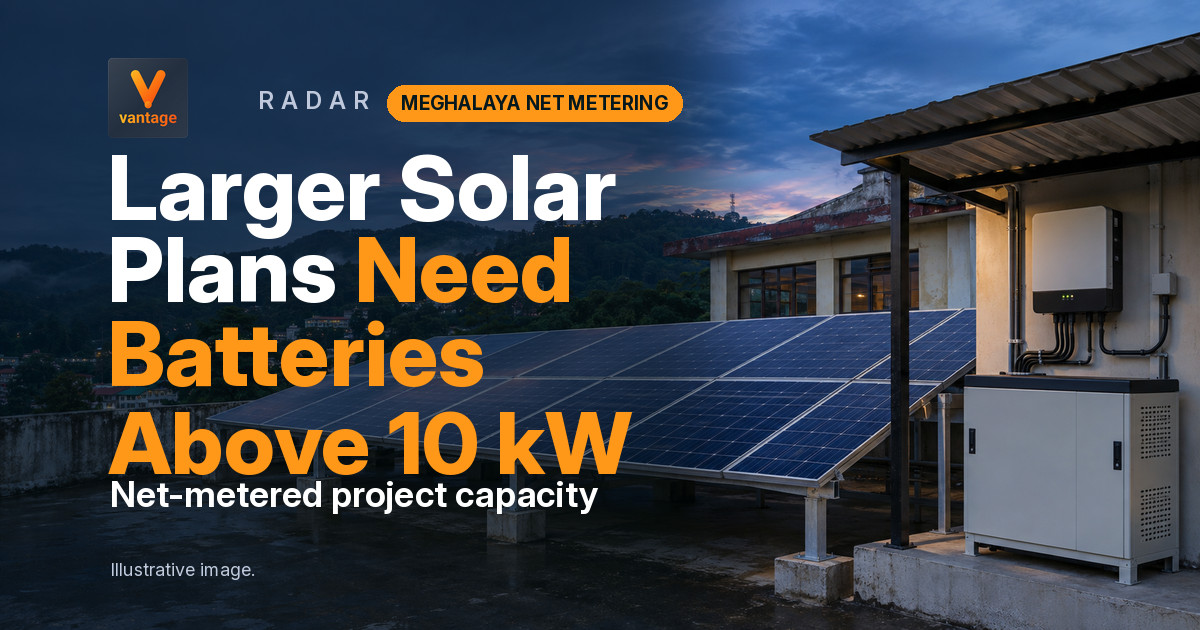
Meghalaya net metering requires batteries for projects above 10 kW, illustrated by a rooftop array with a storage cabinet
Credit: Illustrative image
Inline Intelligence
Meghalaya's 10 November application guidelines confirm that net-metered renewable systems above 10 kW need a hybrid inverter and battery storage. The minimum storage is 20% of the system's daily generation potential.
The Meghalaya State Electricity Regulatory Commission set the battery requirement in its 26 October amendment. The November guidelines carry that requirement into the application process and lay out how the distribution licensee, MePDCL, handles technical feasibility and connection. Mercom India reported the storage requirement on 16 November.
Under the guidelines, net-metered systems have a minimum capacity of 1 kW. The general maximum is the lower of the consumer's sanctioned load or contracted demand and 500 kW. The rules preserve a specific exception for certain previously approved systems above 500 kW. Anyone relying on a prior approval should confirm its terms with the distribution licensee.
The battery requirement introduces another line item for a building planning a larger installation. The threshold is stated in kilowatts, which measure power. The storage calculation uses expected daily generation in kilowatt-hours, a measure of energy. The choice of design therefore affects both the equipment list and what the applicant must document.
Under net metering, exports can offset electricity imported from the grid. MSERC's guidelines say fixed or demand charges and government duties can still be payable. Buyers comparing returns should check those bill lines before accepting a supplier's estimate.
For the wider rooftop market, see the Vantage report on installation volumes. India Rooftop Solar Additions Reach 4.7 GW in Q3
What to Check
- Find the sanctioned load or contract demand on your latest electricity bill and ask MePDCL to confirm the capacity the connection can support.
- Ask each vendor for its daily generation assumption and a separate quote for the hybrid inverter and battery.
- If the proposal sits close to 10 kW, ask MePDCL how it measures the project capacity for the application.
Sources
Click an article title to view the source.
- Guidelines for application for Grid-Interactive Distributed Renewable Energy Sources dated 10 November 2026 and listed by MSERC.
- Grid Interactive Distributed Renewable Energy Sources First Amendment Regulations 2026 dated 26 October 2026 by MSERC.
- India Rooftop Solar Additions Reach 4.7 GW in Q3 published on 13 November 2026 in Vantage.
If you have compared two net-metering proposals, share which generation or storage assumption you found hardest to verify in the attached forum discussion.

From TatvaOps
Solar & Energy Solutions
Considering rooftop solar?
Verified installers, subsidy support, and milestone-secured payments.
Free quotes · Verified contractors · tatvaops.com
Discuss this article
Join the conversation
Continue this discussion on Forums. A board named like this Radar article is filed under Radar.
More from Solar
Indias Rooftop Solar Additions Reach 4.7 GW in Q3
India added approximately 4.7 gigawatts GW of rooftop solar capacity in July–September 2026, more than the 2.1 GW recorded in the same quarter a year earlier, according to Mercom India Research. The increase came as large scale solar installations slowed compared with the preceding quarter.…
Maharashtra Solar Buyers Reassess Project Savings
Businesses considering solar power in Maharashtra are taking another look at how much electricity they can use, bank or purchase from the grid as banking rules and power charges influence project economics. Mercom India reported on 13 November that changes involving electricity banking, time of day…
CBI Files Four Chargesheets in Manesar Land Case, Names M3M Promoter
The Central Bureau of Investigation CBI has filed four chargesheets in the Manesar land case, naming M3M Group promoter Roop Bansal as an accused, according to The Times of India. The chargesheets were filed on 6 November 2026 before a special CBI court in Panchkula. The court has set 11 December…
Inline Intelligence
Key Insight Actions
Connected knowledge for Solar Policy
Move between tutorials, discussions, Studio, and hubs without losing context.
Related discussions
Topic hubs
Conclusion Intelligence
Related Discussions
Was this helpful?
Let us know what you think