

Data Centres Next Door: What Should Homebuyers Check?
Karthik posts articles on Energy and Construction.
Summary
Thane’s data centre dispute raises a practical homebuyer question: which safeguards can be verified? We examine site disclosures, water and power commitments, monitoring and the limits of property price claims. A data centre can serve a national economic priority while raising a very local question: what will living beside it be like? Thane’s dispute makes that question concrete. Earlier local reporting documented opposition around a proposed Amazon facility In the shadow of the cloud: Thane protests proposed hyperscale data centre. The useful response is to identify what can be checked.
Published on
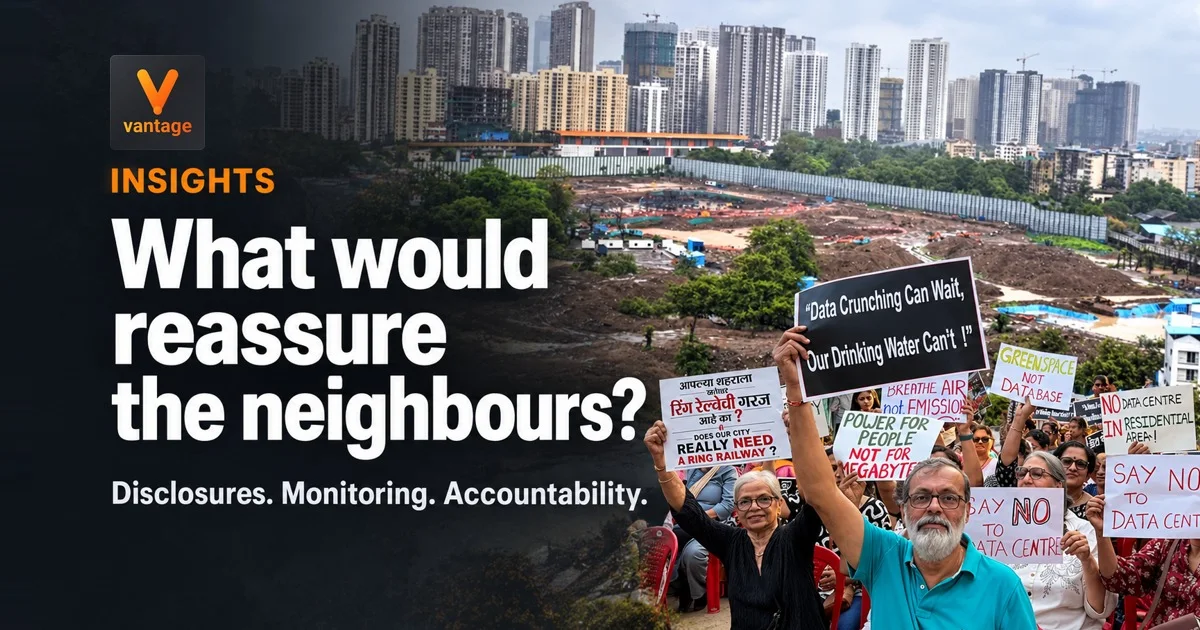
Hero image for this InSights article on Data Centres Next Door, illustrating data centres in a 16:9 landscape frame.
Inline Intelligence
A data centre can serve a national economic priority while raising a very local question: what will living beside it be like?
Thane’s dispute makes that question concrete. Earlier local reporting documented opposition around a proposed Amazon facility -> In the shadow of the cloud: Thane protests proposed hyperscale data centre.
The useful response is to identify what can be checked. An investment announcement cannot establish residential suitability, while objections alone cannot establish environmental harm or a loss in property value.
What evidence would resolve the disagreement?
A credible assessment needs three layers: the approved project design, the operator’s specific commitments and evidence of performance once operations begin.
These answer different questions. A design describes the intended facility. A commitment explains what its operator says it will do. Monitoring tests what actually happens.
Residents and buyers should therefore ask for information that can be compared over time, rather than assurances that remain too broad to evaluate.
Vantage’s earlier analysis examined how land and power support digital infrastructure -> Indias Data-Centre Boom Is Turning Power and Land Into Digital Infrastructure. The neighbourhood question adds another consideration: how that infrastructure fits beside existing homes.
Does “no cooling water” mean no water use?
No. Amazon’s explanation distinguishes cooling from other uses. It states that the proposed Thane facility will use 125 kilolitres of water daily: 10 for employees’ basic needs and 115 of treated sewage water for landscaping and irrigation.
The distinction matters because a claim about one system should not be read as a claim about the entire facility.
For buyers, the useful documents would identify the water sources, permitted quantities and arrangements for interruptions. Those questions should be answered for the particular project, rather than through assumptions about data centres generally.
The company’s explanation is here -> Facts about Amazon's upcoming data centre in Thane, Maharashtra.
What should neighbours ask about noise and power?
Amazon says its Thane project will use a dedicated high-voltage connection and incorporate noise mitigation. These statements should lead to precise questions, not automatic conclusions about either harm or safety.
For noise, ask where measurements will be taken, which operating conditions they will cover and whether results will be available to residents. Construction, ordinary operation and backup-power testing should be considered separately.
For electricity, ask the relevant utility to explain the connection and capacity arrangements. A dedicated connection addresses how the facility receives power; it does not, by itself, answer every question about the wider electricity system.
These are suggested due-diligence questions, not findings that the project will cause outages or exceed noise limits.
Can nearby homes lose value?
This package contains no verified transaction study demonstrating such a loss.
A buyer should distinguish a change in asking price from completed transactions, and a seller’s explanation from evidence of causation. Even a recorded price movement would need context: comparable homes, transaction dates, building condition and broader market changes.
The practical approach is to compare suitable properties and investigate the adjoining development. Applying an assumed “data-centre discount” would give uncertainty a false numerical precision.
The same caution applies to promised gains. A major infrastructure investment does not automatically make every nearby residential property more valuable.
What would a workable neighbourhood agreement contain?
A useful agreement would make responsibilities visible: who monitors performance, who receives complaints, how findings are disclosed and what happens when a problem is confirmed.
Independent technical review could help residents assess claims they cannot reasonably test themselves. Publishing understandable summaries alongside technical documents could also make the discussion more productive.
This is an editorial proposal, not a claim that a particular agreement or monitoring arrangement already exists.
For investors in the facility, neighbourhood acceptance should also be treated as a project consideration. Unresolved concerns can create uncertainty, but the sources reviewed do not establish that this dispute has halted the project.
FAQ
1. Is this a newly started dispute?
No. The Indian Express documented opposition before the October Reuters report. The latest coverage should not be presented as the start of the protests.
2. Does the reporting prove that nearby residents face harm?
No. Reported concerns and proposed safeguards need to be distinguished from independently measured operating effects.
3. Does Amazon say the facility will use no water at all?
No. Its statement separates cooling from water used for employees and landscaping.
4. Does a dedicated power connection resolve every electricity concern?
It explains the proposed supply arrangement. Wider capacity questions require information from the utility and relevant project assessments.
5. Should buyers assume neighbouring homes will become cheaper?
No. A price conclusion requires comparable transaction evidence. No verified project-specific price decline is established here.
6. What should a buyer request first?
Start with the adjoining plot’s approved use, relevant project documents and specific operating commitments. Seek qualified advice where technical interpretation is needed.
Sources
Click an article title to view the source.
- In the shadow of the cloud: Thane protests proposed hyperscale data centre updated on 6 September 2026 in The Indian Express.
- Indias Data-Centre Boom Is Turning Power and Land Into Digital Infrastructure published on 7 October 2026 in Vantage InSights.
- Facts about Amazon's upcoming data centre in Thane, Maharashtra in About Amazon India. Publication date not displayed; reviewed on 11 October 2026.
- Modi wants India to power the AI age, but residents resist data centre boom published on 9 October 2026 in The Financial Express, Bangladesh, reporting by Reuters.
Evidence Caveats
Company statements describe proposed arrangements and commitments, rather than an independent operating audit. The underlying project-specific environmental assessment and clearance conditions were not independently inspected for this article.
The reviewed sources do not establish measured health effects or a transaction-based decline in surrounding home values. Suggested monitoring and disclosure arrangements are editorial recommendations, not verified existing requirements or agreements.
Which independently verifiable safeguard would most influence your assessment of a data centre beside homes? Explain your choice, or share relevant counter-evidence, in the attached forum discussion.
Disclaimer
This article provides general editorial analysis, not personalised investment, legal or environmental advice. Property decisions require site-specific verification and, where appropriate, qualified professional advice.

From TatvaOps
Property Purchase
Want visibility on site progress?
AI-monitored updates and photo proof with Tatva Vision.
Free quotes · Verified contractors · tatvaops.com
Discuss this article
Join the conversation
Continue this discussion on Forums. A board named like this InSights article is filed under InSights.
1 reply already on Forums
More from Real Estate
LTCG Tax Debate: Should You Delay Selling Investments?
Could waiting for LTCG tax relief cost more than it saves? With proposals under discussion, we examine how your current tax liability, market exposure and cash deadline should shape a planned investment sale.
Blackstones India Bet: What Should You Check?
Blackstone’s $100-billion India ambition is a useful signal. For your own money, the harder questions are access, valuation, cash flow and risk. Here is what to check before turning institutional optimism into a personal investment decision.
Senior Living: Buy the Home, Examine the Services: what most readers overlook
Rustomjee’s senior-living evaluation raises a household question: can you afford and rely on the services after buying the home? We examine recurring charges, operator responsibilities, changing support needs and exit flexibility.
Inline Intelligence
Key Insight Actions
Connected knowledge for Real Estate & Infrastructure
Move between tutorials, discussions, Studio, and hubs without losing context.
Related discussions
Senior Living: Buy the Home, Examine the Services: what most readers overlook
1 replies
Related discussionIf Green Certification Is Becoming Standard, What Will Make One Office Building Worth More Than Another?
1 replies
Related discussionMerlin Group Plans 10,000 Crore Expansion: Can a 20 Million Sq Ft Pipeline Deliver Without Stretching Execution?
1 replies
Related discussion
Topic hubs
Conclusion Intelligence
Related Discussions
Senior Living: Buy the Home, Examine the Services: what most readers overlook
Popular in insights discussions1 reply
If Green Certification Is Becoming Standard, What Will Make One Office Building Worth More Than Another?
Popular in insights discussions1 reply
Merlin Group Plans 10,000 Crore Expansion: Can a 20 Million Sq Ft Pipeline Deliver Without Stretching Execution?
Popular in insights discussions1 reply
Was this helpful?
Let us know what you think