

Types of Construction Bricks Explained: Uses, Strengths and How to Choose

Devesh S. is an industry researcher and writer who specializes in translating complex industries into clear, trustworthy, and actionable knowledge. His work…
Featured Snippet
The main types of construction bricks include fired clay bricks, fly ash bricks, concrete bricks, engineering bricks, and specialised bricks. The right choice depends on strength, water absorption, weight, wall location, climate, workmanship, and the project's design requirements.
Published on
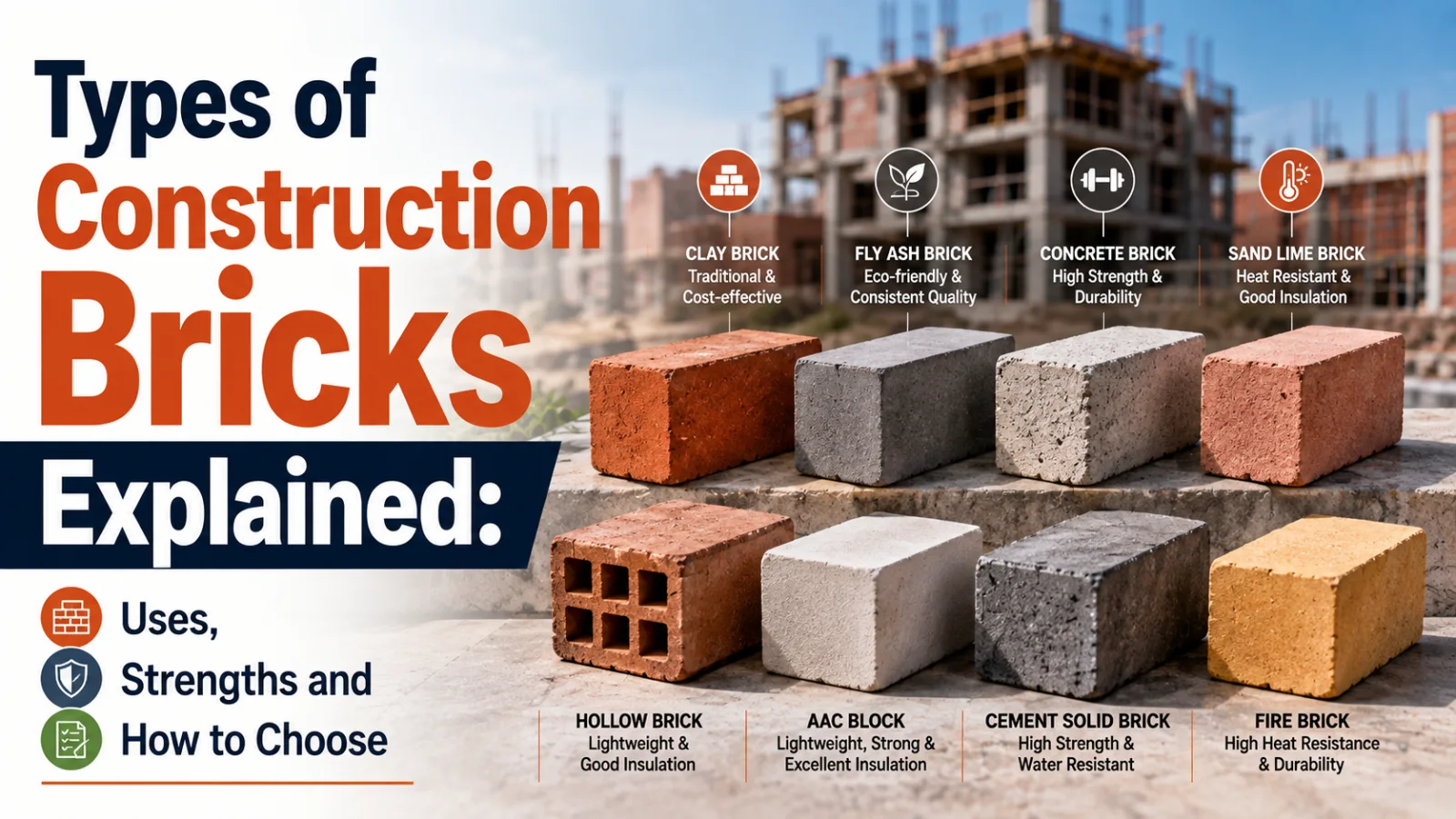
A wall may look simple once it is plastered and painted, but the masonry underneath has a direct effect on durability, moisture behaviour, weight, thermal comfort, and finishing quality. That is why understanding the types of construction bricks before ordering materials can save homeowners from expensive mistakes later.
Bricks are not interchangeable. Traditional fired clay bricks behave differently from fly ash bricks, concrete bricks, and lightweight alternatives such as AAC blocks. Even within the same category, manufacturing quality can vary considerably.
This guide explains the major types of construction bricks, where each type works best, what to check before buying, and how to make a sensible choice for residential construction.
What Are the Main Types of Construction Bricks?
The most common types of construction bricks include fired clay bricks, fly ash bricks, concrete bricks, engineering bricks, and specialised bricks made for particular applications.
For a typical house, the choice usually depends on more than compressive strength. Wall thickness, structural design, water absorption, weight, availability, plaster requirements, workmanship, and the location of the wall all matter.
Quick answer
1. Fired Clay Bricks
Fired clay bricks are among the most familiar masonry materials. They are produced by moulding suitable clay and firing it at high temperatures until the material develops the required hardness and strength.
Their appearance is usually reddish, orange, brown, or a combination of these shades, depending on the clay and firing process.
Why are clay bricks widely used?
Clay bricks have a long history in masonry construction and are familiar to most masons. Good-quality units can provide dependable performance when they are properly manufactured and laid.
They are commonly used for:
- External and internal masonry walls
- Partition walls
- Residential buildings
- Boundary walls
- Architectural brickwork
- Restoration work
One advantage is familiarity. Contractors and masons generally understand how to handle them, cut them, soak them where appropriate, and bond them with mortar.
The downside is variability. Two visually similar stacks can perform differently if their manufacturing quality is poor. Over-burnt, under-burnt, cracked, badly shaped, or highly porous bricks can create problems during masonry and plastering.
2. Fly Ash Bricks
Fly ash bricks are manufactured using fly ash along with other materials such as cement, sand or stone dust, depending on the manufacturing process.
They are generally uniform in shape and surface finish. Their relatively consistent dimensions can make masonry work more predictable.
What are fly ash bricks used for?
Fly ash bricks are commonly considered for:
- Internal and external walls
- Partition masonry
- Residential construction
- Commercial buildings
- Infill walls within framed structures
Their uniformity can reduce variations in mortar joints and may help produce a smoother masonry surface.
However, the quality of fly ash bricks depends heavily on manufacturing and curing. A brick should not be selected simply because it is labelled "fly ash." The actual product should be checked for strength, dimensions, cracks, surface condition, and water absorption.
3. Concrete Bricks
Concrete bricks are manufactured from cementitious materials combined with aggregates and water. They can be produced in different sizes, colours, textures, and strengths.
Unlike traditional fired clay bricks, they are not dependent on firing clay in a kiln.
Concrete bricks can be useful when consistent dimensions, a particular appearance, or specific performance characteristics are required.
Where are concrete bricks used?
Typical applications include:
- Masonry walls
- Architectural façades
- Boundary walls
- Landscaping features
- Utility structures
- Selected load-bearing applications, where designed and specified appropriately
Their weight can be higher than some lightweight masonry alternatives. That matters because heavier wall systems add dead load to the building.
For a multi-storey house, the structural designer should consider the total wall load rather than choosing bricks in isolation.
4. Engineering Bricks
Engineering bricks are manufactured to achieve particular performance characteristics, especially high strength and low water absorption.
They are often associated with demanding applications where durability and resistance to moisture are important.
Where are engineering bricks useful?
They may be considered for:
- Foundations and substructure masonry where specified
- Areas exposed to significant moisture
- Retaining or structural masonry designed for them
- Drainage-related construction
- Heavy-duty applications
They are usually unnecessary for ordinary partition walls simply because they have high performance. Using a premium brick where its properties provide no practical benefit can increase material costs without improving the building meaningfully.
The key is matching the material to the application.
5. Special-Purpose Bricks
Not every brick is produced for ordinary wall construction. Some are designed for specialised environments or specific visual requirements.
Examples include:
Fire Bricks
Fire bricks are designed to withstand high temperatures. They are used around furnaces, kilns, fireplaces, and other areas where ordinary masonry units may not perform adequately.
They should not be treated as a general-purpose replacement for normal house bricks.
Facing Bricks
Facing bricks are selected partly for their visible appearance. Colour, texture, shape, and consistency become important because the masonry may remain exposed rather than being covered with plaster.
Paving Bricks
These are designed for horizontal or pedestrian applications and should not automatically be substituted for wall masonry units.
Perforated Bricks
Perforated bricks contain holes or openings through the unit. Their design can reduce weight and material consumption while providing useful masonry characteristics when properly specified.
The important lesson is simple: a brick designed for one application is not automatically suitable for another.
Brick Types Compared
| Brick Type | Typical Strength | Weight | Water Behaviour | Common Use | Main Advantage |
|---|---|---|---|---|---|
| Fired clay brick | Moderate to high, depending on grade | Medium | Varies by quality | General masonry | Familiar and widely used |
| Fly ash brick | Moderate to high, depending on grade | Medium | Generally consistent when well made | Walls and partitions | Uniform dimensions |
| Concrete brick | Moderate to high | Medium to heavy | Depends on mix and curing | Masonry and architectural work | Consistent manufacturing |
| Engineering brick | High | Medium to heavy | Low absorption in suitable grades | Demanding applications | Strength and durability |
| Fire brick | Designed for high temperatures | Medium | Application-specific | Furnaces and heat-exposed areas | Heat resistance |
| Perforated brick | Depends on design | Lower than solid equivalent | Depends on product | Selected wall applications | Reduced weight |
The table is a starting point, not a substitute for the structural specification. The required brick grade should come from the design and intended use.
Does Brick Strength Matter More Than Appearance?
Yes. A good-looking brick is not necessarily a good construction brick.
Strength is commonly expressed through compressive strength, which indicates how much compressive load a masonry unit can withstand under specified testing conditions.
But strength is only one part of the decision.
A wall also needs to deal with:
- Moisture exposure
- Temperature changes
- Mortar compatibility
- Dimensional consistency
- Surface finish
- Density and dead load
- Workmanship
- Plaster or finish requirements
For example, choosing a very strong brick for a simple non-structural partition does not automatically make the entire wall better. The masonry system needs to be appropriate for the building design.
What Should You Check Before Buying Bricks?
A common mistake is to judge bricks only by colour. A better inspection starts with the batch itself.
1. Check dimensions
Take several bricks from different parts of the stack and compare their dimensions.
Significant variation can lead to uneven mortar joints, alignment problems, increased mortar consumption, and more finishing work.
2. Look for cracks
Reject visibly cracked, badly chipped, severely distorted, or otherwise damaged units unless the specification permits their limited use in appropriate locations.
3. Check the surface
The surface should be reasonably uniform for the intended application. Excessively soft or friable surfaces can indicate poor manufacturing or handling.
4. Compare samples from the batch
Do not approve a single sample and assume every delivery will match it.
If material is being purchased in multiple batches, maintain basic quality checks for each significant delivery.
5. Ask for test information
For larger projects, ask the supplier or manufacturer for relevant test certificates and product specifications. The exact requirements should be based on the project specification and applicable standards.
6. Consider water absorption
Bricks interact with mortar and moisture. Excessive absorption can affect workability and the behaviour of the masonry if the units are not handled correctly.
The acceptable range depends on the brick type and applicable specification, so avoid relying on an arbitrary number without checking the relevant standard.
Brick vs AAC Blocks: Are They the Same?
No. AAC, or autoclaved aerated concrete, is a lightweight masonry material rather than a traditional brick.
AAC blocks contain a large number of fine air pores, which makes them considerably lighter than conventional dense masonry units.
That difference can influence the building in several ways.
| Factor | Traditional Brick Masonry | AAC Block Masonry |
|---|---|---|
| Density | Generally higher | Much lower |
| Wall dead load | Higher | Lower |
| Unit size | Smaller | Larger |
| Number of joints | More | Fewer |
| Handling | Familiar to most masons | Requires suitable handling |
| Cutting | Relatively simple | Generally easy with suitable tools |
| Mortar system | Conventional mortar commonly used | Often uses thin-bed adhesive |
| Thermal performance | Depends on wall composition | Generally favourable due to air-filled structure |
AAC blocks can be attractive where reducing wall weight is a priority. But they require appropriate detailing, compatible mortar or adhesive, and trained workmanship.
The decision should therefore be based on the complete wall system rather than the material's name alone.
How Do You Choose the Right Brick for House Construction?
Start with the wall, not the product catalogue.
Ask these questions:
- Is the wall load-bearing or non-load-bearing?
- Is it an internal or external wall?
- Will it be exposed to significant moisture?
- Does the structural design place limits on wall weight?
- What plaster or finishing system will be used?
- Are the selected units consistent in size?
- Can local masons work with the chosen material correctly?
- What quality documentation is available?
- Is the material suitable for the specified mortar?
- What does the project specification require?
This approach prevents a surprisingly common error: selecting a material because it is popular rather than because it fits the actual wall design.
A Practical Brick Selection Checklist
Before approving a brick or masonry unit, check the following:
- Confirm the required brick or block type in the construction drawings.
- Check the specified strength grade.
- Inspect dimensions and dimensional consistency.
- Look for visible cracks and excessive chips.
- Check the manufacturer's or supplier's product information.
- Verify water absorption requirements where relevant.
- Confirm compatibility with the proposed mortar or adhesive.
- Inspect a representative sample from the actual delivery.
- Keep material test records for important project stages.
- Store bricks or blocks properly on site.
- Prevent unnecessary damage during handling.
- Make sure masons understand the required laying method.
Expert Tips for Better Brick Masonry
Buy by specification, not by colour
A bright red brick may look attractive, but colour alone tells you little about its engineering performance.
Keep the wall system consistent
Changing masonry materials halfway through a wall can create differences in thickness, movement, finishing, and workmanship. Material changes should be planned rather than improvised.
Pay attention to storage
Bricks left directly in mud, standing water, or poorly organised stacks can become damaged before they reach the wall.
Do not hide poor masonry with plaster
Plaster can conceal visual defects, but it cannot correct badly aligned masonry, inappropriate joints, or poor construction practice.
Check workmanship as well as materials
A high-quality brick laid poorly can produce a poor wall. Line, level, plumb, joint thickness, bonding, curing practices, and openings all deserve attention.
Common Mistakes to Avoid
Choosing the cheapest brick
The cheapest unit price does not necessarily mean the lowest wall cost. Poor dimensional consistency can increase mortar, cutting, wastage, and finishing requirements.
Mixing different brick qualities without a plan
Using whatever material is available at the site can make wall performance and finishing less predictable.
Ignoring wall weight
For reinforced concrete framed buildings, masonry contributes dead load. A designer should account for the selected wall material when appropriate.
Assuming all red bricks are identical
Traditional clay bricks can differ substantially in quality, dimensions, firing, and absorption.
Buying without a sample inspection
A small inspection before a large purchase is much easier than discovering quality problems after several courses of masonry have already been built.
Treating bricks as an isolated material decision
The right brick depends on the structural system, mortar, wall location, plaster, moisture exposure, and workmanship. Looking at only one characteristic can lead to the wrong choice.
Frequently Asked Questions
What are the main types of construction bricks?
The main types include fired clay bricks, fly ash bricks, concrete bricks, engineering bricks, and specialised bricks such as fire bricks, facing bricks, paving bricks, and perforated bricks.
Which type of brick is best for house construction?
There is no single brick that is best for every house. The appropriate choice depends on wall type, structural requirements, strength, water absorption, weight, workmanship, availability, and the specified construction system.
Are fly ash bricks better than red bricks?
Neither is universally better. Good-quality fly ash and fired clay bricks can both be suitable for construction. The better choice depends on the project specification, product quality, dimensional consistency, performance requirements, and workmanship.
Are engineering bricks suitable for every wall?
No. Engineering bricks are designed for applications where their particular strength and low-absorption characteristics are useful. Using them everywhere may add cost without providing a meaningful benefit.
Are AAC blocks a type of brick?
AAC blocks are a lightweight autoclaved concrete masonry product rather than traditional bricks. They are commonly used for wall construction but have different handling, jointing, and performance characteristics.
How can I identify a good-quality construction brick?
Check dimensions, shape, visible cracks, surface condition, product specifications, relevant test information, and consistency across the delivered batch. Do not rely on colour alone.
Can different types of bricks be used in the same house?
Yes, different masonry products can be used for different applications, provided the design and detailing account for their differences. Unplanned material substitutions should be avoided.
How important is brick water absorption?
It is an important property because masonry interacts with moisture and mortar. The appropriate absorption characteristics depend on the brick type and intended application, so the relevant product specification should be followed.
Conclusion
Understanding the types of construction bricks makes material selection much less confusing. Fired clay bricks remain a familiar option, fly ash bricks offer dimensional consistency when well manufactured, concrete bricks provide another controlled masonry solution, and engineering bricks are useful where demanding performance is required. Special-purpose bricks serve narrower applications.
The best choice is rarely based on one feature. Strength, water absorption, density, dimensions, wall location, mortar compatibility, workmanship, and project requirements all need to be considered together.
Before placing a large order, inspect a representative sample, verify the specification, and make sure the masonry team knows exactly what has been approved. A few hours spent checking materials can prevent weeks of correcting avoidable masonry problems later.
If you are planning a home construction project in Bangalore, a structured platform such as TatvaOps can also be worth considering for greater visibility over verified professionals, project milestones, homeowner approvals, and execution progress. The idea is simple: make material and workmanship decisions with better project oversight rather than relying entirely on informal updates from the site.

From TatvaOps
Residential Construction
Building or extending your home?
Run your residential build with verified contractors and daily progress tracking.
Free quotes · Verified contractors · tatvaops.com
Discuss this article
Join the conversation
Continue this discussion on Forums. A board named like this InSights article is filed under InSights.
More from Construction
Rupee Defence: Does Relief Change Your Money Decisions ?
RBI’s rupee defence can change currency calculations without guaranteeing a lasting recovery. We examine the different effects on overseas bills, remittances, foreign assets and imported purchases.
Your Savings Have Not Fallen. Why Does the Overseas Goal Cost More?
Your savings balance can stay unchanged while an overseas goal becomes more expensive. Explore how rupee weakness affects foreign bills, imported purchases and remittances, and why the currency of your goal matters.
India's 430 Billion Housing Pipeline Is Huge. The Bigger Question Is Whether Buyers Can Absorb It
India's residential construction pipeline reached $430 billion in 2025, but scale alone does not prove sustainable demand. The next test is whether sales, affordability and developer execution can convert that pipeline into completed, occupied homes.
Key Insight Actions
Connected knowledge for Construction Materials
Move between tutorials, discussions, Studio, and hubs without losing context.
Related discussions
Topic hubs
Conclusion Intelligence
Related Discussions
Was this helpful?
Let us know what you think