

Rooftop Solar Storage Rules Proposed for Larger Systems

Summary
The revised power ministry draft proposes storage for larger rooftop solar systems and allows state regulators to set thresholds. The Union Power Ministry has proposed letting state regulators require energy storage for larger rooftop solar systems from April 2028. The revised draft sets a fallback threshold above 10 kW where a state regulator specifies none. What the draft would change The ministry circulated the revised draft Electricity Rights of Consumers Amendment Rules, 2026, on 23 November. Under the proposal, state electricity regulatory commissions could set two separate parameters for storage.
Published on
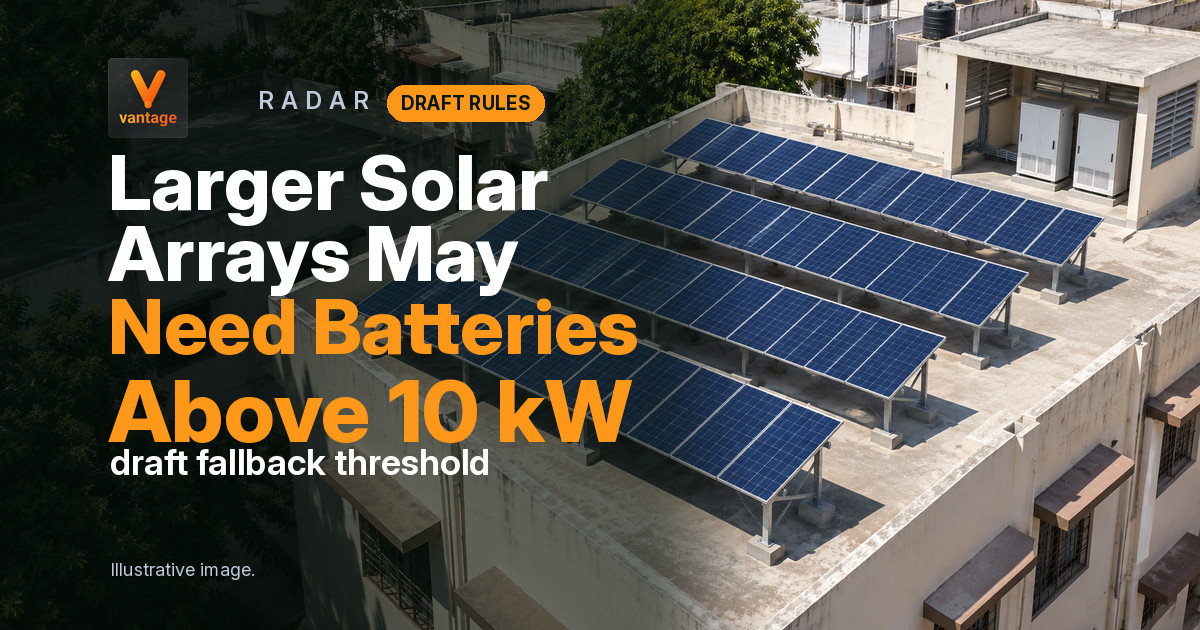
Rooftop solar storage proposal illustrated by solar panels on an Indian building, with the draft threshold above 10 kW
Credit: Illustrative image
Inline Intelligence
The Union Power Ministry has proposed letting state regulators require energy storage for larger rooftop solar systems from April 2028. The revised draft sets a fallback threshold above 10 kW where a state regulator specifies none.
What the draft would change
The ministry circulated the revised draft Electricity (Rights of Consumers) Amendment Rules, 2026, on 23 November. Under the proposal, state electricity regulatory commissions could set two separate parameters for storage. The first is the rooftop generating capacity above which storage would be required. The second is how much energy must be stored relative to the installation's daily generation.
The draft provides a fallback of more than 10 kW of installed generating capacity and describes a storage requirement linked to 20% of daily generation, with room for state regulators to specify another share. Kilowatts measure the generating capacity of a system. Kilowatt-hours measure the energy it generates or stores over time. A 20% storage provision therefore refers to a share of daily energy generation, rather than a percentage of the panel rating.
Why the grid is part of this
Rooftop panels can generate more power at midday than the building uses. The surplus can enter the grid under the applicable metering arrangement. Storage can shift part of that energy to later hours. The draft also proposes giving states discretion over thresholds and certain charges for net metering. The threshold for those charges is a separate question from the threshold for storage.
An earlier Vantage report covered a potential storage addition to the residential subsidy programme → PM Surya Ghar 2.0 May Add Battery Storage, Shared Solar. The November proposal concerns electricity consumer rules and state regulators' powers.
What to Check
- Find the installed system capacity in kW on the vendor's written design and check the current state commission's rooftop solar order.
- Ask the distribution company which metering arrangement applies to your connection and which tariff or export credit enters its calculation.
- Watch for the final central rules and any subsequent state order. Public comments on the revised draft were invited through 23 December 2026.
Sources
Click an article title to view the source.
- Rooftop solar rules: Why the Centre wants users to install storage, pay for excess power published on 25 November 2026 in The Indian Express.
- Govt proposes battery storage for larger rooftop solar systems published on 24 November 2026 in The Times of India.
- Ministry Of Power Proposes Major Changes To Electricity Consumer Rules With New Solar, Storage And Billing Provisions published on 24 November 2026 in SolarQuarter.
- PM Surya Ghar 2.0 May Add Battery Storage, Shared Solar published on 30 July 2026 in Vantage Radar.
In the attached forum discussion, tell us which information a state regulator should publish first so housing societies can budget for a potential storage requirement.

From TatvaOps
Solar & Energy Solutions
Considering rooftop solar?
Verified installers, subsidy support, and milestone-secured payments.
Free quotes · Verified contractors · tatvaops.com
Discuss this article
Join the conversation
Continue this discussion on Forums. A board named like this Radar article is filed under Radar.
More from Solar
Solar Cell Models Get a Standard 12 Character Code
MNRE's final naming format uses a manufacturer brand and a mandatory 12-character base for solar cell models covered by ALMM List-II.
US Tariffs on Indian Goods Could Reach 25 Percent
The US proposes Section 301 tariffs of up to 25% on Indian goods, with exemptions and a conditional 17% scenario. Comments are due on 5 January 2027.
Maharashtra Battery Storage Tariffs Approved
Maharashtra’s regulator has approved procurement tariffs for 2,000 MW of two-hour grid battery capacity. The figures are for capacity procurement over 15 years.
Inline Intelligence
Key Insight Actions
Connected knowledge for Solar Regulation
Move between tutorials, discussions, Studio, and hubs without losing context.
Related discussions
Topic hubs
Conclusion Intelligence
Related Discussions
Was this helpful?
Let us know what you think