

Solar Cell Models Get a Standard 12 Character Code

Summary
MNRE's final naming format uses a manufacturer brand and a mandatory 12 character base for solar cell models covered by ALMM List II. India's renewable energy ministry has set a common naming format for solar cell models under ALMM List II. It requires the manufacturer's brand name, followed by a space and a standard 12 character code. What the code will show The Ministry of New and Renewable Energy set out the format in office memorandum 283/59/2026 GRID SOLAR, dated 25 November 2026. Earlier drafts envisaged a 14 character code.
Published on
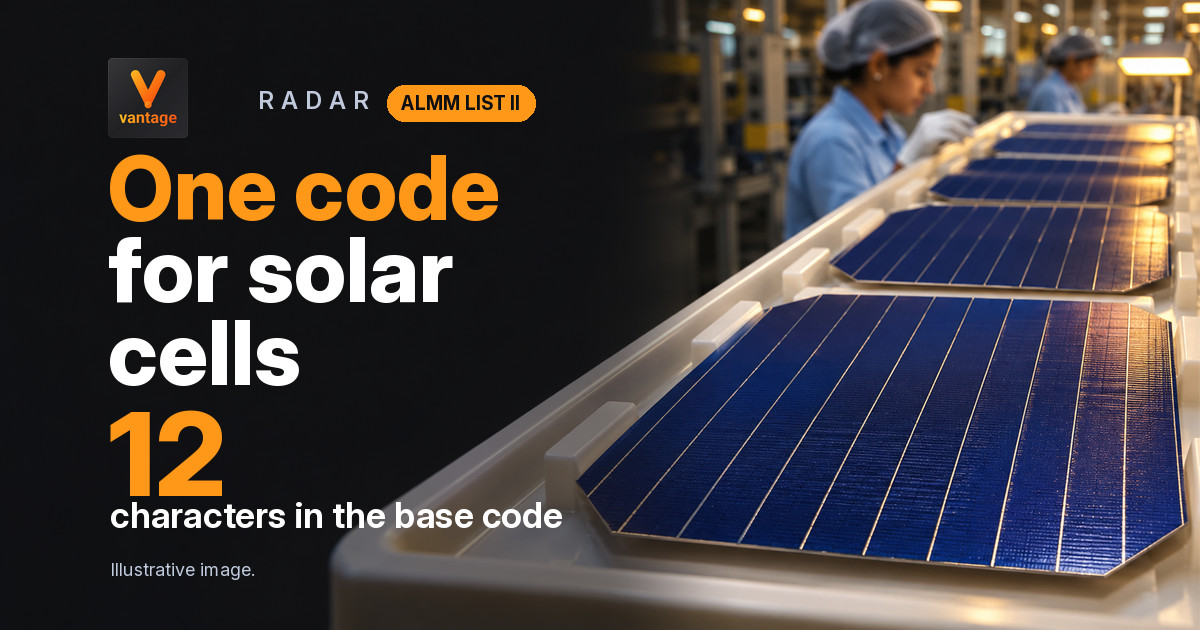
Solar cells on an inspection tray alongside the mandatory 12-character base code for covered ALMM List-II models
Credit: Illustrative image
Inline Intelligence
India's renewable energy ministry has set a common naming format for solar cell models under ALMM List-II. It requires the manufacturer's brand name, followed by a space and a standard 12-character code.
What the code will show
The Ministry of New and Renewable Energy set out the format in office memorandum 283/59/2026-GRID SOLAR, dated 25 November 2026. Earlier drafts envisaged a 14-character code. The final format lets manufacturers append extra details as long as the first 12 characters conform to the ministry's structure.
The code records attributes that previously appeared under manufacturers' own naming conventions. These include cell origin, technology, wafer size and an efficiency band. For example, the technology field uses TC for TOPCon and HJ for heterojunction. The efficiency field gives a band for the cell. A module combines cells into a finished panel, so the cell code is one component of the equipment documentation.
Who changes their model records
New List-II applications filed after the memorandum must use the format. Models already enlisted and applications pending on its issue date are to be renamed within three months. The National Institute of Solar Energy is to check the naming when scrutinising applications and undertaking inspections.
The change concerns List-II cells. Vantage reported separately on the future list for upstream wafers -> ALMM List III for Solar Wafers to Take Effect June 2028. The next practical signal is a revised List-II entry showing the model and its standard name, which will help purchasing teams reconcile supplier documents during the transition.
What to Check
- Identify the version and date of the List-II document you are consulting, using the ministry's published list revision as a reference for how entries are organised.
- Ask the supplier for a dated cross-reference if the old and new model names differ in the quote and the records.
Sources
Click an article title to view the source.
- MNRE Limits ALMM-II Solar Cell Model Identification Code to 12 Characters, published on 26 November 2026 in Mercom India.
- MNRE Mandates Standardised Nomenclature for Solar PV Cell Models Under ALMM List-II, published on 27 November 2026 in Energetica India.
- ALMM List-II 13th Revision, accessed on 27 November 2026 in MNRE.
- ALMM List III for Solar Wafers to Take Effect June 2028, published on 16 September 2026 in Vantage Radar.
In the attached forum discussion, tell us where a cell-model cross-reference would help most: on the quotation, invoice or handover documents.

From TatvaOps
Solar & Energy Solutions
Considering rooftop solar?
Verified installers, subsidy support, and milestone-secured payments.
Free quotes · Verified contractors · tatvaops.com
Discuss this article
Join the conversation
Continue this discussion on Forums. A board named like this Radar article is filed under Radar.
More from Solar
US Tariffs on Indian Goods Could Reach 25 Percent
The US proposes Section 301 tariffs of up to 25% on Indian goods, with exemptions and a conditional 17% scenario. Comments are due on 5 January 2027.
Rooftop Solar Storage Rules Proposed for Larger Systems
The revised power ministry draft proposes storage for larger rooftop solar systems and allows state regulators to set thresholds.
Maharashtra Battery Storage Tariffs Approved
Maharashtra’s regulator has approved procurement tariffs for 2,000 MW of two-hour grid battery capacity. The figures are for capacity procurement over 15 years.
Inline Intelligence
Key Insight Actions
Connected knowledge for Solar Regulation
Move between tutorials, discussions, Studio, and hubs without losing context.
Conclusion Intelligence
Was this helpful?
Let us know what you think