

Maharashtra Battery Storage Tariffs Approved

Summary
Maharashtra’s regulator has approved procurement tariffs for 2,000 MW of two hour grid battery capacity. The figures are for capacity procurement over 15 years. Maharashtra's electricity regulator has approved tariffs for 2,000 MW and 4,000 MWh of grid battery storage, Mercom India and SolarQuarter reported on 24 November. What the rates buy The Maharashtra Electricity Regulatory Commission, or MERC, approved ₹2.40 lakh per MW per month for one part of the tender and ₹2.38 lakh per MW per month for the other, the reports said.
Published on
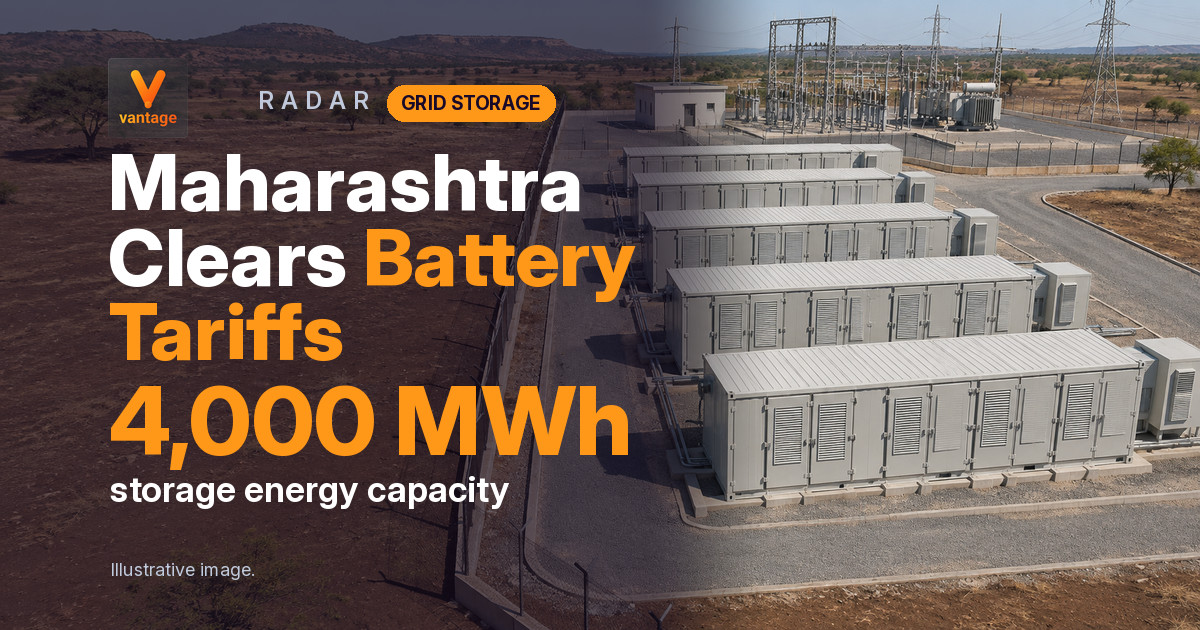
Rows of grid battery enclosures and a substation illustrate the scope of Maharashtra’s 4,000 MWh storage procurement
Credit: Illustrative image
Inline Intelligence
Maharashtra's electricity regulator has approved tariffs for 2,000 MW and 4,000 MWh of grid battery storage, Mercom India and SolarQuarter reported on 24 November. The tariffs apply to a 15-year procurement.
What the rates buy
The Maharashtra Electricity Regulatory Commission, or MERC, approved ₹2.40 lakh per MW per month for one part of the tender and ₹2.38 lakh per MW per month for the other, the reports said. SolarQuarter identified the decision as a 23 November order in Case 218 of 2026. The monthly rates are expressed per megawatt of storage power capacity. A household electricity bill uses a separate tariff schedule.
The tender's headline figures measure two things. The 2,000 MW indicates the rated discharge power of the combined portfolio. The 4,000 MWh indicates how much energy it can deliver at its stated capacity. Dividing energy by rated power gives a two-hour duration, consistent with SolarQuarter's report of one cycle per day and a two-hour discharge.
What happens next
SolarQuarter reported that 500 MW would be located at distribution substations under Part A, with the remaining 1,500 MW assigned to a mix of transmission substations and sites alongside contracted solar projects under Part B. It also reported that the commission directed the Maharashtra State Electricity Distribution Company, or MSEDCL, to execute purchase agreements within 15 days of the order, and that the projects were expected to be commissioned in FY 2027-28.
The procurement can provide capacity to shift electricity between hours. The announcement leaves site commissioning, local reliability outcomes and any effect on consumer tariffs to later developments.
What to Check
- Track the reported Case 218 of 2026 and subsequent purchase agreement or commissioning updates from the utility and regulator.
- Check your consumer category on the bill against the separate MSEDCL tariff schedule for any actual rate change.
Sources
Click an article title to view the source.
- Maharashtra Approves Tariffs for 4,000 MWh Battery Storage Procurement published on 24 November 2026 in Mercom India
- MERC Approves Tariffs For 2,000/MW4,000 MWh Battery Storage Procurement By MSEDCL published on 24 November 2026 in SolarQuarter
- Tariff Details published by Maharashtra State Electricity Distribution Company, accessed 25 November 2026
- Notice for invitation of e-tender for Request for Selection (RfS) Document for setting up of 2000 MW / 4000 MWh Battery Energy Storage Systems under Tariff-Based Competitive Bidding published by Maharashtra State Electricity Distribution Company, accessed 25 November 2026
If you follow power reliability in Maharashtra, what would you look for after commissioning: dispatch data, peak supply figures or feeder-level outage records? Share your experience in the attached Vantage discussion.

From TatvaOps
Solar & Energy Solutions
Procuring materials for site?
Source cement, steel, and finishes with Tatva Direct procurement.
Free quotes · Verified contractors · tatvaops.com
Discuss this article
Join the conversation
Continue this discussion on Forums. A board named like this Radar article is filed under Radar.
More from Solar
Solar Cell Models Get a Standard 12 Character Code
MNRE's final naming format uses a manufacturer brand and a mandatory 12-character base for solar cell models covered by ALMM List-II.
US Tariffs on Indian Goods Could Reach 25 Percent
The US proposes Section 301 tariffs of up to 25% on Indian goods, with exemptions and a conditional 17% scenario. Comments are due on 5 January 2027.
Rooftop Solar Storage Rules Proposed for Larger Systems
The revised power ministry draft proposes storage for larger rooftop solar systems and allows state regulators to set thresholds.
Inline Intelligence
Key Insight Actions
Connected knowledge for Solar and Energy Markets
Move between tutorials, discussions, Studio, and hubs without losing context.
Conclusion Intelligence
Was this helpful?
Let us know what you think