

Maharashtra Solar Buyers Reassess Project Savings

Summary
Businesses considering solar power in Maharashtra are taking another look at how much electricity they can use, bank or purchase from the grid as banking rules and power charges influence project economics. Mercom India reported on 13 November that changes involving electricity banking, time of day tariffs and grid support charges are prompting commercial and industrial consumers to reassess solar projects, particularly where the financial case depends on using surplus generation credits outside solar hours. The impact is not uniform.
Published on
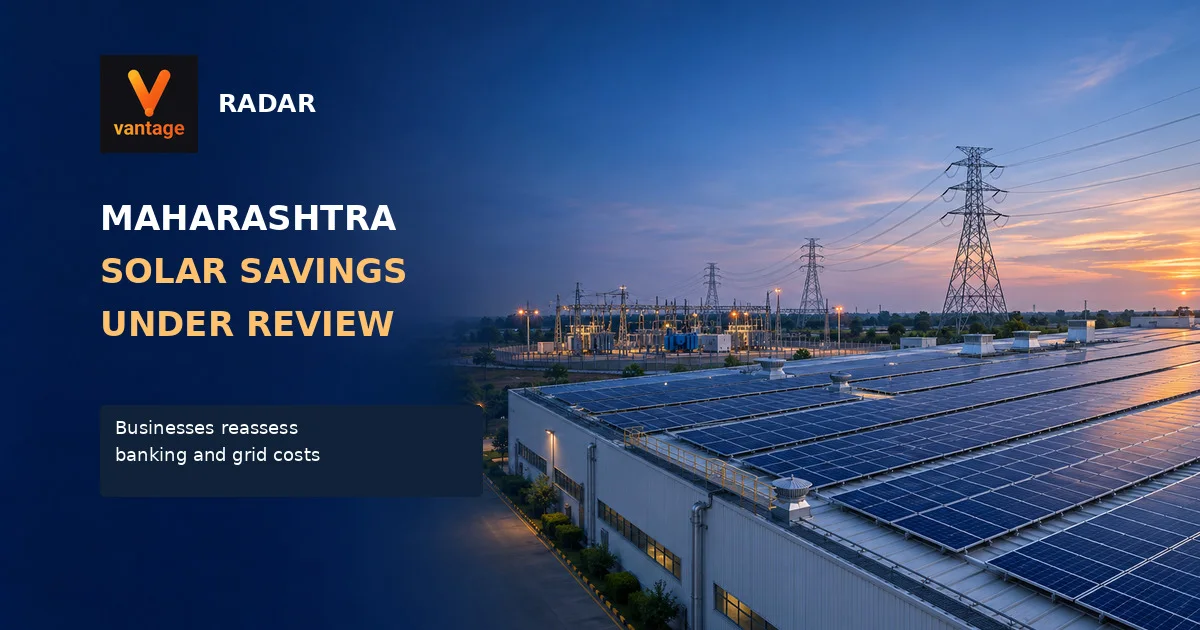
The cover highlights why businesses need to examine how solar generation, electricity banking and grid charges interact before estimating savings.
Inline Intelligence
Businesses considering solar power in Maharashtra are taking another look at how much electricity they can use, bank or purchase from the grid as banking rules and power charges influence project economics.
Mercom India reported on 13 November that changes involving electricity banking, time-of-day tariffs and grid support charges are prompting commercial and industrial consumers to reassess solar projects, particularly where the financial case depends on using surplus-generation credits outside solar hours.
The impact is not uniform. It depends on the project’s metering or open-access arrangement, the applicable utility and tariff, the business’s electricity-use pattern and the rules and orders that apply to its connection.
Read the accessible introduction here -> How Maharashtra’s C&I Solar Projects Can Remain Profitable Despite Banking Curbs.
Why does the timing of solar power matter?
Solar generation is concentrated during daylight, while a factory, office or other business may also need electricity in the evening or overnight.
Under an applicable banking arrangement, surplus renewable electricity may be accounted for as a credit that can be used against eligible consumption under specified conditions. Banking is an accounting arrangement; it does not necessarily mean that a business’s own electricity is physically stored for later.
The value of the credit depends on the rules governing when it can be used, how it is settled and which charges apply. A project’s annual generation alone therefore does not establish its annual bill saving.
What is MERC considering?
The Maharashtra Electricity Regulatory Commission, or MERC, lists draft 2026 regulations for grid-interactive rooftop renewable-energy systems and distribution open access on its website.
A draft is a proposal. Its listing does not establish that every proposed provision has been finalised or that it applies to an existing installation.
Review the regulator’s listing here -> MERC Draft Regulations.
Maharashtra’s published renewable-energy policy also discusses different approaches to energy accounting and banking based on system size and procurement arrangement. Parts of that document describe frameworks for regulatory consideration; they should not automatically be treated as final billing rules for every customer.
Read the state policy here -> Maharashtra Renewable Energy and Energy Storage Policy 2025-26 to 2035-36.
Why businesses need project-specific answers
A daytime office, a single-shift factory and a round-the-clock facility can have very different electricity-use profiles. The same solar system size may therefore produce different bill outcomes.
Businesses also need to distinguish a charge in a solar proposal from a charge confirmed as applicable to their connection. The relevant position can depend on the distribution company, contract, system size, metering arrangement and any applicable orders or legal proceedings.
Vantage previously reported on a separate open-access surcharge in Telangana, illustrating why the delivered cost of power can include more than a supplier’s quoted price -> Telangana Raises Open-Access Power Surcharge.
The next developments to watch are MERC’s final decisions on its draft regulations, any relevant orders or appeals, and project-specific billing guidance from the applicable utility.
Sources
Click an article title to view the source.
- How Maharashtra’s C&I Solar Projects Can Remain Profitable Despite Banking Curbs, published on 13 November 2026 in Mercom India.
- MERC Draft Regulations, Maharashtra Electricity Regulatory Commission, accessed on 13 November 2026.
- Maharashtra Renewable Energy and Energy Storage Policy 2025-26 to 2035-36, Government of Maharashtra, accessed on 13 November 2026.
- Telangana Raises Open-Access Power Surcharge, published on 5 November 2026 in Vantage Radar.
Evidence Caveats
Only the introduction of Mercom’s 13 November article was accessible without signing in. MERC’s website lists the 2026 rooftop and distribution open-access documents as drafts; this article does not assert that their provisions are final or currently applicable to a particular consumer. No individual electricity bill, contract, current tariff calculation or project was reviewed.
If your business is evaluating solar power, which detail is hardest to establish: usable credits, grid charges or the timing of electricity use? Share your experience in the attached forum discussion.

From TatvaOps
Solar & Energy Solutions
Considering rooftop solar?
Verified installers, subsidy support, and milestone-secured payments.
Free quotes · Verified contractors · tatvaops.com
Discuss this article
Join the conversation
Continue this discussion on Forums. A board named like this Radar article is filed under Radar.
More from Solar
Meghalaya Net Metering Sets Battery Rule Above 10 kW
Meghalaya requires storage for net-metered systems above 10 kW. Check the daily generation estimate, battery size and costs before comparing bids.
Indias Rooftop Solar Additions Reach 4.7 GW in Q3
India added approximately 4.7 gigawatts GW of rooftop solar capacity in July–September 2026, more than the 2.1 GW recorded in the same quarter a year earlier, according to Mercom India Research. The increase came as large scale solar installations slowed compared with the preceding quarter.…
CBI Files Four Chargesheets in Manesar Land Case, Names M3M Promoter
The Central Bureau of Investigation CBI has filed four chargesheets in the Manesar land case, naming M3M Group promoter Roop Bansal as an accused, according to The Times of India. The chargesheets were filed on 6 November 2026 before a special CBI court in Panchkula. The court has set 11 December…
Inline Intelligence
Key Insight Actions
Connected knowledge for Solar Policy
Move between tutorials, discussions, Studio, and hubs without losing context.
Related discussions
Maharashtra Solar: Will Your Business Save as Expected?
1 replies
Related discussionDelhis Free Rooftop Solar: Does Your Home Qualify?
5 replies
Related discussionRooftop Solar Costs Rise: Is It Still Worth Installing?
0 replies
Related discussionTelangana Open Access: What Will Your Power Cost?
2 replies
Related discussion
Topic hubs
Conclusion Intelligence
Related Discussions
Maharashtra Solar: Will Your Business Save as Expected?
Popular in insights discussions1 reply
Delhis Free Rooftop Solar: Does Your Home Qualify?
Popular in insights discussions5 replies
Rooftop Solar Costs Rise: Is It Still Worth Installing?
Popular in insights discussions0 replies
Telangana Open Access: What Will Your Power Cost?
Popular in insights discussions2 replies
Was this helpful?
Let us know what you think