

Rooftop Solar Is Growing. Should You Install It?

Summary
India’s rooftop solar additions are rising, but national growth cannot tell you what your own system will save. Here are the roof, bill, cost and subsidy checks to make before installing. India’s rooftop solar market added an estimated 4.7 GW of capacity in July–September 2026, according to Mercom India Research. That is more than the 2.1 GW it recorded in the same quarter a year earlier. But it does not answer the question that matters to a household or business: will a system work for my property and produce savings that justify its cost?
Published on
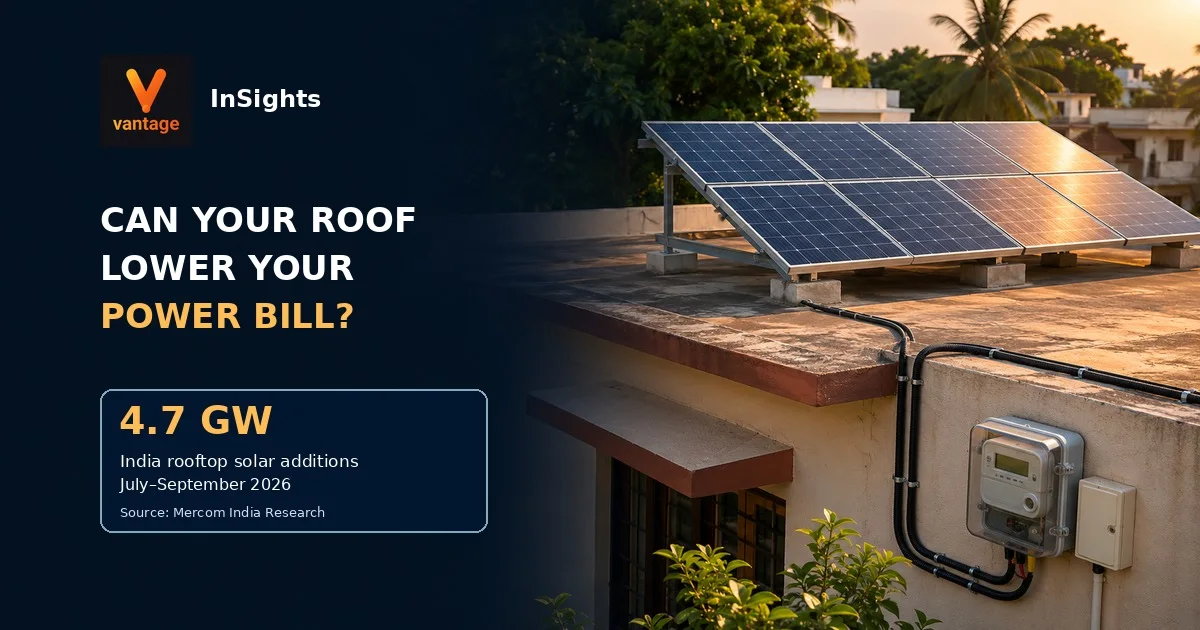
As rooftop solar installations grow across India, homeowners have a practical decision to consider: whether their roof, electricity use and local rules make solar worthwhile.
Inline Intelligence
India’s rooftop solar market added an estimated 4.7 GW of capacity in July–September 2026, according to Mercom India Research. That is more than the 2.1 GW it recorded in the same quarter a year earlier.
Strong market growth can make rooftop solar worth investigating. But it does not answer the question that matters to a household or business: will a system work for my property and produce savings that justify its cost?
The answer depends on the roof, electricity-use pattern, system design, installation cost, utility rules and any support for which the applicant is actually eligible.
Read Mercom’s market summary here -> Q3 and 9M 2026 India Solar Market Update.
What does the 4.7 GW figure tell us?
The figure is Mercom’s estimate of rooftop solar capacity added during July–September 2026. Capacity describes the size of the installed systems; it is not the same as the electricity those systems generate over time.
The estimate covers the rooftop market and should not be treated as a count of household installations alone. It also does not establish a typical installation price, savings amount or payback period for an individual property.
National growth is a market signal. Your own roof and electricity bill are the starting point for a purchase decision.
Why can a solar quote look attractive but produce different savings?
Solar panels mainly generate electricity during daylight. A property that uses more electricity during those hours may consume more of its generation directly. A property that is often empty during the day may depend more on how exported electricity is credited or on storage, where available.
Actual savings can also be affected by:
- Roof orientation, shading and usable area.
- System size, equipment quality and installation.
- Your electricity tariff and consumption pattern.
- The utility’s applicable metering and export-credit rules.
- Fixed charges that may remain on the bill.
- Maintenance, financing and future component replacement.
A system producing a certain number of units in a year does not automatically reduce the bill by the same number of units at the highest retail tariff. Ask the provider to show how the calculation works for your connection.
What if equipment costs are rising?
Mercom identifies domestic cell availability and project costs among the pressures affecting the solar industry. That does not establish that every household quote has increased by the same amount or for the same reason.
Vantage previously examined reported premiums on certain compliant solar modules and why a homeowner should assess the complete installation cost -> DCR Solar Module Premium Raises Rooftop Costs in India.
Ask for an itemised quotation covering modules, inverter, mounting structure, wiring, protection equipment, installation, approvals and any other charges. Compare equipment specifications and warranties as well as the final price.
How should you assess payback?
A simple starting point is:
Simple payback = net upfront cost ÷ estimated annual electricity-bill savings
For example, suppose a household’s net installed cost is ₹1,50,000 and its estimated annual bill saving is ₹25,000. The simple calculation gives six years.
That is a hypothetical example, not a market quotation or a guaranteed result. It assumes the stated annual saving remains unchanged and excludes financing, maintenance, equipment replacement, degradation, changes in tariffs and the time value of money.
The most important step is to test the assumptions behind the annual saving. Ask what happens if generation is lower, a component needs replacement or less electricity is consumed during the day.
Does a subsidy make every installation affordable?
No. Support can reduce the cost for eligible applicants, but the applicable amount, eligibility, equipment requirements, application process and payment status need to be verified through the relevant official scheme and utility.
A quoted subsidy is not the same as money already received. Before committing, ask the provider to distinguish the gross installed price, the assistance assumed and the amount you would need to fund if payment is delayed or eligibility is not confirmed.
Do not assume that a scheme for residential consumers applies to every commercial building or housing society.
What about large-scale solar slowing down?
Mercom estimates that large-scale solar installations declined in July–September compared with the preceding quarter, even as rooftop additions rose. The research firm identifies issues including transmission connectivity, domestic cell availability and project-level execution as factors affecting the industry.
Those industry observations do not prove that a particular rooftop installation will be delayed or become more expensive. They do suggest useful questions for a buyer: Is the equipment available? Who handles utility approval? What completion date is in the contract, and what happens if it changes?
What to check before installing
- Review your bill: Understand how much electricity you use, when you use it and which charges may remain.
- Assess the roof: Check usable space, shading, structural suitability and the permissions required.
- Compare complete quotes: Review equipment specifications, warranties, installation scope, exclusions and payment milestones.
- Verify the assumptions: Confirm the applicable utility process, export treatment and any eligible support through official channels.
- Test the economics: Compare the base estimate with a lower-generation or higher-cost scenario before making a commitment.
Vantage’s earlier guide also explains why rising module costs can change a household’s calculation without determining the outcome for every roof -> Rooftop Solar Costs Rise: Is It Still Worth Installing?.
FAQ
1. Does 4.7 GW mean households alone installed that capacity?
No. Mercom’s figure describes rooftop solar additions across the market; it should not be treated as a household-only figure.
2. Is installed capacity the same as electricity generated?
No. Capacity describes the size or rated output of systems. Electricity generated depends on sunlight, operating conditions, time and system performance.
3. Will rooftop solar make my electricity bill zero?
Not necessarily. You may still purchase electricity from the grid at certain times and may continue to pay fixed or other applicable charges.
4. Does a shorter quoted payback guarantee a better project?
No. Payback depends on assumptions. Compare complete costs, equipment, warranties, generation estimates, financing and the risks excluded from the quote.
5. Can I assume the same subsidy applies to every rooftop project?
No. Eligibility and conditions depend on the relevant scheme, applicant and installation. Verify current rules through official channels.
6. Does slower large-scale solar installation mean my rooftop project will be delayed?
Not necessarily. A particular project’s timing depends on its equipment, installer, approvals and utility process. The national data does not establish an individual completion date.
7. What should I ask an installer first?
Ask for a written, itemised quote and a project-specific savings model that explains generation, self-consumption, export treatment, remaining bill charges and support assumptions.
Sources
Click an article title to view the source.
- Q3 and 9M 2026 India Solar Market Update, Mercom India Research, accessed on 13 November 2026.
- DCR Solar Module Premium Raises Rooftop Costs in India, published on 27 October 2026 in Vantage Radar.
- Rooftop Solar Costs Rise: Is It Still Worth Installing?, published on 27 October 2026 in Vantage InSights.
Evidence Caveats
Mercom’s public research summary provides the national installation estimates; the full dataset and methodology were not independently reviewed. The ₹1,50,000 cost, ₹25,000 annual saving and six-year simple payback are hypothetical. No individual roof, utility bill, installation quote, subsidy application or system performance was assessed.
If you were considering rooftop solar, which would you want to verify first: the complete installation cost, expected bill savings, subsidy eligibility or the installer’s warranty? Share your reasoning in the attached forum discussion.
Disclaimer
This article is for general information and is not personalised engineering, financial or investment advice. Solar performance, utility rules, costs and support vary by property and location. Verify current requirements and seek qualified advice before committing to an installation.

From TatvaOps
Solar & Energy Solutions
Considering rooftop solar?
Verified installers, subsidy support, and milestone-secured payments.
Free quotes · Verified contractors · tatvaops.com
Discuss this article
Join the conversation
Continue this discussion on Forums. A board named like this InSights article is filed under InSights.
More from Solar
Meghalaya Solar Battery Sizing and Quote Checks
Meghalaya requires storage for net-metered systems above 10 kW. Check the daily generation estimate, battery size and costs before comparing bids.
Maharashtra Solar: Will Your Business Save as Expected?
A solar system’s annual generation does not tell a business what it will save. Here is how timing, banking credits, grid charges and storage can affect a Maharashtra project’s economics.
Telangana Open Access: What Will Your Power Cost?
Telangana’s higher open-access surcharge can narrow renewable power savings. Check which units attract the charge, who pays it under your contract and what it does to your delivered cost.
Inline Intelligence
Key Insight Actions
Connected knowledge for Solar Energy
Move between tutorials, discussions, Studio, and hubs without losing context.
Related discussions
Delhis Free Rooftop Solar: Does Your Home Qualify?
5 replies
Related discussionRooftop Solar Costs Rise: Is It Still Worth Installing?
0 replies
Related discussionDCR Solar Module Premium Raises Rooftop Costs in India
3 replies
Related discussionBihar Rooftop Solar: What Is Surplus Power Worth?
1 replies
Related discussion
Topic hubs
Conclusion Intelligence
Related Discussions
Delhis Free Rooftop Solar: Does Your Home Qualify?
Popular in insights discussions5 replies
Rooftop Solar Costs Rise: Is It Still Worth Installing?
Popular in insights discussions0 replies
DCR Solar Module Premium Raises Rooftop Costs in India
Popular in radar discussions3 replies
Bihar Rooftop Solar: What Is Surplus Power Worth?
Popular in insights discussions1 reply
Was this helpful?
Let us know what you think