

Gold Prices in India: Will New Import Routes Cut Costs?
Summary
India is sourcing more gold through the UAE and expanding domestic refining. But will cheaper import routes reduce jewellery prices? Explore gold tariffs, retail costs, purity, ETFs and what Indian gold buyers should check. India is importing more gold through the UAE and developing its ability to refine semi processed gold domestically. That sounds like a potentially positive development for a country where gold plays an important role in household savings, jewellery purchases and investment portfolios. But it creates an interesting puzzle.
Published on
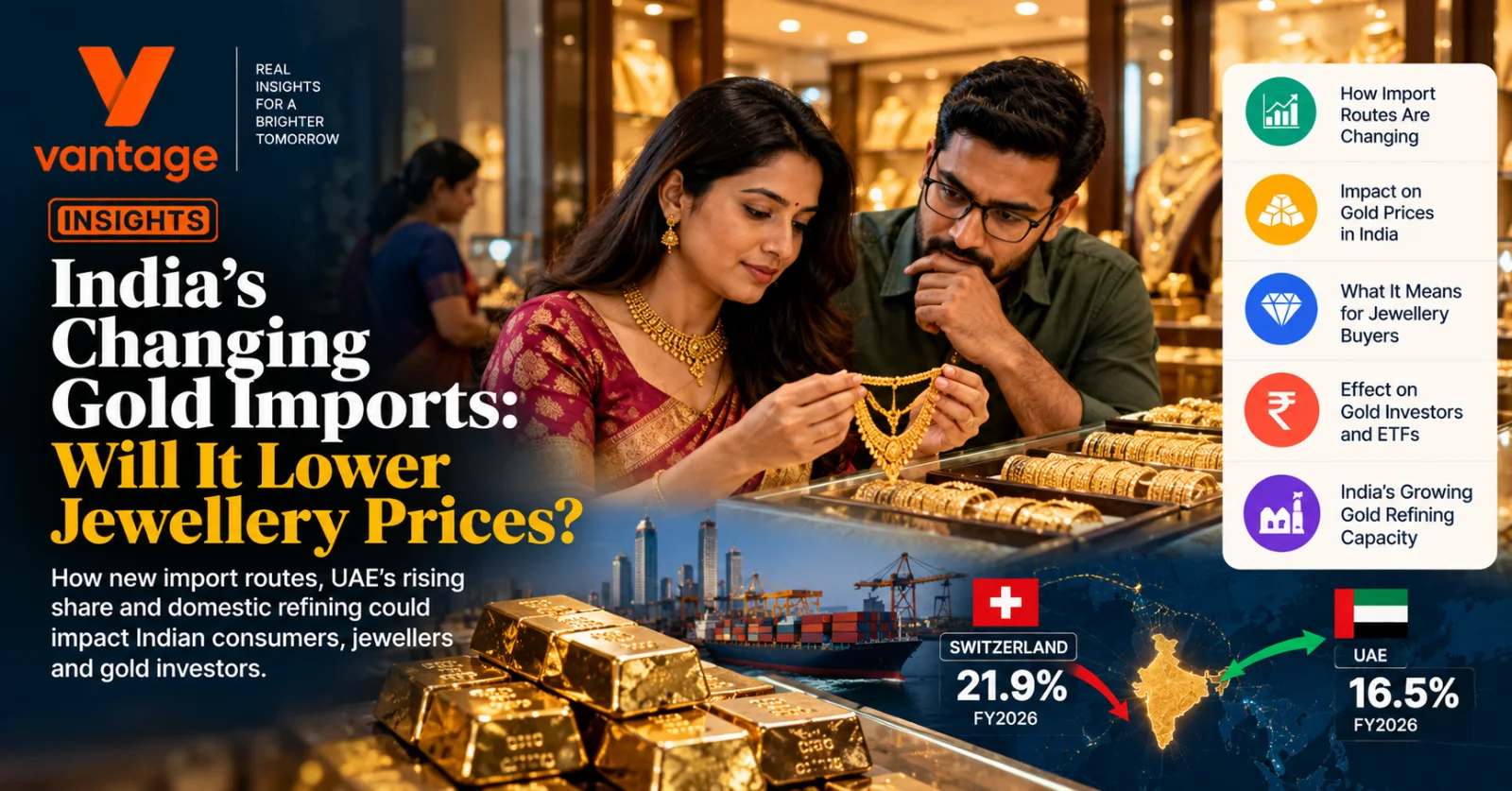
India's changing gold import routes and growing domestic refining capacity raise questions about jewellery prices and investment costs. The image explores how increased gold imports from the UAE and reduced dependence on Switzerland could affect Indian consumers, jewellers and gold investors.
Inline Intelligence
India is importing more gold through the UAE and developing its ability to refine semi-processed gold domestically.
That sounds like a potentially positive development for a country where gold plays an important role in household savings, jewellery purchases and investment portfolios.
But it creates an interesting puzzle.
If India can import gold through cheaper or more efficient routes, will ordinary buyers actually pay less?
The answer is not straightforward.
Trade agreements and refining efficiencies can influence procurement costs, but retail gold prices depend on several factors beyond the country supplying the metal.
Understanding those differences can help households make better jewellery and investment decisions.
What Has Changed in India's Gold Supply Chain?
For many years, Switzerland was one of India's most important sources of refined gold bullion.
Its large, established refining industry supplies high-purity gold to international markets.
India is now developing more diversified supply arrangements.
A 26 October 2026 Economic Times report, citing Crisil Intelligence, stated that Switzerland's share of India's bullion imports declined from 42.4% in FY2021 to 21.9% in FY2026.
During the same period, the UAE's share increased from 10.8% to 16.5%.
Countries supplying semi-refined gold, including Ghana, Chile and Peru, have also become important to India's evolving sourcing arrangements.
This change involves more than switching one supplier for another.
It reflects differences in trade tariffs, refining capacity and the form in which gold enters India.
Why Do Gold-Import Routes Matter?
Gold is a globally traded commodity.
International benchmark prices influence the value of the metal, but the final cost of delivering it to an Indian buyer depends on additional factors.
These may include:
- The international bullion price.
- The rupee-dollar exchange rate.
- Applicable customs duties and taxes.
- Shipping, insurance and financing costs.
- Refining and distribution expenses.
- Wholesale premiums and retail margins.
A more efficient import route can potentially reduce some of these costs.
However, the benefit may be small relative to a major movement in international gold prices or the exchange rate.
Importers and retailers may also face different commercial terms, so a lower cost in one part of the supply chain does not guarantee an equivalent reduction at the jewellery counter.
How Does the India-UAE Trade Agreement Help?
The India-UAE Comprehensive Economic Partnership Agreement provides preferential customs treatment for qualifying gold imports within its tariff-rate quota system.
According to the October 2026 reporting, eligible UAE gold imports can receive a one-percentage-point duty advantage over the standard gold-import rate.
Following the May 2026 duty increase, the report identified rates of 15% for standard finished-bullion imports and 14% for qualifying UAE shipments.
The commercial impact depends on the value of the shipment and compliance with applicable rules.
Consider a hypothetical import shipment with an assessable customs value of ₹1 crore.
A one-percentage-point duty difference would equal ₹1 lakh on that customs value, considering that duty difference alone.
| Illustrative calculation | Standard rate | Preferential rate |
|---|---|---|
| Assessable customs value | ₹1 crore | ₹1 crore |
| Assumed customs duty rate | 15% | 14% |
| Customs duty | ₹15 lakh | ₹14 lakh |
| Difference | ₹1 lakh |
This example does not calculate the shipment's complete landed cost or total tax liability.
It also does not establish that every UAE shipment qualifies for the concession.
The eligible importer must satisfy the applicable quota and origin requirements.
Most importantly, a duty saving at the import stage should not be interpreted as an equal saving for a consumer purchasing jewellery.
Why Is Domestic Gold Refining Becoming Important?
Gold can be imported either as refined bullion or as doré, a semi-refined form that requires additional processing.
A domestic refinery processes doré to produce high-purity gold.
This creates opportunities for value addition inside India rather than importing every unit of gold in finished form.
The October report identifies a 0.65-percentage-point customs duty advantage for eligible doré compared with finished bullion.
That differential can improve the economics of refining locally.
However, profitability also depends on refining recovery, processing costs, financing, compliance and plant utilisation.
The NITI Aayog Trade Watch report identifies several structural limitations, including fragmented refining capacity and international accreditation constraints.
This means domestic refining presents an opportunity, but not a guarantee of cheaper finished gold.
Could Gold Jewellery Become Cheaper?
Potentially, some efficiencies could improve jewellery manufacturers' input costs.
But the retail price involves more than the gold itself.
Suppose a customer buys jewellery containing gold worth ₹1 lakh before additional charges.
The jeweller may add making charges, taxes and other applicable costs.
If the underlying wholesale procurement cost falls slightly, the customer's final saving depends on whether that reduction is passed through.
Meanwhile, a rise in international gold prices or depreciation of the rupee could offset the entire benefit.
A consumer should therefore not assume that importing gold from the UAE instead of Switzerland automatically produces a cheaper necklace or bracelet.
The more useful approach is to compare the final payable amount across sellers, while ensuring purity and documentation are comparable.
Does Importing from a Different Country Affect Gold Purity?
The country from which gold is shipped does not, by itself, determine its purity.
Gold imported as doré requires refining.
Finished bullion and jewellery must be assessed according to the relevant specifications and certification requirements.
For jewellery buyers in India, BIS hallmarking and the Hallmark Unique Identification (HUID) system provide important verification mechanisms.
Consumers should check the applicable hallmarking requirements, product details and purchase invoice.
Gold purity is a separate question from the import route.
A trader's sourcing location should not be treated as proof that a finished jewellery product is better or worse.
What Does This Mean for Gold Investors?
The implications differ depending on how someone holds gold.
Physical gold
Buyers of coins and bars need to consider purity, premiums, taxes, storage, security and resale terms.
Import-related efficiencies may influence availability or wholesale premiums, but investors should evaluate the actual buy-and-sell price difference.
Gold ETFs
Gold exchange-traded funds provide market-linked exposure without requiring an investor to store physical gold personally.
However, ETF investors still face movements in gold prices and should consider expenses, tracking differences, trading liquidity and taxation.
A change in the origin of imported gold does not automatically create higher ETF returns.
Gold jewellery
Jewellery provides personal and cultural value alongside the value of its gold content.
However, making charges and resale deductions can materially affect financial returns.
Jewellery should not be compared directly with investment bullion or financial gold products without accounting for those costs.
Could India's Growing Refining Industry Improve the Economy?
Domestic refining can potentially create processing activity, employment and associated business opportunities.
More diverse sourcing may also reduce dependence on a narrow set of international suppliers.
But India still needs to obtain most of the underlying gold from overseas.
Processing imported gold within India does not remove the foreign-exchange requirement for acquiring the metal.
A higher value of gold imports can still place pressure on the merchandise trade balance.
Therefore, the economic benefit depends on genuine value addition, processing efficiency and the structure of international trade.
Why Do Gold Import Shares Keep Changing?
Country-wise sourcing shares can vary significantly between months, quarters and financial years.
For example, official DGCI&S figures for October-December 2025 show Switzerland supplying 22.86% of India's gold import value and the UAE supplying 22.21%.
These quarterly figures differ from the full-year shares cited by Crisil Intelligence.
The difference does not automatically indicate an error.
Trade flows can be affected by shipments, seasonal demand, import duties, international logistics and market conditions.
It is important to compare matching time periods and data definitions before concluding that one supplier has permanently replaced another.
What Should Gold Buyers Check Next?
1. Compare the total purchase cost
For jewellery, compare purity, net gold weight, making charges, taxes and the final payable amount.
For bullion, assess the actual premium over the reference price and the resale terms.
2. Verify quality and documentation
Check applicable BIS hallmarking information, HUID details and purchase invoices.
Do not rely solely on a salesperson's statement about imported or internationally sourced gold.
3. Separate jewellery from investment decisions
If the primary goal is investment, compare suitable gold investment products based on costs, liquidity, custody and tax treatment.
A product's suitability depends on personal circumstances.
4. Avoid treating import news as a price forecast
Gold prices are affected by international markets, currency movements and wider economic expectations.
A changing supply route alone is insufficient evidence that prices will rise or fall.
Will the Benefits Reach Indian Households?
The evolution of India's gold trade is an important structural development.
Greater domestic refining capacity and more diversified international sourcing may improve supply-chain resilience and commercial efficiency.
But the gains are not automatically distributed equally.
Importers, refiners, jewellery manufacturers and consumers operate at different stages of the market.
The eventual benefit depends on costs, competition, regulation and the way savings move through the supply chain.
For Indian households, the practical lesson is clear.
Where India imports gold from matters, but the price, purity and terms on which you personally buy it matter more.
FAQ
1. Why is India importing less gold from Switzerland?
India has diversified its supply toward alternative trading hubs and countries providing semi-refined gold, partly because of domestic refining growth and preferential trade arrangements.
2. Is the UAE replacing Switzerland as India's biggest gold supplier?
Not conclusively. Their shares vary by reporting period, and Switzerland remains an important supplier. Full-year and quarterly figures should not be treated as interchangeable.
3. Can the India-UAE trade agreement make gold cheaper?
Preferential duty treatment can reduce some import costs for eligible shipments, but does not guarantee lower retail gold prices.
4. What is gold doré?
Doré is semi-refined gold containing other materials that must be processed to produce high-purity bullion.
5. Does Indian refining reduce dependence on imported gold?
It can reduce reliance on imported finished bullion, but India remains dependent on overseas supplies of the underlying metal.
6. Will gold jewellery prices fall because import routes are changing?
Not necessarily. International gold prices, exchange rates, duties, making charges and retailer pricing also determine the final cost.
7. Is UAE-sourced gold different in quality from Swiss gold?
The supplier country does not automatically determine purity. Quality depends on the refining process, specifications and verification.
8. Does this development make gold ETFs a better investment?
Not by itself. ETF performance depends primarily on the underlying gold market, expenses, tracking and other investment characteristics.
9. How can consumers check jewellery purity in India?
Consumers can examine applicable BIS hallmarking and HUID information, along with the invoice and product specifications.
10. Could changing gold imports affect India's trade deficit?
Yes. The value of gold imports contributes to the merchandise import bill, although the overall trade balance depends on many other imports and exports.
Sources
Click an article title to view the source.
- India's gold import route changing course for a benefit all jewellers want, published on 26 October 2026 in The Economic Times.
- Quarterly Review of Merchandise Foreign Trade: October-December 2025, published in March 2026 by the Directorate General of Commercial Intelligence and Statistics, Government of India.
- Trade Watch: October-December FY2025-26, published in 2026 by NITI Aayog.
- India's gold rush takes a Dubai detour as UAE shipments soar while rest of world imports fall, published on 2 September 2026 in The Economic Times.
Evidence Caveats
The historical fiscal-year import shares are attributed to Crisil Intelligence in The Economic Times. The underlying complete Crisil dataset was not independently inspected.
Official DGCI&S quarterly data covers a different reporting period and should not be directly substituted for fiscal-year figures.
Reported preferential tariff rates and quotas depend on eligibility, customs classification and prevailing regulations. The illustrative duty calculation excludes other possible components of landed cost.
No evidence presented here establishes that changes in international sourcing have produced a particular reduction in Indian retail jewellery prices.
Gold prices, import regulations and applicable tax treatments can change. This article does not forecast future gold returns.
Join the discussion: If India becomes more efficient at sourcing and refining gold, who should benefit most: domestic refiners, jewellers or consumers? Have you noticed meaningful differences in gold premiums, making charges or retail pricing? Share your observations, reasoning or relevant evidence in the attached forum discussion.
Disclaimer
This article is for general educational and informational purposes only. It is not personalised financial, investment, legal or tax advice. Gold and gold-linked investments carry market, liquidity and cost risks. Readers should verify current prices, product terms and applicable regulations and consult appropriately qualified professionals when needed.

From TatvaOps
Property Purchase
Procuring materials for site?
Source cement, steel, and finishes with Tatva Direct procurement.
Free quotes · Verified contractors · tatvaops.com
Discuss this article
Join the conversation
Continue this discussion on Forums. A board named like this InSights article is filed under InSights.
1 reply already on Forums
More from Real Estate
Mumbai Luxury Home Data What Buyers Should Check
Luxury registration totals are not a like-for-like price index. Here is how buyers can compare properties and ownership costs.
Binance Security Incident What Holders Can Check
The Binance incident highlights the difference between a displayed balance and access to assets. Here are practical checks for holders.
Gurugram Power Choice What Residents Should Check
A proposed second electricity distributor is on hold. Here is what Gurugram and Nuh residents can check on bills and service.
Inline Intelligence
Key Insight Actions
Connected knowledge for Gold Market Analysis
Move between tutorials, discussions, Studio, and hubs without losing context.
Conclusion Intelligence
Was this helpful?
Let us know what you think