

Apartment Handover: What Bengaluru Owners Must Check
Summary
Karnataka RERA's 60 day direction to Eco Life Developers highlights why apartment possession is not the end of a builder's obligations. Learn what Bengaluru homeowners should verify about association registration, common areas and legal handover. You have received the keys to your apartment. The interiors are complete, the family has moved in and maintenance charges are being collected. But who legally controls the common areas? Has the apartment owners' association been properly registered? And have the developer's responsibilities actually been completed? These questions have become especially relevant following a Karnataka RERA direction involving Eco Life Developers.
Published on
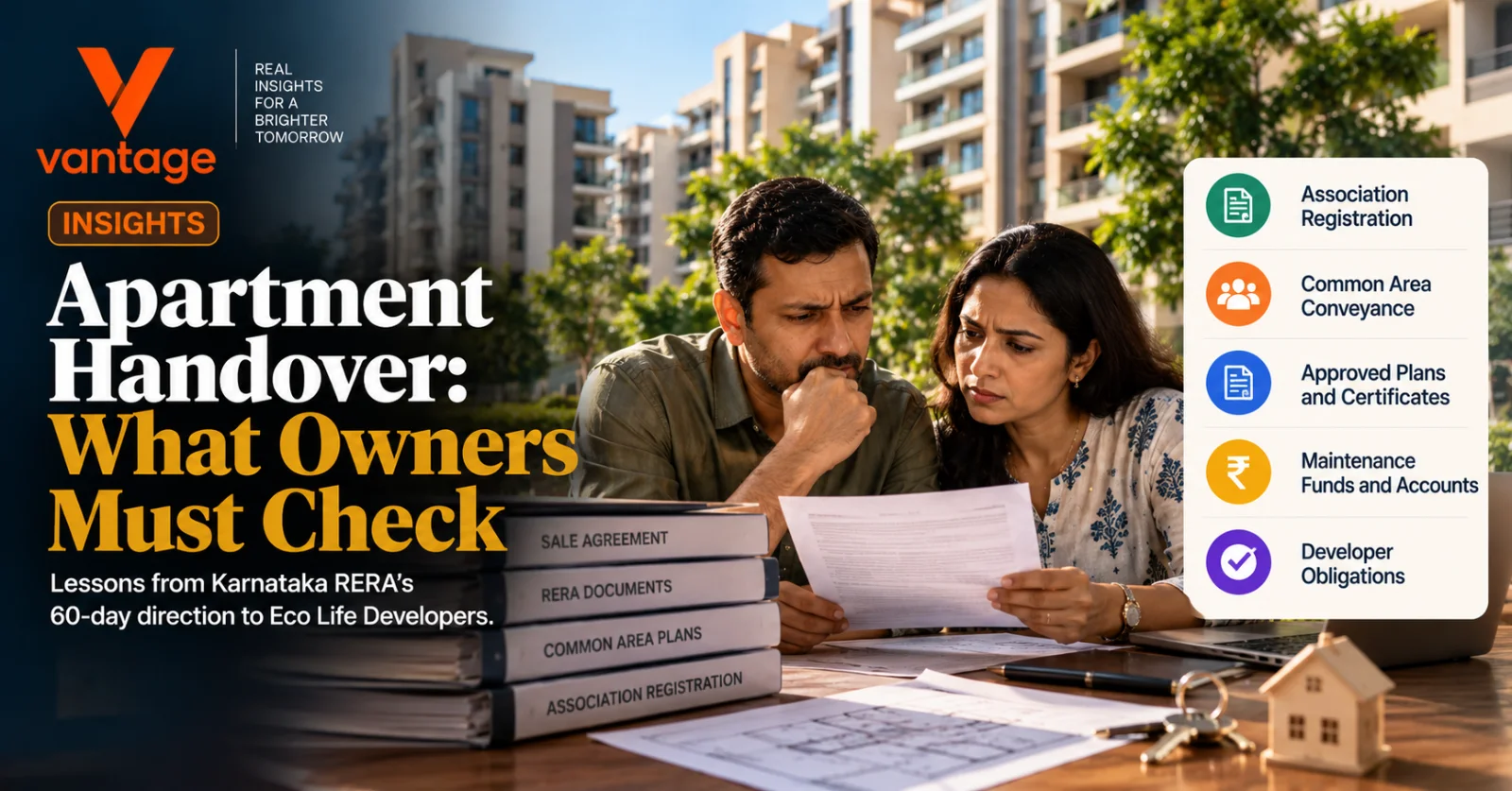
The image highlights essential legal and property documents Bengaluru apartment owners should verify after possession, including association registration, common-area conveyance, approved building plans and maintenance accounts. It draws on Karnataka RERA's 60-day direction to Eco Life Developers, emphasising homeowner rights and developer accountability.
Inline Intelligence
You have received the keys to your apartment. The interiors are complete, the family has moved in and maintenance charges are being collected.
But who legally controls the common areas? Has the apartment owners' association been properly registered? And have the developer's responsibilities actually been completed?
These questions have become especially relevant following a Karnataka RERA direction involving Eco Life Developers.
The authority reportedly gave the developer 60 days to take steps to facilitate formation and registration of an association of allottees, alongside directions concerning common-area conveyance obligations.
The case highlights a risk that buyers may overlook: physical possession of an apartment is not the same as a fully documented handover of the development.
What Does Apartment Handover Actually Mean?
Most homebuyers think of handover as the day they receive their apartment keys.
That is an important milestone, but it is only one aspect of property ownership.
An apartment project has at least three distinct dimensions:
- Individual possession: The buyer receives physical possession of the purchased apartment.
- Legal documentation: The ownership and conveyance formalities applicable to the individual unit and shared interests are completed.
- Common-property management: The legally recognised association or other authorised body obtains the rights, documents and management arrangements required under applicable law.
These steps are connected, but they do not necessarily occur simultaneously.
A family may occupy a completed flat while questions concerning association registration, common facilities and developer handover obligations remain unresolved.
What Happened in the Eco Life Developers Case?
According to Bangalore Mirror's report dated 26 October 2026, apartment buyer Swetha Rangaswamy complained that the developer had not completed the necessary formalities relating to association registration and common-area transfer despite the apartments being handed over.
The complainant also alleged that the developer referred to an existing association registration but had not furnished a certificate supporting that position.
Karnataka RERA subsequently directed the respondents to take the required steps within their statutory obligations to facilitate association registration within 60 days.
The authority also directed completion of applicable conveyance requirements under Sections 11(4)(f) and 17 of the central RERA Act.
Importantly, the reported order should not be read as a general determination that every document or fund relating to the property was missing. The full order and its detailed factual findings were not independently available for this analysis.
The case nevertheless raises wider questions about what apartment buyers should request after possession.
Why Does Association Registration Matter?
An apartment owners' association provides a formal mechanism for collective administration, subject to the legal structure applicable to the property.
It can play an important role in maintaining common facilities, representing owners' interests and overseeing decisions affecting shared infrastructure.
For instance, residents may need collective arrangements for:
- Lift maintenance and service contracts.
- Water supply, pumps and common electricity.
- Security and housekeeping.
- Repairs to shared building infrastructure.
- Common-area maintenance budgets and expenditure.
- Decisions about major repairs and replacements.
But the authority to perform these functions, own or administer common property, and represent owners depends on the project's legal documents and applicable law.
A WhatsApp group, informal committee or residents' meeting cannot automatically replace prescribed statutory registration and conveyance procedures.
Why Is the Transfer of Common Areas Important?
When someone purchases an apartment, they are not simply buying the enclosed living space.
The applicable property documents may also establish an undivided interest in certain common areas and facilities.
These shared elements can include portions of the land and building infrastructure, subject to the project's legal structure and approved plans.
Under Section 17 of the Real Estate (Regulation and Development) Act, 2016, promoters have statutory conveyance and handover responsibilities concerning apartments and common areas.
The exact recipient of the common-area title, the form of conveyance and the required procedure depend on the applicable legal framework.
For owners, documentary clarity helps establish rights and responsibilities for property management.
It can also reduce uncertainty when major repairs, redevelopment questions or disputes arise.
Can Residents Manage a Building Without Complete Documents?
Residents may already have practical arrangements for maintenance and day-to-day services.
However, practical management and legally documented authority are not identical.
Suppose a hypothetical apartment complex has an elected residents' committee.
The committee collects maintenance charges, pays security staff and arranges repairs.
But assume its legal registration status is uncertain and the developer has not provided the necessary common-area records.
The committee may face difficulties proving its authority for certain transactions or decisions.
Some challenges may be operational, while others may require legal clarification.
The exact consequences depend on the applicable law, contracts, registration status and the documents already held by residents.
This is why a formal handover should be assessed through documentary evidence rather than assumptions.
What Documents Should Owners Ask to Review?
The precise legal requirements differ by project and applicable law, but a practical review can begin with several categories.
1. Association registration records
Ask for evidence of registration with the competent authority where required.
Check that the association's legal name, registration details and governing documents correspond to the actual development.
2. Conveyance and common-area documents
Review the relevant conveyance deeds, property declarations and documents identifying ownership interests in shared areas.
A qualified property lawyer can help interpret what has legally transferred and whether further instruments are needed.
3. Approved building plans
Request the approved layout plans, relevant sanctioned drawings and completion-related documentation.
These records can help owners understand what was authorised and how common areas were represented.
4. Occupancy and completion records
Examine the occupancy certificate or completion certificate, as applicable, and confirm whether it covers the relevant building or project phase.
These documents are different from association-registration certificates.
5. Maintenance and operational records
Where applicable, review maintenance agreements, service contracts, common utility records, reserve or corpus fund statements and relevant accounts.
The legal entitlement to particular records or balances must be assessed from the prevailing statutory framework and contractual arrangements.
What Happens to Maintenance Money?
This is another important question at the time residents take over building management.
Developers may collect different categories of payments, including advance maintenance, maintenance deposits, security deposits or corpus contributions.
These categories are not always legally interchangeable.
Buyers should review the agreements, receipts, accounting treatment and statutory rules applicable to each payment.
A practical reconciliation may involve establishing:
- How much was collected from apartment purchasers.
- The contractual purpose of each collection.
- Amounts spent on legitimate project or maintenance obligations.
- Remaining balances and supporting statements.
- Which amounts, if any, must be transferred to the owners' association.
The reported Eco Life Developers directions should not be interpreted as independently proving a particular unpaid corpus amount or establishing a monetary award.
Any financial claim needs case-specific evidence.
Can Owners Complain to Karnataka RERA After Possession?
Possession does not automatically extinguish all rights or obligations under the central RERA framework.
Depending on the issue and jurisdiction, post-possession disputes may involve statutory duties concerning conveyance, promised facilities, documents or other obligations.
However, whether a particular complaint is maintainable, which forum has jurisdiction and what relief is available depend on the law and facts.
Owners should document the issue before starting a formal dispute.
Useful supporting material may include the registered sale agreement, conveyance documents, possession correspondence, relevant certificates, written requests to the promoter and communications about association formation.
The affected owners may then obtain legal advice on the appropriate regulatory or judicial remedy.
A previous Bangalore Mirror report from June 2026 described another K-RERA matter involving maintenance-related assets and common-facility obligations.
That was a separate case, but it illustrates how disagreements can continue after residents have received possession.
What About Karnataka's Changing Apartment Laws?
Apartment ownership in Karnataka involves interactions between central RERA requirements and state legislation.
Reports and legal commentaries in October 2026 discuss the Karnataka Apartment (Ownership and Management) Act, 2026, which addresses matters such as association formation, documentation and management transfer.
However, the precise commencement status, applicable transitional provisions and effect on existing developments need confirmation from authoritative government notifications.
Owners should not assume that every provision discussed in news coverage is already operative for their project.
The safest approach is to establish which law and rules were in force at the relevant date, and which provisions govern the particular apartment development.
For complex matters involving competing association structures or title transfer, professional legal interpretation is important.
How Can Incomplete Handover Affect Property Value?
Incomplete paperwork does not automatically mean that an apartment is worth less.
However, uncertainty concerning title, common areas, regulatory compliance or management obligations may create additional questions during due diligence.
A future buyer, lender or legal adviser may require clarification before proceeding with a transaction.
The effect depends on the nature of the missing documents and whether the issue can be resolved.
There is no defensible basis for assigning a universal percentage reduction in property value simply because association formalities are incomplete.
The underlying lesson is that properly documented rights can reduce uncertainty for present and future owners.
What Should Bengaluru Apartment Owners Check Next?
Step 1: Establish the association's legal status
Request the applicable registration details and documents. Identify the competent authority and whether the association is recognised under the law governing the project.
Step 2: Review the common-area handover
Ask which conveyance, title and operational documents have been executed and delivered.
Distinguish documents already available from those still pending.
Step 3: Reconcile financial and maintenance records
Review relevant receipts, balances, statements and service contracts. Seek clarification on amounts collected for specific purposes.
Step 4: Put unresolved issues in writing
Maintain dated records of requests, responses and supporting evidence. If obligations appear unmet, obtain advice about the correct legal procedure.
An individual owner may not need to conduct every review personally. A properly authorised owners' association, supported by qualified professionals, can coordinate the process.
The Larger Lesson for Homebuyers
A new apartment can look fully complete while significant administrative or legal formalities remain outstanding.
The Karnataka RERA matter involving Eco Life Developers illustrates why owners should look beyond physical possession and examine the legal arrangements for common facilities and collective management.
For prospective buyers, these checks can begin before booking and continue through possession.
For existing residents, they can form part of an orderly transition from developer management to owner-led administration.
A home is not just the apartment behind the front door. The rights and responsibilities associated with the entire development matter too.
FAQ
1. What did Karnataka RERA order Eco Life Developers to do?
According to reporting published on 26 October 2026, K-RERA directed the respondents to take necessary steps to facilitate constitution and registration of an association of allottees within 60 days and fulfil applicable common-area conveyance obligations.
2. Is an apartment owners' association compulsory?
The requirements for formation and registration depend on applicable central and state law and the project's legal structure. RERA includes promoter obligations concerning association formation.
3. Can a developer's responsibility continue after possession?
Yes. Certain statutory and contractual responsibilities can continue after a buyer receives physical possession.
4. What is a common-area conveyance?
It is the legally required transfer or documentation of title or associated rights in relevant common areas to the appropriate recipient under applicable law.
5. Is a residents' WhatsApp group an officially registered association?
No. An informal communications group is not itself evidence of registration under applicable law.
6. What is the difference between an occupancy certificate and association registration?
An occupancy certificate concerns permission to occupy a building under applicable building regulations. Association registration concerns the legal status of an owners' collective body. They serve different purposes.
7. Must the developer transfer the corpus fund?
The answer depends on the statutory framework, contracts and nature of the funds collected. Owners should obtain records and seek qualified advice on applicable transfer obligations.
8. Can an individual owner approach RERA?
In appropriate circumstances, an allottee may file a complaint concerning an alleged RERA violation. Jurisdiction, procedure and available relief must be assessed for the particular case.
9. Does incomplete association documentation make an apartment illegal?
Not automatically. The legal significance depends on which documents are missing and the specific applicable requirements.
10. Can homeowners verify whether an association is registered?
They can request registration particulars and seek confirmation through the relevant competent authority or official records, where accessible.
Sources
Click an article title to view the source.
- K-RERA orders builder to hand over project documents & funds, published on 26 October 2026 in Bangalore Mirror.
- Eco Life Developers Must Register Allottees' Body in 60 Days, published on 26 October 2026 in Constro Facilitator.
- Real Estate (Regulation and Development) Act, 2016, published in 2016 in The Gazette of India, hosted by the Haryana Real Estate Regulatory Authority.
- K-RERA orders builder to transfer assets, upholds homebuyers' rights, published on 17 June 2026 in Bangalore Mirror.
Evidence Caveats
The reported K-RERA directions are based on news coverage. The complete original case order, exact order date, case identifier, full submissions and compliance record were not independently authenticated for this article.
Allegations made in the complaint are described as allegations, not independent findings of wrongdoing.
The discussion of statutory obligations is general. Karnataka's apartment-law framework, including the commencement and transitional effects of 2026 legislation, requires project-specific legal verification.
The discussion of maintenance accounts, common-area rights and property transactions explains possible considerations. It does not establish that any particular fund was withheld, title is defective or financial loss occurred in the reported case.
Join the discussion: Did your apartment association receive all the necessary documents when the developer handed over the property? Which parts of the process proved difficult, and what would have made it more transparent? Share your experience, questions or alternative perspective in the attached forum discussion.
Disclaimer
This article is for general educational and informational purposes only. It does not constitute legal, financial or property-purchase advice. Statutory obligations, documentation and remedies depend on the applicable law and individual circumstances. Readers should consult appropriately qualified professionals and competent authorities before making decisions or taking legal action.

From TatvaOps
Property Development
Developing a property?
Structured oversight for multi-unit and investor-led builds.
Free quotes · Verified contractors · tatvaops.com
Discuss this article
Join the conversation
Continue this discussion on Forums. A board named like this InSights article is filed under InSights.
1 reply already on Forums
More from Real Estate
Mumbai Luxury Home Data What Buyers Should Check
Luxury registration totals are not a like-for-like price index. Here is how buyers can compare properties and ownership costs.
Binance Security Incident What Holders Can Check
The Binance incident highlights the difference between a displayed balance and access to assets. Here are practical checks for holders.
Gurugram Power Choice What Residents Should Check
A proposed second electricity distributor is on hold. Here is what Gurugram and Nuh residents can check on bills and service.
Inline Intelligence
Key Insight Actions
Connected knowledge for Real Estate Compliance
Move between tutorials, discussions, Studio, and hubs without losing context.
Related discussions
Topic hubs
Conclusion Intelligence
Related Discussions
Was this helpful?
Let us know what you think