

Ajmera Wants a 2 Million Sq Ft Mumbai Rental Portfolio: Can a Residential Developer Build a REIT-Ready Income Business?
Karthik posts articles on Energy and Construction.
Summary
Ajmera Realty wants to build at least 2 million sq ft of Mumbai rental assets over five to eight years, with a potential REIT structure as a longer term objective. The real test is whether a residential heavy developer can turn retained commercial assets into occupied buildings, recurring rental inc Ajmera Realty wants to do something that could gradually change the economics of its business. The developer plans to build at least 2 million sq ft of rental assets in Mumbai over the next five to eight years .
Published on
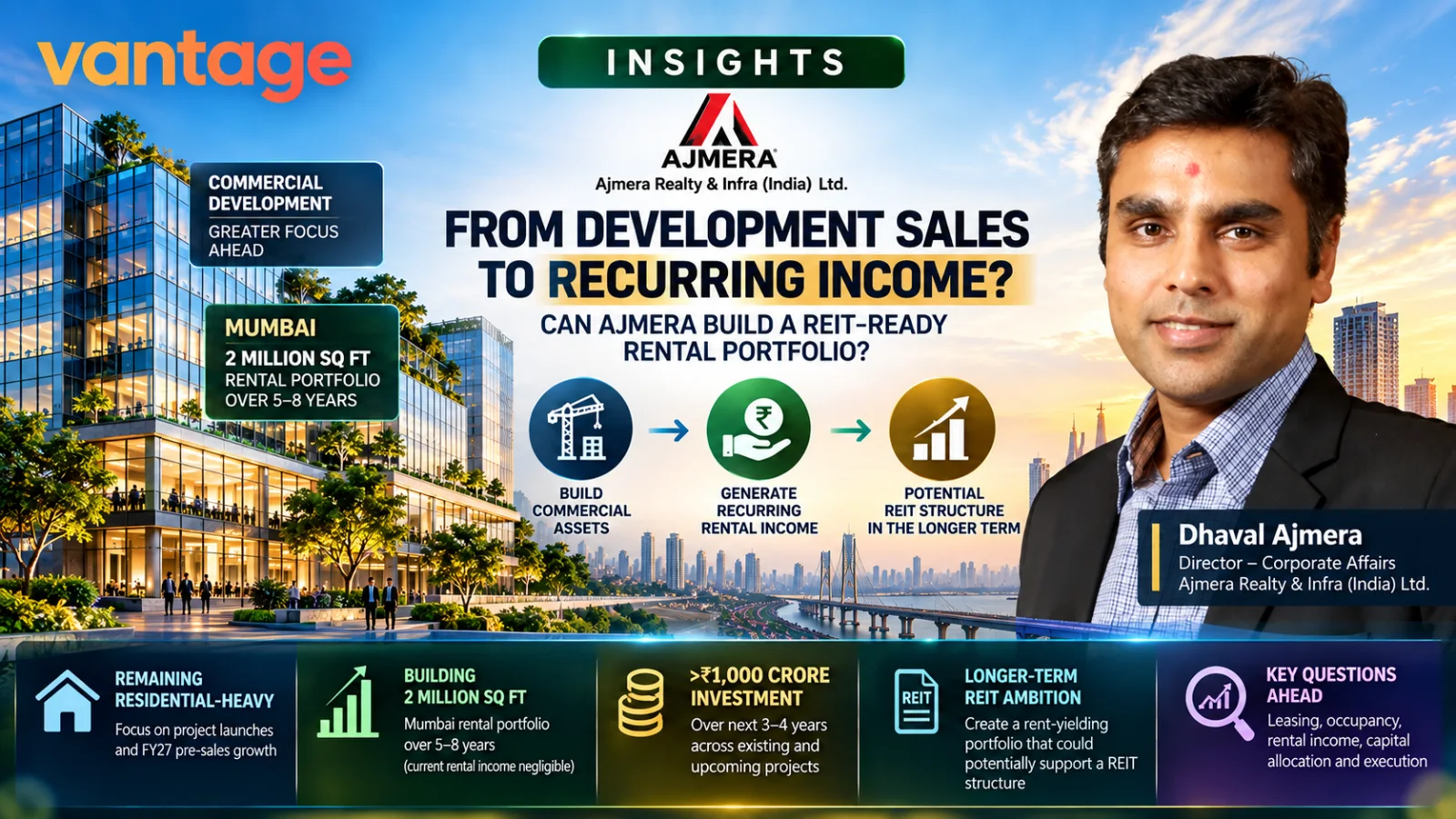
Editorial InSights banner showing a modern Mumbai commercial office development alongside the supplied executive portrait. The visual illustrates Ajmera Realty's proposed transition from development sales towards recurring rental income, with a 2 million sq ft Mumbai rental portfolio planned over five to eight years and a potential REIT structure as a longer-term ambition. It also highlights leasing, occupancy, rental income, capital allocation and execution as key factors to monitor.
Inline Intelligence
Ajmera Realty wants to do something that could gradually change the economics of its business.
The developer plans to build at least 2 million sq ft of rental assets in Mumbai over the next five to eight years.
Eventually, it wants a portfolio of rent-yielding properties that could potentially support a REIT structure.
Today, however, Ajmera says its rental income is negligible.
That creates the central investment question:
Can Ajmera successfully move from predominantly selling real estate to retaining enough high-quality assets to build a meaningful recurring-income business?
Selling Property and Owning Rental Property Are Different Businesses
A residential developer typically buys or controls land, builds homes, sells them and collects cash from buyers.
The capital can then be recycled into another development.
A rental-property owner follows a different model.
It develops or acquires an asset, leases it and retains ownership in exchange for recurring rental income.
The capital can remain tied to the property for much longer.
For Ajmera, building 2 million sq ft of rental assets therefore represents more than diversification by property type.
It could introduce a second capital model alongside residential development.
Why Would Ajmera Want Recurring Rental Income?
Residential sales can generate substantial cash flows, but they depend on repeated launches and sales.
Rental assets can create recurring income after stabilisation.
That can potentially reduce dependence on development sales and provide greater visibility over part of a company's future cash flows.
A successful rental portfolio could also create a pool of institutional-quality assets with longer-term monetisation options.
Ajmera has specifically identified a potential REIT structure as one such future possibility.
But the sequence matters.
The company first needs the assets.
Then it needs tenants.
Then it needs stable rental cash flows.
Only after that does a potential REIT become a more concrete strategic question.
Two Million Sq Ft Is the Destination, Not the Starting Point
The headline can easily be misread.
Ajmera does not currently have 2 million sq ft of Mumbai rental assets.
It wants to create at least that amount over five to eight years.
Current rental income is described as negligible.
This means the strategy starts from a relatively small recurring-income base.
Investors should therefore measure progress incrementally rather than assume the final portfolio already exists.
What Would a REIT-Ready Portfolio Actually Require?
Size alone is insufficient.
A 2 million sq ft portfolio with weak occupancy or poor tenants would have very different economics from 2 million sq ft of well-leased institutional-quality property.
The more relevant measures would eventually include:
- operational rental area;
- occupancy;
- tenant profile;
- contracted rent;
- lease expiry schedule;
- rental escalation;
- net operating income;
- property valuations;
- debt; and
- capital expenditure requirements.
These figures are not available for Ajmera's proposed future rental portfolio.
That is expected because the portfolio is still an ambition rather than a stabilised collection of assets.
Commercial Launches Are the First Milestone to Watch
Ajmera remains residential-heavy, but management says commercial development will receive greater focus over the coming quarters.
A boutique office project in Mumbai is among the planned launches, subject to approvals.
That makes future commercial launches important.
Investors need to see not simply how much commercial space Ajmera develops, but how much it intends to retain.
A commercial building sold to buyers or investors does not create the same recurring-income portfolio as a building retained and leased by the developer.
The distinction between develop-to-sell and develop-to-hold will therefore become increasingly important.
The ₹1,000 Crore Investment Plan Does Not Tell Us the Rental Allocation
Ajmera expects to invest more than ₹1,000 crore across existing and upcoming projects over the next three to four years.
But the reviewed evidence does not specify how much of that capital will fund the rental strategy.
This is one of the most important unavailable metrics.
Retaining income-producing assets can require substantial equity and debt because the developer does not immediately monetise the entire property through sales.
The pace at which Ajmera allocates capital to retained assets will therefore help determine how quickly the rental portfolio grows.
Residential Growth Still Has to Continue
Ajmera is simultaneously targeting ₹2,200 crore of FY27 pre-sales.
Its overall portfolio is expected to remain predominantly residential.
That means management has to pursue two objectives:
continue expanding residential sales
while
building a longer-duration rental portfolio.
Those objectives can complement each other if residential cash flows help fund expansion.
But they can also compete for capital.
The strategic test is whether Ajmera can create rental assets without constraining the residential business that currently forms the core of its development model.
Debt Becomes More Important When Assets Are Retained
Ajmera says current debt is approximately ₹600 crore to ₹700 crore, largely consisting of project-linked funding.
It also says earlier balance-sheet debt of approximately ₹500 crore to ₹600 crore has been completely repaid.
Management expects borrowing to remain linked to individual projects and says corporate-level capital raising is not currently planned.
That approach will be worth monitoring as the rental strategy develops.
A residential project can repay development debt through customer collections and sales.
A retained rental property relies more heavily on leasing and recurring cash flows after completion.
The duration and structure of financing can therefore become different.
A Rental Portfolio Can Improve Revenue Quality, but Not Automatically
Recurring rental income is often considered attractive because it can be more predictable than development sales.
But recurring does not mean risk-free.
Rental-property performance depends on:
- occupancy;
- rent collection;
- tenant credit;
- lease expiries;
- market rents;
- operating expenses;
- financing costs; and
- capital expenditure.
An empty office building does not produce attractive recurring income simply because the developer intended to hold it.
The quality of Ajmera's eventual portfolio will therefore matter as much as its size.
Mumbai Creates Opportunity and Concentration
Ajmera's proposed rental portfolio is specifically focused on Mumbai.
That gives the company exposure to a deep commercial and residential property market.
It also creates geographic concentration.
Mumbai office performance differs substantially between business districts and micro-markets.
The eventual economics will depend on where Ajmera's rental properties are located and what type of occupiers they attract.
The reviewed evidence does not yet provide enough detail to evaluate the future portfolio at that level.
Could a REIT Eventually Unlock Capital?
Potentially, but this should remain a scenario rather than a forecast.
A REIT structure can allow a sponsor to place qualifying income-producing assets into a listed vehicle while investors gain exposure to rental cash flows.
Vantage previously reported that India's six listed REITs distributed ₹3,136 crore to more than 4.85 lakh unitholders in Q1 FY27.
Those trusts collectively manage more than 214 million sq ft of Grade A office and retail assets.
This demonstrates that India's REIT market has developed meaningful scale.
It does not establish that Ajmera will launch a REIT, what assets would qualify, what valuation they might receive or when such a transaction could happen.
The REIT Ambition Creates a Useful Discipline
Even if Ajmera does not pursue a REIT for several years, the possibility can influence how rental assets are developed and managed.
Institutional income-producing portfolios typically benefit from:
- clear ownership structures;
- strong tenant covenants;
- long leases;
- reliable property-level data;
- disciplined leverage;
- professional facilities management; and
- transparent operating performance.
Building assets with those characteristics can improve portfolio quality regardless of whether a REIT transaction eventually occurs.
What Should Investors Monitor First?
The first milestone is not a REIT filing.
It is rental portfolio formation.
Investors should watch whether Ajmera begins disclosing:
Rental area completed
This shows whether the 2 million sq ft ambition is becoming physical operating space.
Rental area leased
Completed space without tenants does not establish a recurring-income business.
Occupancy
This indicates how effectively new assets are being absorbed.
Rental income
Ajmera currently describes rental income as negligible. Growth from that baseline would provide direct evidence that the strategy is working.
Net operating income
Revenue alone does not show the profitability of a rental portfolio.
Capital deployed
This would help investors understand the cost of building the recurring-income platform.
Debt associated with retained assets
This becomes important when evaluating the quality and risk of rental cash flows.
What Would Strengthen the Ajmera Rental Thesis?
The strategy would become more credible if the company demonstrates:
- successful commercial launches;
- clear identification of assets being retained;
- meaningful leasing before or soon after completion;
- rising rental income;
- healthy occupancy;
- manageable project-linked debt; and
- continued residential pre-sales.
That combination would suggest Ajmera is adding recurring income without weakening its core development business.
What Could Challenge the Strategy?
Potential risks include:
- delayed commercial launches;
- slower leasing;
- higher construction costs;
- weaker office demand in specific Mumbai micro-markets;
- capital becoming tied up in vacant assets;
- rising project debt;
- tenant concentration; and
- competition for capital with residential projects.
These are analytical risks to monitor.
The reviewed evidence does not establish that they are currently occurring.
Two Million Sq Ft Does Not Tell Us What the Portfolio Is Worth
It would be tempting to apply an assumed rent or capitalisation rate to 2 million sq ft and calculate a future portfolio valuation.
That would create false precision.
The necessary inputs are not yet available.
We do not have a verified future portfolio-wide:
- rent per sq ft;
- occupancy rate;
- NOI;
- tenant mix;
- lease duration;
- operating-cost ratio;
- cap rate; or
- debt structure.
Vantage therefore does not estimate a future valuation or REIT size from the 2 million sq ft target.
The Most Important Shift Is From Transactions to Income
Ajmera's strategy matters because it could change how part of the business creates value.
Residential development largely depends on transactions.
Build.
Sell.
Collect.
Reinvest.
A rental portfolio introduces another cycle.
Build.
Lease.
Operate.
Collect recurring income.
Retain or eventually monetise.
The second model takes longer to mature, but it can create a different type of real estate platform.
Ajmera's Next Five to Eight Years Will Test the Hybrid Model
Ajmera is not abandoning residential development.
Management says the portfolio will remain residential-heavy.
Instead, the company is attempting to add a second leg to the business through commercial and rental assets.
If the strategy works, Ajmera could eventually combine:
residential development cash flows
with
recurring Mumbai rental income.
A REIT could then become one potential capital-market option for a mature portfolio.
But that is several steps ahead of where the company stands today.
For now, the evidence supports a simpler conclusion.
Ajmera has set a 2 million sq ft Mumbai rental ambition.
The investment case will depend on whether that ambition turns into occupied buildings and durable cash flow.
Frequently Asked Questions
Why is Ajmera Realty building a Mumbai rental portfolio?
Ajmera wants to create a longer-term rent-yielding asset portfolio alongside its predominantly residential development business. Management has also identified a potential future REIT structure as an objective.
Is Ajmera Realty's 2 million sq ft rental portfolio already operational?
No. The company aims to build at least 2 million sq ft over five to eight years and says current rental income is negligible.
Will Ajmera launch a REIT?
The company has not announced a REIT launch. Management says the eventual objective is to create rent-yielding assets that could potentially support a REIT structure.
What would make Ajmera's rental portfolio REIT-ready?
Portfolio size alone is not enough. Completed assets, occupancy, stable rental income, tenant quality, leases, property valuations and an appropriate capital structure would all matter.
Could the rental strategy increase Ajmera Realty's debt?
Retaining rental assets can require longer-duration capital, but the future impact cannot be quantified from the available evidence. Ajmera currently says its ₹600 crore to ₹700 crore debt is largely project-linked.
What is Ajmera Realty's FY27 pre-sales target?
Ajmera is targeting ₹2,200 crore of FY27 pre-sales. It remains company guidance rather than an achieved result.
How much will Ajmera spend on the rental portfolio?
The reviewed evidence does not provide a dedicated rental-portfolio investment figure. The company expects to invest more than ₹1,000 crore across existing and upcoming projects over three to four years.
What is the most important metric to watch next?
The transition from planned square footage to completed and leased rental assets is critical. Rental income, occupancy, NOI and capital deployed would provide stronger evidence of progress than the 2 million sq ft target alone.
Related Vantage Coverage
Click on article title to view article.
“Six listed Indian REITs distribute Rs 3,136 crore to investors in Q1 FY27” published on 17 August 2026 in Vantage-Radar
Sources
Click on article title to view article.
“Ajmera Realty looks to create two million sq ft of rental portfolio in Mumbai over next 5-8 years” published on 2 October 2026 in ETRealty
Evidence Caveats
- The 2 million sq ft figure is a future rental-portfolio ambition over five to eight years.
- Ajmera says current rental income is negligible.
- A REIT is a potential longer-term objective, not an announced transaction.
- ₹2,200 crore is FY27 pre-sales guidance.
- More than ₹1,000 crore is planned investment across the broader project portfolio, not a disclosed budget specifically for rental assets.
- Ajmera's reported ₹600 crore to ₹700 crore debt is described by management as largely project-linked.
- Future rental income, NOI, occupancy, cap rates, asset valuations and REIT valuation are unavailable.
- Discussion of capital allocation, recurring-income quality and REIT readiness is editorial analysis rather than company guidance.

From TatvaOps
Property Management & Rental Operations
Developing a property?
Structured oversight for multi-unit and investor-led builds.
Free quotes · Verified contractors · tatvaops.com
Discuss this article
Join the conversation
Continue this discussion on Forums. A board named like this InSights article is filed under InSights.
1 reply already on Forums
More from Real Estate
LTCG Tax Debate: Should You Delay Selling Investments?
Could waiting for LTCG tax relief cost more than it saves? With proposals under discussion, we examine how your current tax liability, market exposure and cash deadline should shape a planned investment sale.
Blackstones India Bet: What Should You Check?
Blackstone’s $100-billion India ambition is a useful signal. For your own money, the harder questions are access, valuation, cash flow and risk. Here is what to check before turning institutional optimism into a personal investment decision.
Senior Living: Buy the Home, Examine the Services: what most readers overlook
Rustomjee’s senior-living evaluation raises a household question: can you afford and rely on the services after buying the home? We examine recurring charges, operator responsibilities, changing support needs and exit flexibility.
Inline Intelligence
Key Insight Actions
Connected knowledge for Real Estate Strategy
Move between tutorials, discussions, Studio, and hubs without losing context.
Related discussions
Blackstones India Bet: What Should You Check?
1 replies
Related discussionGST ITC Relief Could Change Commercial Real Estate Economics, but How Much Would Developers Actually Save?
1 replies
Related discussionAnarock Profit Rose 53, but Cash Flow Turned Negative: What Should IPO Investors Trust More?
1 replies
Related discussionGaurs Sold 1,088 Yamuna Expressway Homes for 1,800 Crore: Is Airport-Led Housing Demand Becoming Sustainable?
1 replies
Related discussion
Topic hubs
Conclusion Intelligence
Related Discussions
Blackstones India Bet: What Should You Check?
Popular in insights discussions1 reply
GST ITC Relief Could Change Commercial Real Estate Economics, but How Much Would Developers Actually Save?
Popular in insights discussions1 reply
Anarock Profit Rose 53, but Cash Flow Turned Negative: What Should IPO Investors Trust More?
Popular in insights discussions1 reply
Gaurs Sold 1,088 Yamuna Expressway Homes for 1,800 Crore: Is Airport-Led Housing Demand Becoming Sustainable?
Popular in insights discussions1 reply
Was this helpful?
Let us know what you think