

Maharashtra Solar: Will Your Business Save as Expected?

Summary
A solar system’s annual generation does not tell a business what it will save. Here is how timing, banking credits, grid charges and storage can affect a Maharashtra project’s economics. A solar proposal may show an attractive annual generation figure and a short payback period. But a business does not use electricity as one annual block. It needs power at particular times, and the financial value of solar electricity can change depending on when it is generated, consumed or credited.
Published on
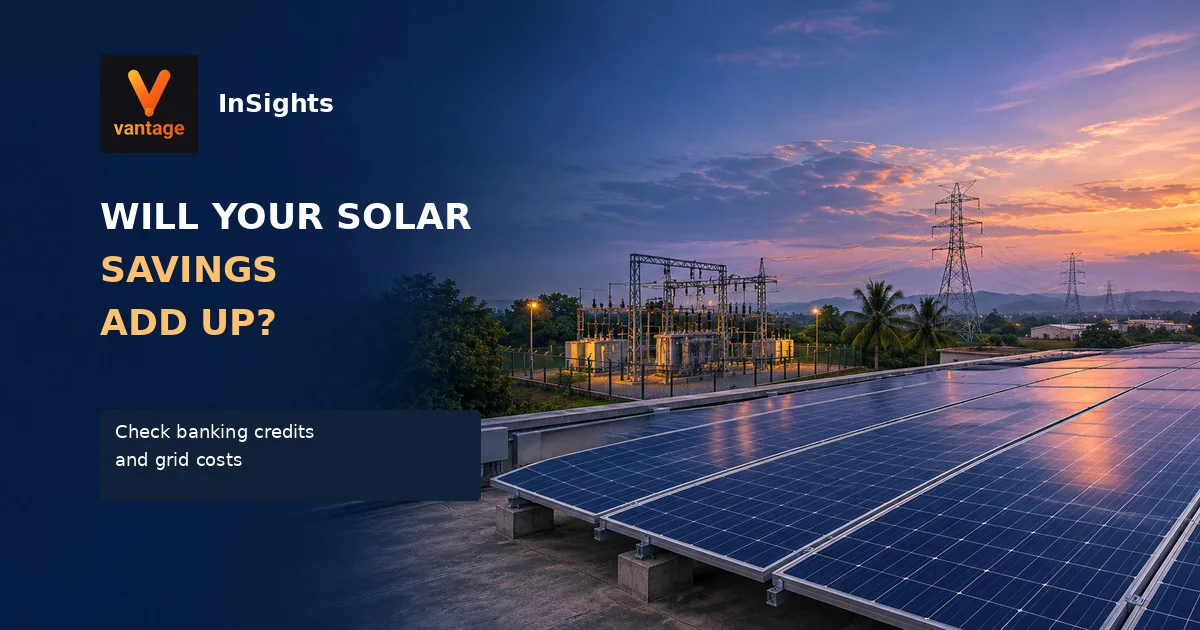
The cover highlights why a business’s solar savings depend on more than the electricity its panels generate. Banking treatment, grid costs and the timing of power use can all affect the result.
Inline Intelligence
A solar proposal may show an attractive annual generation figure and a short payback period. But a business does not use electricity as one annual block. It needs power at particular times, and the financial value of solar electricity can change depending on when it is generated, consumed or credited.
That is the question facing commercial and industrial solar users in Maharashtra as electricity banking, time-of-day tariffs and grid-related charges draw renewed attention.
The answer is not that solar is necessarily profitable or unprofitable. It is that a project’s savings depend on the business’s usage pattern and the rules that apply to its particular connection.
Mercom India’s accessible introduction describes why businesses are reassessing projects that rely on surplus solar generation to offset consumption outside solar hours -> How Maharashtra’s C&I Solar Projects Can Remain Profitable Despite Banking Curbs.
What is electricity banking?
In this context, banking is a way of accounting for eligible surplus renewable electricity supplied to the grid and later applying a credit under the relevant rules.
It should not be confused with a physical battery. A battery stores electricity at a site or another location. A banking credit is governed by the applicable accounting, settlement and charge provisions. The two arrangements can serve different purposes and have different costs.
A proposal should explain when a credit is created, when it can be used, whether it expires or is settled, and which charges and losses are included. The answers depend on the applicable framework and contract.
Why can two businesses get different results?
Imagine two hypothetical businesses with similar solar panels:
- Business A uses most of its electricity while the sun is shining.
- Business B uses much of its electricity in the evening and overnight.
Business A may consume a larger share of its solar generation directly. Business B may depend more on the treatment of surplus generation, storage or grid purchases outside solar hours.
This is a conceptual example, not a calculation of savings for either business. The outcome also depends on working days, seasonal changes, system design, tariff category, equipment performance and the rules applicable to each connection.
A project that generates the same number of units as a business consumes over a year does not automatically eliminate its electricity bill. Fixed charges, grid purchases at other times and other applicable charges may remain.
Are Maharashtra’s proposed rules already final?
MERC lists draft 2026 regulations for grid-interactive rooftop renewable-energy systems and for distribution open access. The listing shows that proposals are being considered; it does not by itself establish the final rules or their effect on your installation.
Review the regulator’s listing here -> MERC Draft Regulations.
Maharashtra’s renewable-energy policy also discusses indicative frameworks that vary by system size and procurement option. A policy proposal, a draft regulation, a final regulation, a tariff order and a contract are different documents. Each needs to be read for its own purpose.
Read the policy here -> Maharashtra Renewable Energy and Energy Storage Policy 2025-26 to 2035-36.
Before relying on a sales quote, ask which current rules and orders apply to your distribution company and connection. Also check whether a relevant order is subject to an appeal, stay or subsequent decision.
What should a solar savings estimate include?
A useful estimate starts with your electricity bill and time-of-day usage, then models how the proposed system interacts with them.
Ask the installer or adviser to show:
- Your consumption pattern: Electricity used by time of day, season and operating shift, using available meter data and bills.
- Direct solar use: How much generation is expected to be consumed at the site as it is produced.
- Surplus treatment: Which units may be exported, banked or settled, and under which verified arrangement.
- Remaining grid purchases: Power expected to be bought when solar is unavailable or insufficient.
- Charges and losses: Applicable grid, banking, wheeling or other charges, where relevant, with their source and assumptions.
- Project costs: Installation, maintenance, financing, insurance, replacement and any storage costs.
- Sensitivity: How results change if generation, operating hours, charges or usable credits differ from the base case.
Not every charge applies to every project. Ask the provider to identify which ones apply to your proposed arrangement and why, rather than adding a generic list to every estimate.
Could a battery solve the problem?
A battery may allow some solar electricity to be stored for later use, but it adds cost and requires its own technical and financial assessment.
Useful questions include the battery’s usable capacity, charging and discharging efficiency, expected lifetime, warranty, replacement cost, operating strategy and whether it provides backup during an outage under the proposed design.
A battery can change when electricity is available, but it does not automatically eliminate all grid charges or guarantee a faster payback. Compare a no-battery case and a battery case using the same assumptions and the applicable rules.
How should you compare two solar proposals?
Ask each provider for a consistent breakdown of total installed cost, expected generation, direct consumption, exported or banked energy, remaining grid purchases and applicable charges. Compare the proposals over the same period and with the same operating assumptions.
A simple payback calculation divides an upfront cost by an estimated annual saving. It can be a useful starting point, but it does not capture the timing of cash flows, financing, degradation, maintenance or replacement. Ask for those items separately before treating a quoted payback as a decision.
Vantage previously examined a different state’s open-access surcharge and why quoted power prices may not equal delivered costs -> Telangana Raises Open-Access Power Surcharge. Telangana’s charge should not be applied to a Maharashtra connection.
What to check next
- Identify your arrangement: Confirm the distribution company, tariff category, contract demand, system size and whether the proposal uses rooftop metering, captive power or open access.
- Verify the current rules: Ask the utility and a qualified adviser to identify the applicable final regulations, tariff orders and any relevant legal developments.
- Request a time-based model: Compare generation and consumption by time of day, including weekends and seasonal changes.
- Stress-test the quote: Ask for outcomes under lower generation, different credit treatment, higher costs and, if relevant, a battery replacement.
FAQ
1. Does banking mean my solar electricity is stored in a battery?
No. Banking generally refers to accounting for eligible surplus energy as a credit under applicable rules. Physical storage is a separate arrangement.
2. Does every Maharashtra solar customer have the same banking treatment?
No universal conclusion follows. Treatment can depend on the connection, system size, procurement and metering arrangement, utility and applicable rules.
3. Are MERC’s 2026 draft regulations automatically in force?
No. A draft is a proposal. Check the regulator’s final notifications and relevant orders before treating a proposed provision as applicable.
4. Will solar eliminate a business’s electricity bill?
Not necessarily. A business may continue to buy power at other times and may still face fixed or other applicable charges.
5. Will a battery guarantee savings?
No. A battery can change the timing of usable electricity, but its installation, performance, maintenance and replacement costs affect the result.
6. Should a household use the same assumptions as a factory?
Not automatically. Household and commercial or industrial connections may have different tariffs, arrangements and rules. Check the relevant category and utility.
7. What is the first document to request from a solar provider?
Ask for a project-specific savings model alongside the proposed system design, and request the tariff and regulatory assumptions used in that model.
Sources
Click an article title to view the source.
- How Maharashtra’s C&I Solar Projects Can Remain Profitable Despite Banking Curbs, published on 13 November 2026 in Mercom India.
- MERC Draft Regulations, Maharashtra Electricity Regulatory Commission, accessed on 13 November 2026.
- Maharashtra Renewable Energy and Energy Storage Policy 2025-26 to 2035-36, Government of Maharashtra, accessed on 13 November 2026.
- Telangana Raises Open-Access Power Surcharge, published on 5 November 2026 in Vantage Radar.
Evidence Caveats
Only the introduction of Mercom’s 13 November article was accessible without signing in. The MERC documents listed are drafts, while the state policy includes proposed and indicative frameworks. This article does not determine the current legal or billing position for a particular project. The business comparison is hypothetical; no customer bill, contract, solar quote, battery design or project-specific savings calculation was reviewed.
If you are evaluating solar for a business, which assumption would you most want independently verified: daytime use, the value of exported energy, grid charges or battery costs? Share your reasoning in the attached forum discussion without posting confidential bills or contracts.
Disclaimer
This article is for general information and is not engineering, legal, tax or investment advice. Electricity rules, charges, contracts and project economics vary. Verify the current requirements and obtain qualified advice before committing to a project.

From TatvaOps
Solar & Energy Solutions
Considering rooftop solar?
Verified installers, subsidy support, and milestone-secured payments.
Free quotes · Verified contractors · tatvaops.com
Discuss this article
Join the conversation
Continue this discussion on Forums. A board named like this InSights article is filed under InSights.
1 reply already on Forums
More from Solar
Meghalaya Solar Battery Sizing and Quote Checks
Meghalaya requires storage for net-metered systems above 10 kW. Check the daily generation estimate, battery size and costs before comparing bids.
Rooftop Solar Is Growing. Should You Install It?
India’s rooftop solar additions are rising, but national growth cannot tell you what your own system will save. Here are the roof, bill, cost and subsidy checks to make before installing.
Telangana Open Access: What Will Your Power Cost?
Telangana’s higher open-access surcharge can narrow renewable power savings. Check which units attract the charge, who pays it under your contract and what it does to your delivered cost.
Inline Intelligence
Key Insight Actions
Connected knowledge for Solar Energy
Move between tutorials, discussions, Studio, and hubs without losing context.
Related discussions
Topic hubs
Conclusion Intelligence
Related Discussions
Was this helpful?
Let us know what you think