

India's Mall Business Is Growing. Is It a Good Investment?
Summary
India's mall operators may see 14–16% revenue growth in FY2028. Explore Crisil's forecast, rising rental income, new mall supply, REIT opportunities and the investment risks behind commercial property growth. India's shopping mall business is entering another phase of expansion. New retail developments, strong preleasing and rising rental income could accelerate revenue growth for Grade A mall operators over the next financial year. According to an October 26, 2026 report by Crisil Ratings, revenue growth among the mall operators it assessed could increase from 10–11% in FY2027 to 14–16% in FY2028.
Published on
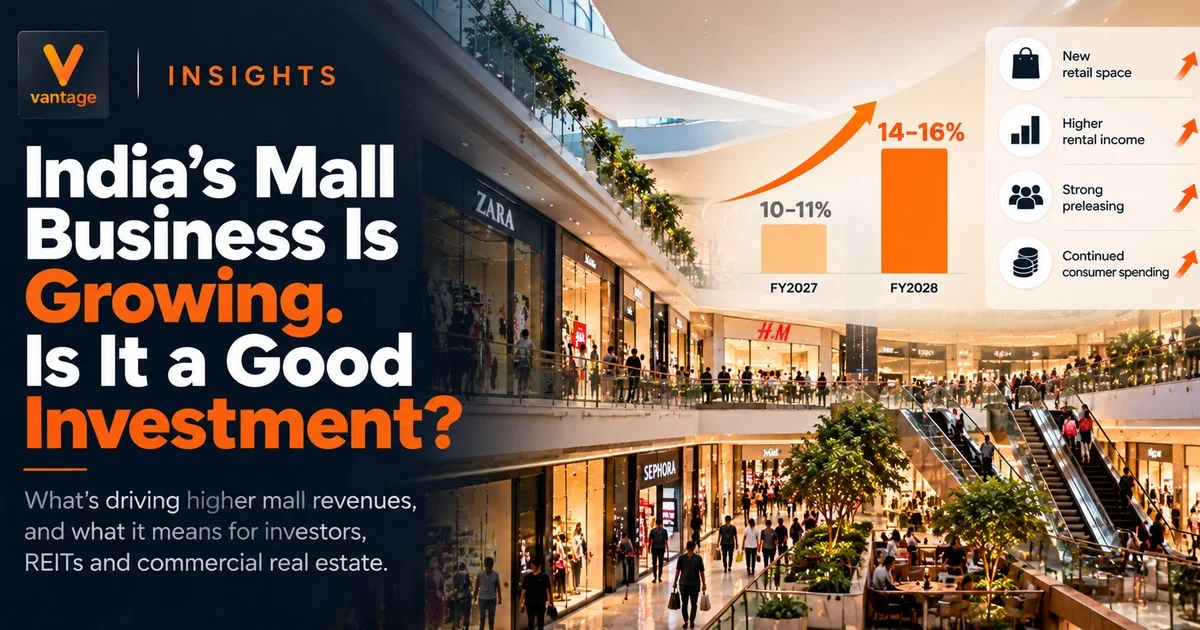
Modern Indian shopping mall with retail stores, shoppers and escalators, illustrating Crisil Ratings' forecast of 14–16% mall operator revenue growth in FY2028 and its implications for commercial real estate investment, rental income and REITs.
Inline Intelligence
India's shopping mall business is entering another phase of expansion. New retail developments, strong preleasing and rising rental income could accelerate revenue growth for Grade A mall operators over the next financial year.
According to an October 26, 2026 report by Crisil Ratings, revenue growth among the mall operators it assessed could increase from 10–11% in FY2027 to 14–16% in FY2028.
The projection reflects a combination of new retail space, rental escalation and continued consumer spending.
For commercial real estate investors, this creates an interesting opportunity to examine.
But there is an important distinction between an industry that is growing and an investment that is attractively priced.
An increase in mall revenue does not necessarily guarantee stronger investor returns.
To understand the opportunity, investors must examine where that growth is coming from, how it is financed and whether property income can justify current valuations.
What Is Driving India's Mall Revenue Growth?
The latest Crisil analysis covers 44 Grade A malls across 11 Indian cities.
Together, these properties represent approximately 37 million sq. ft. of retail space, or around half of India's Grade A mall stock, according to the agency.
The cities covered include Bengaluru, Mumbai, Delhi-NCR, Hyderabad, Chennai, Pune, Kolkata, Ahmedabad, Lucknow, Chandigarh and Indore.
Crisil expects nearly two-thirds of the projected FY2028 revenue growth to originate from new retail space.
The remaining growth will be supported by rental increases, renewed leasing agreements and income linked to retailer sales.
This distinction matters.
Higher revenue arising from newly opened malls is different from growth produced by existing properties charging higher rents.
Both can support earnings, but they involve different investment requirements and operating risks.
How Much New Mall Space Is Expected?
Crisil forecasts the addition of approximately 4.5–5 million sq. ft. of retail space across FY2027 and FY2028.
This is more than double the addition in the preceding two financial years.
New developments can expand the geographic reach of mall operators and introduce additional rental income.
However, adding floor space is not equivalent to immediately generating profitable revenue.
A mall must attract tenants, maintain occupancy, encourage visitor spending and manage operating expenses.
The stronger the preleasing, the lower the initial risk of completed space remaining vacant.
According to Crisil, around 70% of the retail space expected to become operational in FY2027 has already been preleased.
This provides some visibility over future rental income.
Yet preleasing does not eliminate execution risk. Construction delays, tenant fit-out requirements, lease commencements and retailer performance can still affect revenue.
Why Occupancy Matters More Than the Number of Malls
Occupancy is one of the most important operating indicators for commercial properties.
A mall can contain substantial leasable space but generate disappointing income if tenants do not occupy it.
Crisil expects average portfolio occupancy to remain around 93–94% in FY2027 and FY2028, compared with approximately 95–96% currently.
The modest expected decline reflects new supply entering the market.
New malls generally require time to reach mature occupancy levels.
For investors, the key question is whether occupancy remains healthy after the portfolio expands.
A mall operator that maintains occupancy while increasing rental income may be in a stronger position than one that rapidly adds space but struggles to attract tenants.
However, occupancy should also be assessed alongside rental rates and tenant quality.
A property with high occupancy but weak rental economics may still generate disappointing returns.
Rental Growth Is Another Major Driver
Mall operators earn income primarily by leasing retail space to brands and other commercial tenants.
Their income typically includes contracted rent and, for some leases, an additional component linked to tenant sales.
Crisil reports that around 25% of the retail area in its sample is due for lease renewal across FY2027 and FY2028.
These renewals may create opportunities for higher rentals where market conditions support them.
Existing leases can also include contractual rent escalations.
However, not all renewals will necessarily occur at higher prices.
The outcome depends on location, retailer demand, footfall, trading performance and competing retail space.
A premium mall in a strong catchment area may have different pricing power from a mall facing higher vacancies or weaker local spending.
This is why investors should evaluate individual property performance rather than rely solely on nationwide growth forecasts.
How Consumer Spending Affects Mall Income
The financial health of a mall depends partly on the performance of the retailers operating inside it.
Under some leases, operators receive a proportion of tenants' sales in addition to other contracted rental payments.
Crisil estimates that revenue-sharing arrangements contribute approximately 10–15% of overall mall-operator revenue.
This creates a connection between consumer spending and property income.
When retailer sales improve, some mall operators may earn additional revenue.
When discretionary consumption weakens, those revenue components may come under pressure.
Crisil reported double-digit mall consumption growth during the first quarter of FY2027 in the portfolio it analysed.
But stronger consumption does not mean all retail categories or malls experience equal growth.
Apparel, jewellery, electronics, food and beverages, and entertainment may respond differently to changes in consumer spending.
An investor should examine the tenant mix, not simply the headline number of visitors or stores.
The ₹5,500 Crore Expansion Question
Strong growth forecasts are attractive, but new malls require substantial investment.
Crisil expects capital expenditure of approximately ₹5,000–5,500 crore across FY2027 and FY2028 for its assessed operators.
That compares with approximately ₹2,500 crore during the preceding two financial years.
The agency expects this expenditure to be funded through a combination of debt and equity in roughly equal proportions.
This expansion could support future rental income.
However, it also creates financial obligations.
Debt is projected to rise by more than 20% to approximately ₹17,000 crore by FY2028.
The important question is whether incremental earnings from the new space will grow sufficiently to cover financing costs and support a healthy balance sheet.
Crisil expects debt-to-EBITDA ratios to remain around 3.1–3.3 times through FY2028, compared with approximately 3.1 times in FY2026.
That forecast suggests operating earnings could broadly keep pace with borrowing.
Nevertheless, higher interest rates or large debt-funded acquisitions could weaken this balance.
What Does This Mean for Commercial Property Investors?
Investors evaluating commercial property often focus on rental income and capital appreciation.
But gross rental growth tells only part of the story.
The value of an income-producing property depends on factors including:
- Sustainable net operating income.
- Tenant occupancy and lease quality.
- Maintenance and management expenses.
- Future capital expenditure.
- Financing obligations.
- Exit valuation and market liquidity.
Consider a simplified hypothetical example.
Suppose a commercial property generates ₹60 lakh in annual gross rent.
After ₹12 lakh of property-level operating expenses, its net operating income is ₹48 lakh.
If the property is valued at ₹8 crore, the illustrative property-level income yield is:
₹48 lakh ÷ ₹8 crore × 100 = 6%.
Now suppose annual net operating income rises to ₹54 lakh while the property value remains unchanged.
The yield on that unchanged valuation becomes 6.75%.
But if the market valuation simultaneously increases to ₹10 crore, the income yield falls to 5.4%.
This demonstrates why higher rental income does not automatically make a property a better investment at any price.
The figures are hypothetical and exclude financing costs, taxes, transaction costs and possible capital expenditure.
Are Shopping Mall REITs an Alternative?
Real Estate Investment Trusts, or REITs, allow investors to participate in portfolios of income-producing real estate through listed units, subject to the structure and holdings of each trust.
Some Indian REIT portfolios have exposure to retail malls.
Compared with directly purchasing an individual commercial property, listed REITs can offer a smaller investment entry size and exchange-based trading.
They may also provide exposure to multiple properties rather than relying on a single building.
However, REITs carry risks.
Their unit prices can fluctuate, distributions can vary, and the underlying properties remain exposed to changes in rents, occupancy and financing conditions.
Investors also need to understand the tax treatment of different distribution components.
Not every REIT has the same property composition.
An office-focused REIT is not equivalent to a retail-mall-focused REIT merely because both invest in commercial property.
Before investing, readers should review the latest portfolio disclosures, financial statements, distribution history and valuation metrics.
Five Metrics to Examine Before Investing
1. Occupancy
Check whether the portfolio maintains healthy occupancy as new space becomes available.
An expanding mall with weak tenant demand may take longer to produce its expected income.
2. Same-property rental growth
Distinguish organic growth at existing properties from revenue generated by newly acquired or completed malls.
This helps assess whether existing assets are performing better.
3. Net operating income
Property income after relevant operating expenses can provide a more useful measure than gross revenue alone.
However, it is still not the same as cash available to an equity investor.
4. Debt and interest coverage
Higher borrowing can fund expansion, but it also increases exposure to financing costs and economic slowdowns.
Debt ratios should be examined alongside maturity schedules and interest obligations.
5. Property valuation
An attractive business can still be an unattractive investment when the purchase price is excessively high.
Compare sustainable income with the valuation and consider alternative investment opportunities.
What Could Go Wrong With the Growth Forecast?
Crisil's outlook depends on several assumptions.
First, new malls must become operational as planned.
Second, preleased space must transition into income-generating occupancy.
Third, consumer spending must remain supportive.
Fourth, rental growth must be sufficient to offset operating and financing expenses.
A sharp increase in interest rates could affect mall operators in two ways.
It could increase their borrowing costs while also putting pressure on discretionary consumer spending.
Both developments could weaken the relationship between earnings growth and debt.
Large acquisitions funded predominantly by borrowing would create another risk.
A mall operator may expand its portfolio while simultaneously increasing financial vulnerability.
This is why Crisil's expectation of stable credit profiles should be treated as a forecast dependent on operating conditions, not a guarantee.
Does This Forecast Make Commercial Property Better Than Residential Property?
Not necessarily.
Residential and commercial properties have different income structures, lease arrangements, tenant risks, financing requirements and market liquidity.
A residential apartment may appeal to investors seeking housing use, rental income and potential appreciation.
A commercial property may offer different income characteristics but also greater sensitivity to tenant quality and business conditions.
The more useful comparison is based on net, after-cost and after-tax outcomes over a similar investment horizon.
Investors should consider potential vacancies, maintenance, property taxes, financing expenses, transaction costs and the ease of selling.
The Crisil forecast establishes a potential growth outlook for a segment of organised retail real estate.
It does not establish that commercial property will outperform residential property, mutual funds, listed equities or other investments.
Why Bengaluru Investors Should Pay Attention
Bengaluru is one of the 11 cities covered in Crisil's sample.
The city's organised retail properties serve different residential catchments, employment centres and consumer markets.
However, the report does not provide a separate Bengaluru-specific 14–16% revenue-growth forecast.
Therefore, it would be inaccurate to assume that every Bengaluru shopping mall will achieve the national sample's projected growth rate.
Local investors should examine the specific mall's location, tenant mix, competing developments, accessibility and rental performance.
The performance of one successful shopping destination cannot be generalised to every commercial property in the city.
What Should Investors Watch in FY2028?
As the industry approaches the next phase of expansion, several developments will determine whether Crisil's forecast is realised.
The most important include the pace of new mall openings, the conversion of preleasing into occupied space, changes in rental rates and the performance of consumer spending.
Investors should also follow the relationship between additional debt and growth in operating earnings.
Strong revenue growth accompanied by weakening cash flows may deserve more caution than slower growth supported by disciplined capital allocation.
Conclusion
India's Grade A mall operators are preparing for another period of expansion.
Crisil Ratings expects revenue growth to accelerate to 14–16% in FY2028, helped by new space, rental increases and strong preleasing.
The forecast points to opportunities within organised retail property.
However, it also comes with substantially higher capital expenditure and borrowing.
For investors, the central question is not simply whether shopping malls are growing.
It is whether the income generated by those assets can justify their financing costs and valuations.
Commercial real estate can offer attractive opportunities, but the quality of the underlying property and the price paid remain critical.
FAQ
1. How fast are Indian mall revenues expected to grow?
Crisil Ratings forecasts 14–16% revenue growth in FY2028 for the mall-operator sample it assessed, compared with 10–11% in FY2027.
2. Why are mall operators expecting higher revenue?
The forecast is supported by new retail space, healthy preleasing, contractual rental increases, lease renewals and income linked to retailer sales.
3. Are Indian shopping malls operating at high occupancy?
Crisil expects portfolio occupancy in its sample to remain around 93–94% during FY2027 and FY2028, compared with approximately 95–96% currently.
4. Does mall revenue growth guarantee higher property returns?
No. Investment returns also depend on expenses, debt, valuation, capital expenditure, liquidity and changing market conditions.
5. Can investors participate in shopping malls through REITs?
Some listed real estate investment trusts provide exposure to retail properties. Investors should verify each REIT's actual portfolio, financial disclosures, distribution structure and risks.
6. Is Bengaluru included in the Crisil report?
Yes. Bengaluru is one of the 11 cities covered, but the published headline forecast is for the combined sample, not a separate city-level estimate.
Sources
Click an article title to view the source.
-
New Space to Accelerate Mall Revenue Growth ~500 Bps Next Fiscal published on 26 October 2026 by Crisil Ratings.
-
New Mall Supply to Drive Revenue Growth to 14–16 Per Cent Next Fiscal: Crisil published on 26 October 2026 by ETRetail.
-
Mall Operators to Sustain Double-Digit Growth Through Next Fiscal published on 26 November 2025 by Crisil Ratings, for historical comparison.
Evidence Caveats
The 14–16% growth estimate is a forecast by Crisil Ratings based on a defined sample of Grade A malls. It is not a verified outcome for FY2028 or a guaranteed industry-wide growth rate.
The report's city list does not imply identical growth across those locations.
The income-yield calculation is hypothetical and is not intended to represent typical Indian commercial-property yields.
The article does not recommend any particular property, company, security or REIT.
Join the Discussion
Would you rather invest in a commercial property generating rental income or gain indirect exposure through a listed REIT?
What matters most in your decision: rental yield, property location, occupancy, liquidity or potential appreciation?
Share your perspective in the Vantage community.
Understanding these trade-offs can help investors distinguish a growing real estate sector from an investment that genuinely suits their financial goals.
Disclaimer
This article is for general educational and editorial purposes only. It does not constitute personalised investment, financial, legal or tax advice. Commercial property and REIT investments carry market, credit, liquidity, valuation and regulatory risks. Readers should review current disclosures and consult qualified advisers where appropriate before making investment decisions.

From TatvaOps
Property Management & Rental Operations
Developing a property?
Structured oversight for multi-unit and investor-led builds.
Free quotes · Verified contractors · tatvaops.com
Discuss this article
Join the conversation
Continue this discussion on Forums. A board named like this InSights article is filed under InSights.
1 reply already on Forums
More from Real Estate
Mumbai Luxury Home Data What Buyers Should Check
Luxury registration totals are not a like-for-like price index. Here is how buyers can compare properties and ownership costs.
Binance Security Incident What Holders Can Check
The Binance incident highlights the difference between a displayed balance and access to assets. Here are practical checks for holders.
Gurugram Power Choice What Residents Should Check
A proposed second electricity distributor is on hold. Here is what Gurugram and Nuh residents can check on bills and service.
Inline Intelligence
Key Insight Actions
Connected knowledge for Retail Real Estate Investment
Move between tutorials, discussions, Studio, and hubs without losing context.
Related discussions
Topic hubs
Conclusion Intelligence
Related Discussions
Was this helpful?
Let us know what you think