

If Green Certification Is Becoming Standard, What Will Make One Office Building Worth More Than Another?
Karthik posts articles on Energy and Construction.
Summary
Green certification is becoming standard across India's Grade A office market, which means the label alone may no longer create a premium. The next divide could be between buildings that can prove their efficiency, resilience and retrofit readiness and older assets that risk a brown discount. India's office market may be approaching an important sustainability tipping point. Green certification was once a relatively clear way for an office building to differentiate itself. Now, it is becoming increasingly common.
Published on
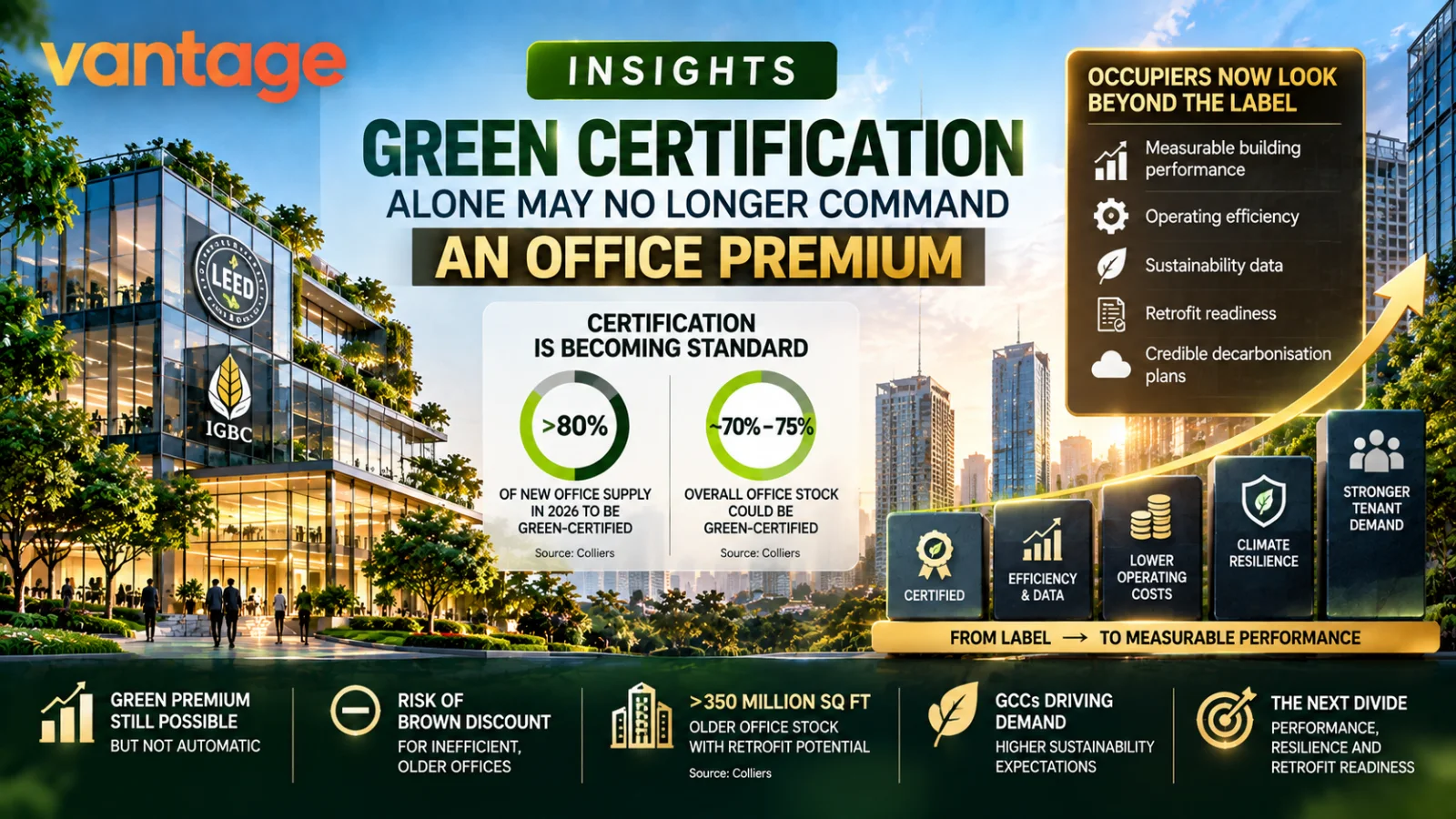
A modern green-certified Grade A office building set against an Indian urban skyline, with visual indicators showing the shift from certification towards measurable building performance. The banner highlights operating efficiency, sustainability data, lower operating costs, climate resilience and stronger tenant demand, while contrasting these advantages with retrofit and brown-discount risks for older office stock.
Inline Intelligence
India's office market may be approaching an important sustainability tipping point.
Green certification was once a relatively clear way for an office building to differentiate itself.
Now, it is becoming increasingly common.
Colliers expects more than 80% of new office supply in 2026 to be green-certified, while overall green penetration could reach approximately 70% to 75%.
At the same time, Grant Thornton Bharat says certification alone is becoming less of a differentiator.
Occupiers, lenders and investors increasingly want measurable operating performance, better building data, retrofit readiness and credible decarbonisation plans.
This changes the commercial real estate question.
It is no longer simply:
Is the building green-certified?
It is increasingly:
Can the building prove that it actually performs better?
Certification Can Lose Scarcity Without Losing Importance
A useful way to understand the shift is through scarcity.
When only a minority of premium offices were green-certified, the label helped separate them from competing stock.
As certification becomes standard in new Grade A development, its scarcity value declines.
That does not make certification irrelevant.
It can instead become a minimum requirement.
This is similar to other features of institutional office buildings.
Reliable power, professional facilities management and modern elevators are important.
But a premium Grade A building does not command higher rent simply because it has elevators.
Tenants expect them.
Green certification could increasingly move in the same direction.
The Green Premium May Be Turning Into a Performance Premium
Historically, certified offices have shown stronger rental and occupancy outcomes.
Colliers' earlier analysis found green-certified Grade A occupancy of approximately 80% to 90%, compared with 65% to 85% for non-certified offices.
City-level rental premiums also varied significantly.
But as certification spreads, tenants can differentiate between certified buildings using another layer of information.
That layer is operating performance.
A building that can demonstrate:
- lower energy consumption;
- efficient water use;
- strong indoor environmental performance;
- sophisticated building controls;
- renewable-energy integration; and
- credible emissions reduction
may have a stronger proposition than another building carrying a similar certification but performing less efficiently.
The potential premium therefore moves from the label towards measurable outcomes.
This Is Particularly Important for GCC Tenants
Global Capability Centres are becoming one of India's most important office occupier groups.
Many are part of multinational companies with global sustainability targets.
Their Indian real estate therefore sits inside a larger corporate environmental strategy.
A GCC may need office data not simply because sustainability is desirable, but because its parent company needs information for operational targets and reporting.
That can turn building performance into a procurement issue.
Landlords unable to provide reliable information may become less attractive even if their buildings hold recognised certifications.
Data Infrastructure Could Become Part of Building Quality
Commercial property has traditionally been judged through visible characteristics.
Location.
Facade.
Floorplate.
Lobby.
Parking.
Amenities.
Increasingly, some of the most important infrastructure may be less visible.
Sensors, meters, building-management systems and analytics can provide information on how an office actually operates.
For landlords, these systems can identify inefficiency.
For tenants, they can provide sustainability information.
For investors and lenders, they can provide evidence about asset quality and future capital requirements.
The building's data layer can therefore become part of its commercial value proposition.
The Bigger Investment Risk May Be the Brown Discount
Investors naturally focus on whether sustainable buildings can earn a green premium.
But once sustainability becomes standard, the opposite question may become more important.
How much value could an inefficient building lose?
Grant Thornton warns that older assets with weak sustainability credentials could face a brown discount if they become more expensive to lease, finance or retrofit.
This reframes the investment case.
A landlord may not need a large explicit green premium for sustainability investment to make economic sense.
Avoiding vacancy, tenant loss, financing disadvantages or asset obsolescence can itself create value.
Brown Discount Could Matter More Than Green Premium
Imagine two competing office buildings.
Both are in similar locations.
One has modern efficient systems, strong operating data and a credible upgrade roadmap.
The other has ageing HVAC, weak monitoring and requires significant capital expenditure.
Even if the first building cannot charge a dramatic green premium, the second may increasingly need to offer lower rent or invest heavily to remain competitive.
The market difference can therefore emerge through a discount on the weaker asset rather than a premium on the stronger one.
That is potentially a major shift in office investment logic.
More Than 350 Million Sq Ft Faces a Retrofit Question
Colliers estimates that more than 350 million sq ft of Indian office stock older than 10 years presents retrofit potential.
It estimates the opportunity at more than ₹425 billion, or over ₹42,500 crore.
This creates a substantial potential market for:
- HVAC upgrades;
- energy-efficient lighting;
- building automation;
- renewable energy;
- water management;
- smart metering;
- indoor environmental improvements; and
- other building-system upgrades.
But the investment case will vary dramatically between assets.
Not Every Old Building Should Be Retrofitted
This is where the analysis becomes more difficult.
An owner should not automatically spend heavily on every ageing office.
A retrofit makes economic sense only when the value protected or created justifies the cost.
Owners need to consider:
- remaining building life;
- location quality;
- tenant demand;
- achievable rent;
- current vacancy;
- upgrade costs;
- competing new supply;
- financing;
- ownership structure; and
- redevelopment potential.
For a prime office in an irreplaceable location, a substantial retrofit could be attractive.
For a poorly located building with structural limitations, redevelopment may eventually make more sense.
The Retrofit Decision Is Really a Capital Allocation Decision
The sustainability debate can sometimes become too technical.
For property owners, it is ultimately a capital allocation problem.
Suppose an upgrade requires significant capital.
The owner needs to know whether that investment will:
- retain major tenants;
- reduce vacancy;
- lower energy costs;
- support rents;
- improve financing;
- extend the building's useful life; or
- protect eventual sale value.
Without those outcomes, certification or retrofit expenditure can become a cost rather than an investment.
This is why measurable performance becomes so important.
Owners need evidence that upgrades are changing the economics of the asset.
Climate Resilience Adds Another Layer
Energy efficiency is only one component of future building quality.
Climate resilience is becoming increasingly relevant.
Indian office markets face different physical risks, including:
- extreme heat;
- flooding;
- water stress;
- heavy rainfall;
- power disruption; and
- infrastructure pressure.
An efficient building that remains highly vulnerable to local climate risks may still face long-term operating challenges.
Investors with long holding periods therefore need to assess both sustainability and resilience.
Green Leases Could Change Landlord-Tenant Relationships
Grant Thornton expects green leases to become more common.
This matters because landlords and tenants influence different parts of a building's environmental performance.
A landlord can operate central systems efficiently.
But a tenant's equipment, fit-out and energy consumption also matter.
Green leases can create frameworks for:
- data sharing;
- efficiency targets;
- waste management;
- energy use;
- water use; and
- cooperation on sustainability initiatives.
That can turn sustainability from a landlord marketing exercise into a shared operating framework.
What Does This Mean for New Office Developers?
New developers face a higher bar.
If more than 80% of new supply is green-certified, simply obtaining certification may not distinguish a project from nearby Grade A competitors.
Developers increasingly need to think about:
measurable performance
rather than simply
certification compliance.
The strongest new assets may combine:
- certification;
- efficient systems;
- automation;
- high-quality data;
- renewable energy;
- wellness;
- resilience; and
- credible long-term operating plans.
That combination is harder to replicate than a certification label alone.
What Does This Mean for REITs?
The issue is particularly relevant for institutional office portfolios and REITs.
Large portfolios can contain buildings of different ages and technical standards.
As tenant requirements evolve, older assets may require additional capital expenditure.
REIT investors should therefore examine more than the percentage of a portfolio that is green-certified.
Useful questions include:
- How old is the portfolio?
- What proportion requires major retrofit?
- What capital expenditure is planned?
- Can the assets provide tenant-level sustainability data?
- How efficient are the buildings?
- What renewable-energy strategy exists?
- How exposed are assets to climate risk?
- Could older buildings face leasing disadvantages?
These factors can influence future NOI and capital requirements.
Certification Could Become Necessary but Insufficient
This may be the simplest way to describe India's next sustainability phase.
Green certification could become:
necessary
but
insufficient.
Without certification, an office may struggle to meet the requirements of institutional occupiers.
With certification alone, it may still struggle to differentiate itself from dozens of competing certified buildings.
The competitive advantage increasingly comes from what sits behind the label.
The Best Buildings May Be Those That Can Prove Their Economics
Ultimately, tenants care about more than sustainability scores.
They care about buildings that work.
An efficient building can potentially:
- reduce utility costs;
- improve operational reliability;
- provide better employee environments;
- support corporate sustainability reporting; and
- reduce future transition risk.
These are economic outcomes.
The sustainability conversation therefore becomes stronger when it moves away from labels and towards measurable business performance.
The Next Office Divide Could Be Performance Versus Obsolescence
India's office market is adding large amounts of new Grade A stock.
Much of it will be green-certified.
That raises the competitive pressure on older assets.
The emerging divide may no longer simply be:
green versus non-green.
It could increasingly become:
high-performing, measurable and upgradeable
versus
inefficient, opaque and difficult to retrofit.
For landlords, this means sustainability investment becomes part of asset management.
For tenants, it becomes part of office selection.
For lenders, it can become part of risk assessment.
And for investors, it becomes a question of future capital expenditure and obsolescence.
The green label still matters.
But the next premium may belong to buildings that can prove they deserve it.
Frequently Asked Questions
Is green certification becoming worthless for Indian offices?
No. The evidence indicates that certification remains important. The change is that certification alone is becoming less capable of differentiating one premium office from another.
What could replace the traditional green premium?
A broader performance premium could increasingly reflect measurable efficiency, operating data, climate resilience, building quality and credible decarbonisation plans alongside certification.
What is the biggest risk for older office buildings?
Older assets that are inefficient or difficult to retrofit could face weaker tenant demand, higher capital expenditure or a brown discount relative to modern buildings.
Should every old office building be retrofitted?
Not automatically. Owners need to compare retrofit costs with potential benefits such as tenant retention, operating savings, rental performance and preservation of asset value.
Why are GCCs important to sustainable office demand?
Many GCCs belong to multinational companies with global environmental commitments, making building performance and sustainability data increasingly relevant to office selection.
Could green buildings still charge higher rents?
Yes, but the premium is not automatic. Location, quality, operating performance and tenant demand also influence achievable rents.
What should REIT investors examine beyond certification?
Building age, retrofit requirements, energy performance, sustainability data, climate exposure, planned capital expenditure and tenant requirements can all be relevant.
What could define a premium office building in the future?
Certification combined with measurable efficiency, strong building data, automation, resilience, renewable energy and retrofit readiness could increasingly distinguish premium assets.
Sources
Click on article title to view article.
“Green label losing edge as occupiers seek performance data, retrofit-ready offices: Grant Thornton” published on 2 October 2026 in The Times of India
“India Real Estate Outlook and Trends 2026” published in 2026 by Colliers
“India Office Market Demand Forecast 2026” published in 2026 by Colliers
Evidence Caveats
- "Performance premium" is an editorial framing of the shift described by Grant Thornton. It is not a standard quantified national market metric in the reviewed evidence.
- Certification remains relevant and increasingly widespread. The evidence supports declining differentiation from certification alone, not declining importance of sustainability.
- Historical green rental premiums cannot be attributed solely to certification without controlling for location, building quality and other variables.
- The brown discount is an emerging risk concept rather than a uniform discount applicable to every older asset.
- Retrofit economics need to be assessed building by building.
- No reviewed evidence provides a uniform national return on investment for office retrofits or a single performance-based rental premium.

From TatvaOps
Property Management & Rental Operations
Financing your project?
Explore credit and milestone-secured payment options with Tatva Finance.
Free quotes · Verified contractors · tatvaops.com
Discuss this article
Join the conversation
Continue this discussion on Forums. A board named like this InSights article is filed under InSights.
1 reply already on Forums
More from Real Estate
LTCG Tax Debate: Should You Delay Selling Investments?
Could waiting for LTCG tax relief cost more than it saves? With proposals under discussion, we examine how your current tax liability, market exposure and cash deadline should shape a planned investment sale.
Blackstones India Bet: What Should You Check?
Blackstone’s $100-billion India ambition is a useful signal. For your own money, the harder questions are access, valuation, cash flow and risk. Here is what to check before turning institutional optimism into a personal investment decision.
Senior Living: Buy the Home, Examine the Services: what most readers overlook
Rustomjee’s senior-living evaluation raises a household question: can you afford and rely on the services after buying the home? We examine recurring charges, operator responsibilities, changing support needs and exit flexibility.
Inline Intelligence
Key Insight Actions
Connected knowledge for Sustainability in Real Estate
Move between tutorials, discussions, Studio, and hubs without losing context.
Related discussions
Senior Living: Buy the Home, Examine the Services: what most readers overlook
1 replies
Related discussionData Centres Next Door: What Should Homebuyers Check?
1 replies
Related discussionMerlin Group Plans 10,000 Crore Expansion: Can a 20 Million Sq Ft Pipeline Deliver Without Stretching Execution?
1 replies
Related discussion
Topic hubs
Conclusion Intelligence
Related Discussions
Senior Living: Buy the Home, Examine the Services: what most readers overlook
Popular in insights discussions1 reply
Data Centres Next Door: What Should Homebuyers Check?
Popular in insights discussions1 reply
Merlin Group Plans 10,000 Crore Expansion: Can a 20 Million Sq Ft Pipeline Deliver Without Stretching Execution?
Popular in insights discussions1 reply
Was this helpful?
Let us know what you think