

Renewable Energy Land Delays Put Execution in Focus
Summary
India’s renewable energy expansion faces a practical constraint before construction can begin: securing land that is legally and physically ready for development. Mercom India reported on 3 November that land acquisition and conversion can take up to 24 months in some states, complicating project execution. That is a reported upper end timeline, not a national average or a forecast for every project. What the latest report establishes The accessible introduction identifies land readiness as a challenge across solar, wind, hybrid and battery storage projects.
Published on
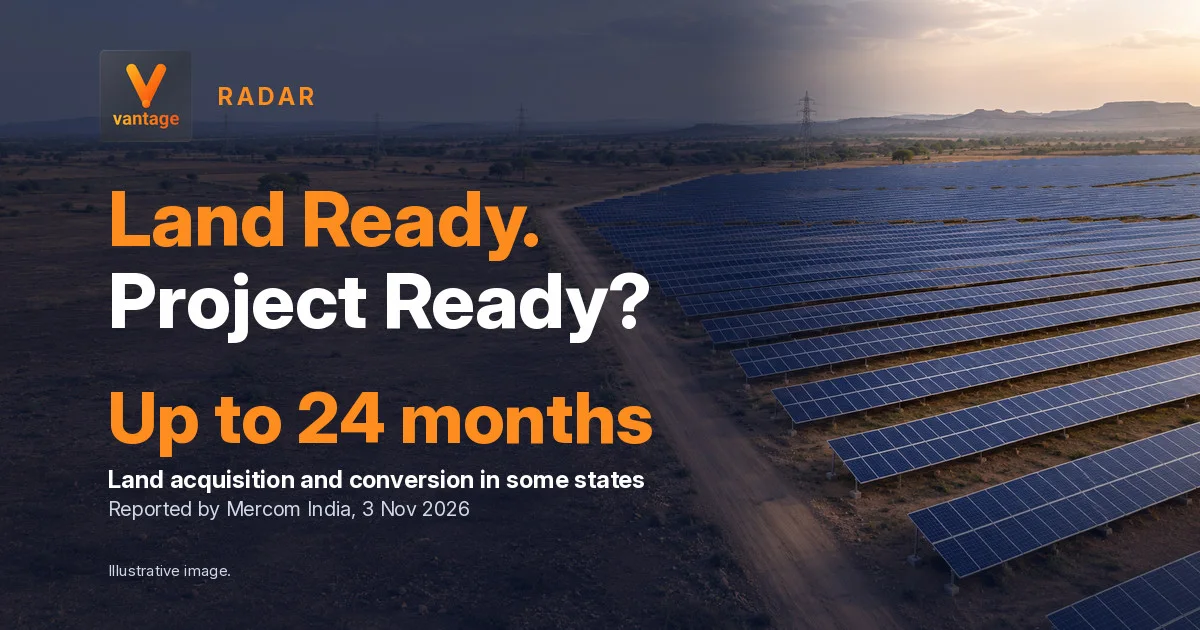
Solar arrays beside open land connect India’s renewable-energy expansion with the article’s focus on land readiness, permissions and infrastructure dependencies.
Inline Intelligence
India’s renewable-energy expansion faces a practical constraint before construction can begin: securing land that is legally and physically ready for development.
Mercom India reported on 3 November that land acquisition and conversion can take up to 24 months in some states, complicating project execution. That is a reported upper-end timeline, not a national average or a forecast for every project.
What the latest report establishes
The accessible introduction identifies land readiness as a challenge across solar, wind, hybrid and battery-storage projects. Its headline also flags fragmented ownership, rising costs, regulatory restrictions and transmission constraints -> India’s Renewable Energy Growth Faces a Deepening Land Acquisition Crisis.
The detailed report is access-restricted. Its state-level examples, methodology and underlying project records could not be inspected, so the reported timeline should retain that qualification.
Land availability and project readiness are different
Official records show that the underlying problem predates this report.
In a parliamentary reply published on 20 July 2023, the Ministry of New and Renewable Energy identified land acquisition as a developer responsibility and described following up with states for suitable land without encumbrances. It also recorded examples of solar parks cancelled over forest or coastal-clearance issues -> Ministry following up with concerned State Governments for allotment of barren land, free of encumbrances for Solar Parks: Union Power & NRE Minister Shri R. K. Singh.
That historical evidence provides context, rather than a measurement of conditions in November 2026.
MNRE’s solar-parks scheme description similarly explains the value of combining developed land, statutory clearances and shared infrastructure -> Development of Solar Parks and Ultra Mega Solar Power Projects.
The distinction is consequential: identifying a site does not establish that construction can start or electricity can reach the grid.
Why the execution question matters
A development pipeline describes potential future assets. Investors and power buyers still need evidence that individual projects can move through permissions, construction and connection.
Vantage’s earlier funding coverage examined why clean-energy investment must support infrastructure as well as generation -> Clean Energy Needs 220 Billion Dollars.
The land report brings attention to an earlier dependency in that delivery chain. More available capital cannot, by itself, settle ownership, land-use or access questions.
What to watch next
The meaningful follow-through will be project-specific: documented land possession, required permissions, construction progress and a workable grid-connection programme.
The report does not establish that every renewable project is delayed, that a particular company will miss its targets, or that household electricity tariffs will rise.
Sources
Click an article title to view the source.
- India’s Renewable Energy Growth Faces a Deepening Land Acquisition Crisis published on 3 November 2026 in Mercom India.
- Ministry following up with concerned State Governments for allotment of barren land, free of encumbrances for Solar Parks: Union Power & NRE Minister Shri R. K. Singh published on 20 July 2023 by Press Information Bureau, Ministry of New and Renewable Energy.
- Development of Solar Parks and Ultra Mega Solar Power Projects on the Ministry of New and Renewable Energy website. Undated page; accessed on 3 November 2026.
- Clean Energy Needs 220 Billion Dollars published on 30 October 2026 in Vantage, by Vantage Editorial.
Evidence Caveats
The Mercom report’s detailed content is access-restricted. The 24-month figure comes from its accessible introduction and has not been independently verified against project records. The 2023 parliamentary reply is historical context. MNRE’s scheme page displays a period ending in 2025-26 and is used to explain the model, not to confirm current scheme availability.
Which milestone would give you greater confidence in a renewable project’s delivery date: usable land, completed permissions or a confirmed connection programme? Explain your reasoning in the attached forum discussion.

From TatvaOps
Solar & Energy Solutions
Considering rooftop solar?
Verified installers, subsidy support, and milestone-secured payments.
Free quotes · Verified contractors · tatvaops.com
Discuss this article
Join the conversation
Continue this discussion on Forums. A board named like this Radar article is filed under Radar.
More from Solar
CBI Files Four Chargesheets in Manesar Land Case, Names M3M Promoter
The Central Bureau of Investigation CBI has filed four chargesheets in the Manesar land case, naming M3M Group promoter Roop Bansal as an accused, according to The Times of India. The chargesheets were filed on 6 November 2026 before a special CBI court in Panchkula. The court has set 11 December…
Delhi Rooftop Solar: What Follows 1 Lakh Sign-Ups?
More than one lakh households have registered for Delhi’s rooftop solar programme, Chief Minister Rekha Gupta said on 4 November. She said installations would begin soon. The sign up total was already above one lakh in late October, when Hindustan Times reported that vendor selection was pending…
Suzlon Revenue Rises as Wind Deliveries Reach 710 MW
Suzlon reports higher wind deliveries and revenue, but narrower operating margins. Check the prior-year tax effect before interpreting the profit comparison.
Inline Intelligence
Key Insight Actions
Connected knowledge for Renewable Energy
Move between tutorials, discussions, Studio, and hubs without losing context.
Related discussions
Cyclone Murasu: Check Safety Before Planning Repairs
1 replies
Related discussionDLFs Proposed IREO Investment: What Should Property Buyers Check?
1 replies
Related discussionManesar Land Case: What Should a Property Buyer Check?
1 replies
Related discussionDelhis Free Rooftop Solar: Does Your Home Qualify?
5 replies
Related discussion
Topic hubs
Conclusion Intelligence
Related Discussions
Cyclone Murasu: Check Safety Before Planning Repairs
Popular in insights discussions1 reply
DLFs Proposed IREO Investment: What Should Property Buyers Check?
Popular in insights discussions1 reply
Manesar Land Case: What Should a Property Buyer Check?
Popular in insights discussions1 reply
Delhis Free Rooftop Solar: Does Your Home Qualify?
Popular in insights discussions5 replies
Was this helpful?
Let us know what you think