

WeWork India Adds 4,500+ Desks in Whitefield and Wakad: Are Offices Following Employees Home?
Karthik posts articles on Energy and Construction.
Summary
WeWork India is adding more than 4,500 desks across approximately 2.25 lakh sq ft in Whitefield and Wakad. The bigger signal is location: both centres sit within major employment corridors supported by large residential catchments. If enterprises increasingly prioritise employee commute, transit and WeWork India's latest expansion is easy to describe as another flexible office capacity addition. Approximately 2.25 lakh sq ft. More than 4,500 desks. Two centres. But the more important signal may be their locations. One is in Whitefield, an established Bengaluru technology and residential district.
Published on
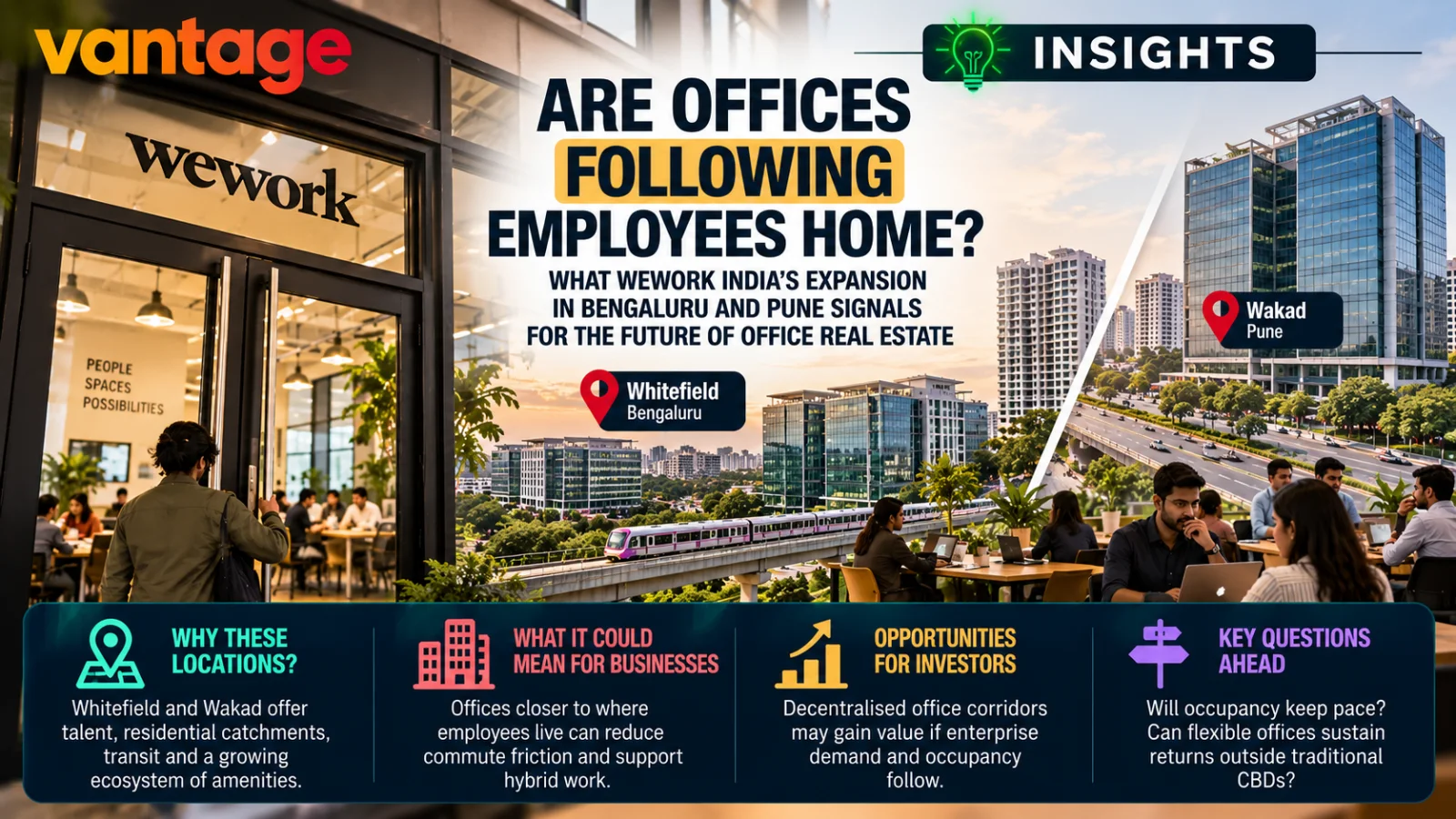
InSights editorial banner examining WeWork India's expansion in Whitefield, Bengaluru, and Wakad, Pune, through a flexible-office and location-strategy lens. The visual combines coworking space, modern office districts, residential catchments and urban transport to explore whether companies are moving workplaces closer to where employees live, while highlighting implications for hybrid work, decentralised office corridors, enterprise demand and future occupancy.
Inline Intelligence
WeWork India's latest expansion is easy to describe as another flexible-office capacity addition.
Approximately 2.25 lakh sq ft.
More than 4,500 desks.
Two centres.
But the more important signal may be their locations.
One is in Whitefield, an established Bengaluru technology and residential district.
The other is in Wakad, close to Pune's Hinjewadi employment hub and surrounded by a substantial residential ecosystem.
This suggests a changing question in corporate real estate.
Instead of asking only:
Where is the city's most prestigious office district?
companies may increasingly ask:
Where can we place employees close enough to both work and home that they actually want to use the office?
Hybrid Work Changes the Value of Location
Before hybrid work became widespread, employees often had little choice about commuting to a central corporate location.
The office itself determined the destination.
Flexible and hybrid working alter that relationship.
When employees can work remotely for part of the week, the friction involved in travelling to an office becomes more visible.
A two-hour commute for a five-day office week was once accepted by many workers as unavoidable.
The same commute can look less attractive when remote alternatives exist.
That gives residentially connected employment corridors more strategic value.
Whitefield Demonstrates the Mature Version
Whitefield is no longer simply an outer Bengaluru technology district.
It has developed a large ecosystem of:
offices,
housing,
retail,
schools,
hotels,
restaurants,
and transport infrastructure.
WeWork India's Infinix Palladium provides more than 3,100 desks across approximately 1.7 lakh sq ft.
That is a large single-centre commitment.
The format suggests the operator sees Whitefield as capable of supporting enterprise-scale flexible workspace rather than only small coworking demand.
Wakad Tests the Model in a Different Way
Wakad sits close to Hinjewadi but is also a major residential location.
That creates a potentially useful corporate real estate proposition.
A company can access the wider Pune technology workforce without requiring every employee to commute into a traditional central office district.
WeWork Millennium Towers adds around 1,400 desks across approximately 55,000 sq ft.
The company has also reportedly leased close to 1.8 lakh sq ft in the same asset for managed-office clients.
That makes the building relevant not just as a coworking location but as a broader enterprise workspace node.
The Office Is Becoming Part of a Daily-Life Network
Arnav S. Gusain, Chief Supply Officer at WeWork India and CEO of Rivet by WeWork India, framed the expansion around how easily people can move between where they live, work and spend time.
That concept matters for developers.
A successful office district may increasingly need more than Grade A buildings.
It may need:
housing nearby,
public transport,
restaurants,
retail,
healthcare,
schools,
and recreation.
In other words, commercial real estate may increasingly depend on the quality of the surrounding urban ecosystem.
This Could Change Which Land Becomes Valuable
If companies are willing to locate more offices outside traditional CBDs, land values and development opportunities can shift.
Residential corridors near major employment hubs can become mixed-use commercial markets.
That creates opportunities for:
office developers,
flex operators,
retail developers,
hospitality,
and residential projects.
But the effect is not automatic.
A residential catchment without strong transport or corporate demand does not become an office district merely because people live there.
Flexible Operators Can Test Emerging Micro-Markets
Traditional corporate leases often involve long commitments and substantial fit-out investment.
Flexible operators can provide another route.
They aggregate demand from multiple companies and offer shorter or more adaptable occupancy structures.
That can allow enterprises to establish satellite or distributed offices without committing to an entire conventional office development.
For landlords, a large flex operator can also absorb significant space.
Infinix Palladium demonstrates that this can mean an entire building.
But Flexibility Does Not Remove Real Estate Risk
The operator still needs to fill desks.
More than 4,500 additional desks create capacity.
The commercial outcome depends on utilisation.
If the desks achieve high occupancy at sustainable pricing, the centres can create attractive operating economics.
If occupancy remains weak, lease and operating obligations remain.
Flexibility for the customer can therefore transfer some real estate risk towards the workspace operator.
Desk Density Offers an Interesting Comparison
Using the reported figures:
Infinix Palladium provides more than 3,100 desks across approximately 170,000 sq ft.
That implies roughly 55 sq ft per desk using a simple area-to-desk calculation.
Millennium Towers provides approximately 1,400 desks across 55,000 sq ft.
That implies roughly 39 sq ft per desk.
These are Vantage-derived ratios.
They should not be interpreted as actual workstation sizes.
The reported areas can include meeting rooms, common areas, circulation, amenities and other facilities, while the desk counts may use different operational assumptions.
The comparison therefore illustrates centre configuration, not employee space standards.
Scale Is Not the Same as Utilisation
WeWork India's network is now reported at 79 centres across 9.1 million sq ft.
Its website reports approximately 134,000 desks and more than 110,000 members as of 30 June 2026.
Dividing those two figures would produce approximately 82 members per 100 desks.
But that would not be a valid occupancy rate.
Members and desks are different operating metrics, and membership structures can include products that do not map one-to-one onto dedicated desks.
This is exactly the type of attractive-looking calculation investors should avoid without the company's defined occupancy methodology.
Enterprise Demand Is the Critical Variable
The biggest opportunity for flexible workspace is no longer necessarily the individual coworker.
Large enterprises and GCCs can take substantial blocks of capacity.
That changes the economics.
Enterprise clients can potentially provide:
larger contracts,
greater visibility,
repeat expansion,
and lower customer acquisition intensity per desk.
But concentration can also create risk if a large client contracts or leaves.
The accessible evidence does not disclose the tenant concentration or pre-commitment profile of the new centres.
What Does This Mean for Office Developers?
Developers should increasingly think about office buildings as part of an urban network.
A strong development proposition can include:
Talent access
How many relevant workers live within a practical commute?
Transit
Can employees reach the building without relying entirely on cars?
Residential density
Can the office draw from nearby housing markets?
Amenities
Are food, retail, healthcare and recreation available?
Enterprise infrastructure
Can the building support large corporate teams?
Flexibility
Can occupiers expand or contract without relocating?
These factors can become competitive advantages.
What Does It Mean for Residential Developers?
There is also a residential implication.
If more office capacity moves closer to residential corridors, some neighbourhoods can become more self-contained.
That can reduce commute distances and strengthen weekday demand for:
retail,
food and beverage,
services,
and rental housing.
But proximity to flexible office space alone does not guarantee residential appreciation.
The scale and durability of employment remain more important.
What Does It Mean for Investors in Office Assets?
Investors should distinguish between three different signals.
Space taken by the operator
shows supply commitment.
Desks sold or contracted
shows customer demand.
Cash generated after property and operating costs
shows economic performance.
The current announcement primarily establishes the first of these, plus available desk capacity.
It does not provide enough information to determine centre-level returns.
The Whitefield Expansion Is Not Entirely New
Infinix Palladium was already identified in an April 2026 company exchange filing.
The earlier filing described approximately 169,485 sq ft and around 3,100 desks.
Therefore, the October announcement should not be interpreted as WeWork suddenly adding 1.7 lakh sq ft of previously undisclosed Whitefield supply.
It is better understood as previously announced capacity moving into the operating portfolio.
That distinction is important when analysing expansion velocity.
Wakad Has a Status Detail to Watch
The 5 October announcement describes Millennium Towers as opened.
However, some current WeWork India website pages still label the centre as "opening shortly" or "coming soon".
This could simply reflect website-update timing.
But until the discrepancy is resolved, it is safer not to infer a precise first operational date from the website alone.
The Bigger Office-Market Signal
The most interesting aspect of S47 is therefore not the 2.25 lakh sq ft headline.
It is the type of micro-market WeWork India is prioritising.
Whitefield combines employment and residential scale.
Wakad combines proximity to Hinjewadi with residential and regional connectivity.
Both fit a model in which the office is located within a broader work-life ecosystem.
If enterprise occupiers continue to prioritise commute reduction and distributed workforces, this model could increase the value of decentralised office corridors.
But proving that shift requires more than openings.
It requires occupancy.
What Should We Watch Next?
For Whitefield and Wakad:
- occupancy ramp-up;
- enterprise and GCC commitments;
- desk pricing;
- member retention;
- conventional office rents;
- new flexible-office supply;
- public transport usage;
- residential growth; and
- future centre additions.
Those metrics will show whether the strategy is creating a durable office-market pattern.
The Real Test Is Whether Employees Use the Space
Flexible workspace operators can build offices almost anywhere.
The difficult part is creating a location that companies want to buy and employees want to use.
Whitefield and Wakad represent an increasingly important proposition:
bring the office closer to established employment and residential ecosystems rather than forcing every worker towards a single central business district.
If occupancy follows, that could reshape how developers think about the geography of Indian offices.
If it does not, the expansion will remain capacity rather than proof of a new location model.
Frequently Asked Questions
Why is WeWork India expanding in Whitefield and Wakad?
The company points to enterprise ecosystems, talent, residential catchments, transit and surrounding amenities as key location advantages.
How many desks has WeWork India added?
The two centres provide more than 4,500 desks across approximately 2.25 lakh sq ft.
Is Whitefield becoming a major flexible office market?
Whitefield is already a significant Bengaluru office district, and WeWork India's large centre reinforces its importance. The announcement alone does not establish market-wide flexible-office demand.
Why is Wakad important for Pune office space?
Wakad combines proximity to Hinjewadi with a large residential catchment and access to the Mumbai-Pune Expressway.
Are all 4,500 desks already occupied?
The reviewed evidence does not establish that. The figure represents available capacity.
Does WeWork India's expansion prove companies are leaving CBDs?
No. It supports a strategy of expanding in decentralised employment and residential corridors, but it does not establish a market-wide abandonment of central business districts.
Is flexible office space mainly for startups?
No. WeWork India explicitly targets enterprises, GCCs, Fortune 500 companies and growing businesses in addition to smaller users.
What should property investors watch after the new centres open?
Occupancy, enterprise commitments, pricing, lease obligations, operating margins and cash generation are more informative than announced desk capacity alone.
Sources
Click on article title to view article.
“WeWork India expands Bengaluru, Pune footprint with two new centres” published on 5 October 2026 in Business Standard
Primary Sources
“WeWork India” current portfolio information published by WeWork India
“Millennium Towers” centre information published by WeWork India
Evidence Caveats
- More than 4,500 desks represents capacity, not confirmed occupied desks.
- The desk-density calculations are Vantage-derived area-to-desk comparisons and are not workstation-size measurements.
- The company's member count should not be divided by desk capacity and described as occupancy.
- Infinix Palladium appeared in an earlier April 2026 expansion filing.
- Current WeWork India pages contain inconsistent operational labels for Millennium Towers.
- No centre-level occupancy, revenue, EBITDA, rent obligation, fit-out cost or return data was available in the reviewed sources.
- The idea that offices are increasingly following residential catchments is an editorial interpretation supported by the company's location rationale, not a quantified nationwide market conclusion.

From TatvaOps
Commercial Interiors
Building farm infrastructure?
Verified execution partners for agri and rural builds.
Free quotes · Verified contractors · tatvaops.com
Discuss this article
Join the conversation
Continue this discussion on Forums. A board named like this InSights article is filed under InSights.
1 reply already on Forums
More from Real Estate
LTCG Tax Debate: Should You Delay Selling Investments?
Could waiting for LTCG tax relief cost more than it saves? With proposals under discussion, we examine how your current tax liability, market exposure and cash deadline should shape a planned investment sale.
Blackstones India Bet: What Should You Check?
Blackstone’s $100-billion India ambition is a useful signal. For your own money, the harder questions are access, valuation, cash flow and risk. Here is what to check before turning institutional optimism into a personal investment decision.
Senior Living: Buy the Home, Examine the Services: what most readers overlook
Rustomjee’s senior-living evaluation raises a household question: can you afford and rely on the services after buying the home? We examine recurring charges, operator responsibilities, changing support needs and exit flexibility.
Inline Intelligence
Key Insight Actions
Connected knowledge for Office Space Trends
Move between tutorials, discussions, Studio, and hubs without losing context.
Related discussions
Topic hubs
Conclusion Intelligence
Related Discussions
Was this helpful?
Let us know what you think