

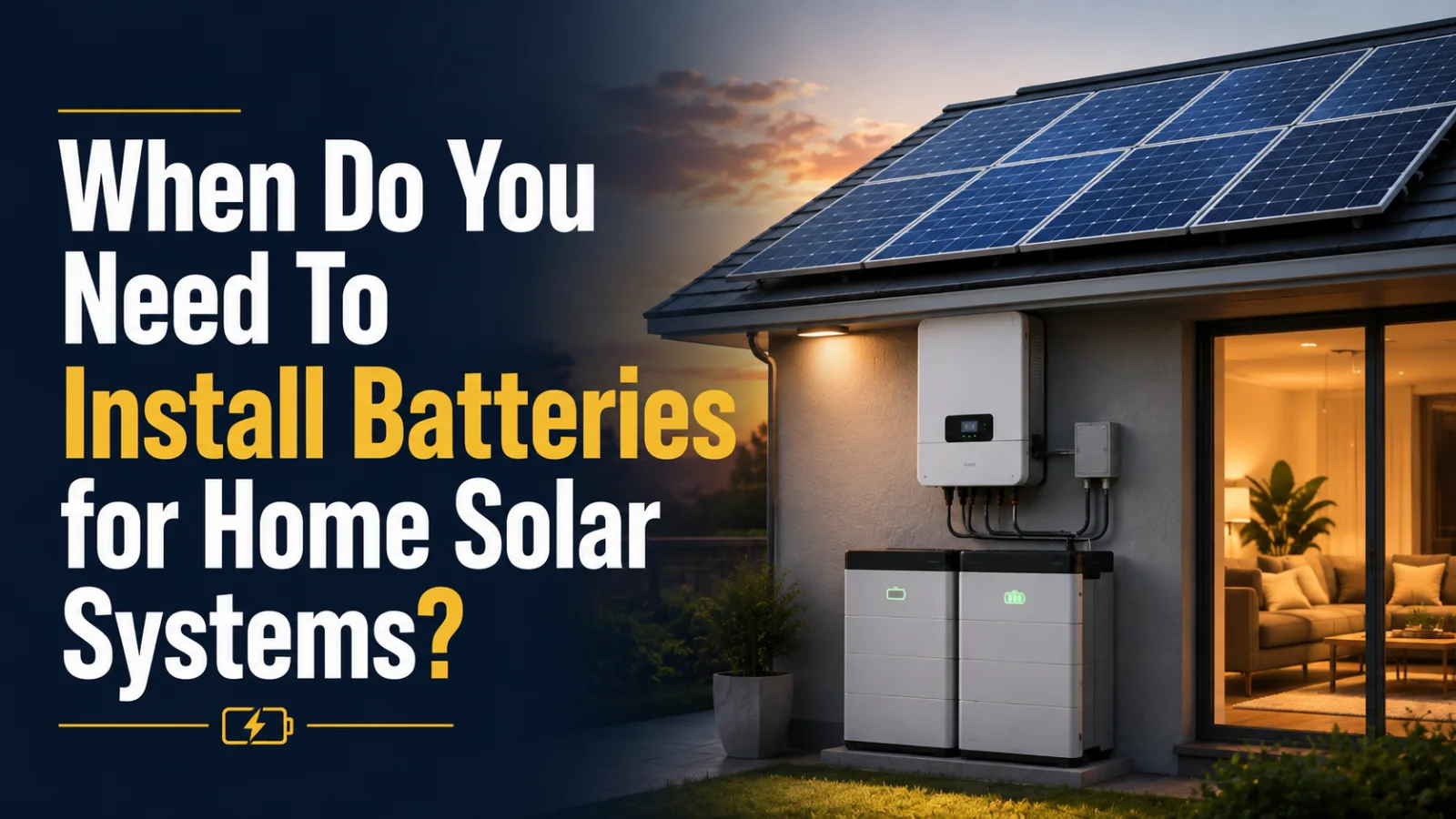
When Do You Need To Install Batteries for Home Solar Systems?

Devesh S. is an industry researcher and writer who specializes in translating complex industries into clear, trustworthy, and actionable knowledge. His work…
Summary
Wondering when batteries make sense for home solar? Learn when to add solar battery storage, when you can skip it, and how to choose wisely. Installing solar panels does not automatically mean you need batteries. That surprises many homeowners. After all, solar panels produce electricity during the day, so it seems logical to store that electricity for later. But batteries add a significant cost to a home solar system, and in many situations, they are not necessary.
Published on
Inline Intelligence
Installing solar panels does not automatically mean you need batteries.
That surprises many homeowners. After all, solar panels produce electricity during the day, so it seems logical to store that electricity for later. But batteries add a significant cost to a home solar system, and in many situations, they are not necessary.
The right question is not, "Should every solar system have a battery?"
It is:
"What problem am I trying to solve with battery storage?"
For some homes, a battery is essential because reliable electricity is the priority. For others, it may add years to the investment payback without delivering enough practical benefit.
This guide explains when batteries make sense, when you can comfortably skip them, and what to consider before adding battery storage to your rooftop solar system.
Problem Statement: Why Are Homeowners Confused About Solar Batteries?
The confusion usually begins because people assume solar panels and batteries are one package.
They are not.
A solar panel system can operate in several different ways:
- Solar panels connected directly to the electricity grid
- Solar panels combined with battery backup
- A completely independent off-grid system
- A hybrid setup that uses solar, the grid, and batteries together
Each arrangement solves a different problem.
For example, a homeowner who wants to reduce electricity bills may not need batteries at all. A family living in an area with frequent power cuts may benefit greatly from battery storage.
The decision depends on your electricity usage, grid reliability, budget, and what you expect your solar system to do after sunset.
Featured Snippet: When Do You Need Batteries for Home Solar?
You need batteries for home solar when you want backup power during outages, use electricity heavily after sunset, face unreliable grid supply, or want greater energy independence. If your goal is mainly to reduce daytime electricity bills with reliable grid access, batteries may not be necessary.
First, Understand What a Solar Battery Actually Does
Solar panels generate electricity only when sufficient sunlight is available.
During the day, that electricity can be used immediately to power appliances such as:
- Fans
- Refrigerators
- Washing machines
- Air conditioners
- Water pumps
- Lights
- Home office equipment
A battery stores surplus electricity so it can be used later.
Think of it as an energy bank.
Instead of allowing unused solar energy to disappear or sending it entirely elsewhere, the system can store some of it for nighttime use or emergencies.
However, batteries have limitations. They have a fixed storage capacity, a charging cycle life, efficiency losses, and eventually need replacement.
That is why adding a battery should be a practical decision rather than an automatic upgrade.
When Do You Actually Need a Battery for Home Solar?
1. You Experience Frequent or Long Power Cuts
This is one of the clearest reasons to install batteries.
A standard grid-connected solar system often shuts down during a power outage for safety reasons. Even if the sun is shining and your rooftop panels are producing electricity, you may not be able to use that solar power during a grid outage.
A battery-backed hybrid system changes that.
During an outage, the battery can supply selected appliances, depending on the system design.
What Can a Solar Battery Usually Support?
That depends on the battery capacity and inverter configuration. A properly designed backup system may support:
- Essential lights
- Fans
- Wi-Fi routers
- Refrigerators
- Television
- Computers
- Selected plug points
Running the entire home, including multiple air conditioners and heavy appliances, requires substantially more battery capacity.
The lesson: Do not buy a battery before deciding what you actually want to keep running during an outage.
2. Your Household Uses Most Electricity After Sunset
Solar generation and household consumption do not always happen at the same time.
Imagine a family where everyone leaves home during the day. The solar panels generate plenty of electricity, but the largest electricity consumption happens in the evening.
That might include:
- Cooking-related appliances
- Lighting
- Air conditioning
- Television and entertainment
- Charging electric vehicles
- Home office usage
In this situation, battery storage can help shift some solar energy from daytime to evening use.
Before installing batteries, though, homeowners should compare this option with available grid arrangements and billing mechanisms. Sometimes exporting surplus electricity to the grid and drawing power later may be financially more sensible than storing every extra unit in a battery.
Battery storage becomes more attractive when energy independence and backup reliability matter as much as financial savings.
3. You Want Backup Power for Essential Appliances
You do not always need enough battery capacity to power your entire house.
In fact, designing backup for only critical loads is often the smarter approach.
For example, during an outage, you may only need:
- One refrigerator
- A few fans
- Lights in key rooms
- Internet connectivity
- Phone charging
- A laptop
A smaller, carefully planned battery system may be enough.
This is usually more economical than attempting to run every appliance in the house.
Before choosing battery capacity, create two lists:
Essential Loads
Appliances that must continue operating during an outage.
Non-Essential Loads
Appliances that can remain switched off until grid power returns.
This simple exercise can prevent unnecessary spending on oversized battery storage.
4. You Want Greater Energy Independence
Some homeowners simply do not want to depend heavily on the electricity grid.
Battery storage allows you to retain more of the solar electricity generated on your own roof.
This does not necessarily mean complete independence. True energy independence requires careful planning because solar generation changes with:
- Weather
- Seasonal sunlight
- Roof shading
- Household consumption
- Battery capacity
Still, a hybrid system can reduce dependence on grid electricity and provide more control over how your energy is used.
This is especially useful for homeowners who value resilience and want protection against unexpected outages.
5. You Are Installing an Off-Grid Solar System
If your property does not have reliable grid access, batteries become much more important.
An off-grid solar system generally requires a way to store electricity for use when solar generation is unavailable.
An Off-Grid System Typically Includes:
- Solar panels
- Solar inverter
- Battery bank
- Charge management equipment
- Electrical protection systems
Without battery storage, an off-grid home would struggle to maintain electricity after sunset or during extended periods of poor solar generation.
Off-grid solar requires more detailed system design than a typical grid-connected installation. Battery capacity, appliance loads, backup duration, and seasonal generation all need to be calculated carefully.
When You Probably Do Not Need Batteries
You Mainly Want Lower Electricity Bills
If your main objective is to reduce your electricity bill and you have reliable grid access, an on-grid solar system may be sufficient.
In this setup, your solar panels generate electricity during daylight hours. Your household uses the available solar power, and the grid handles the remaining electricity requirement according to the applicable utility arrangement.
Because batteries are not included, the initial investment is generally lower.
For many homeowners, this creates a better financial return compared with installing a large battery system.
Your Area Has Reliable Electricity Supply
If power cuts are rare and short, spending heavily on battery storage may not provide enough value.
You may be better off investing in:
- Better-quality panels
- A properly sized inverter
- Strong mounting structures
- Professional installation
- Electrical protection equipment
Battery storage should solve a real problem. If outages are almost nonexistent, the battery may spend most of its life sitting unused.
Your Electricity Usage Happens Mostly During the Day
Homes with significant daytime consumption can benefit directly from solar generation without needing storage.
Examples include households where:
- Someone works from home
- Air conditioning runs during the day
- Water pumps operate during sunlight hours
- Appliances are regularly used in the afternoon
The more solar electricity you consume directly while it is being generated, the less need you may have for batteries.
On-Grid vs Hybrid vs Off-Grid: Which System Uses Batteries?
| Solar System Type | Uses Battery? | Best For | Main Limitation |
|---|---|---|---|
| On-Grid Solar | Usually No | Reducing electricity bills | Limited backup during outages |
| Hybrid Solar | Yes, optional or integrated | Savings plus backup power | Higher initial cost |
| Off-Grid Solar | Yes | Locations without reliable grid supply | Requires careful battery sizing |
| Solar with Dedicated Backup | Yes | Essential appliance backup | May not power the entire home |
The right system depends on your priorities.
If savings are your primary goal, on-grid solar may be enough.
If uninterrupted electricity matters, a hybrid system deserves serious consideration.
If the grid is unavailable or unreliable, battery-backed or off-grid solar becomes more practical.
How Much Battery Storage Does Your Home Need?
There is no universal answer such as "every home needs a 10 kWh battery."
Battery requirements depend on three major factors:
- How much electricity your essential appliances consume
- How many hours of backup you want
- How much of your home you want the battery to support
A household that only wants lights, fans, and Wi-Fi for a few hours needs a completely different battery setup from a home trying to run air conditioning throughout the night.
A Simple Way to Start Calculating Your Needs
List every appliance you want to run during a power cut.
Then note:
- Appliance power rating
- Number of appliances
- Expected operating hours
For example:
| Appliance | Approximate Priority | Backup Requirement |
|---|---|---|
| Lights | Essential | High |
| Ceiling Fans | Essential | High |
| Refrigerator | Essential | High |
| Wi-Fi Router | Essential | High |
| Television | Optional | Medium |
| Air Conditioner | Depends on need | Very high battery demand |
| Water Heater | Usually non-essential | High consumption |
A solar professional can then calculate the required usable battery capacity and inverter capability.
The important part is starting with your actual lifestyle rather than buying storage based on a generic recommendation.
What Type of Battery Is Best for Home Solar?
Lithium-Ion Batteries
Lithium-based batteries are increasingly popular for home energy storage.
They generally offer:
- Higher energy density
- Longer usable cycle life
- Faster charging
- Less maintenance
- Better space efficiency
The upfront cost can be higher, but performance and lifespan may make them attractive for long-term solar applications.
Lithium Iron Phosphate Batteries
Lithium iron phosphate, often called LiFePO4 or LFP, is commonly considered for stationary energy storage because of its durability and thermal characteristics.
The right battery chemistry should still depend on the specific product, warranty, inverter compatibility, and system design.
Lead-Acid Batteries
Lead-acid batteries have been used for backup power systems for many years.
They may have a lower initial purchase cost, but they generally require more attention and may offer a shorter usable life compared with modern lithium options.
They can still make sense in specific budget-sensitive or low-usage applications.
The key is to compare lifetime value rather than looking only at the purchase price.
Battery Capacity Is Not the Same as Backup Time
This is a common misunderstanding.
A large battery does not automatically mean long backup.
Backup duration depends on how much electricity your appliances are consuming.
Imagine two homes with the same battery capacity:
- Home A runs lights, fans, and a refrigerator.
- Home B runs multiple air conditioners and heavy appliances.
Home A will receive much longer backup.
That is why battery sizing should always consider the actual load.
Battery capacity answers, "How much energy can I store?"
Load answers, "How quickly will I use that energy?"
Both matter equally.
What Should You Check Before Adding Batteries to an Existing Solar System?
If you already have rooftop solar, you may be able to add battery storage later.
But do not assume the existing system is automatically compatible.
Check the following:
Inverter Compatibility
Some solar inverters are designed only for on-grid operation. Adding batteries may require replacing or upgrading the inverter.
Existing Solar Capacity
Your current solar panel capacity affects how quickly the system can recharge batteries.
Roof Generation
A roof with shading or limited sunlight may struggle to generate enough surplus energy for both household consumption and battery charging.
Electrical Load
Your existing wiring and distribution system may need modifications to create a dedicated backup circuit.
Battery Location
Batteries need a suitable installation location with appropriate safety considerations, accessibility, and environmental protection.
A professional assessment before buying the battery is far better than discovering compatibility issues after purchase.
The Financial Question: Are Solar Batteries Worth the Cost?
This depends on what "worth it" means to you.
If you measure value only through electricity bill savings, batteries may not always be the strongest investment.
Battery storage involves:
- Initial purchase cost
- Installation cost
- Possible inverter upgrades
- Efficiency losses
- Eventual replacement costs
But financial calculations are only part of the picture.
A battery can also provide value through:
- Protection from power cuts
- Improved energy independence
- Backup for home offices
- Protection for essential appliances
- Greater control over solar energy use
For a family working from home, avoiding several hours of electricity disruption may have real value that does not show up neatly in a simple payback calculation.
A Practical Decision Framework for Homeowners
Ask yourself these five questions.
Question 1: How Often Does My Power Go Out?
Frequent or long outages make battery storage more attractive.
Question 2: What Must Continue Working During an Outage?
Identify essential appliances before calculating battery size.
Question 3: Do I Use Most Electricity During the Day or Evening?
Heavy evening consumption can make energy storage more useful.
Question 4: Is My Goal Savings, Backup, or Independence?
These are different goals and may require different solar system designs.
Question 5: Can My Budget Support Battery Replacement in the Future?
Batteries are not permanent equipment. Consider their expected life and replacement planning.
Home Solar Battery Checklist
Before installing batteries, make sure you can answer the following:
- How many hours of backup do I need?
- Which appliances are essential during an outage?
- What is the total power demand of those appliances?
- Is my existing solar inverter battery-compatible?
- Does my roof generate enough solar energy for battery charging?
- Do I want backup for selected loads or the entire house?
- Which battery chemistry suits my usage and budget?
- What warranty is offered on the battery?
- What happens when the battery reaches the end of its useful life?
- Has the installer explained the full system design clearly?
If you cannot answer most of these questions, you are probably not ready to purchase a battery yet.
Expert Tips Before Installing a Solar Battery
Size the Battery Around Your Lifestyle
Do not copy your neighbour's battery configuration.
Two households with similar-sized homes can have completely different electricity requirements.
Prioritise Critical Loads
Backing up everything can become expensive very quickly.
Separate essential circuits from high-consumption appliances where possible.
Check the Entire System, Not Just the Battery
The battery, inverter, solar panels, electrical wiring, protection systems, and backup circuits must work together.
A premium battery cannot compensate for poor system design.
Think About Future Expansion
Your electricity needs may increase.
You may add:
- An electric vehicle
- More air conditioning
- Additional appliances
- A home office
Ask whether the proposed system can be expanded later.
Read the Warranty Carefully
Check:
- Warranty duration
- Usable capacity conditions
- Cycle limitations, if applicable
- Installation requirements
- Exclusions
A battery warranty can look impressive until you read the fine print.
Common Mistakes to Avoid
Buying the Largest Battery You Can Afford
Bigger is not automatically better.
An oversized battery can increase project costs without delivering proportional benefits.
Expecting a Small Battery to Run the Entire House
Heavy appliances consume stored energy quickly.
Set realistic expectations before installation.
Ignoring Inverter Compatibility
This can lead to expensive modifications later.
Always confirm whether your existing or planned inverter supports the intended battery configuration.
Choosing Based Only on Battery Price
The cheapest battery may not provide the best long-term value.
Compare warranty, usable capacity, compatibility, expected lifespan, and service support.
Forgetting About Future Replacement
Every battery eventually reaches the end of its useful operating life.
Include replacement planning in your long-term solar budget.
Does Every Home With Solar Need a Battery?
No.
That is the simplest answer.
Many homeowners can benefit from solar panels without ever installing battery storage.
An on-grid system may be the right choice if:
- Your electricity supply is reliable
- Your goal is primarily bill reduction
- You consume a good amount of electricity during the day
- You want to keep the initial investment lower
Battery storage becomes more useful if:
- Power outages are frequent
- Backup power is important
- You want to use more solar energy after sunset
- Grid reliability is poor
- Energy independence is a major priority
The best system is not necessarily the one with the most equipment.
It is the one designed around how your household actually uses electricity.
Frequently Asked Questions
1. Do I need a battery with my home solar system?
No. You only need a battery if you want backup power, greater energy independence, or the ability to store solar energy for use later. Many grid-connected solar systems operate effectively without batteries.
2. Can solar panels work during a power cut without a battery?
In many standard grid-connected systems, solar generation shuts down during a power outage for safety reasons. A properly designed hybrid or backup system with battery storage can provide electricity to selected loads during an outage.
3. How long can a solar battery power a home?
Backup time depends on battery capacity and electricity consumption. A battery running lights and fans will last much longer than the same battery powering air conditioners or other high-consumption appliances.
4. Is a lithium battery better for home solar?
Lithium-based batteries often offer higher energy density, longer usable cycle life, and lower maintenance than traditional lead-acid batteries. The best choice depends on budget, system compatibility, warranty, and expected usage.
5. Can I add a battery to my existing solar system later?
Often, yes. However, compatibility depends on your existing inverter, electrical design, solar capacity, and backup requirements. Some systems may require an inverter upgrade before batteries can be added.
6. Should I install enough battery capacity to run my entire house?
Not always. Designing battery backup only for essential appliances is often more practical and affordable. Your required battery capacity should be based on the appliances you need during an outage.
7. Do batteries improve solar savings?
Batteries can help you store solar electricity for later use, but they also add significant cost and experience efficiency losses. Whether they improve the financial return depends on your electricity usage and local grid arrangements.
8. What is the difference between an on-grid and hybrid solar system?
An on-grid system primarily works with the electricity grid and usually does not include batteries. A hybrid system combines solar panels, grid electricity, and battery storage to provide greater flexibility and backup capability.
Conclusion: Install a Battery Only When It Solves a Real Problem
A solar battery can be extremely useful, but it is not a mandatory part of every home solar installation.
If your priority is lowering electricity bills and you have dependable grid power, a battery-free system may be the smarter choice.
If power cuts disrupt your home, you need reliable backup for essential appliances, or you want to store more of your own solar energy for nighttime use, battery storage deserves serious consideration.
The best starting point is to understand your home's electricity pattern. Look at when you consume power, which appliances are essential, how often outages occur, and how much independence you actually want.
That approach leads to a better system than simply adding the biggest battery your budget allows.
A Soft Recommendation Before You Finalise Your Solar Plan
Battery storage affects more than the equipment list. It changes system design, inverter selection, backup circuits, installation planning, and long-term costs. Before committing, it helps to work through the design with a structured installation team that can compare options and explain the trade-offs clearly.
For homeowners planning solar power for homes in bangalore, TatvaOps can be worth considering as a technology-driven project management platform that connects homeowners with verified solar professionals, helps compare system proposals, tracks execution, and keeps milestone-based payments under homeowner approval. The goal should be simple: install a solar system that matches how your home actually uses electricity, rather than paying for equipment you may never fully need.

From TatvaOps
Solar & Energy Solutions
Considering rooftop solar?
Verified installers, subsidy support, and milestone-secured payments.
Free quotes · Verified contractors · tatvaops.com
Discuss this article
Join the conversation
Continue this discussion on Forums. A board named like this InSights article is filed under InSights.
More from Solar
Battery Storage: What Matters Beyond Factory Capacity?
India has a larger battery manufacturing base. That does not settle your backup requirements, installed cost or warranty. Here is what a property owner should ask before choosing a storage system.
Apartment Solar: Can Surats Savings Be Reproduced?
Surat’s apartment solar figures imply a 3.23-year simple payback after reported subsidy. We examine why subsidy receipts, actual bills, operating costs and household benefit allocation must be checked before another society adopts that estimate.
Bihar Rooftop Solar: What Is Surplus Power Worth?
Bihar’s draft solar amendments raise a question beyond subsidy: what is surplus electricity worth? We distinguish on-site savings, export adjustments and year-end payments, and explain why a proposal should not be treated as an implemented rule.
Inline Intelligence
Key Insight Actions
Connected knowledge for Solar Energy
Move between tutorials, discussions, Studio, and hubs without losing context.
Conclusion Intelligence
Was this helpful?
Let us know what you think