

Maharashtra Battery Storage and Home Backup

Summary
A 4,000 MWh grid storage approval gives Maharashtra a way to shift power between hours. Use your own outage log and critical load to assess whether home backup still makes sense. If you are buying a backup battery for your flat or housing society in Maharashtra, a large state storage announcement may sound like a reason to wait. The more useful test is whether the equipment would solve interruptions you can document today. The grid procurement and an inverter in your utility room act at different points on the network.
Published on
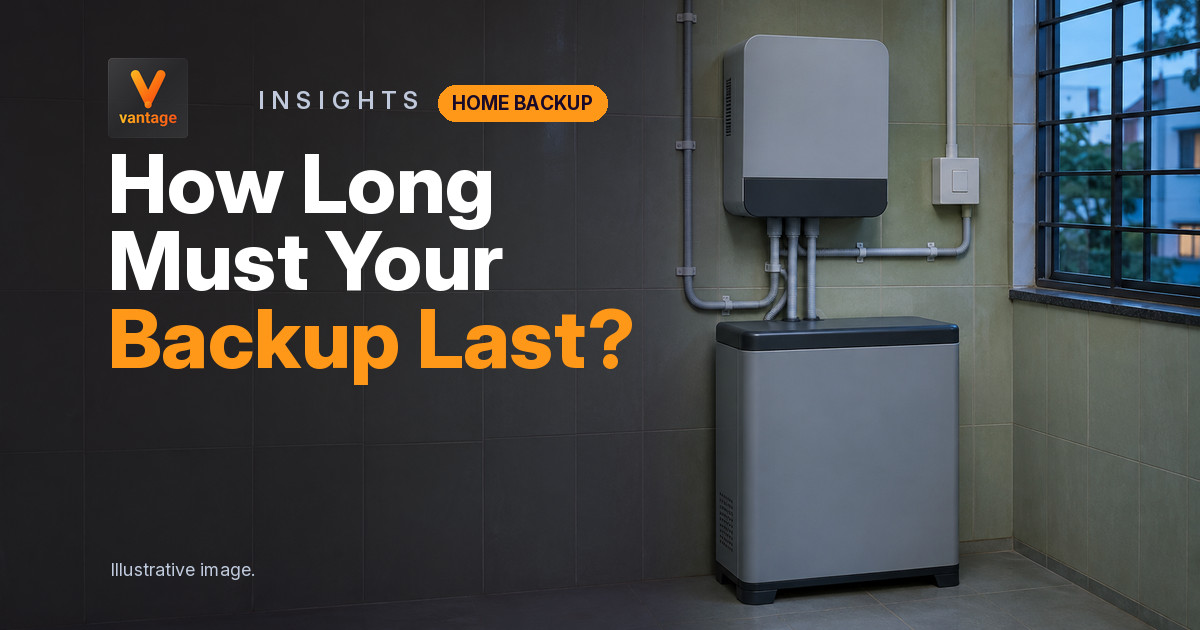
A residential inverter and battery illustrate how Maharashtra households can size backup against their own power cuts
Credit: Illustrative image
Inline Intelligence
If you are buying a backup battery for your flat or housing society in Maharashtra, a large state storage announcement may sound like a reason to wait. The more useful test is whether the equipment would solve interruptions you can document today. The grid procurement and an inverter in your utility room act at different points on the network.
What the grid batteries can do
The approved procurement covers 2,000 MW of power and 4,000 MWh of energy, according to Mercom India and SolarQuarter. Megawatts describe how fast a battery system can deliver power. Megawatt-hours describe how much energy it can deliver over time at the rated figures. That ratio gives two hours at full rated output. SolarQuarter reported a one-cycle-per-day design and expected commissioning during FY 2027-28.
At a grid level, storage can move electricity from one time of day to another. Equipment can charge when power is available and discharge during a later period. The value depends on when it runs, how much is available and whether the grid can route power where it is needed. An apartment's supply can still be interrupted by a local feeder, building wiring or maintenance. The approval supplies no feeder-level outage forecast.
Developers tracking battery project requirements can read Vantage's explanation of separate domestic content proposals -> Battery Storage Tender Checks for Local Content. The procurement decision discussed here is about a Maharashtra tariff approval, with contract and commissioning milestones to follow.
How to put a household quote in context
The reported ₹2.38 lakh to ₹2.40 lakh per MW per month pays for capacity under a utility procurement. Your own comparison starts with the appliances you need during an outage, their combined power and how long the interruptions typically last. A home system's practical limits include usable energy, inverter output and short starting surges. Ask the installer to state the assumptions in writing, including whether the quoted usable energy is measured at the battery or supplied to the loads.
Housing societies should count shared equipment separately. Lifts and pumps can have starting loads and safety requirements that need a qualified electrical professional. A useful quote identifies what the system will back up, the estimated running time and who will service it. If your only concern is the electricity bill, use the applicable MSEDCL tariff schedule and bill category for that question.
Checks Before Paying for Home Backup
Use runtime at your measured critical load as the screening metric. An editorial comparison point is your longest interruption during a representative recent period. Choose a different threshold if a rare long outage would matter more to your household.
- Record outage dates and durations from your own meter observations, society log or utility complaint references.
- List critical loads from equipment labels and have an electrician confirm power and starting requirements where needed.
- Compare written vendor quotes for delivered usable kWh, continuous output, shutdown limits, warranty and installed cost.
- Read MSEDCL's consumer schedule for any claimed bill effect and the utility's project updates for commissioning.
If outages repeatedly interrupt critical loads, then consider asking for a backup configuration sized against the observed duration. If you rarely lose supply and are considering a battery solely for lower bills, then compare the installed and replacement costs against savings under your actual tariff before making a commitment.
Worked example. In a hypothetical November 2026 quote, critical loads average 300 W. Three hours of backup needs 0.9 kWh delivered to those loads. A quote of ₹36,000 for 1.2 kWh delivered gives four theoretical hours and an upfront installed cost of ₹30,000 per delivered kWh of rated usable capacity. That figure compares equipment offers. It is neither a price per unit of grid electricity nor a lifetime operating cost.
Watch for signed procurement agreements, commissioning disclosures and any update to your own consumer tariff schedule.
FAQ
Does the procurement set my electricity rate? Its rates are for grid storage capacity. Your applicable consumer tariff is published separately.
Does one megawatt-hour describe how fast a battery can discharge? It describes energy. You need the power rating in megawatts to calculate duration at full rated output.
Should a housing society use a vendor's runtime estimate as a guarantee? Ask what load, battery condition and test procedure the estimate assumes, then compare it with actual requirements.
Sources
Click an article title to view the source.
- Maharashtra Approves Tariffs for 4,000 MWh Battery Storage Procurement published on 24 November 2026 in Mercom India
- MERC Approves Tariffs For 2,000/MW4,000 MWh Battery Storage Procurement By MSEDCL published on 24 November 2026 in SolarQuarter
- Tariff Details published by Maharashtra State Electricity Distribution Company, accessed 25 November 2026
- Notice for invitation of e-tender for Request for Selection (RfS) Document for setting up of 2000 MW / 4000 MWh Battery Energy Storage Systems under Tariff-Based Competitive Bidding published by Maharashtra State Electricity Distribution Company, accessed 25 November 2026
- Battery Storage Tender Checks for Local Content published on 18 November 2026 in Vantage InSights
Evidence Caveats
Vantage checked the tender scope against the utility notice and the November decision against two specialist reports. It did not independently inspect the signed procurement order or confirm individual site commissioning. The quoted household system and cost are hypothetical.
How often does your building lose power long enough to need its own backup, and which equipment actually needs to stay on? Share what you learned from your outage log or installer quote in the attached Vantage discussion.
Disclaimer
This article provides general information. It does not constitute engineering or financial advice. Use a qualified electrical professional for load assessment, system design and installation.

From TatvaOps
Solar & Energy Solutions
Considering rooftop solar?
Verified installers, subsidy support, and milestone-secured payments.
Free quotes · Verified contractors · tatvaops.com
Discuss this article
Join the conversation
Continue this discussion on Forums. A board named like this InSights article is filed under InSights.
More from Solar
Solar Cell Codes and Rooftop Quote Checks
Ask for the module model, its documented cell model and the applicable list entry before accepting a rooftop quote or substitution.
US Tariff Exposure Checks for Indian Investors
Trace US sales, product exemptions and pricing pressure before judging how the Section 301 proposal could affect your portfolio.
Rooftop Solar Storage Costs and Buyer Checks
Compare storage and no-storage quotes using actual tariffs, usable battery capacity and realistic backup requirements.
Inline Intelligence
Key Insight Actions
Connected knowledge for Solar and Energy Markets
Move between tutorials, discussions, Studio, and hubs without losing context.
Conclusion Intelligence
Was this helpful?
Let us know what you think