

Battery Storage Tender Checks for Local Content

Summary
Storage bidders can match the tender and government order, verify equipment origin and separately price the proposed payment security option. A storage supplier can quote the right capacity and still leave a crucial question open. Can the contractor prove that the equipment meets the sourcing terms of a particular tender? The Power Ministry's November 2026 draft makes that issue important for developers and suppliers across several categories of grid procurement. It also proposes different wording on how standalone storage developers may contribute to payment security.
Published on
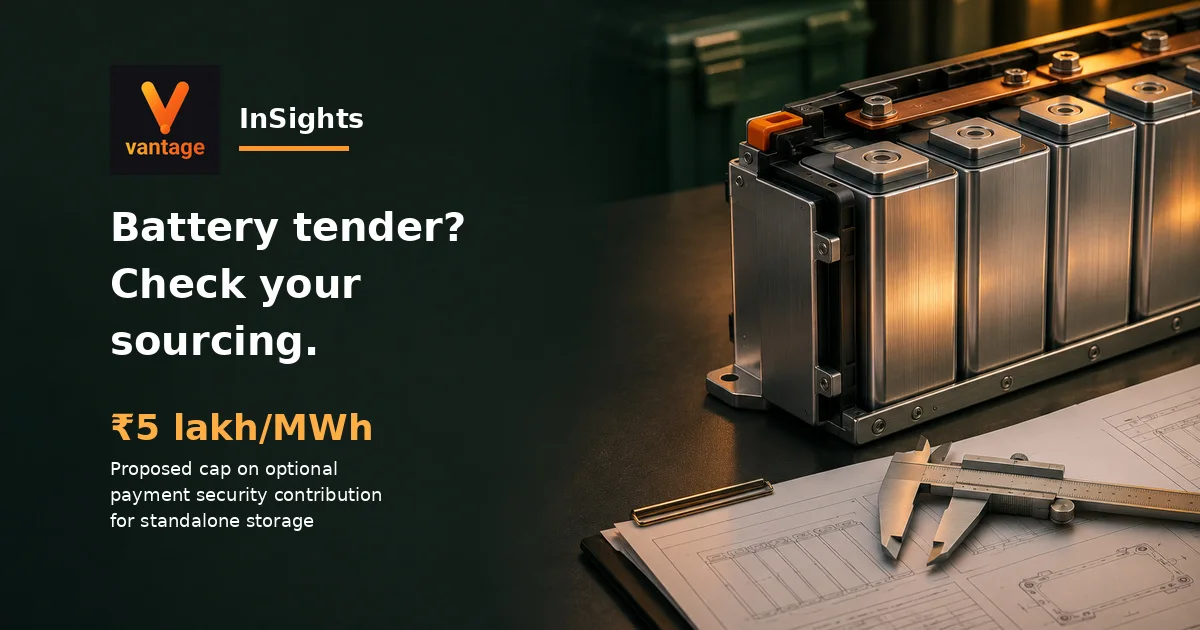
The banner highlights two separate tender considerations: proof of equipment sourcing and the proposed payment-security contribution. The battery module and inspection scene are an AI-generated illustration.
Credit: Illustrative image
Inline Intelligence
A storage supplier can quote the right capacity and still leave a crucial question open. Can the contractor prove that the equipment meets the sourcing terms of a particular tender? The Power Ministry's November 2026 draft makes that issue important for developers and suppliers across several categories of grid procurement. It also proposes different wording on how standalone storage developers may contribute to payment security.
Start with the tender category
The draft sets out different amendments for solar, wind-solar hybrid, firm and dispatchable renewable power and standalone battery energy storage. The wording also refers to separate government orders. Treat those as separate documents with separate jobs. The consultation describes the proposed framework. The applicable orders supply requirements. The request for selection, later clarifications and contract documents show how a specific bid is assessed.
In the draft standalone storage rules, the request for selection would contain provisions implementing the relevant domestic-content orders. Until those terms are known for a bid, a supplier's statement that a system is made in India leaves questions about the defined scope. Ask which parts or activities the claim covers and which dated documents establish that for the equipment being offered. A tender may define the relevant equipment and proof more precisely than a product brochure.
Vantage previously examined the distinction between cell manufacturing and downstream assembly. Those definitions can help when asking a supplier to describe its offer in the terms of a specific tender. Battery Storage: What Matters Beyond Factory Capacity?
Budget the sourcing and security questions separately
Price comparisons work best when the scope, contractual performance and evidence burden match. A sourcing requirement can change which offers qualify, when equipment is available and what documentation the developer must collect. List gaps in the offer by component or contractual obligation, then request written answers tied to that tender. Keep the timing impact visible when a supplier offers a substitute part.
The standalone storage draft separately proposes optional developer contributions to a payment security fund and a ceiling of ₹5 lakh per MWh where collected. A cash-flow estimate should show when a contribution would be due and what the contract provides in return. Keep that estimate separately from equipment pricing and any assumptions made about funding under other schemes.
What Storage Bidders Can Check Now
- Match the category. Identify the tender type and issuing agency in the request for selection. Keep the Ministry of Power draft separate from the rules in force for the bid date.
- Locate the referenced order. Verify the effective date, content threshold and calculation basis in the applicable government order or tender clarification. The consultation itself sets no new common percentage.
- Match evidence to the offer. Ask the supplier for a component schedule and the specific origin evidence required by the procurement documents. Record who supplies each document and when.
- Price the security option separately. Check the tender and agreement for contribution terms, instalments and coverage. If the final terms follow the draft, compare the stated amount with the proposed ₹5 lakh per MWh ceiling.
If you are bidding now, then consider qualifying suppliers against the live documents and using the clarification process for ambiguities. If you are budgeting for a future bid, then consider separate scenarios for sourcing cost and security contribution until applicable terms are published. A residential buyer can check their own installer and scheme terms, since this consultation concerns grid procurement.
Worked example. For an illustrative 100 MWh standalone project on 18 November 2026, the proposed ceiling would imply up to ₹5 crore if the developer opted in and the final terms applied that maximum. Actual collections and timing would depend on the bid and agreement.
Signals to monitor. Track the consultation through 25 November, any resulting government orders setting substantive content requirements, and tender-specific clarifications before financial bids close.
FAQ
Has a common new local-content percentage been set?
The November draft refers to government orders for the applicable domestic-content requirements. Check the order governing the particular tender.
Which standalone bid document would carry the provisions?
The draft points to the request for selection. Also check amendments and the final terms of the battery energy storage purchase agreement.
What does MWh measure here?
Megawatt-hours measure stored energy capacity. The proposed security contribution ceiling is expressed per MWh.
Can bidders treat the security ceiling as a fixed charge?
The draft describes a ceiling and proposes an optional contribution. Use the operative terms to establish the amount and due dates.
Does this set the battery price for rooftop purchasers?
This proposal addresses the specified grid procurement guidelines. Household equipment prices and scheme eligibility depend on a different set of terms.
Sources
Click an article title to view the source.
-
Seeking Comments on Amendments to Grid Power and Battery Storage Procurement Guidelines circulated on 10 November 2026 by the Ministry of Power.
-
Indian-made batteries set for wider push in renewable energy projects updated on 18 November 2026 in Financial Express.
-
India pushes for more locally made batteries in renewable energy projects published on 16 November 2026 in Moneycontrol.
-
Battery Storage: What Matters Beyond Factory Capacity? published on 23 October 2026 in Vantage InSights.
Evidence Caveats
The draft remains subject to consultation and any final action. The worked example applies the proposed ceiling to a hypothetical project. It establishes no incurred expense or contract entitlement.
Which sourcing requirement would you ask a tendering authority to define before making a commercial commitment? Share a public example in the attached Vantage forum.
Disclaimer
This article provides general information. Use the operative procurement and contract documents for any bid decision.

From TatvaOps
Integrated Facility Management & Security
Comparing contractor quotes?
Line up pricing, scope, and timelines before you sign.
Free quotes · Verified contractors · tatvaops.com
Discuss this article
Join the conversation
Continue this discussion on Forums. A board named like this InSights article is filed under InSights.
More from Solar
Solar Cell Codes and Rooftop Quote Checks
Ask for the module model, its documented cell model and the applicable list entry before accepting a rooftop quote or substitution.
US Tariff Exposure Checks for Indian Investors
Trace US sales, product exemptions and pricing pressure before judging how the Section 301 proposal could affect your portfolio.
Rooftop Solar Storage Costs and Buyer Checks
Compare storage and no-storage quotes using actual tariffs, usable battery capacity and realistic backup requirements.
Inline Intelligence
Key Insight Actions
Connected knowledge for Energy Procurement
Move between tutorials, discussions, Studio, and hubs without losing context.
Conclusion Intelligence
Was this helpful?
Let us know what you think