

Mumbai Property Revenue Rose 13 This Diwali. Does That Mean Homes Cost More?

Summary
Mumbai’s Diwali property registrations barely changed, but revenue rose 13%. Does that mean homes cost more? Here is what buyers can and cannot conclude from the figures. Mumbai’s Diwali property figures contain a striking gap. Registrations rose only slightly, from 3,668 to 3,683, while revenue collections increased from ₹339 crore to ₹384 crore. Does that mean every Mumbai home became more expensive? No. The figures tell us how many properties were registered and how much revenue was collected during two comparable festive windows.
Published on
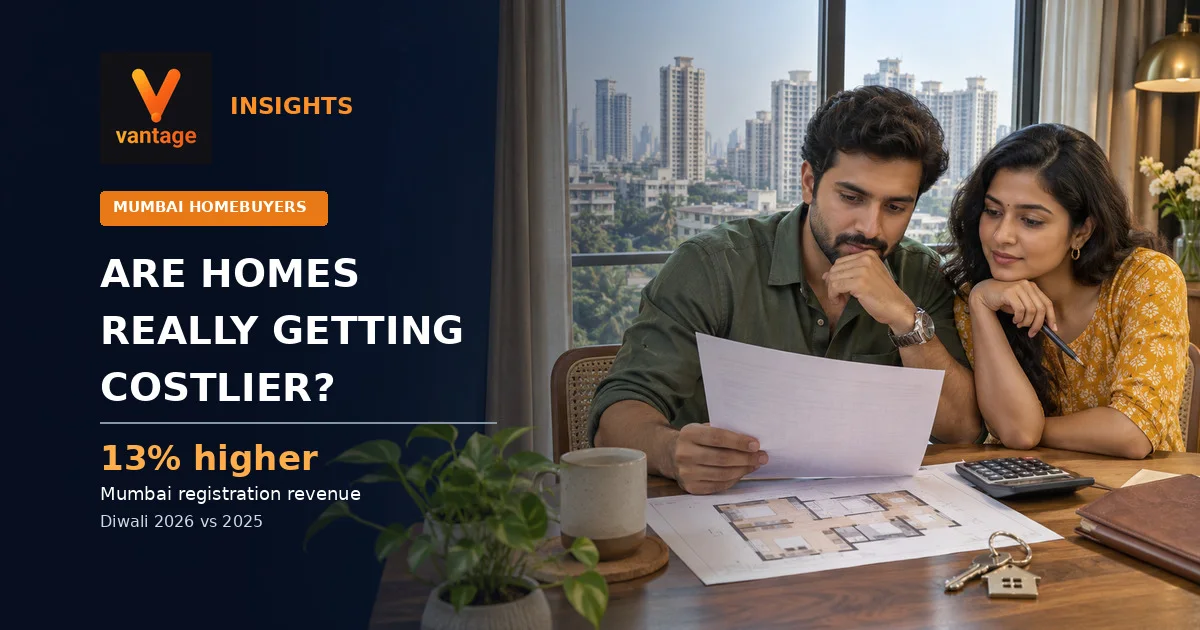
Hero image for this InSights article on Mumbai Property Revenue Rose 13 This Diwali. Does That Mean Homes Cost More, illustrating mumbai property in a 16:9 landscape frame.
Inline Intelligence
Mumbai’s Diwali property figures contain a striking gap. Registrations rose only slightly, from 3,668 to 3,683, while revenue collections increased from ₹339 crore to ₹384 crore.
Does that mean every Mumbai home became more expensive? No. The figures tell us how many properties were registered and how much revenue was collected during two comparable festive windows. They do not reveal the price change for each building, neighbourhood or type of home.
For someone considering a purchase, the more useful question is what the gap can tell us, and what still needs to be checked at the level of an individual property.
What Does the Gap Suggest?
The 2026 figures cover 1 to 11 November. The comparable 2025 festive window ran from 13 to 23 October, according to Hindustan Times reporting on Knight Frank India’s analysis.
The number of registrations rose by approximately 0.4%. Revenue rose by approximately 13%. Knight Frank India said the faster revenue growth pointed to a higher value of transactions being registered.
That is a reasonable interpretation of the reported aggregate pattern, but it is not a direct measurement of the price change for the same homes. A different mix of properties, transaction values or applicable charges can affect collections.
Imagine two periods with a similar number of registrations. If the second period includes more expensive properties, total collections could rise even if a comparable home in a particular neighbourhood has not risen by the same percentage. That is an illustration of a possible mechanism, not a finding about the composition of Mumbai’s Diwali registrations.
Are Registrations the Same as New Sales?
Not exactly. Registration is a formal step in a property transaction. It may occur after a buyer has selected a home and agreed to the purchase.
A festive-period registration count therefore cannot tell us that all those decisions were made during the festive window. Nor does it establish how many earlier enquiries converted into bookings.
Vantage’s earlier analysis explored how a buyer can assess a festive offer beyond its advertised discount -> Mumbai’s Festive Home Offers: Is a Discount Enough to Make a Good Purchase?.
Should a Buyer Hurry Because Activity Is High?
The figures alone do not provide a reason to rush. Market activity can help a buyer understand the broader setting, but an individual decision depends on the specific home, total cost, financing and documents.
A project may appear attractive because of location or an offer. It may still need closer review if the payment schedule is difficult to manage, the possession date is uncertain or comparable homes are available on better terms.
Waiting also has trade-offs: the same unit may not remain available, and a lower price is not guaranteed. The useful question is whether you have enough evidence to make the commitment, rather than whether the registration count has reached a festive high.
What Should You Compare Before Booking?
1. Compare the full cost
Ask for an itemised written quotation showing the agreed property price, applicable statutory charges, financing costs and other project charges. Check any advertised benefit and the conditions attached to it.
A discount is meaningful only after comparing the full transaction cost with a suitable alternative.
2. Compare similar homes
Look for evidence from comparable properties in the same locality, taking account of carpet area, building age, construction stage, possession timeline and amenities.
A citywide revenue increase cannot substitute for this comparison. It also cannot establish a fair price for one apartment.
3. Test the payment schedule
Check when the down payment and subsequent instalments are due. If borrowing, ask the lender for the applicable interest rate, fees and a repayment schedule.
For an under-construction home, consider how your budget would cope if rent and loan-related payments overlap for longer than expected. This is a scenario to test, not a prediction that a particular project will be delayed.
4. Review the project documents
Check the project’s registration and available disclosures with the relevant real estate regulator. Ask an independent property lawyer to review the title, approvals and agreement where appropriate.
A strong market headline does not establish the status of a specific project.
What Would Make the Next Data Release More Useful?
A breakdown by location, property type, price range and transaction characteristics would help explain the aggregate increase. It could also show whether the shift is concentrated in particular segments.
Until then, the reported figures support a narrower conclusion: registration volumes were broadly stable during the comparable Diwali windows, while revenue collections rose more quickly. They do not establish a universal price rise.
FAQ
How many properties were registered during Diwali 2026?
Mumbai recorded 3,683 registrations from 1 to 11 November 2026, according to the reported registration data.
How much did registrations increase?
They rose from 3,668 in the comparable 2025 festive period to 3,683 in 2026, an increase of 15 registrations, or approximately 0.4%.
Why did revenue rise faster than registrations?
Knight Frank India said the increase pointed to a higher value of transactions being registered. The aggregate figures alone do not establish the exact contribution of every possible factor.
Does a 13% revenue increase mean home prices rose 13%?
No. Revenue collections and individual property prices are different measures. The figures do not show a 13% price increase for every home or locality.
Do the registrations represent only homes booked during those 11 days?
No. Registration can occur after a purchase decision or agreement. The figures do not establish when every transaction was first agreed.
Should I buy because registrations reached a four-year festive high?
That depends on your circumstances and the property. Review affordability, comparable prices, documentation and the payment schedule before making a decision.
Sources
Click an article title to view the source.
- Mumbai’s Festive Home Offers: Is a Discount Enough to Make a Good Purchase? published on 7 November 2026 in Vantage InSights.
- Mumbai records highest Diwali-period property registrations in 4 years published on 13 November 2026 in The Economic Times.
- Mumbai's property registrations rises 0.4% during the 10-day Diwali 2026 period, while stamp duty revenue jumps 13% to ₹384 crore published on 13 November 2026 in Hindustan Times.
- Mumbai property registrations hit 4-year Diwali high, collections jump 13% to Rs 384 crore published on 13 November 2026 in Moneycontrol.
Evidence Caveats
The figures are attributed to news reports citing Maharashtra registration data and Knight Frank India’s analysis. The underlying transaction-level dataset was not independently retrieved.
The 2026 and 2025 comparisons use corresponding 11-day festive windows, not the same calendar dates. The aggregate data does not establish individual price changes, booking dates or the cause of every change in revenue.
The illustrative transaction-mix explanation is a possible mechanism, not an independently verified breakdown of the registrations.
In the attached forum discussion, share which evidence would give you the most confidence before buying: comparable prices, a developer’s delivery record, the payment schedule or something else. Explain why.
Disclaimer
This article is for general information and is not personalised financial, legal or tax advice. Property costs and obligations depend on the transaction and applicable rules. Consult an appropriately qualified professional about your circumstances.

From TatvaOps
Property Purchase
Procuring materials for site?
Source cement, steel, and finishes with Tatva Direct procurement.
Free quotes · Verified contractors · tatvaops.com
Discuss this article
Join the conversation
Continue this discussion on Forums. A board named like this InSights article is filed under InSights.
More from Real Estate
Bharat Future City Plot Checks Before Paying a Premium
How to check a Bharat Future City plot's planning record, road access and utilities before assigning value to proposed infrastructure.
Telangana House Pattas and What Families Should Check
How Telangana families can trace old house pattas, reconcile loan and allotment records and check collection instructions with their district office.
Amrapali Assets Could Be Auctioned. Will That Bring Your Home Closer?
Amrapali asset sales could help recover funds, but will that bring a waiting buyer closer to possession? Here are the steps between a proposed auction, project funding and a completed home.
Inline Intelligence
Key Insight Actions
Connected knowledge for Real Estate Market Analysis
Move between tutorials, discussions, Studio, and hubs without losing context.
Related discussions
Gulmohar Greens: What Should Buyers Check When Building Approvals Are Disputed?
1 replies
Related discussionMumbai Is Registering More Properties but Collecting Less Stamp Duty. What Is the Market Signalling?
1 replies
Related discussionIndias Housing Market Is Selling More Homes, but Supply Is Running Faster Than Demand
1 replies
Related discussion
Topic hubs
Conclusion Intelligence
Related Discussions
Gulmohar Greens: What Should Buyers Check When Building Approvals Are Disputed?
Popular in insights discussions1 reply
Mumbai Is Registering More Properties but Collecting Less Stamp Duty. What Is the Market Signalling?
Popular in insights discussions1 reply
Indias Housing Market Is Selling More Homes, but Supply Is Running Faster Than Demand
Popular in insights discussions1 reply
Was this helpful?
Let us know what you think