

Capital Gains Data: What Should Investors Check?

Summary
Only about 5% of individual returns reported positive long term gains in AY 2023–24. What does that figure tell investors, and what should you check before selling an asset? If only about 5% of individual tax returns reported positive long term capital gains income in assessment year 2023–24, does that mean capital gains tax matters to only a small group of investors? The answer is not that simple. The figure describes what appeared in returns for one assessment year.
Published on
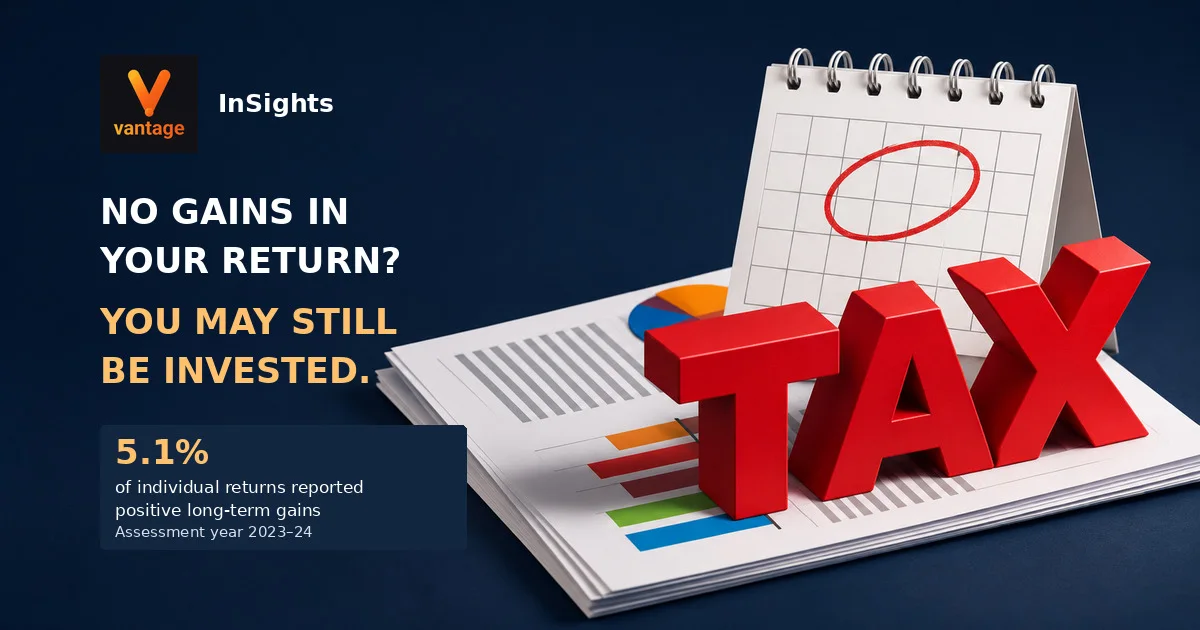
The cover asks investors to consider the potential tax impact before selling an asset. It connects the historical tax-return figure with the practical need to check the asset type, transaction date and applicable rules.
Inline Intelligence
If only about 5% of individual tax returns reported positive long-term capital gains income in assessment year 2023–24, does that mean capital-gains tax matters to only a small group of investors?
The answer is not that simple. The figure describes what appeared in returns for one assessment year. It does not tell us how many people held investments, how many sold assets in another year or how many could face a capital-gains calculation when they eventually transfer an asset.
For an investor deciding whether to sell a property, redeem a fund or rebalance a portfolio, the more useful question is not whether most filers reported gains in an earlier year. It is what applies to the transaction being considered now.
What does the 5% figure actually measure?
The Income Tax Department’s assessment year 2023–24 statistics list 7,54,61,286 individual returns in its long-term capital gains table. Of these, 7,16,32,552 are in the zero-gains category.
The difference is 38,28,734 returns, or approximately 5.1% of the total. The table covers reported long-term capital gains income from capital assets generally, not only gains from equity shares.
Review the individual-return table in the official report -> Income Tax Return Statistics: Assessment Year 2023–24.
Why might an investor report no long-term gain?
Holding an investment and reporting a gain from transferring it are different events. Someone may own shares, fund units or property without transferring them in a particular year. Another person may transfer an asset without the return showing positive long-term capital gains income in the way captured by this table.
The statistics do not provide enough detail to assign a reason to every zero entry. They also do not show whether someone who reported a gain paid tax on that gain, or how much tax they paid.
That means the data is useful for understanding reported returns, but it should not be treated as a census of investors or as a forecast of who will have a taxable gain next year.
What should you check before selling an asset?
Start with the asset and the transaction, rather than applying a rate mentioned in a general headline. The relevant treatment can depend on the type of asset, acquisition and transfer dates, holding period, transaction details and rules applicable to the relevant year.
The Income Tax Department’s guidance explains the concept of capital gains and the information required in a return -> ITR-2 Frequently Asked Questions.
Before making a decision, assemble the records needed to discuss your case:
- Acquisition details: Purchase date, purchase price and supporting documents.
- Proposed transfer: Expected sale or redemption value, date and transaction-related costs.
- Asset type: For example, property, listed shares or a specific mutual fund. Different assets can be subject to different treatment.
- Other relevant records: Earlier transactions, available loss records and any documents needed to assess a potentially applicable relief or adjustment.
A qualified tax professional can help determine which rules and return form apply. Do not assume that a figure applicable to one type of equity transaction applies to property or every mutual fund.
Should a possible tax change determine when you sell?
A reported discussion about changing tax rules is not the same as a change that has taken effect. A decision to wait may also have consequences: the asset’s price could change, a financial goal could be delayed, or money may remain exposed to risks the investor wanted to reduce.
Consider the tax estimate alongside your reason for selling, time horizon, liquidity needs, investment risk and transaction costs. The right balance will vary.
Vantage has previously examined what remains uncertain when possible LTCG relief is discussed -> LTCG Tax Review: Should It Change Your Investment Plan?.
What to check next
- Identify the transaction: Note the asset, expected transfer date and why you are considering a sale or redemption.
- Gather the records: Keep acquisition statements, transaction documents and relevant expense records together.
- Estimate the outcome: Ask an appropriately qualified adviser to consider the rules applicable to your asset and circumstances, including any eligible adjustments.
- Compare the whole decision: Consider tax alongside risk, costs and the date you need the money. Revisit the calculation if the transaction or applicable law changes.
FAQ
1. Does the 5.1% figure cover all investors in India?
No. It is an approximate share of individual income-tax returns in the department’s assessment year 2023–24 long-term capital gains table.
2. Does the figure refer only to stock-market gains?
No. The table describes long-term capital gains income from capital assets generally; it is not limited to listed equities.
3. Does a zero entry mean the person owned no investments?
No. The table does not establish that. An investor may hold an asset without transferring it in the relevant year, among other possibilities.
4. Does reporting a gain prove that tax was paid on it?
No. Reported gains and tax liability are different measures. The amount of tax, if any, depends on the applicable rules and circumstances.
5. Do all assets have the same capital-gains treatment?
No. The asset, relevant dates and other conditions can affect the calculation. Check the rules applicable to the specific transaction.
6. Should I wait to sell because a tax change is being discussed?
A discussion does not establish that a change will be enacted or when it would apply. Consider your financial goal, timing, risk and current applicable rules with qualified advice.
Sources
Click an article title to view the source.
- Income Tax Return Statistics: Assessment Year 2023–24, Income Tax Department, accessed on 13 November 2026.
- ITR-2 Frequently Asked Questions, Income Tax Department, accessed on 13 November 2026.
- LTCG Tax Review: Should It Change Your Investment Plan?, published on 3 November 2026 in Vantage InSights.
Evidence Caveats
The percentage is calculated from the department’s assessment year 2023–24 individual-return table: total returns minus the zero-gains category, divided by total returns. The data concerns reported long-term capital gains income, not current investor numbers or tax collected. This article does not calculate the tax on any individual transaction; rules and circumstances can change.
When planning a sale, how do you balance the possible tax impact against the date you need the money and the risk of remaining invested? Share your approach or questions in the attached forum discussion without disclosing sensitive financial details.
Disclaimer
This article is for general information and is not personalised tax, legal, financial or investment advice. Tax treatment depends on the asset, transaction, applicable law and individual circumstances. Consult a qualified professional before acting.

From TatvaOps
Property Development
Developing a property?
Structured oversight for multi-unit and investor-led builds.
Free quotes · Verified contractors · tatvaops.com
Discuss this article
Join the conversation
Continue this discussion on Forums. A board named like this InSights article is filed under InSights.
1 reply already on Forums
More from Real Estate
Bharat Future City Plot Checks Before Paying a Premium
How to check a Bharat Future City plot's planning record, road access and utilities before assigning value to proposed infrastructure.
Telangana House Pattas and What Families Should Check
How Telangana families can trace old house pattas, reconcile loan and allotment records and check collection instructions with their district office.
Amrapali Assets Could Be Auctioned. Will That Bring Your Home Closer?
Amrapali asset sales could help recover funds, but will that bring a waiting buyer closer to possession? Here are the steps between a proposed auction, project funding and a completed home.
Inline Intelligence
Key Insight Actions
Connected knowledge for Taxation & Investment
Move between tutorials, discussions, Studio, and hubs without losing context.
Related discussions
Topic hubs
Conclusion Intelligence
Related Discussions
Was this helpful?
Let us know what you think