

Kolkata Captured Just 1 of 6.3 Lakh Crore Housing Sales Value: Should the City Chase Premium Housing?
Karthik posts articles on Energy and Construction.
Summary
Kolkata accounted for just 1% of the ₹6.3 lakh crore residential sales value across nine major markets in FY26, while MMR alone captured 34%. But the gap reflects ticket sizes as much as housing demand. Kolkata's strategic challenge is not simply to build more luxury homes, but to increase housing v Kolkata has an unusual housing market problem. It sells homes. It remains relatively affordable. Its Metro network is expanding. New residential corridors are emerging.
Published on
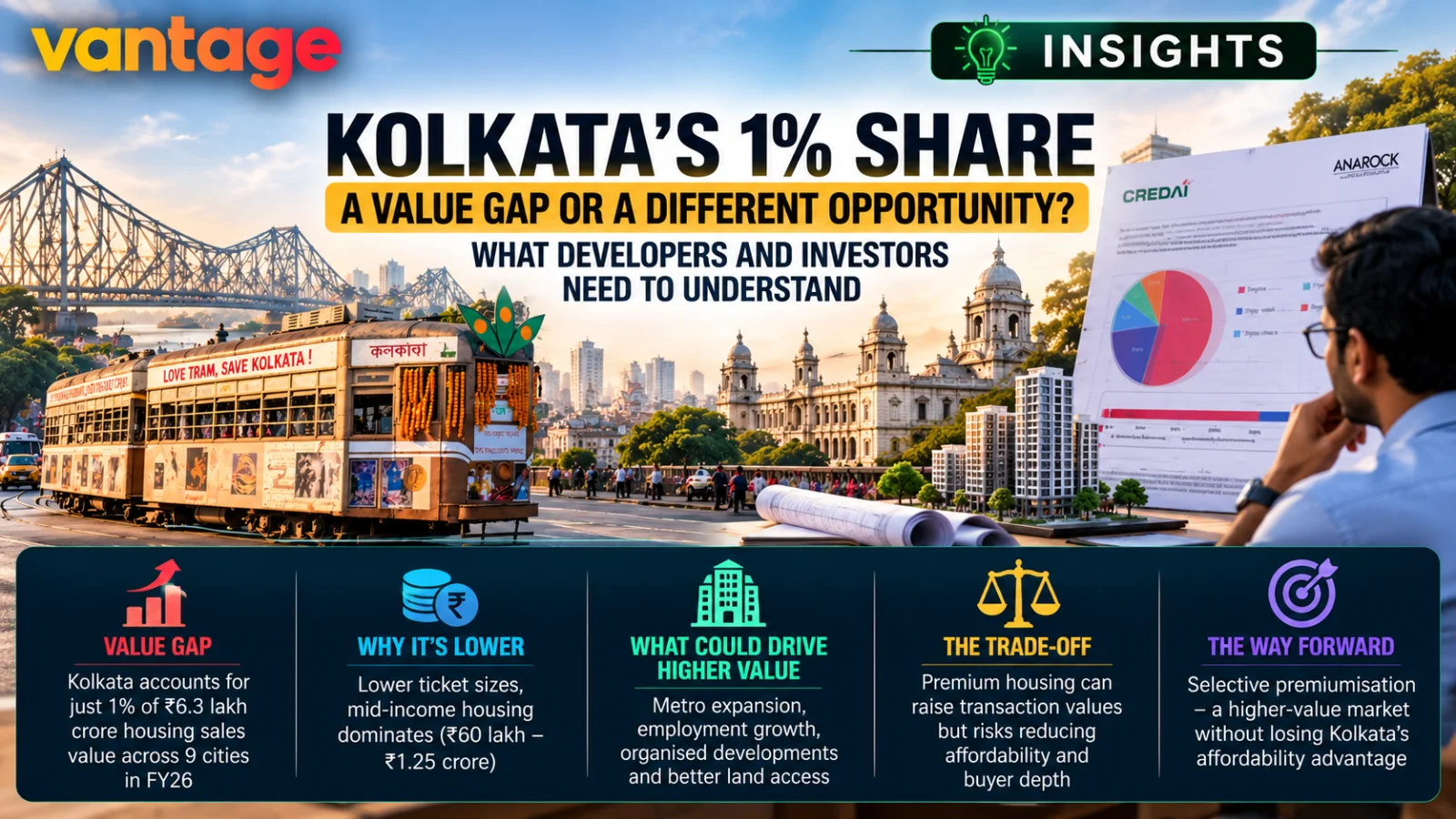
banner presenting Kolkata's housing sales-value gap through a city-focused visual featuring the tram, Howrah Bridge, urban development and CREDAI-ANAROCK research imagery. The analysis contrasts Kolkata's 1% share of ₹6.3 lakh crore in FY26 housing sales value across nine cities with its lower ticket sizes and mid-income housing base, while highlighting Metro expansion, employment growth, organised development and selective premiumisation as potential drivers of higher value.
Inline Intelligence
Kolkata has an unusual housing-market problem.
It sells homes.
It remains relatively affordable.
Its Metro network is expanding.
New residential corridors are emerging.
Yet the city accounted for only 1% of the ₹6.3 lakh crore residential sales value across nine major markets in FY26.
Meanwhile, MMR captured 34%, Delhi-NCR 22% and Bengaluru 15%.
The obvious conclusion would be that Kolkata needs more expensive housing.
That conclusion is too simple.
The more important question is whether Kolkata can increase the value of its housing market without destroying the affordability that supports demand in the first place.
India's Housing Boom Is Increasingly a Premiumisation Boom
The ₹6.3 lakh crore FY26 sales-value figure is substantially higher than the approximately ₹2.35 lakh crore recorded in FY22.
That is roughly 2.68 times the earlier value.
But unit sales have not expanded at anything close to the same rate.
This tells us that India's housing expansion is increasingly being driven by the value of each transaction.
Premiumisation is central to that change.
Luxury Supply Has Expanded Dramatically
High-end, luxury and ultra-luxury homes represented approximately 45% of new housing supply across the nine cities in FY26.
In FY22, their share was just 12.6%.
That is an increase of 32.4 percentage points.
It is also roughly 3.6 times the FY22 share.
Both are Vantage-derived comparisons.
Developers have increasingly allocated capital towards expensive homes because those projects can generate higher sales value and potentially stronger margins.
Kolkata Is Positioned Differently
Kolkata has not moved as far up the price curve.
Average residential prices were approximately ₹6,120 per sq ft in 2025.
CREDAI West Bengal President Sushil Mohta described the ₹60 lakh to ₹1.25 crore range as the city's main housing segment.
That creates an economic trade-off.
Lower prices suppress total transaction value.
But they also allow a larger middle-income population to participate in the housing market.
Kolkata's lower sales value may therefore partly reflect affordability rather than weak housing activity.
Sales Value Is Not the Same as Market Quality
Consider two hypothetical cities.
City A sells 10,000 homes averaging ₹3 crore.
Sales value = ₹30,000 crore.
City B sells 10,000 homes averaging ₹75 lakh.
Sales value = ₹7,500 crore.
City A has four times the transaction value.
But both cities sold exactly the same number of homes.
This simple example demonstrates why sales-value rankings should not be confused with housing-market depth.
The examples are illustrative and not Kolkata or MMR data.
Why Developers Still Care About Sales Value
Although sales value is not everything, it matters enormously to developers.
Higher ticket sizes can support:
- higher revenue per project;
- stronger land bids;
- more spending on amenities;
- larger absolute margins;
- institutional capital participation; and
- more ambitious redevelopment.
A market that remains permanently low-ticket can therefore face limits on developer economics.
The challenge is increasing value without outrunning local purchasing power.
Could Kolkata Simply Build More Luxury Homes?
That would be risky.
Premium housing requires a sufficiently deep pool of buyers with:
high household incomes,
substantial wealth,
access to financing,
or investment demand.
A handful of successful luxury projects does not prove that an entire city can absorb a large premium pipeline.
If developers move too aggressively upmarket, unsold inventory can rise.
The better strategy may be selective premiumisation rather than a city-wide luxury pivot.
What Is Selective Premiumisation?
Selective premiumisation means developing higher-ticket housing where the fundamentals justify it.
That could include locations with:
- strong Metro connectivity;
- established high-income catchments;
- proximity to employment;
- premium social infrastructure;
- scarce land;
- strong developer brands; and
- demonstrated resale demand.
Other corridors can remain focused on mid-income housing.
This creates a broader product ladder instead of forcing the entire city towards one price segment.
Metro Expansion Could Be the Bridge
Infrastructure can make peripheral locations more valuable without immediately pushing them into ultra-luxury pricing.
East Kolkata already demonstrates this possibility.
Rajarhat, New Town, Tangra, Salt Lake and the EM Bypass corridor accounted for around 35% of Kolkata's new launches in 2025.
East Kolkata launches increased 121% year on year.
If improved connectivity reduces commuting friction, developers can potentially offer larger or higher-quality housing while maintaining lower land costs than central locations.
That can increase ticket sizes through product quality and accessibility rather than luxury branding alone.
Employment Is More Important Than Luxury Branding
Sustainable housing premiumisation ultimately requires income.
If a city creates more high-paying jobs, it creates a larger pool of households capable of purchasing expensive homes.
Office development, GCCs, technology businesses, logistics, retail and other commercial investment therefore matter to Kolkata's residential market.
Without corresponding income growth, higher housing prices can become increasingly dependent on investors or a narrow wealthy segment.
That is less durable.
Land Reform Could Change the Supply Equation
Developers cited by Moneycontrol argue that older land regulations and fragmented ownership have made it difficult to assemble large sites.
If land reform makes larger parcels easier to develop, Kolkata could support more integrated projects.
That can improve:
project scale,
amenities,
open space,
infrastructure,
and potentially ticket sizes.
But land reform does not automatically create demand.
It changes the supply opportunity.
Demand still needs to come from households and investors willing and able to pay.
The City's 1% Share May Be Too Dramatic a Headline
Applying 1% to ₹6.3 lakh crore produces approximately ₹6,300 crore.
But the 1% itself is rounded.
More importantly, comparing this with MMR's 34% can exaggerate the impression of underperformance because Mumbai housing operates at radically different price points.
The relevant question is not whether Kolkata can become MMR.
It is whether Kolkata can increase value relative to its own income base, land economics and employment growth.
Affordability Has Economic Value
Affordability is often discussed as though it represents a market weakness.
For homebuyers, it can be an advantage.
A city where professional households can still purchase reasonably located homes may offer:
lower debt burdens,
larger homes for the same budget,
and broader access to ownership.
Those benefits do not appear in a sales-value league table.
Kolkata should be careful not to sacrifice them purely to improve its national ranking.
But Affordability Can Also Become a Developer Constraint
There is another side.
If selling prices remain low while:
construction costs rise,
land becomes expensive,
regulatory costs increase,
and financing remains costly,
developers may find some housing categories increasingly difficult to build profitably.
That can push developers towards higher ticket sizes even when buyer affordability has not increased at the same pace.
This is one reason India's affordable housing supply has faced pressure.
What Would Sustainable Premiumisation Look Like?
For Kolkata, it would probably involve several developments happening together.
Higher incomes
A larger base of households capable of purchasing ₹1 crore-plus homes.
Better infrastructure
Metro and road connectivity expanding viable residential locations.
More employment centres
Reducing dependence on a limited number of established business districts.
Larger organised projects
Allowing better amenities and product quality.
Gradual ticket-size growth
Prices rising alongside buyer purchasing power rather than far ahead of it.
Continued mid-market supply
Ensuring the city does not abandon its largest buyer base.
Investors Should Not Buy the 1% Narrative Alone
A low sales-value share does not automatically imply that Kolkata property is undervalued.
Nor does it guarantee future catch-up.
An investment case requires evidence at the micro-market level.
Investors should examine:
- launch and sales trends;
- inventory;
- rental demand;
- employment access;
- infrastructure delivery;
- developer track record;
- resale liquidity; and
- actual transaction prices.
The national sales-value comparison provides context, not an investment thesis.
Homebuyers Face a Different Question
For an end-user, Kolkata's relative affordability may be more relevant than its share of national transaction value.
A homebuyer should ask:
Can I comfortably service the loan?
Is the project connected to employment?
Is the developer executing on time?
Is the neighbourhood improving?
Does the price make sense relative to comparable homes?
Whether Kolkata accounts for 1% or 2% of a national sales-value pool does not answer those questions.
Developers Have the Hardest Decision
Developers need to decide where the city's next ₹1.5 crore, ₹2 crore and ₹3 crore buyer will come from.
If the answer is supported by:
income growth,
location scarcity,
infrastructure,
brand,
and proven absorption,
premium development can make sense.
If the answer is simply that luxury housing is selling elsewhere in India, the strategy is much weaker.
Kolkata's Opportunity Is Not to Become More Expensive
The city's opportunity is to become more valuable.
Those are not necessarily the same thing.
Value can increase through:
better transport,
better housing quality,
stronger employment,
better public infrastructure,
larger organised developments,
and improved neighbourhoods.
Prices may rise as a consequence.
But making housing expensive without improving the economic ecosystem is not sustainable premiumisation.
The Decision for Kolkata
The 1% figure exposes a genuine gap between Kolkata and India's largest residential markets.
But closing that gap should not become the objective by itself.
The better goal is a housing market where transaction value rises because incomes, infrastructure, project quality and economic activity are rising with it.
That would allow Kolkata to capture more of India's residential value while retaining one of its strongest competitive advantages:
a housing market that remains accessible to a much broader group of buyers than India's most expensive metros.
Frequently Asked Questions
Why is Kolkata's share of housing sales value only 1%?
Lower ticket sizes and a market concentrated more heavily in mid-income housing are major reasons.
Should Kolkata developers build more luxury housing?
Selective premium development may have opportunities, but the evidence does not support a city-wide luxury shift. Buyer depth and affordability remain critical.
Is Kolkata housing cheaper than other major metros?
ANAROCK's data show average Kolkata residential prices around ₹6,120 per sq ft in 2025, while Moneycontrol describes the city as substantially more affordable than several larger metropolitan markets.
Does low sales value mean weak housing demand?
No. Sales value depends on both transaction volume and ticket size.
Could Kolkata property prices catch up with Mumbai or NCR?
There is no evidence supporting a specific catch-up trajectory. The markets have different land, income, employment and supply structures.
Which Kolkata areas could benefit from Metro expansion?
ANAROCK highlights the expanding Orange and Purple Metro lines, while East Kolkata locations such as Rajarhat, New Town, Tangra, Salt Lake and the EM Bypass have already become important development corridors.
Is premiumisation good for homebuyers?
It can increase housing quality and choice, but excessive price escalation can reduce affordability. The effect depends on whether incomes and housing supply evolve alongside prices.
What should investors watch in Kolkata real estate?
Employment growth, Metro delivery, land availability, project absorption, inventory, rental demand and resale liquidity are more useful than the 1% national sales-value figure alone.
Sources
Click on article title to view article.
“Kolkata sells homes but misses the big money as premium housing boom lifts other cities” published on 5 October 2026 in Moneycontrol
“Mumbai leads top 9 cities in residential sales value with 34% share in FY26: CREDAI-ANAROCK report” published on 2 October 2026 in Hindustan Times
Primary Data
“Indian Residential Real Estate Sector Annual Report 2025” published by ANAROCK
Evidence Caveats
- The 1% figure is sales value, not unit-sales share.
- The 32.4 percentage-point increase and approximately 3.6-times premium-supply comparison are Vantage-derived.
- The ₹6,300 crore approximation uses a rounded market share and is not an exact reported Kolkata FY26 sales value.
- Selective premiumisation is Vantage editorial analysis, not a recommendation contained in the CREDAI-ANAROCK report.
- No reliable evidence establishes a future Kolkata price-growth rate or a guaranteed premiumisation opportunity.
- City-wide averages should not be used as forecasts for individual properties.

From TatvaOps
Property Development
Financing your project?
Explore credit and milestone-secured payment options with Tatva Finance.
Free quotes · Verified contractors · tatvaops.com
Discuss this article
Join the conversation
Continue this discussion on Forums. A board named like this InSights article is filed under InSights.
1 reply already on Forums
More from Real Estate
LTCG Tax Debate: Should You Delay Selling Investments?
Could waiting for LTCG tax relief cost more than it saves? With proposals under discussion, we examine how your current tax liability, market exposure and cash deadline should shape a planned investment sale.
Blackstones India Bet: What Should You Check?
Blackstone’s $100-billion India ambition is a useful signal. For your own money, the harder questions are access, valuation, cash flow and risk. Here is what to check before turning institutional optimism into a personal investment decision.
Senior Living: Buy the Home, Examine the Services: what most readers overlook
Rustomjee’s senior-living evaluation raises a household question: can you afford and rely on the services after buying the home? We examine recurring charges, operator responsibilities, changing support needs and exit flexibility.
Inline Intelligence
Key Insight Actions
Connected knowledge for Real Estate Market Analysis
Move between tutorials, discussions, Studio, and hubs without losing context.
Related discussions
Topic hubs
Conclusion Intelligence
Related Discussions
Was this helpful?
Let us know what you think