

Indias Data-Centre Boom Is Turning Power and Land Into Digital Infrastructure
Karthik posts articles on Energy and Construction.
Summary
India is approaching 2 GW of operational data centre capacity. But the next phase depends on something more physical: finding locations where power, land, connectivity, cooling and digital demand can meet at scale. A data centre may be classified as real estate. But try developing one without enough electricity. India had approximately 1.75 GW of operational data centre capacity at the end of H1 2026 , according to CBRE. More than 200 MW is expected to become operational during the second half, potentially taking the market to approximately 2 GW by year end.
Published on
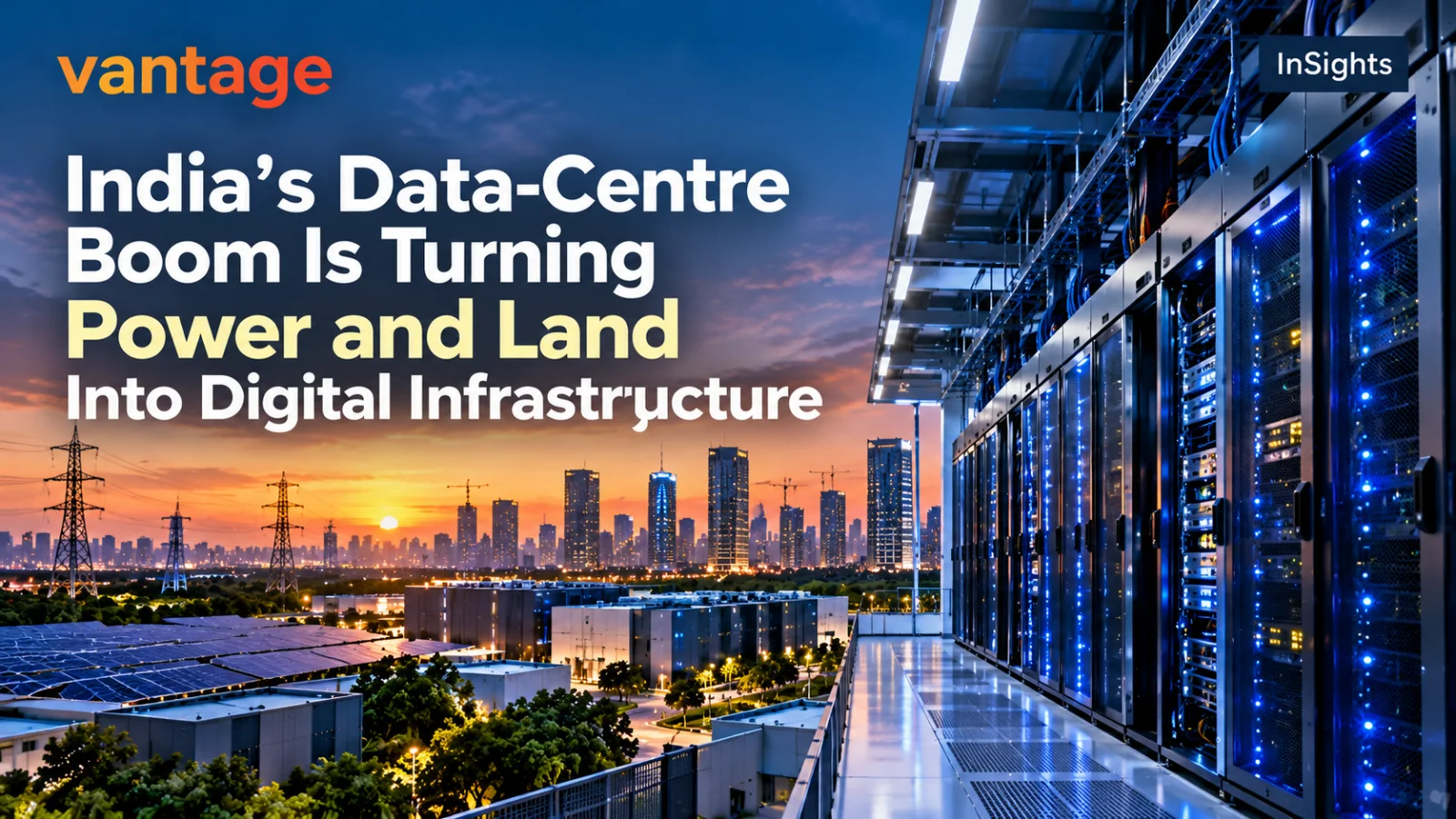
An editorial composite showing illuminated data-centre server racks alongside an Indian urban landscape, electricity transmission infrastructure and solar generation at sunset. The image visualises how data-centre expansion increasingly connects digital infrastructure with power availability, land, energy systems and urban development.
Inline Intelligence
A data centre may be classified as real estate.
But try developing one without enough electricity.
India had approximately 1.75 GW of operational data-centre capacity at the end of H1 2026, according to CBRE. More than 200 MW is expected to become operational during the second half, potentially taking the market to approximately 2 GW by year-end.
The investment pipeline is considerably larger. CBRE estimates approximately $173 billion of data-centre investment commitments have accumulated since 2021.
Yet the next phase of growth will not be determined by capital alone.
It will depend on whether developers can find locations where power, land, connectivity, cooling and market demand converge.
That turns India's data-centre boom into something much bigger than a technology story.
It is becoming a land and infrastructure story.
A megawatt is changing the way property is measured
Traditional commercial real estate is usually discussed in square feet.
Data centres add another unit: megawatts.
The difference is revealing.
Office developers primarily create space for people and businesses. Data-centre developers create highly engineered environments capable of operating computing equipment continuously.
The building still matters.
But so do the electricity connection, electrical redundancy, cooling systems, fibre connectivity and backup infrastructure.
That means two otherwise similar land parcels can have very different values for a data-centre operator.
One may have a realistic route to a large power connection and multiple fibre networks.
The other may not.
For this asset class, infrastructure can be as important as location.
India is approaching 2 GW
CBRE estimates India's operational capacity reached approximately 1.75 GW at the end of H1 2026 after around 130 MW was added during the first six months.
More than 200 MW is expected to go live in H2.
If delivered, India would approach 2 GW of operational capacity by the end of 2026.
CBRE's longer-term outlook has previously indicated that the market could exceed 3 GW by the end of 2028.
But operational capacity is only one part of the picture.
CBRE estimates approximately $38 billion of investment commitments were announced during H1 2026, taking cumulative commitments since 2021 to approximately $173 billion.
Those figures are substantial.
They are also easy to misread.
An investment commitment is not the same as completed construction or capital already deployed.
A project must still secure a site, electricity, connectivity, approvals, equipment and construction capacity before an announcement becomes operational infrastructure.
That gap between committed capital and functioning megawatts may become one of the most important measures of India's data-centre market.
Power could redraw the map
More than 80% of India's operational capacity remains concentrated in Mumbai, Chennai and Delhi-NCR, according to CBRE.
Mumbai alone accounted for 94% of new supply delivered during H1 2026.
There are reasons these clusters developed.
Navi Mumbai and Chennai's Siruseri benefit from connectivity infrastructure, cable landing stations and established corporate ecosystems.
But CBRE expects incremental supply to expand into Hyderabad, Bengaluru, Kolkata and Visakhapatnam.
Availability of land, power and water is among the factors supporting that expansion.
This creates an interesting property-market consequence.
Data centres do not necessarily need to occupy the most expensive central urban land. Large facilities can potentially move towards locations where infrastructure economics are more favourable, provided network latency and connectivity remain appropriate for the workload.
That creates the possibility of a new geography of digital real estate.
Power-secure land could command a different premium
For conventional property, infrastructure usually supports the asset.
For a data centre, some infrastructure is effectively part of the product.
Electricity is the clearest example.
CBRE's India operator research identifies power availability as an important site-selection consideration, alongside network connectivity, renewable-energy sourcing and market access.
The broader Asia-Pacific market shows why.
CBRE says power availability is increasingly determining where new data-centre capacity can be delivered. Growth is shifting towards markets capable of accommodating large, high-density computing loads.
India therefore faces an unusual real-estate question:
Could access to power become more important than proximity to a traditional business district?
For certain data-centre workloads, the answer may increasingly be yes.
That does not mean any site with electricity becomes valuable.
Network connectivity, reliability, land characteristics, approvals, cooling and customer requirements still matter.
But it does mean that developers may need to think about land and energy infrastructure together rather than acquiring land first and solving electricity later.
AI raises the infrastructure intensity
Artificial intelligence is adding another layer.
CBRE estimates that more than 15% of cumulative Indian data-centre investment commitments between 2021 and H1 2026 were linked to AI.
AI workloads can involve high-density computing equipment, increasing power and cooling requirements.
Across global data-centre markets, CBRE has found that AI is influencing the development of larger, denser facilities and increasing the importance of power availability.
But India's growth should not be reduced to an AI narrative.
Demand also comes from cloud providers, BFSI institutions, hyperscalers, government users, technology companies and OTT platforms.
That broader demand base matters.
It suggests the underlying requirement for digital infrastructure extends beyond the current AI investment cycle.
The electricity system has its own growth problem
Data-centre operators are not seeking power in a static electricity market.
The International Energy Agency expects India's electricity demand to increase by an average 6.4% per year through 2030.
Industry, buildings, cooling, agriculture and transport are all contributing to that expansion.
India is simultaneously adding large amounts of renewable generation and transmission infrastructure. The IEA expects solar to provide roughly half of India's additional electricity-demand growth through 2030, with coal supplying around a quarter and the balance coming from wind, nuclear, hydro and gas.
Data centres therefore enter a power system undergoing rapid expansion and transition.
This creates a practical tension.
Operators increasingly want large quantities of reliable electricity, often accompanied by renewable-energy objectives.
Utilities must accommodate those concentrated loads while also meeting rising demand from the rest of the economy.
For developers, the result is straightforward: power procurement becomes part of real-estate development strategy.
Water and cooling cannot be separated from the site
Cooling creates another physical constraint.
Servers generate heat, and higher-density computing can increase the engineering challenge.
Different cooling technologies have different land, electricity and water implications.
That means "water availability" should not be interpreted as every data centre necessarily consuming the same amount of water.
Cooling design matters.
Climate matters.
Technology matters.
Facility density matters.
But water and cooling strategy can still influence which sites are viable, particularly as facilities grow larger and environmental scrutiny increases.
This is another reason data-centre site selection cannot be reduced to land price.
Higher resilience means more specialised construction
CBRE reports that Tier IV facilities represented 43% of Indian data-centre supply in H1 2026, compared with 21% in 2024.
Tier IV facilities are designed around high levels of fault tolerance and infrastructure redundancy.
That changes the construction proposition.
Data-centre development requires specialised mechanical and electrical engineering, redundant power systems, backup generation, cooling equipment, security and sophisticated commissioning.
As computing density increases, engineering requirements can become more demanding still.
For India's construction sector, data-centre growth therefore creates a specialised capability opportunity.
The winners may not simply be contractors capable of constructing large buildings.
They may be companies capable of delivering complex mission-critical infrastructure reliably and repeatedly.
Domestic developers are becoming more important
Another notable change is who is delivering capacity.
Domestic developers accounted for 48% of new H1 2026 supply, according to CBRE.
American players contributed 28% and European players 24%.
Domestic investors also held the largest share of cumulative capital deployed since 2021 at 38%, ahead of US investors at 27%.
That suggests India's data-centre ecosystem is developing local capital and execution capability alongside international participation.
CBRE's operator survey adds another indicator.
92% of surveyed operators said they planned to add more than 100 MW of capacity during the next 24 months.
Those are plans rather than completed projects.
But they show the scale at which operators are thinking.
The real-estate opportunity may extend beyond the data centre
Large digital campuses can also influence surrounding infrastructure.
They may require new substations and transmission connections.
Fibre networks need to reach the site.
Road access is needed for construction and operations.
Renewable-power procurement can create relationships with generation and storage projects elsewhere.
Specialised engineering, equipment maintenance and technical services can cluster around major markets.
The built-environment impact therefore extends beyond the walls of the facility.
This is why describing data centres simply as an "alternative real-estate asset class" can understate what is happening.
They sit at the intersection of property, electricity, telecommunications and computing infrastructure.
Not every announced campus will be built
Large investment figures inevitably create the risk of over-extrapolation.
CBRE's $173 billion figure represents cumulative investment commitments, not completed capital expenditure.
Operator expansion plans are intentions.
Expected capacity can be delayed.
Projects can encounter land, power, equipment, regulatory or construction constraints.
And AI demand itself will evolve as computing technology, model economics and workload efficiency change.
For investors evaluating the sector, the quality of the pipeline may therefore matter as much as its headline size.
A useful distinction is:
announced MW → powered MW → constructed MW → operational MW → occupied MW
Those stages are not interchangeable.
The closer a project moves towards operating and contracted capacity, the more tangible the asset becomes.
The next data-centre map will be an infrastructure map
India reaching 2 GW would be a meaningful milestone.
But the more consequential development may be what happens between 2 GW and 3 GW.
The first phase of India's market has been heavily concentrated in established hubs.
The next phase could test whether new locations can combine sufficient demand with the physical infrastructure needed to support much larger facilities.
That puts several questions at the centre of site selection:
Where can developers secure power quickly enough?
Which markets can provide resilient connectivity?
Where can large parcels be assembled without making network economics uncompetitive?
How will renewable-power requirements affect site strategy?
Can cooling systems be designed around local resource constraints?
And perhaps most importantly:
Which announced projects can actually become operational megawatts?
For property investors, that changes the way the opportunity should be evaluated.
The most important data-centre locations of the next decade may not simply be India's largest cities.
They may be the places where digital demand meets physical capacity.
If you work in data centres, utilities, construction, land acquisition or digital infrastructure, which bottleneck is already changing your site decisions? Power, connectivity, land, cooling, equipment lead times or approvals?
If this analysis is useful to someone making decisions around data-centre development, energy infrastructure or land, consider sharing it with them.
FAQ
How much operational data-centre capacity does India currently have?
CBRE estimates that India had approximately 1.75 GW of operational data-centre capacity at the end of H1 2026.
Will India reach 2 GW in 2026?
CBRE expects more than 200 MW of additional capacity to become operational during H2 2026, putting total capacity on track to reach approximately 2 GW by year-end. This remains a forecast rather than completed capacity.
How much new capacity was added during H1 2026?
Approximately 130 MW, according to CBRE.
Where is most Indian data-centre capacity located?
More than 80% of operational capacity is concentrated in Mumbai, Chennai and Delhi-NCR. Mumbai accounted for 94% of new supply delivered during H1 2026.
Are other Indian cities emerging as data-centre locations?
Yes. CBRE expects incremental supply to expand into markets including Hyderabad, Bengaluru, Kolkata and Visakhapatnam, supported by factors including land, power and water availability.
Has India really attracted $173 billion into data centres?
CBRE reports approximately $173 billion of cumulative investment commitments since 2021. This should not be interpreted as $173 billion of completed investment or operating assets.
Is AI the main reason data-centre demand is growing?
AI is increasingly important, and CBRE says more than 15% of cumulative commitments since 2021 were AI-linked. But demand also comes from cloud, hyperscale, BFSI, OTT and other digital users.
Why does electricity matter so much for data-centre real estate?
Data centres require large quantities of reliable electricity to operate computing and cooling infrastructure continuously. Power availability can therefore directly affect site viability and development timelines.
Why is cooling important?
Computing equipment produces heat. As rack and computing densities increase, facilities require increasingly capable cooling systems. Cooling design can affect electricity consumption, engineering requirements and, depending on technology, water use.
What should investors watch instead of project announcements?
Track the progression from announced capacity to secured power, construction, commissioning, operational capacity and ultimately occupied or contracted capacity. These stages provide a clearer indication of whether a proposed project is becoming a functioning asset.
Sources
Click on article title to view article
“Beyond Growth: India’s Rise Among APAC’s Leading Data Centre Markets” published on 21 September 2026 by CBRE
“India Data Centre Market Monitor H1 2026” published on 17 September 2026 by CBRE
“India’s operational data centre capacity on track to reach 2 GW by the end of the year” published on 6 October 2026 in The Economic Times
“APAC Data Centre Investment Hits Record US$11.6 Billion as Power Access Reshapes Growth” published on 21 May 2026 by CBRE
“Global Data Center Trends 2026” published on 17 June 2026 by CBRE
“Demand – Electricity 2026” published in 2026 by the International Energy Agency
Evidence Caveats
The principal Indian data-centre capacity, investment and operator-survey figures in this article originate from CBRE research. CBRE is a commercial real-estate services and investment firm, so these figures should be understood as industry research rather than official government statistics.
The 2 GW year-end figure is a forecast based partly on capacity expected to become operational during H2 2026. Expected capacity may be delayed and should not be treated as already operating.
The approximately $173 billion figure represents investment commitments announced since 2021. Commitments, capital deployed, construction expenditure and the value of completed operating assets are different measures and should not be treated interchangeably.
The article's discussion of how power, land, connectivity and cooling may affect future development is analytical interpretation based on CBRE's identified site-selection priorities and wider infrastructure evidence. It does not imply that every Indian market faces identical constraints.
What are you seeing on the ground? Add your perspective to the Vantage discussion, particularly if you work in data-centre development, utilities, land, construction, MEP engineering, connectivity or investment. Where Vantage's participation-points mechanism is active and applicable, substantive participation can also earn points. Share this analysis with colleagues or decision-makers who can add practical evidence about which constraints are actually determining projects.
Disclaimer
This article is for general information and educational purposes only. It does not constitute investment, financial, legal, engineering, energy, environmental, property or other professional advice. Data-centre projects vary materially by location, design, power requirement, cooling technology, customer profile and regulatory environment. Readers should independently verify project and market information and obtain appropriate professional advice before making investment, development or property decisions.

From TatvaOps
Residential Construction
Building or extending your home?
Run your residential build with verified contractors and daily progress tracking.
Free quotes · Verified contractors · tatvaops.com
Discuss this article
Join the conversation
Continue this discussion on Forums. A board named like this InSights article is filed under InSights.
1 reply already on Forums
More from Real Estate
LTCG Tax Debate: Should You Delay Selling Investments?
Could waiting for LTCG tax relief cost more than it saves? With proposals under discussion, we examine how your current tax liability, market exposure and cash deadline should shape a planned investment sale.
Blackstones India Bet: What Should You Check?
Blackstone’s $100-billion India ambition is a useful signal. For your own money, the harder questions are access, valuation, cash flow and risk. Here is what to check before turning institutional optimism into a personal investment decision.
Senior Living: Buy the Home, Examine the Services: what most readers overlook
Rustomjee’s senior-living evaluation raises a household question: can you afford and rely on the services after buying the home? We examine recurring charges, operator responsibilities, changing support needs and exit flexibility.
Inline Intelligence
Key Insight Actions
Connected knowledge for Construction Industry
Move between tutorials, discussions, Studio, and hubs without losing context.
Related discussions
Topic hubs
Conclusion Intelligence
Related Discussions
Was this helpful?
Let us know what you think