

Cyclone Murasu: Check Safety Before Planning Repairs
Summary
After Cyclone Murasu’s reported landfall, a quieter sky does not establish that a property is safe. Follow local return instructions, obtain qualified assessments and define the repair scope before committing to restoration work. For a homeowner away from an affected property, the immediate question after landfall is often practical: can someone go back, check the damage and start repairs? The answer needs more than a weather headline.
Published on
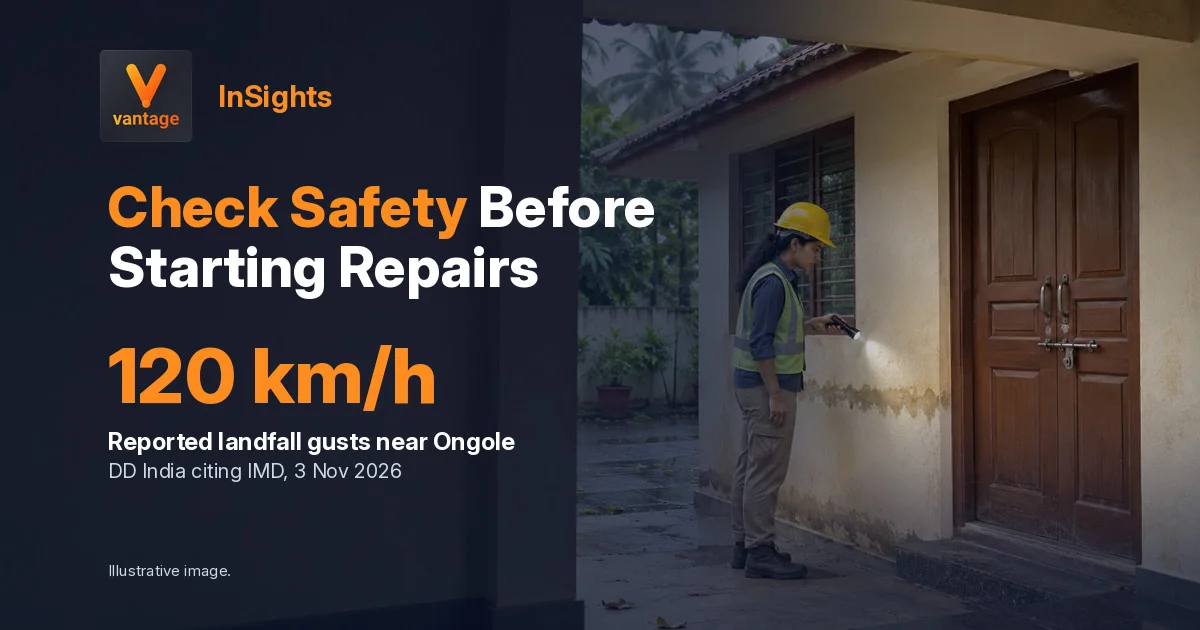
An engineer assesses visible water staining outside a coastal home, connecting the article’s focus on qualified assessment, safe return and clearly defined repairs.
For a homeowner away from an affected property, the immediate question after landfall is often practical: can someone go back, check the damage and start repairs?
The answer needs more than a weather headline.
DD India reported that Murasu crossed near Ongole early on 3 November with sustained winds of 100–110 km/h, gusting to 120 km/h -> Cyclone Murasu crosses Andhra coast near Ongole with winds up to 120 kmph, heavy rain likely.
Those figures describe the reported crossing. They cannot establish whether a particular home is safe, whether its approach road is usable or whether its electrical installation can be switched on.
When is returning home appropriate?
Start with local instructions.
Government cyclone guidance says evacuated residents should wait until advised to return and use recommended routes. It also warns against floodwater and fallen power lines -> Do’s And Dont’s.
For an NRI or an owner living elsewhere, this means avoiding pressure on a caretaker, relative or contractor to visit simply to send photographs.
An update can wait when access is unsafe. Property documentation should follow permission to return, rather than become the reason to enter a hazardous area.
Does an intact exterior establish that the home is safe?
No. A photograph is a limited record, not a structural or electrical assessment.
The US Centers for Disease Control and Prevention advises staying away from damaged buildings until an appropriate authority has examined them. Its disaster-cleanup guidance also warns against operating electrical switches or tools while standing in water -> Guidelines for Cleaning Safely After a Disaster.
If reaching the main electrical switch requires entering standing water, seek an electrician rather than attempting it yourself.
These are general safety principles. Indian local authorities determine evacuation and access instructions; qualified professionals must assess the actual building and services.
Why can rushing the repair quotation create confusion?
Once access and assessment are safe, the financial task is to define the work accurately.
A quotation that simply says “cyclone repairs” leaves important questions unanswered. Does it cover temporary protection, removal of damaged material, electrical assessment, replacement work or only surface finishing?
The practical risk is a mismatch between what the owner thinks has been resolved and what the contractor has priced.
Consider a hypothetical example: repainting a water-marked wall may improve its appearance, but the quotation still needs to identify whether the source of water entry has been assessed and addressed. The photograph alone cannot settle that question.
Separate assessment from the repair decision
A useful planning sequence is:
- Confirm safe access. Follow local instructions before arranging a visit.
- Obtain the necessary assessment. Use appropriately qualified people for structural, electrical or other specialist concerns.
- Define the repair scope. Record the affected area, proposed work, materials, exclusions and unresolved questions.
- Agree how completion will be checked. Identify who will verify each stage before treating the work as finished.
This is a framework for organising decisions. It is not a technical procedure for repairing storm damage.
Urgent protective work and permanent reinstatement may require different scopes. Ask the professional responsible to explain the distinction and document what remains to be done.
What should an owner managing remotely request?
After safe access is confirmed, ask for a dated record that identifies the location and explains the observation.
Separate what is visible from what has been professionally assessed. For example, “water staining visible in the bedroom” is an observation. “The roof is safe and the leak is permanently resolved” requires appropriate supporting assessment.
For each proposed repair, request a written scope, itemised quotation and a clear account of who will inspect completion. Record changes before authorising additional work.
These steps support accountability, but they cannot guarantee the absence of hidden damage.
Where does insurance fit?
Vantage’s earlier analysis discusses the financial questions that arise when coastal homes flood -> Cyclone Arnab: Who Pays When Coastal Homes Flood?.
For this event, check your own policy and contact the insurer for its reporting and documentation requirements. Do not assume that a previous article establishes your coverage or claim outcome.
Any photographs or records should be gathered only when safe. Documentation must not delay emergency assistance.
FAQ
Does landfall mean it is safe to return?
No. Follow local return and access instructions. Conditions at your property may differ from the reported storm position.
Can a caretaker confirm building safety through photographs?
Photographs can record visible conditions. They cannot replace an appropriate structural or electrical assessment.
Should I switch on the power to test appliances?
Do not operate switches or equipment while standing in water. Seek qualified help where wiring or equipment may have been affected.
Can I begin with painting and cosmetic repairs?
Have the relevant damage and its cause assessed first. Agree the sequence with the professional responsible for the work.
What should a repair quotation include?
Ask for the defined work, materials, exclusions, price, proposed sequence and completion checks. Clarify unresolved conditions and how additional work will be authorised.
Will cyclone damage automatically be covered by insurance?
Coverage and claim requirements depend on the actual policy and circumstances. Confirm them directly with the insurer.
Sources
Click an article title to view the source.
- Cyclone Murasu crosses Andhra coast near Ongole with winds up to 120 kmph, heavy rain likely published on 3 November 2026, at 9:45 am IST, in DD India.
- Do’s And Dont’s on the District North and Middle Andaman administration website. Undated guidance; accessed on 3 November 2026.
- Guidelines for Cleaning Safely After a Disaster published on 15 May 2024, updated on 26 August 2026, by the US Centers for Disease Control and Prevention.
- Cyclone Arnab: Who Pays When Coastal Homes Flood? published on 28 October 2026 in Vantage, by Aru06.
Evidence Caveats
The landfall account is attributed reporting, not a directly inspected post-landfall IMD bulletin. This article does not establish current conditions, damage severity or safe access at any property. The Indian guidance is general cyclone advice, not a local return order. CDC guidance supplies general building and electrical safety principles, not Indian regulatory requirements. Repair-planning suggestions are editorial analysis; no building, quotation or insurance policy was inspected.
If you have managed a property recovery remotely, what helped distinguish a useful condition report from an incomplete update? Share your experience or a practical question in the attached forum discussion, without posting private addresses or sensitive documents.
Disclaimer
This article provides general information, not a live emergency advisory, property safety clearance or personalised engineering, electrical, insurance or legal advice. Follow local authorities and obtain appropriately qualified professional assessments before entering or repairing affected property.

From TatvaOps
Home Maintenance & Appliance Care
Electrical upgrades or fixes?
Certified electricians, safety checks, and transparent pricing on TatvaOps.
Free quotes · Verified contractors · tatvaops.com
Discuss this article
Join the conversation
Continue this discussion on Forums. A board named like this InSights article is filed under InSights.
1 reply already on Forums
More from Construction
Supertech Homebuyers: What NBCCs 9,600 Crore Work-Award Target Means for Your Project
NBCC expects to award Supertech project work this quarter. For buyers awaiting possession, the key questions are which package covers their home, who will build it and what the project-specific schedule says.
Haryanas Proposed 264 FAR: What Can You Actually Build on Your Plot?
Haryana’s proposed 264% FAR could change how much some plot owners build. Here is how to understand the figures, potential charges, court proceedings and approvals before making plans.
Free Flow Tolling What Highway Users Should Check
How drivers can prepare their FASTag and review transactions as barrier-less tolling expands.
Key Insight Actions
Connected knowledge for Disaster Recovery
Move between tutorials, discussions, Studio, and hubs without losing context.
Related discussions
Topic hubs
Conclusion Intelligence
Related Discussions
Was this helpful?
Let us know what you think