

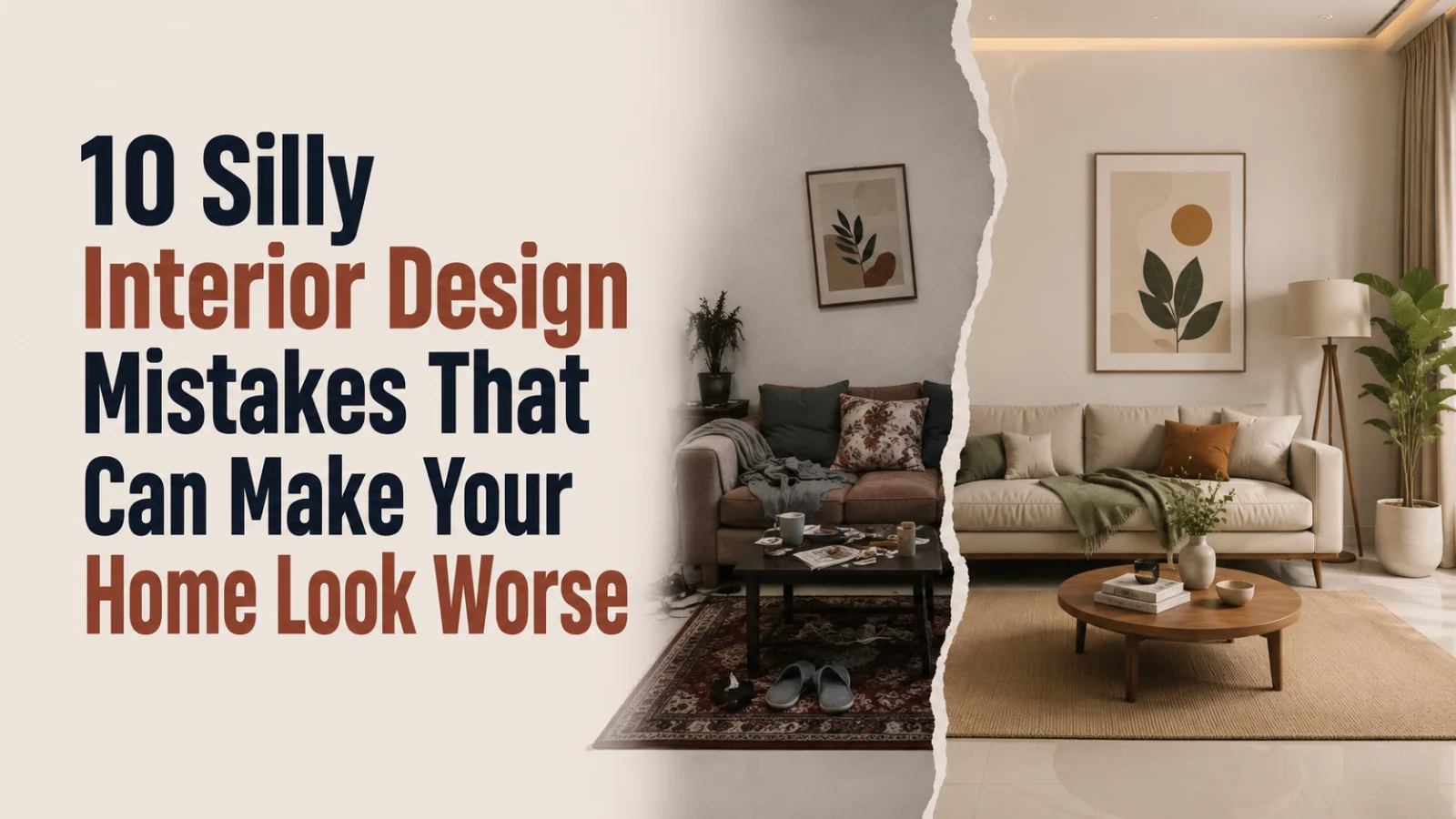
10 Silly Interior Design Mistakes That Can Make Your Home Look Worse

Devesh S. is an industry researcher and writer who specializes in translating complex industries into clear, trustworthy, and actionable knowledge. His work…
Featured Snippet
The biggest interior design mistakes include buying furniture before measuring the space, ignoring lighting, copying trends blindly, poor storage planning, choosing materials only for appearance, and making changes after execution begins. Good interiors balance appearance, comfort, function, budget, and long-term maintenance.
Published on
Inline Intelligence
A beautiful home is rarely ruined by one big mistake. More often, it is a collection of small decisions that seemed harmless at the time.
A sofa that looked perfect in the showroom turns out to block the walkway. The pendant lights look stunning online but leave half the room dark. The wardrobe is beautiful but somehow does not have enough hanging space. And that trendy wall colour? It suddenly feels like a decision you have to live with forever.
These are the kinds of mistakes that make homeowners wonder why their finished interiors do not look or function the way they imagined.
Good interior design for home bangalore projects begin with better planning, not simply better-looking products. Whether you are designing a compact apartment, renovating an older home, or starting with an empty shell, avoiding a few silly mistakes can save money, time, and daily frustration.
Here are 10 of the most common ones.
What Are the Biggest Interior Design Mistakes Homeowners Make?
1. Buying Furniture Before Measuring the Room
This sounds obvious. Yet it happens constantly.
People see a beautiful sectional sofa, dining table, or king-sized bed and imagine it inside their home. The purchase happens first. Measurements happen later.
That is where the trouble begins.
Furniture occupies more than its physical footprint. You also need space to:
- Walk around it comfortably
- Open drawers and doors
- Pull out dining chairs
- Access windows
- Clean the surrounding area
- Move other furniture when needed
A large sofa may technically fit inside your living room but still make the entire space feel cramped.
The better approach
Measure the room first and plan the circulation space around the furniture. A floor plan is far more useful than trying to judge dimensions by eye.
Before finalising furniture, ask:
- Where will people walk?
- Which doors need clearance?
- Does the furniture block natural light?
- Can drawers and shutters open fully?
- Will the room still feel comfortable when everyone is using it?
This is one reason structured space planning should happen before shopping begins.
2. Treating Lighting as an Afterthought
Many homeowners spend weeks selecting flooring, furniture, and wall finishes, then choose lights near the end of the project.
That is a mistake.
Lighting affects how you see almost everything else in the room.
The same wall colour can look warm, dull, dramatic, or completely different depending on the lighting around it.
The three layers of good lighting
A well-planned home generally needs a mix of:
Ambient lighting The overall illumination of a room.
Task lighting Focused lighting for activities such as reading, cooking, grooming, or working.
Accent lighting Lighting used to highlight artwork, textures, architectural details, or decorative elements.
Relying only on ceiling lights often creates flat, uninteresting interiors.
A common silly mistake
Installing too many decorative lights without checking whether the room actually has enough usable illumination.
A pendant light may look spectacular above a dining table. That does not mean it can light the entire dining area by itself.
Plan the lighting layout alongside the furniture and electrical plan, not after the false ceiling is already complete.
3. Choosing Trends Over Everyday Comfort
Trends are fun. Homes should not feel like permanent showrooms.
A common mistake is choosing every element based on what is currently popular online.
The problem is that trends change faster than wardrobes, kitchens, flooring, and ceilings.
Before choosing a highly distinctive finish or colour, ask yourself one simple question:
Will I still enjoy seeing this every day three years from now?
That does not mean your home needs to be boring.
Instead, use timeless elements for expensive or permanent features and experiment with trends through items that are easier to change.
A practical balance
| Design Element | Better Approach |
|---|---|
| Flooring | Choose durable, timeless finishes |
| Large furniture | Prioritise comfort and proportion |
| Wall colours | Use bold shades selectively |
| Decor | Experiment with current trends |
| Soft furnishings | Change seasonally or over time |
| Permanent fixtures | Focus on long-term usability |
A trend should support your lifestyle, not dictate it.
4. Forgetting That Storage Needs Will Grow
One of the most frustrating interior design mistakes is assuming your current belongings are all you will ever own.
They will not be.
Storage fills up surprisingly quickly.
A wardrobe designed only around today's clothing may struggle a few years later. Kitchen cabinets that looked sufficient during planning can become overcrowded once appliances, containers, and everyday supplies move in.
Plan storage based on categories
Instead of asking, "How many cabinets do we need?" ask:
- Where will luggage go?
- Where will cleaning supplies go?
- Where will extra bedding be stored?
- Where will seasonal clothing go?
- Where will documents be kept?
- Where will small appliances live?
- Is there enough space for children's belongings in the future?
The goal is not to fill every wall with cabinets.
Too much storage can make a home feel heavy and visually crowded.
The goal is smart storage.
A good interior plan identifies what needs to be stored before cabinets and wardrobes are designed.
5. Copying a Pinterest Image Exactly
Pinterest is excellent for inspiration.
It is not a construction drawing.
A room photographed for a design magazine may have:
- Different ceiling heights
- Much larger dimensions
- Better natural light
- Custom-made furniture
- Expensive finishes
- Professional styling
- A completely different climate
Copying an image without adapting it to your home can lead to disappointing results.
Take inspiration, not instructions
Instead of saying:
"I want this exact living room."
Break the image down.
Ask:
- Do I like the colour palette?
- Is it the furniture style I like?
- Is the lighting appealing?
- Do I like the textures?
- Would this layout work in my room?
This gives your designer useful information while allowing the design to respond to your actual space.
Good interiors should look intentional, not copied.
6. Ignoring the Importance of Material Samples
Choosing materials from a small photograph or catalogue can be risky.
Wood finishes, laminates, tiles, fabrics, paints, and stones can look completely different under actual lighting.
A material that appears warm on your phone may look grey in your living room.
A glossy laminate that looks elegant in a showroom might become difficult to maintain in a high-use area.
Always check materials in context
Before approving a finish, consider:
- Natural light in the room
- Artificial lighting
- Surrounding colours
- Texture
- Cleaning requirements
- Durability
- Scratch resistance
- Moisture exposure
Appearance matters, but performance matters too.
For kitchens and bathrooms especially, material decisions should account for heat, moisture, cleaning frequency, and daily use.
This is where a clear project scope and material specification become valuable. When finishes are vaguely described, substitutions and misunderstandings become much easier during execution.
TatvaOps interior design projects can benefit from a structured process where scope, materials, pricing, and milestones are defined before execution moves forward.
7. Making Every Room Match Perfectly
There is a difference between a cohesive home and a home where every room looks identical.
Some homeowners become so focused on "matching" that every bedroom, wardrobe, wall, and piece of furniture follows the same design formula.
The result can feel repetitive.
Your home should have a consistent design language, but each room can still have its own personality.
Think cohesion, not duplication
You can create visual consistency through:
- A related colour palette
- Similar wood tones
- Repeated metal finishes
- Consistent design proportions
- Similar lighting temperatures
Then allow individual rooms to respond to their purpose.
A bedroom can feel calm and soft.
A study can feel focused and practical.
A children's room can be more playful.
The rooms belong to the same home without needing to be clones of one another.
8. Trying to Save Money in the Wrong Places
Everyone has a budget. The mistake is not having one.
The mistake is cutting costs without understanding what you are sacrificing.
For example, reducing spending on a decorative accessory may have very little impact on how the home functions.
Cutting corners on hardware, waterproofing, electrical work, ventilation, or frequently used fittings can create expensive problems later.
Where should you prioritise your budget?
Spend carefully on elements that are:
- Difficult to replace
- Used every day
- Connected to safety
- Hidden behind finished surfaces
- Expensive to repair after completion
You can often save money on decorative items that are easier to upgrade later.
A sensible budget is not about choosing the cheapest option everywhere. It is about knowing where quality matters most.
Unexpected costs also become more likely when homeowners make changes verbally during execution.
TatvaOps project management is particularly relevant here because clearly documented scopes and milestone-based planning can reduce confusion around what was agreed, what has changed, and how payments should be handled.
9. Starting Work Without a Clear Final Plan
This might be the most expensive silly mistake on the list.
A homeowner approves the basic design and starts execution.
Then comes a new idea.
Then another.
The wardrobe needs another drawer.
The kitchen layout changes.
The light positions move.
A wall finish is replaced.
The television unit becomes larger.
Every change may sound small individually. Together, they can disrupt timelines, budgets, procurement, and coordination between different teams.
Finalise the important decisions first
Before major work begins, aim to confirm:
- Space layout
- Furniture positions
- Electrical requirements
- Lighting layout
- Storage requirements
- Kitchen functionality
- Materials and finishes
- Budget allocation
- Execution milestones
Not every tiny decorative choice needs to be decided immediately.
But the decisions that affect construction, wiring, plumbing, carpentry, or fabrication should not be left vague.
TatvaOps helps create more structure around this process by matching homeowners with verified professionals, allowing design quotes and concepts to be compared before commitment, and locking project scope and milestones upfront.
10. Assuming the Designer Will Automatically Know Everything
A good designer brings expertise.
But they cannot read your mind.
Homeowners sometimes assume that a designer will automatically understand:
- Their storage habits
- Their cooking style
- Their daily routines
- Their preferred level of maintenance
- Their future plans
- Their budget priorities
That assumption can lead to a home that looks good but does not work well for the people living in it.
The best design brief is honest
Tell your designer:
- How many people live in the home
- How often you cook
- Whether you work from home
- What frustrates you about your current home
- How much storage you genuinely need
- Which materials you dislike
- Whether you entertain guests often
- What your realistic budget is
The more useful information you provide, the better the design decisions can be.
TatvaOps interior designers and execution teams work within a structured requirement-sharing process that considers factors such as project scope, budget, timeline, city, and style preferences before the right professionals are matched.
Why These "Silly" Mistakes Are Actually Expensive
Most interior design mistakes do not look serious in the beginning.
That is exactly why they are dangerous.
A misplaced socket can mean breaking a finished wall later.
A badly sized wardrobe can become a permanent daily inconvenience.
Poor lighting can make an expensive room feel ordinary.
An undocumented scope change can lead to confusion about cost and responsibility.
The best time to solve a design problem is before the work begins.
Interior Design for Home Bangalore: What Should Homeowners Plan First?
For anyone researching interior design for home bangalore, the best starting point is not furniture shopping or selecting wall colours.
Start with function.
Ask yourself:
- How will each room be used?
- What are the non-negotiables?
- What can be flexible?
- What needs to last for years?
- What can be upgraded later?
- Where are the biggest risks to the budget?
Once these questions are clear, design choices become easier.
A Simple Planning Framework
Step 1: Understand the Space
Measure rooms, ceiling heights, windows, doors, and structural limitations.
Step 2: List Daily Activities
Think about how the household actually lives instead of how a catalogue suggests a home should look.
Step 3: Set a Realistic Budget
Separate essential work from upgrades and decorative purchases.
Step 4: Build the Layout
Decide furniture placement and circulation before buying major pieces.
Step 5: Plan Services
Coordinate electrical points, lighting, plumbing, appliances, and ventilation early.
Step 6: Choose Materials
Balance appearance, durability, maintenance, and budget.
Step 7: Finalise the Scope
Document important decisions before execution begins.
Step 8: Track Execution
Review progress regularly rather than waiting until the end to identify problems.
TatvaOps AI project tracking can support this stage by providing daily AI-monitored progress updates and photos, creating a clearer record of what is happening during execution.
Quick Checklist Before You Start Your Home Interiors
Use this checklist before approving your interior design plan:
Space Planning
- Have all rooms been measured accurately?
- Is there enough space to move comfortably?
- Have door and drawer clearances been checked?
Furniture
- Does every major piece suit the room dimensions?
- Have comfort and functionality been considered?
- Is there enough flexibility for future changes?
Storage
- Have hidden storage needs been considered?
- Is there dedicated space for luggage and seasonal items?
- Are wardrobes designed around actual usage?
Lighting
- Is there ambient lighting?
- Is task lighting available where needed?
- Have decorative lights been balanced with functional lighting?
Materials
- Have samples been checked in the actual space?
- Are the materials suitable for daily use?
- Have maintenance requirements been considered?
Budget and Execution
- Is the project scope clearly documented?
- Are major decisions finalised before work begins?
- Is there a process for reviewing completed work before payments are released?
Expert Tips for Avoiding Interior Design Regrets
Prioritise Function Before Decoration
A beautiful room that does not work for daily life will quickly become frustrating.
Start with layout, movement, storage, lighting, and comfort. Decoration comes after the foundation is right.
Design for Your Future, Not Just Today
You do not need to predict everything.
But consider likely changes such as working from home, growing families, ageing parents, or additional storage needs.
Keep Some Budget Aside
Interior projects often reveal additional needs once planning begins.
Having a reasonable contingency can prevent rushed decisions later.
Approve Samples Carefully
Do not rush through material approvals.
Look at colours and finishes under the lighting conditions of your actual home.
Track Progress Throughout Execution
Problems are easier to address when they are identified early.
A structured project management system is especially useful when multiple professionals, materials, timelines, and milestones need coordination.
TatvaOps provides daily AI-monitored progress updates and maintains an evidence trail of project activity, helping homeowners stay more closely informed throughout execution.
Common Mistakes to Avoid During Interior Design Execution
Even after the design is finalised, execution can introduce new problems.
Watch out for:
- Approving work without reviewing it carefully
- Making repeated mid-project changes
- Accepting undocumented material substitutions
- Releasing payments without verifying milestones
- Assuming verbal instructions will be remembered correctly
- Failing to compare designer concepts and quotes before committing
- Ignoring installation details until the final stage
A project does not become organised simply because the design looks organised on paper.
The execution process needs structure too.
TatvaOps addresses this by using milestone-based, escrow-protected payments where payments are released only after the homeowner reviews and approves the completed milestone. That creates a clearer connection between completed work and payment.
Frequently Asked Questions
1. What is the most common interior design mistake?
One of the most common mistakes is buying furniture before properly measuring the room and planning circulation space. A piece may fit physically but still make the room uncomfortable to use.
2. Should I choose furniture or lighting first?
Neither should be selected completely independently. Furniture layout and lighting plans should be developed together because furniture placement affects where task and accent lighting are needed.
3. How can I avoid overspending on home interiors?
Start with a clear budget, prioritise essential and difficult-to-replace elements, document the scope, and avoid frequent changes after execution begins.
4. Is it okay to copy interior design ideas from Pinterest?
Yes, but use them as inspiration rather than exact blueprints. Adapt colours, layouts, materials, and furniture to your room dimensions, lifestyle, lighting, and budget.
5. What should I finalise before interior work begins?
You should finalise the overall layout, major furniture positions, electrical points, lighting requirements, storage needs, key materials, budget priorities, and execution scope.
6. How much storage should a home have?
There is no universal answer. Storage should be planned around the household's belongings, lifestyle, future needs, and available space rather than adding cabinets simply to fill empty walls.
7. How do I choose the right interior design professional?
Compare design concepts, pricing, scope, relevant experience, and execution processes. It is also important to understand how project progress, payments, material specifications, and disputes will be managed.
Conclusion
The funniest part about many interior design mistakes is that they do not seem like mistakes when they happen.
Buying the sofa before measuring the room feels exciting.
Choosing lights at the last minute feels harmless.
Copying a beautiful image from social media feels easy.
But a home is not a photograph. It has to work every morning, every evening, and through years of changing routines.
The smartest approach to interior design for home bangalore is to slow down during the planning stage. Measure carefully. Think about everyday habits. Prioritise function. Review materials in person. Document important decisions. And avoid making expensive changes halfway through execution.
A well-designed home is not the one with the most expensive finishes or the most dramatic social-media-worthy features.
It is the one that feels easy to live in.
Soft Recommendation
If you are planning home interiors in Bangalore and want to reduce the chances of budget confusion, unreliable execution, or poor project visibility, a structured platform such as TatvaOps can be a sensible option to explore. With verified professionals, upfront project milestones, homeowner-approved payments, and 24/7 AI-monitored execution tracking, TatvaOps can bring more transparency to what is often a complicated interior design journey.

From TatvaOps
Residential Interiors
Planning your interiors?
Get verified designers, fixed scope, and milestone-secured payments on TatvaOps.
Free quotes · Verified contractors · tatvaops.com
Discuss this article
Join the conversation
Continue this discussion on Forums. A board named like this InSights article is filed under InSights.
More from Interior Design
How a Modular Kitchen Is Actually Manufactured?
Learn how a modular kitchen is manufactured, from design and cutting to edge banding, assembly, quality checks, delivery and installation.
MDF vs HDHMR vs Plywood: Which One Should You Choose for Your Home Interiors?
Compare MDF, HDHMR and plywood for interior design for home bangalore. Understand durability, moisture resistance, finishes, cost and where each works best.
Interior Design Is Not Interior Execution: What Happens Between the Design and the Final Room
Understand what happens after an interior design is approved, from drawings and materials to site execution, quality checks, timelines, and final handover.
Inline Intelligence
Key Insight Actions
Connected knowledge for Interior Design Guides
Move between tutorials, discussions, Studio, and hubs without losing context.
Related discussions
Topic hubs
Conclusion Intelligence
Related Discussions
Was this helpful?
Let us know what you think