

Your EMI Hasnt Changed. Has Your Home Loan Become More Expensive?
Karthik posts articles on Energy and Construction.
Summary
An unchanged EMI can hide a longer home loan. Explore how a quarter point rate increase affects repayments, the trade off between cash flow and interest costs, and what to ask your lender. A home loan instalment can remain unchanged even as the repayment period grows. That creates an easily missed distinction between keeping this month’s budget comfortable and limiting the total cost of borrowing.
Published on
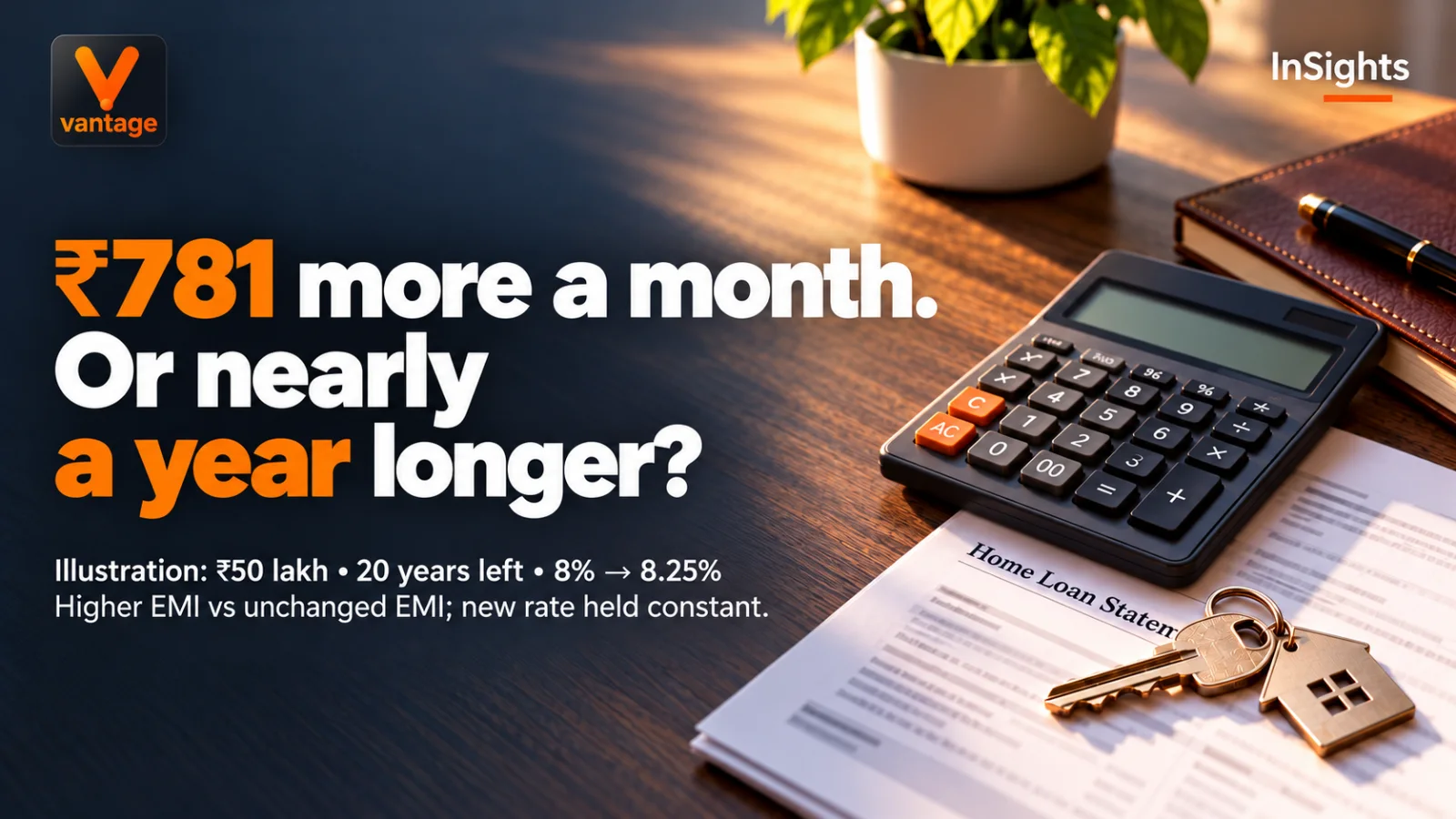
Warm editorial imagery with a prominent orange-and-white hook and clearly stated calculation assumptions.
Inline Intelligence
A home-loan instalment can remain unchanged even as the repayment period grows. That creates an easily missed distinction between keeping this month’s budget comfortable and limiting the total cost of borrowing.
In a Vantage illustration, a ₹50 lakh loan with 20 years remaining takes nearly another year to repay if its rate rises from 8% to 8.25% and the original EMI is retained.
The question for borrowers is therefore more useful than simply asking whether their EMI will rise: which repayment choice fits both today’s cash flow and tomorrow’s financial commitments?
Why does an unchanged EMI conceal a change?
Each loan payment covers interest and reduces outstanding principal. When the interest rate increases, retaining the same payment leaves less money available to reduce the balance.
The household may experience no immediate increase in its monthly debit, but the loan can remain outstanding for longer.
That does not automatically make tenure extension the wrong choice. It can preserve cash flow when a household needs flexibility. The trade-off becomes problematic when the borrower cannot see or evaluate it.
The first step is to compare the old repayment schedule with the revised one, including the maturity date.
How much difference does a quarter-point increase make?
The table below models a change from 8% to 8.25%, with 20 years remaining and the repayment period held constant.
| Outstanding principal | Monthly EMI at 8% | Monthly EMI at 8.25% | Monthly increase |
|---|---|---|---|
| ₹25 lakh | ₹20,911 | ₹21,302 | ₹391 |
| ₹50 lakh | ₹41,822 | ₹42,603 | ₹781 |
| ₹75 lakh | ₹62,733 | ₹63,905 | ₹1,172 |
| ₹1 crore | ₹83,644 | ₹85,207 | ₹1,563 |
Vantage calculations using the standard monthly reducing-balance EMI formula. Figures are independently rounded to the nearest rupee. These interest rates are illustrative assumptions, not current lender offers.
For the ₹50 lakh example, retaining the original unrounded EMI instead stretches the modelled term from 240 months to approximately 251.86 months. In practice, that is around 252 payments, with an adjusted final instalment.
The result assumes no further rate changes or prepayments. A real floating-rate loan will follow its actual reset history and repayment activity.
Which matters more: monthly flexibility or an earlier finish?
There is no universal answer because the value of spare cash differs between households.
A borrower with a reliable monthly surplus may prefer a higher instalment to preserve the original repayment timeline. Someone facing uncertain income or substantial near-term commitments may place greater value on liquidity.
A longer term also needs to be considered against the borrower’s expected working years. Extending a loan closer to retirement can create a different problem from increasing today’s EMI.
Compare the choices on the same basis: outstanding principal, effective interest rate, remaining term and total projected payments. Otherwise, a smaller EMI can appear cheaper simply because repayment lasts longer.
What options should your lender explain?
RBI’s updated framework addresses repayment choices and communication when floating rates reset. Its FAQs describe options involving a higher EMI, a longer repayment period or both, as well as prepayment.
A fixed-rate switch is available where the lender offers it. It should not be assumed to be a guaranteed option.
See Link -> Frequently Asked Questions on Reset of Floating Interest Rate on EMI-based Personal Loans
Ask for a comparison showing:
- The revised EMI if the original maturity date is retained.
- The revised maturity date if the EMI stays unchanged.
- The effect of a proposed part prepayment.
- The terms and charges for any switching or refinancing option.
The purpose is to understand the consequences before choosing. An advertised rate or a short notification rarely supplies the complete comparison.
Should you use savings to reduce the loan?
Prepayment reduces the balance on which future interest is calculated. But the cash used is no longer available for an emergency, a delayed possession or another near-term obligation.
That trade-off deserves attention before comparing the loan rate with an expected investment return.
Borrowing costs are contractual, although floating rates can change. Investment returns may be uncertain, and the cash may not be accessible when needed. Taxes, fees and any applicable prepayment costs can further change the comparison.
For someone considering whether to invest or prepay, the useful question is: what remains after allowing for risk, costs, liquidity needs and the possibility that the expected return does not materialise?
This article does not establish that investing or prepaying is preferable for every reader.
How should a prospective buyer adjust the budget?
Separate the purchase into three financial commitments.
Upfront cash: Down payment, transaction costs and money required before occupation.
Monthly ownership: EMI, maintenance, utilities, insurance where applicable and travel costs.
Overlapping payments: Rent before possession, construction-linked demands, and furnishing or interior-work commitments.
This makes it easier to identify the actual pressure point. A household may be able to absorb a modest EMI increase but struggle with several payments falling due together.
A useful stress test is to calculate affordability at a loan rate another 0.5 or 1 percentage point higher. This is a planning scenario, not a forecast. Separately test a delayed move or a temporary income interruption.
Does a rate hike make waiting for a cheaper home sensible?
A financing-cost increase does not establish that a particular property will become cheaper.
Waiting has its own variables: rent, available supply, changes in personal circumstances and the possibility that prices or borrowing costs move differently from expectations.
Equally, a seller’s proposed discount should be assessed against the full acquisition cost and payment conditions. A financing arrangement that delays a payment is not necessarily equivalent to a price reduction.
The reasoned response is to revisit affordability and compare actual offers. A policy headline cannot decide the suitability of a property on its own.
The answer is in the revised schedule
An unchanged EMI can conceal additional repayment months. Whether accepting that extension is sensible depends on what the household gains from preserving monthly cash and what it gives up over time.
The strongest starting point is a written comparison of available repayment options, followed by a budget that accounts for obligations outside the loan.
If you are making this decision with a spouse, co-buyer or adviser, discuss the assumptions together. Agreement on the monthly payment is only part of agreement on the purchase.
FAQ
1. What does a 25-basis-point increase mean?
It means 0.25 percentage points. An illustrative loan rate of 8% would become 8.25%.
2. Will every home-loan EMI rise immediately?
No. The benchmark, reset date, loan terms and repayment treatment determine the effect.
3. Can my EMI stay unchanged while the loan costs more?
Yes. In the illustrated scenario, extending repayment increases interest paid even though the monthly instalment stays the same.
4. Are 8% and 8.25% current bank quotations?
No. They are assumptions used to demonstrate the calculation.
5. Can every borrower switch to a fixed rate?
No. The updated RBI framework makes that choice conditional on the lender offering it. Review the quoted rate and charges.
6. Is using savings for prepayment always better?
No. Compare the interest saving with the liquidity you retain and your upcoming obligations. Avoid assuming that an uncertain investment return is directly comparable to borrowing costs.
7. Does the rate decision predict falling property prices?
No. Property-specific and local-market evidence is needed to assess that possibility.
8. What document should I request first?
An updated repayment schedule showing the applicable rate, EMI, remaining instalments and maturity date, together with the alternatives available.
Sources
Click on article title to view article in a new tab
- “Frequently Asked Questions - Circular dated August 18, 2023 on Reset of Floating Interest Rate on Equated Monthly Instalments (EMI) based Personal Loans” updated on 1 October 2025 by the Reserve Bank of India.
- “Reset of Floating Interest Rate on Equated Monthly Instalments (EMI) based Personal Loans” published on 18 August 2023 by the Reserve Bank of India, updated 1 October 2025.
- “Home loan EMI for these borrowers will go up as RBI increases repo rate by 25 bps: Know the impact on Rs 25 lakh-Rs 2 cr home loans” published on 7 October 2026 in The Economic Times.
Evidence Caveats
Repayment figures are independent illustrations, not lender quotations. They assume monthly reducing-balance calculations, constant rates within each scenario, no fees and no prepayments. Actual reset dates, rounding conventions and contractual limits can alter the outcome.
The RBI borrower circular and FAQs reviewed include amendments effective from October 2025. A fixed-rate switching option should not be assumed to exist at every lender.
No lender-specific October repricing schedule or post-decision housing-sales dataset has been verified for this analysis. Discussion of purchase timing, negotiation and household choices represents analysis rather than an observed market outcome.
Join the attached forum discussion: What would make you choose a higher EMI over a longer tenure, or the reverse? Explain the practical consideration that matters most to you. Different experiences and counterarguments are welcome; please leave out sensitive financial details.
Disclaimer
This article provides general information and illustrative analysis, not personalised financial, investment or legal advice. Confirm your contract, applicable charges and revised repayment schedule with your lender, and obtain qualified advice where appropriate.

From TatvaOps
Finance
Financing your project?
Explore credit and milestone-secured payment options with Tatva Finance.
Free quotes · Verified contractors · tatvaops.com
Discuss this article
Join the conversation
Continue this discussion on Forums. A board named like this InSights article is filed under InSights.
More from Real Estate
LTCG Tax Debate: Should You Delay Selling Investments?
Could waiting for LTCG tax relief cost more than it saves? With proposals under discussion, we examine how your current tax liability, market exposure and cash deadline should shape a planned investment sale.
Blackstones India Bet: What Should You Check?
Blackstone’s $100-billion India ambition is a useful signal. For your own money, the harder questions are access, valuation, cash flow and risk. Here is what to check before turning institutional optimism into a personal investment decision.
Senior Living: Buy the Home, Examine the Services: what most readers overlook
Rustomjee’s senior-living evaluation raises a household question: can you afford and rely on the services after buying the home? We examine recurring charges, operator responsibilities, changing support needs and exit flexibility.
Inline Intelligence
Key Insight Actions
Connected knowledge for Home Loan Management
Move between tutorials, discussions, Studio, and hubs without losing context.
Related discussions
Topic hubs
Conclusion Intelligence
Related Discussions
Was this helpful?
Let us know what you think