

High-Street Leasing Jumped 33 While Mall Leasing Fell 38: Is Indian Retail Real Estate Changing?
Karthik posts articles on Energy and Construction.
Summary
India's retail leasing fell 4.4% in Q3 2026, but high street leasing jumped 33.1% while mall leasing fell 37.8%. With Grade A mall vacancy at just 4.8%, the divergence may say more about where retailers can find quality space than about weakening physical retail demand. India's retail property market looks weaker if you read only one number. Total leasing fell 4.4% year on year in Q3 2026. But underneath that decline, two retail formats moved sharply in opposite directions. High street leasing rose 33.1%. Mall leasing fell 37.8%. High streets captured almost 68% of quarterly leasing.
Published on
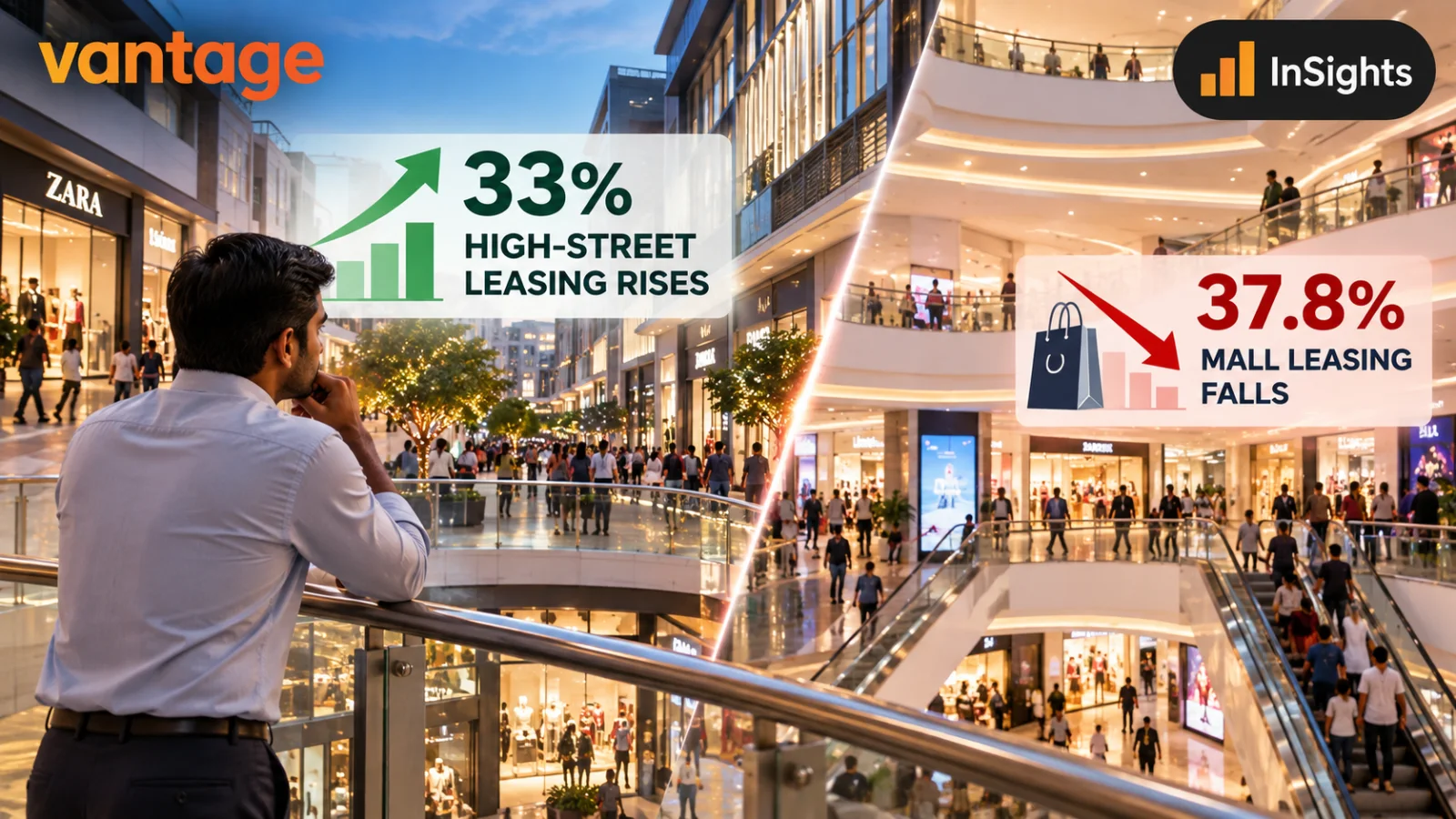
A split-screen editorial visual comparing India's high-street and shopping mall retail markets. A business professional overlooks busy retail environments, with the high-street side highlighting a 33% rise in leasing and the mall side showing a 37.8% decline in mall leasing. The image illustrates the widening divergence between the two retail formats.
Inline Intelligence
India's retail property market looks weaker if you read only one number.
Total leasing fell 4.4% year-on-year in Q3 2026.
But underneath that decline, two retail formats moved sharply in opposite directions.
High-street leasing rose 33.1%.
Mall leasing fell 37.8%.
High streets captured almost 68% of quarterly leasing.
Yet Grade A mall vacancy did not rise.
It fell to 4.8%.
That combination creates a more interesting question than whether Indian retail demand is slowing.
Are retailers choosing high streets because they prefer them, or because India's best malls simply do not have enough available space?
The evidence suggests both format preference and supply constraints matter, but the current data does not allow their effects to be separated precisely.
A 4.4% Leasing Decline Does Not Mean Retail Demand Fell 4.4%
Leasing is a real-estate activity measure.
It records space transacted during a period.
It does not directly measure:
- store sales;
- consumer spending;
- retailer profitability;
- footfall;
- ecommerce activity; or
- total occupied retail stock.
That distinction is especially important in Q3.
India recorded 2.22 million sq ft of leasing, down 4.4% from the previous year.
But year-to-date leasing reached 6.57 million sq ft, up 0.4%.
The nine-month market was therefore broadly stable.
Calling Q3 evidence of a broad retail slowdown would go beyond what the data supports.
The Mall Numbers Contain an Apparent Contradiction
Mall leasing declined 37.8% year-on-year.
Normally, such a large fall might raise concern about tenant demand.
But Grade A mall vacancy fell to 4.8%.
No new Grade A mall supply was added for the third consecutive quarter.
Those facts matter.
If a retailer wants a 15,000 sq ft store in a particular premium mall but no suitable unit is available, no lease can occur.
Demand can exist without producing a transaction.
This is one reason commercial real-estate leasing volumes should always be read alongside vacancy and supply.
High Streets Became the Release Valve
Main streets recorded 1.51 million sq ft of leasing, up 33.1% year-on-year.
They accounted for 67.9% of total activity.
One interpretation is that high streets are becoming a release valve for retailer expansion.
Brands still want physical locations.
Premium malls have limited availability.
Prime streets provide another way to reach consumers.
This does not mean high streets and malls are interchangeable.
Their economics and customer experiences can be very different.
But scarcity in one format can strengthen demand for the other.
High Streets Offer Something Malls Cannot Always Replicate
A prime high street can offer a retailer direct visibility to a city.
A flagship storefront on a major shopping road can function as both a store and a brand statement.
High streets can also provide flexibility in:
- store size;
- frontage;
- operating configuration;
- building type; and
- neighbourhood positioning.
For food and beverage operators, street locations can also provide direct access independent of mall operating structures.
But high streets have disadvantages too.
Parking can be difficult.
Building quality varies.
Pedestrian infrastructure can be inconsistent.
Individual landlords can complicate aggregation of large spaces.
The correct comparison is therefore not "high streets good, malls bad".
It is about which format best serves each retailer's economics and customer strategy.
Rising High-Street Rents Are the Other Side of the Boom
Prime high-street rents increased an average 6.8% year-on-year.
This matters for retailers and property investors in opposite ways.
For landlords, stronger rents can improve income.
For occupiers, the same increase raises store costs.
If high-street demand continues growing while prime space remains limited, retailers may face increasing occupancy costs.
That creates a natural constraint.
A location can be strategically attractive but economically unattractive if rent rises faster than store productivity.
The sustainability of the high-street boom therefore depends partly on whether retailer revenues can support higher occupancy costs.
Mall Scarcity Can Create Pricing Power Too
The same principle applies to Grade A malls.
Vacancy of 4.8% means suitable space is relatively scarce across the surveyed quality stock.
Established malls with strong footfall and retailer demand can potentially gain negotiating leverage.
But this creates a problem for the wider retail ecosystem.
If existing malls are almost full, retailer expansion becomes difficult unless:
- tenants exit;
- malls are expanded;
- new malls open; or
- brands move to alternative formats.
The current high-street surge may therefore be partly a consequence of mall success rather than mall failure.
The 12.7 Million Sq Ft Pipeline Is the Key Test
Approximately 12.7 million sq ft of Grade A mall supply is expected through 2028.
That future supply creates a useful natural test for the high-street thesis.
If new malls open and mall leasing rebounds strongly, it would support the argument that recent weakness was substantially supply-constrained.
If high streets continue taking a larger share even after quality mall availability improves, that would provide stronger evidence of a more structural format shift.
We do not yet have that answer.
The next two years could provide it.
Domestic Brands Are Driving the Market
Domestic retailers accounted for 86.3% of Q3 leasing.
That is strategically important.
India's retail property cycle is being driven predominantly by home-grown brands rather than relying on international retailers for expansion.
For retail landlords, this broadens the potential tenant pool.
It can also change the types of locations required.
Indian brands expanding nationally may use different formats across different cities, combining mall stores, high-street locations and smaller neighbourhood formats.
Fashion and F&B Explain Why Location Still Matters
Fashion accounted for 24.9% of leasing.
Food and beverage represented 19.2%.
Accessories and lifestyle accounted for 13.1%.
Together, these categories produced 57.2% of Q3 activity.
These categories are particularly sensitive to physical location.
A restaurant needs the right catchment and visibility.
A fashion brand benefits from complementary retailers and customer traffic.
Lifestyle brands often depend on discovery and physical interaction.
This helps explain why retail real estate remains highly relevant despite digital commerce.
The store is not merely a distribution point.
For many brands, it is part of customer acquisition and brand experience.
Delhi-NCR Shows the Scale Opportunity
Delhi-NCR was India's largest retail leasing market in Q3, with approximately 0.55 million sq ft.
It also has the largest expected share of upcoming mall supply, according to Cushman & Wakefield.
That makes NCR an important market to watch.
If new Grade A malls open into strong retailer demand, leasing volumes could increase.
But new supply also introduces competition.
Older malls may need to improve their tenant mix, experience and physical environment to retain consumers and brands.
More supply can therefore help retailers while increasing competitive pressure among property owners.
Older Malls Face a Different Risk From New Malls
A national shortage of Grade A mall space does not guarantee every existing mall will perform well.
Retailers increasingly care about:
- catchment quality;
- footfall;
- tenant mix;
- food and entertainment;
- accessibility;
- parking;
- design;
- maintenance; and
- brand adjacencies.
An ageing mall in a weak location can struggle even when national Grade A vacancy is low.
Just as the office market is experiencing a flight towards high-quality buildings, retail can experience a flight towards the strongest malls and high streets.
Quality scarcity and asset obsolescence can exist at the same time.
What Does This Mean for Retail Property Investors?
The 33% high-street growth figure is attractive.
But investors should not buy a street-facing retail unit simply because national high-street leasing increased.
Retail property is exceptionally location-sensitive.
Two shops 500 metres apart can have very different economics.
Investors need to assess:
actual pedestrian traffic
tenant quality
lease structure
frontage
parking and accessibility
local competition
catchment spending power
and
future supply.
The national number is a signal to investigate, not a substitute for asset-level analysis.
What Does This Mean for Mall Owners?
For high-performing mall owners, low vacancy can be an advantage.
But future supply creates competition.
Approximately 12.7 million sq ft of Grade A mall space is expected through 2028.
Existing owners will therefore need to defend their relevance through:
- tenant curation;
- experiences;
- food and beverage;
- entertainment;
- maintenance;
- redevelopment; and
- consumer engagement.
The strongest malls increasingly operate less like collections of shops and more like managed consumer destinations.
Could High Streets Keep Taking Market Share?
Yes, but the evidence does not establish that they will.
High streets currently benefit from strong retailer demand and constrained Grade A mall availability.
Their share could remain elevated if brands increasingly prefer:
- flagship stores;
- direct frontage;
- flexible formats;
- neighbourhood penetration; or
- locations unavailable inside malls.
But high-street rents are already rising.
If rents increase too quickly or new mall supply becomes attractive, the format balance could shift again.
Retailers will ultimately allocate stores based on economics rather than format ideology.
The Real Trade-Off Is Availability Versus Control
Malls offer retailers a controlled environment.
The landlord manages the broader property, tenant mix, common areas, parking and often consumer programming.
High streets offer direct access and visibility, but the surrounding environment is less controlled.
For a retailer, the decision is therefore partly about what it values more.
Mall: managed environment, concentrated footfall and complementary tenants.
High street: visibility, direct frontage and potentially greater format flexibility.
Neither format universally wins.
The current numbers show that high streets had far more available momentum in Q3.
The Bigger Story Is Not That Malls Are Losing
The most tempting interpretation of the Q3 data is:
high streets are winning and malls are losing.
That is too simplistic.
Mall leasing fell 37.8%.
But Grade A mall vacancy also fell.
If malls were fundamentally losing relevance, those two numbers would be difficult to reconcile.
A better interpretation is that India's retail property market has a quality-space constraint.
Retailers are expanding.
The best malls have limited availability.
High streets are absorbing a larger share of that expansion.
And new mall supply is coming.
The real test arrives when that supply opens.
If retailers fill it while continuing to expand on high streets, India may be entering a period where both formats grow simultaneously.
If high streets retain their current dominance despite abundant new mall space, then something more structural has changed.
That is the question worth watching through 2028.
Frequently Asked Questions
Why is high-street leasing rising in India?
High-street leasing increased 33.1% year-on-year in Q3 2026. Cushman & Wakefield cites demand for prominent, high-visibility locations, while limited quality mall availability provides additional context for the shift.
Are shopping malls losing popularity in India?
The Q3 data does not establish that. Mall leasing fell sharply, but Grade A mall vacancy also tightened to 4.8%, indicating limited available space in quality malls.
Is high-street retail a better property investment than mall retail?
Not automatically. Returns depend on the individual location, rent, tenant, lease, footfall, frontage, catchment and acquisition price.
Why did mall leasing fall 38% if mall vacancy is so low?
Limited available space can restrict new leasing transactions. A retailer cannot lease space that is not available in the required mall, location or configuration.
Will new malls reduce demand for high streets?
That is not yet known. Around 12.7 million sq ft of Grade A mall supply is expected through 2028. How retailers respond to that new supply will help show whether the high-street surge is cyclical or structural.
Which retail sectors are expanding most?
Fashion was the largest Q3 leasing category at 24.9%, followed by food and beverage at 19.2% and accessories and lifestyle at 13.1%.
What should retail property investors watch through 2028?
Grade A mall completions, mall vacancy, high-street leasing share, rental growth, retailer expansion and asset-level footfall will be important indicators.
Sources
Click on article title to view article.
“India retail leasing falls 4.4% to 2.22 million sq ft in Q3 2026: Report” published on 3 October 2026 in ETRealty
“Retail space leasing in malls falls 38% in Q3 across top 8 cities: Cushman” published on 2 October 2026 in Business Standard
“India’s Retail Leasing Reaches 2.22 MSF in Q3 2026; Grade A Mall Vacancy Tightens to 4.8%: Cushman & Wakefield” published on 1 October 2026 by Cushman & Wakefield
Evidence Caveats
The analysis that high streets may be absorbing demand constrained by limited Grade A mall availability is an editorial interpretation supported by the leasing, vacancy and supply data. The reviewed evidence does not quantify how many high-street transactions would otherwise have occurred in malls.
The 4.4% leasing decline is not evidence of a 4.4% decline in consumer spending or physical retail sales.
The 33.1% increase measures high-street leasing volume, not rental growth. Prime high-street rents increased by an average 6.8% year-on-year.
The 12.7 million sq ft mall pipeline is expected supply through 2028. It should not be treated as completed or guaranteed supply.
No reviewed evidence establishes future high-street leasing growth, future mall rents, asset-level investment returns or the permanent market share of either format.

From TatvaOps
Property Management & Rental Operations
Financing your project?
Explore credit and milestone-secured payment options with Tatva Finance.
Free quotes · Verified contractors · tatvaops.com
Discuss this article
Join the conversation
Continue this discussion on Forums. A board named like this InSights article is filed under InSights.
1 reply already on Forums
More from Real Estate
LTCG Tax Debate: Should You Delay Selling Investments?
Could waiting for LTCG tax relief cost more than it saves? With proposals under discussion, we examine how your current tax liability, market exposure and cash deadline should shape a planned investment sale.
Blackstones India Bet: What Should You Check?
Blackstone’s $100-billion India ambition is a useful signal. For your own money, the harder questions are access, valuation, cash flow and risk. Here is what to check before turning institutional optimism into a personal investment decision.
Senior Living: Buy the Home, Examine the Services: what most readers overlook
Rustomjee’s senior-living evaluation raises a household question: can you afford and rely on the services after buying the home? We examine recurring charges, operator responsibilities, changing support needs and exit flexibility.
Inline Intelligence
Key Insight Actions
Connected knowledge for Retail Real Estate
Move between tutorials, discussions, Studio, and hubs without losing context.
Conclusion Intelligence
Was this helpful?
Let us know what you think