

Indian Stocks Rise as Global Tech Falls: What Should Investors Check?
Summary
Indian benchmarks rose as global technology stocks fell. Before reacting to one session, check your holdings, benchmark, currency exposure, costs and investment horizon. Your Indian equity fund may be up on a day when a US technology heavy investment is falling. That can make it tempting to conclude that one market has become safer than the other. A single trading session cannot establish that. On the morning of 6 November 2026, Indian benchmarks rose while several Asian markets fell following a sharp US technology selloff.
Published on
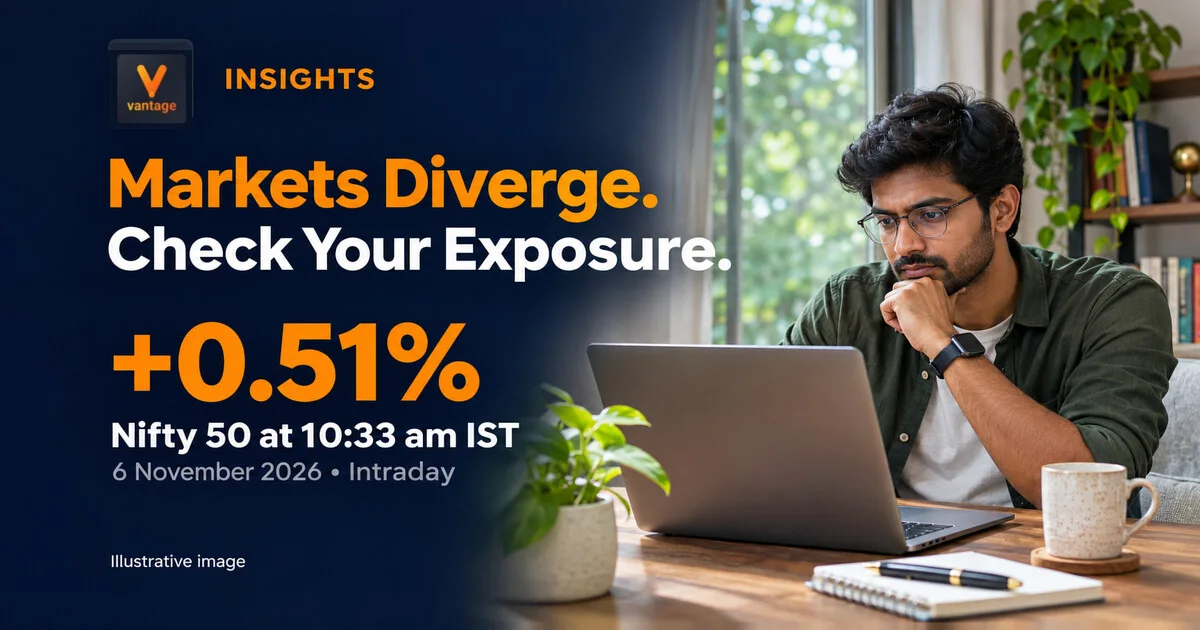
An illustrative Vantage InSights banner encourages readers to check their portfolio exposure as Indian and global markets move differently. The Nifty figure is labelled with its observation time and date.
Inline Intelligence
Your Indian equity fund may be up on a day when a US technology-heavy investment is falling. That can make it tempting to conclude that one market has become safer than the other. A single trading session cannot establish that.
On the morning of 6 November 2026, Indian benchmarks rose while several Asian markets fell following a sharp US technology selloff. The more useful question for an investor is not simply which index won that morning. It is what the investments you own actually hold, how they fit your goals and what risks remain.
At 10:33 am IST, the Nifty 50 was up 0.51% and the Sensex was up 0.76%, according to Reuters. The previous US session had seen the Nasdaq fall 5.5%. Those figures cover different markets and observation periods; the Indian readings are intraday, not closing returns.
See the reported market snapshot -> India bucks Asia tech rout as oil slide reverses market fortunes.
Why can markets move in different directions?
Stock indices do not all own the same businesses. A technology-heavy market can react strongly when investors reassess AI spending or the valuations of companies linked to that theme. An Indian benchmark has a different mix of sectors and companies and can respond to different domestic factors.
Reuters reported that the recent fall in oil prices, signs of foreign buying and India's relatively limited direct exposure to AI-linked hardware were among the factors supporting Indian shares.
Those factors are plausible explanations for the observed divergence, not guarantees about the next session. Indian companies can still be affected by global demand, currency changes, foreign-investor decisions and shifts in risk appetite.
Does a rising Sensex mean your portfolio is up?
Not necessarily. The Sensex and Nifty 50 are benchmarks made up of selected large companies. Your portfolio may contain mid-cap or small-cap funds, individual shares, international investments or other assets that move differently.
Reuters reported that Indian mid-cap and small-cap indices were weaker during the same 6 November session in which the main benchmarks rose. A headline about the Sensex therefore cannot tell you the return on your individual portfolio.
Start with the holdings or fund factsheets for your own investments. Then compare each fund with its appropriate benchmark over the same period, accounting for fees and the type of return being compared.
Should you move money after one day of divergence?
A single day's performance is a weak basis for deciding that one market will consistently outperform another.
Consider a hypothetical investor who holds an Indian equity fund and a US equity fund for a goal several years away. If the US fund falls while the Indian fund rises, the portfolio's outcome depends on the amounts held in each, their underlying holdings, currency movements and costs. It cannot be inferred from either index alone.
For an Indian investor, a foreign investment's rupee return can differ from the underlying market return in its local currency. Exchange-rate movements can add to or reduce the return when converted into rupees; fees and taxes can also affect the outcome.
This is an illustration of how returns work, not a recommendation to buy, sell or retain a particular fund.
What does foreign buying tell you?
Reuters reported net foreign purchases of ₹14,796 crore in Indian shares on 5 November, using provisional exchange data. A large inflow can help explain demand during that session, but it is not a promise of future buying or future returns.
Foreign flows can reverse. They also do not reveal whether a particular stock or fund is appropriate for a household's goals.
Vantage's earlier analysis of the 5 November rally looks at checking a fund against its benchmark and considering the investment horizon -> Sensex and Nifty Rally: What Should Investors Check?.
What should you check next?
- Look at your actual exposure. Review the countries, sectors and largest holdings in your funds. Two funds with different names may still own many of the same companies.
- Match the comparison. Compare performance over the same dates and in the same currency. Check whether the return includes dividends and whether fees are reflected.
- Revisit the goal and time horizon. Money needed for a near-term payment may have a different capacity to withstand a market fall from money intended for a much later goal.
- Check concentration and costs. Consider how much depends on one market, sector or stock, and review fund expenses and any costs or tax consequences before making changes.
If you are unsure how these considerations apply to your circumstances, a qualified financial adviser can help review the complete portfolio and goal.
FAQ
Why did Indian shares rise while global technology stocks fell?
Reuters reported several possible influences, including lower oil prices, renewed foreign buying and different exposure to AI-linked hardware. Markets have different compositions, and no single explanation guarantees how they will move next.
Does a rising Nifty mean every Indian stock rose?
No. An index reflects the movements of its constituent stocks. Other companies and indices can fall while the benchmark rises.
Were the Nifty and Sensex figures closing prices?
No. The figures in this article were reported for 10:33 am IST on 6 November 2026. Prices may have changed later in the session.
Does foreign buying guarantee that Indian markets will keep rising?
No. The reported ₹14,796 crore net purchase relates to one session and was based on provisional data. Future flows and returns are uncertain.
Can currency movements affect an Indian investor's foreign returns?
Yes. A return measured in a foreign currency can differ when converted into rupees. The effect can be positive or negative, before considering fees and taxes.
Is international diversification automatically suitable for everyone?
No. Suitability depends on the investor's goals, time horizon, existing holdings, access, costs, taxes and willingness and ability to bear risk.
Sources
Click an article title to view the source.
- India bucks Asia tech rout as oil slide reverses market fortunes, published on 6 November 2026 in Reuters.
- India stocks draw biggest foreign inflow in nearly six years as oil falls, AI trade cools, published on 5 November 2026 in Reuters.
- Sensex and Nifty Rally: What Should Investors Check?, published on 5 November 2026 in Vantage InSights.
Evidence Caveats
The Indian index figures are an intraday snapshot, while the Nasdaq figure refers to the previous US trading session. They are not like-for-like investment returns or a prediction of market direction. The foreign-flow figure is provisional. Explanations for the divergence are based on market reporting and analysts' assessments; they do not establish a single cause. Actual portfolio returns depend on holdings, timing, currency, costs and taxes.
When markets you follow move in opposite directions, how do you decide whether the change matters to your long-term plan? Share the checks you use or a question in the attached forum discussion. Please avoid posting account balances or other sensitive financial details.
Disclaimer
This article is general information, not personalised investment, tax or financial advice. Investments can lose value. Consider your circumstances and consult a qualified professional before making investment decisions.

From TatvaOps
Property Development
Developing a property?
Structured oversight for multi-unit and investor-led builds.
Free quotes · Verified contractors · tatvaops.com
Discuss this article
Join the conversation
Continue this discussion on Forums. A board named like this InSights article is filed under InSights.
2 replies already on Forums
More from Real Estate
Your Project Is Delayed. Can You Stop Paying the Builder?
A Haryana RERA case shows why project delay and buyer default can be separate questions. Before withholding an instalment, check the payment milestone, demand notices, construction evidence and your agreement.
Your Flat Is Delayed, but Payment Demands Keep Coming. What Should You Check?
Before you commit to a number, a delayed home can leave a buyer facing two pressures at once: the property is not ready, while instalment demands or loan repayments continue — worth a full read?
Is Your Cheque Book Still Valid? Three Things to Check Before a Payment
The RBI rejected a nationwide cheque-book replacement claim, but bank-specific instructions may still matter. Check your cheque series, the date on each cheque and your bank’s Positive Pay rules.
Inline Intelligence
Key Insight Actions
Connected knowledge for Investing
Move between tutorials, discussions, Studio, and hubs without losing context.
Related discussions
Topic hubs
Conclusion Intelligence
Related Discussions
Was this helpful?
Let us know what you think